

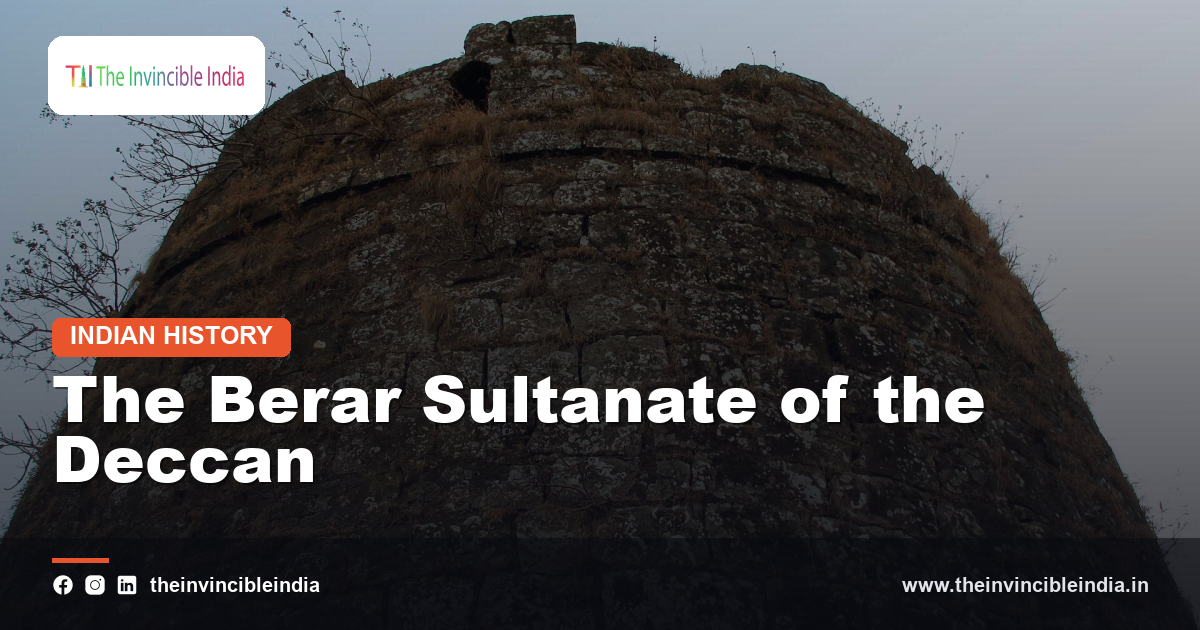
The Berar Sultanate, ruled by the Imad Shahi dynasty and sometimes called the Imad Shahi kingdom of Berar, was one of the five Deccan sultanates that emerged from the breakup of the Bahmani kingdom around the close of the fifteenth century, generally dated to about 1490. Founded by Fathullah Imad-ul-Mulk, a governor who asserted his independence as Bahmani authority weakened, the sultanate was centred on the Berar region of the central Deccan, associated with the town of Ellichpur, also known as Achalpur, and with the imposing hill forts of Gawilgarh and Narnala. Compared with its larger neighbours it was a smaller and shorter-lived state, and it was eventually absorbed by the Sultanate of Ahmadnagar and later passed under Mughal rule. The sultanate belongs to the rich history of the medieval Deccan, in the same era as the southern empire described in our guide to the Vijayanagara Empire. Because several dates and details are debated, this account keeps to general terms where the record is uncertain.
Quick answer: The Berar Sultanate was one of the five Deccan sultanates that emerged from the breakup of the Bahmani kingdom around the close of the fifteenth century, generally dated to about 1490. Ruled by the Imad Shahi dynasty and founded by Fathullah Imad-ul-Mulk, it was centred on the Berar region of the central Deccan, associated with Ellichpur (Achalpur) and the hill forts of Gawilgarh and Narnala. A smaller and shorter-lived state than its neighbours, it was eventually absorbed by Ahmadnagar and later passed under Mughal rule.
Key Takeaways
- The Berar Sultanate was one of the five Deccan sultanates formed when the Bahmani kingdom broke up, generally dated to about 1490.
- It was ruled by the Imad Shahi dynasty, founded by Fathullah Imad-ul-Mulk, a former Bahmani governor.
- The sultanate was centred on the Berar region of the central Deccan, in present-day Maharashtra.
- It is associated with the town of Ellichpur, also known as Achalpur, and the hill forts of Gawilgarh and Narnala.
- Smaller and shorter-lived than its rivals, it was eventually absorbed by the Sultanate of Ahmadnagar.
- The Berar region later passed under Mughal rule as the empire expanded into the Deccan.
Read on for the history, culture, and legacy in detail.
Quick Facts
| Detail | Information |
|---|---|
| State | Berar Sultanate (Imad Shahi kingdom) |
| Dynasty | Imad Shahi dynasty |
| Period | From around 1490; dates debated |
| Region | Berar, central Deccan, present-day Maharashtra |
| Capital | Associated with Ellichpur (Achalpur) |
| Founder | Fathullah Imad-ul-Mulk |
| Key Forts | Gawilgarh and Narnala |
| Origin | Breakup of the Bahmani kingdom |
| Absorbed By | Ahmadnagar, then Mughal rule |
Who Ruled the Berar Sultanate?
The Berar Sultanate was ruled by the Imad Shahi dynasty, a line of sultans who governed the Berar region of the central Deccan from around the close of the fifteenth century. The dynasty takes its name from its founder, Fathullah Imad-ul-Mulk, a provincial governor who carved out an independent state as the authority of the Bahmani kingdom collapsed. As one of the five successor sultanates of the Bahmanis, the Imad Shahis of Berar presided over a smaller realm than some of their neighbours, but one that controlled a strategically important and fertile region. The rulers maintained the Indo-Islamic traditions of the Deccan sultanates, combining Persian and regional influences in administration and culture. Their state was shaped by its position among larger and often rival neighbours. The Imad Shahi dynasty thus represents one strand of the fragmented political order that followed the Bahmani kingdom in the medieval Deccan.
Where Was the Berar Sultanate Located?
The Berar Sultanate was located in the Berar region of the central Deccan, in the area of present-day Maharashtra, a fertile tract known historically for its agriculture and especially for cotton. Lying to the north of the Deccan plateau, Berar was a well-defined and prosperous region whose wealth made it a valuable prize among the powers of the age. The sultanate was associated above all with the town of Ellichpur, also known as Achalpur, and with the surrounding country, defended by strong hill forts. Its position placed it among the successor states of the Bahmani kingdom and alongside rival sultanates that contested the Deccan. The region’s fertility and its forts gave the state resources and defensibility, while its location exposed it to the ambitions of larger neighbours. Berar was thus both the heartland and the name of the sultanate, anchoring it in the historical geography of the central Deccan.
How Did the Berar Sultanate Emerge?
The Berar Sultanate emerged from the breakup of the Bahmani kingdom, the great Deccan power that had dominated the region for much of the medieval period before fragmenting around the close of the fifteenth century. As the central authority of the Bahmani sultans weakened amid factional struggles and the growing independence of provincial governors, the governors of several regions asserted their own sovereignty. In Berar, the governor Fathullah Imad-ul-Mulk declared his independence, founding the Imad Shahi dynasty and the sultanate, generally dated to about 1490. This followed the pattern by which the Bahmani realm dissolved into five successor sultanates across the Deccan. The emergence of Berar was thus part of a wider transformation of the political landscape of the region. The precise circumstances and timing are drawn from later histories and are treated cautiously by scholars. The founding of the sultanate marks the beginning of independent Imad Shahi rule in Berar.
Who Founded the Berar Sultanate?
The Berar Sultanate was founded by Fathullah Imad-ul-Mulk, remembered as the governor who established the Imad Shahi dynasty and independent rule in Berar as the Bahmani kingdom fell apart. According to the histories of the period, he had served as a provincial official under the Bahmanis before asserting his own authority over the region of Berar. His assumption of independent sovereignty, generally dated to about 1490, inaugurated the sultanate and gave the dynasty its name. He is remembered for establishing the state and for strengthening its position in the central Deccan through control of its forts and resources. The details of his origins and career are drawn from later chronicles and are treated with scholarly care. Fathullah Imad-ul-Mulk thus holds the place of founder in the history of the Berar Sultanate. From his foundation the Imad Shahi dynasty continued to rule the region for several generations.
What Was the Imad Shahi Dynasty?
The Imad Shahi dynasty was the ruling house of the Berar Sultanate, a line of sultans descended from or succeeding the founder Fathullah Imad-ul-Mulk who governed the region across several generations. As one of the dynasties of the five Deccan sultanates, the Imad Shahis maintained the traditions of Indo-Islamic rule that had developed under the Bahmanis, blending Persian administrative and cultural influences with the character of the Deccan. The dynasty ruled a smaller state than some of its neighbours and was often caught up in the rivalries and shifting alliances that marked the politics of the region. Its history is one of efforts to preserve the independence of Berar amid the pressures of larger powers. The names and reigns of the individual Imad Shahi rulers are drawn from the histories of the period and are treated with care. The dynasty gave the sultanate its identity and its place among the Deccan states.
Why Was Ellichpur Important?
Ellichpur, also known as Achalpur, was the town most closely associated with the Berar Sultanate, remembered as a principal centre of the Imad Shahi state in the Berar region. As a historic town of the central Deccan, it served as a focus of the sultanate’s political and administrative life and is linked in the record to the seat of Imad Shahi power. Its position within the fertile and strategically important region of Berar made it a natural centre for the state. The town reflected the Indo-Islamic culture of the Deccan sultanates in its character and institutions. As with other centres of the age, the precise details of its role are drawn from later histories and are described in general terms. Ellichpur, or Achalpur, thus anchors the Berar Sultanate in the historical geography of the region. It remains associated in memory with the Imad Shahi dynasty and its rule over Berar.
What Were the Forts of Gawilgarh and Narnala?
Gawilgarh and Narnala were the two great hill forts most closely associated with the Berar Sultanate, imposing strongholds that guarded the region and symbolised the power of the Imad Shahi dynasty. Set in rugged, elevated terrain, these forts commanded important positions in the Berar country and provided strong defences in an age of frequent warfare among the Deccan states. Gawilgarh, perched in the hills, and Narnala, another formidable hill fort, are remembered for their massive fortifications, gateways and strategic strength. Such forts were central to the military and political life of the Deccan, serving as refuges, garrisons and seats of authority. The forts of Berar passed through the hands of successive powers as the region changed rulers over time. Their remains stand among the notable heritage of the region. Gawilgarh and Narnala thus embody the military character of the Berar Sultanate and the fortified landscape of the medieval Deccan.
What Were the Five Deccan Sultanates?
The five Deccan sultanates were the successor states that emerged from the breakup of the Bahmani kingdom around the close of the fifteenth century, dividing the central and southern Deccan among themselves. These were, in the usual reckoning, the sultanates of Ahmadnagar, Bijapur, Golconda, Bidar and Berar, each ruled by its own dynasty and each contesting power in the region. The Berar Sultanate, under the Imad Shahi dynasty, was one of these five, generally the smaller among them. The sultanates shared the Indo-Islamic culture inherited from the Bahmanis but were frequently rivals, forming shifting alliances and waging wars against one another and against neighbouring powers. Their divided politics shaped the history of the Deccan for more than a century. Over time, the smaller sultanates were absorbed by the larger ones, and all were eventually drawn under Mughal rule. The five sultanates form the essential context for understanding the Berar Sultanate and its fortunes.
How Did Berar Relate to the Other Deccan Sultanates?
Berar related to the other Deccan sultanates through the shifting patterns of alliance, rivalry and conflict that characterised the politics of the region after the fall of the Bahmanis. As one of the five successor states, the Imad Shahi sultanate of Berar engaged with its neighbours, especially the powerful Sultanate of Ahmadnagar on its borders, through diplomacy, marriage, warfare and territorial disputes. These relations were often tense, as the larger sultanates sought to extend their power at the expense of the smaller ones. Berar, being among the lesser states, was particularly exposed to the ambitions of its stronger neighbours. The sultanates also occasionally combined against common threats, as in their collective action against the southern empire of Vijayanagara. The record of these relations is drawn from the histories of the period and is treated in general terms. The fortunes of Berar were thus bound up with the complex rivalries of the Deccan sultanates.
How Was the Berar Sultanate Governed?
The Berar Sultanate was governed by the Imad Shahi sultan, whose authority rested on control of the fertile region of Berar, its revenues and its network of forts. The administration followed the Indo-Islamic traditions developed under the Bahmani kingdom, with officials, commanders and provincial arrangements managing revenue, justice and the military. The wealth of Berar, drawn especially from its agriculture, supported the court and the armies on which the state depended. The strong hill forts of Gawilgarh and Narnala were central to the defence and control of the territory. As in the other Deccan sultanates, nobles and military commanders held important roles within the structure of government, and their loyalty was vital to the ruler. The details of the administration are drawn from the histories of the period and are described in general terms. This system of governance enabled the smaller state of Berar to maintain its independence for a time amid powerful neighbours.
What Was the Culture of the Berar Sultanate?
The culture of the Berar Sultanate belonged to the rich Indo-Islamic tradition of the Deccan sultanates, which blended Persian, Arabic, Turkish and regional Indian influences into a distinctive courtly and artistic world. Like the other successor states of the Bahmani kingdom, Berar shared in the architecture, administration and cultural life shaped by this synthesis, seen in forts, mosques and other buildings of the age. The Persian language and Islamic learning held an important place at the courts of the Deccan, alongside the regional languages and traditions of the population. The sultanate’s culture reflected its position in the central Deccan, at a meeting point of northern and southern influences. As a smaller and shorter-lived state, Berar left a more modest cultural record than its larger neighbours, but it shared in the broader heritage of the Deccan sultanates. This cultural world forms part of the rich medieval heritage of the region.
How Did the Berar Sultanate Decline?
The Berar Sultanate declined as the pressures of its more powerful neighbours and the instability of a smaller state gradually undermined its independence. As one of the lesser among the five Deccan sultanates, Berar was particularly vulnerable to the ambitions of the larger states, above all the neighbouring Sultanate of Ahmadnagar. Over time, through warfare and political pressure, the independence of the Imad Shahi dynasty was eroded, and the sultanate was eventually absorbed by Ahmadnagar. This brought to an end the separate existence of Berar as an independent state under its own dynasty. The precise course and timing of this decline are drawn from the histories of the period and are treated cautiously by scholars. Rather than a dramatic single collapse, the end of the Imad Shahi state came through its absorption by a stronger neighbour. The decline of Berar illustrates the fate of the smaller Deccan sultanates amid the rivalries of the age.
How Did Berar Pass to the Mughals?
Berar passed under Mughal rule as the great northern empire expanded into the Deccan in the course of its southern campaigns. After the independent sultanate was absorbed by Ahmadnagar, the region of Berar became caught up in the long struggle between the Deccan states and the advancing Mughals. As the Mughals extended their power into the Deccan, Berar was among the territories that came under their control, becoming part of the imperial domains in the region. This transition was part of the wider Mughal conquest of the Deccan, which gradually brought the former sultanates under the empire. The details of these events are drawn from the histories of the period and are described in general terms. The passage of Berar to the Mughals marked the final stage in the region’s journey from an independent sultanate to a province of a greater empire. Berar thus became part of the Mughal Deccan in the later history of the region.
Why Is the Berar Sultanate Significant?
The Berar Sultanate is significant as one of the five Deccan sultanates that emerged from the breakup of the Bahmani kingdom and as an example of the fragmented political order that shaped the medieval Deccan. Though smaller and shorter-lived than some of its neighbours, the Imad Shahi state controlled the important region of Berar and its strong forts, playing its part in the complex rivalries of the age. Its history illustrates how provincial governors carved out independent states as a great kingdom fell apart, and how smaller states fared amid powerful neighbours. The sultanate belongs to the rich Indo-Islamic heritage of the Deccan, seen in the forts and traditions of the region. For students of Indian history, Berar offers a window onto the successor states of the Bahmanis and the politics of the medieval Deccan. Its significance rests on its place within this wider story of the region.
The Berar Sultanate Today
The Berar Sultanate is remembered today chiefly through the forts and heritage of the Berar region of present-day Maharashtra, above all the hill forts of Gawilgarh and Narnala and the historic town of Ellichpur, or Achalpur. The remains of these forts, set in rugged terrain, draw visitors and students of history and stand as enduring symbols of the fortified landscape of the medieval Deccan. The memory of the Imad Shahi dynasty survives as part of the larger story of the five Deccan sultanates and the breakup of the Bahmani kingdom. Scholars continue to study the histories, inscriptions and monuments of the period to refine the understanding of Berar and its place in the region. For readers of Indian history, the Berar Sultanate offers a striking example of a smaller successor state of the Deccan. Its legacy endures in the forts of Berar and in the heritage of the central Deccan.
Sources & Further Reading
- Archaeological Survey of India (asi.nic.in).
- Ministry of Culture, Government of India (indiaculture.gov.in).
- Directorate of Tourism, Government of Maharashtra (maharashtratourism.gov.in).
Frequently Asked Questions
What was the Berar Sultanate?
The Berar Sultanate was one of the five Deccan sultanates that emerged from the breakup of the Bahmani kingdom around the close of the fifteenth century, generally dated to about 1490. It was ruled by the Imad Shahi dynasty and centred on the Berar region of the central Deccan.
Who founded the Berar Sultanate?
The Berar Sultanate was founded by Fathullah Imad-ul-Mulk, a provincial governor who asserted his independence as the Bahmani kingdom fell apart. He established the Imad Shahi dynasty, which gave the sultanate its ruling line and its name.
Where was the Berar Sultanate located?
The Berar Sultanate was located in the Berar region of the central Deccan, in present-day Maharashtra, a fertile tract known for its agriculture. It was associated with the town of Ellichpur, also known as Achalpur, and with the hill forts of Gawilgarh and Narnala.
What were the five Deccan sultanates?
The five Deccan sultanates were the successor states of the Bahmani kingdom: Ahmadnagar, Bijapur, Golconda, Bidar and Berar. Each was ruled by its own dynasty, and they were frequently rivals in the politics of the medieval Deccan.
What happened to the Berar Sultanate?
The Berar Sultanate, being among the smaller of the five Deccan sultanates, was eventually absorbed by the neighbouring Sultanate of Ahmadnagar. The region of Berar later passed under Mughal rule as the empire expanded into the Deccan.
What forts are associated with the Berar Sultanate?
The Berar Sultanate is associated above all with the imposing hill forts of Gawilgarh and Narnala, which guarded the region and symbolised the power of the Imad Shahi dynasty. Their remains are among the notable heritage of the Berar region today.


