

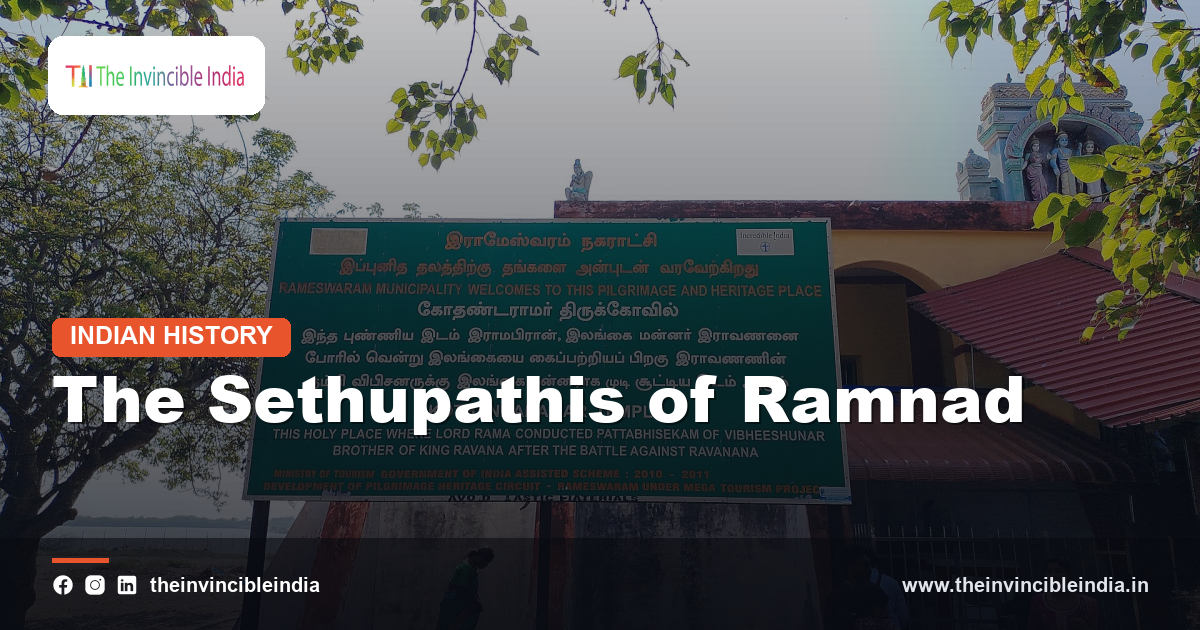
The Sethupathis of Ramnad, also written as the Sethupathis of Ramanathapuram, were a line of chieftains and later rajas who ruled the Ramnad region in the far south of Tamil Nadu, generally remembered from around the sixteenth and seventeenth centuries. Their title, Sethupathi, meaning guardian of the Setu, refers to their role as protectors of the Setu, the sacred causeway linking the mainland with Rameswaram, and of the pilgrimage to that holy island. Rising as chieftains, or poligars, in the era of the Nayak rulers of Madurai, the Sethupathis became notable patrons of the great Ramanathaswamy temple at Rameswaram and built the Ramalinga Vilasam palace at Ramanathapuram. The notable ruler Raghunatha Kilavan is especially remembered among them. Their story belongs to the rich history of the Tamil country, in the same broad era as the southern dynasty described in our guide to the Chola dynasty. Because several dates and details rest on tradition, this account keeps to general terms where the record is uncertain.
Quick answer: The Sethupathis of Ramnad, also called the Sethupathis of Ramanathapuram, were a line of chieftains and rajas who ruled the Ramnad region in the far south of Tamil Nadu, generally remembered from around the sixteenth and seventeenth centuries. Their title, Sethupathi, means guardian of the Setu, the sacred causeway to Rameswaram. Rising as poligars under the Nayaks of Madurai, they became notable patrons of the Ramanathaswamy temple at Rameswaram and built the Ramalinga Vilasam palace; Raghunatha Kilavan was a notable ruler.
Key Takeaways
- The Sethupathis of Ramnad, also called the Sethupathis of Ramanathapuram, ruled the Ramnad region in the far south of Tamil Nadu.
- Their title, Sethupathi, means guardian of the Setu, the sacred causeway linking the mainland with Rameswaram.
- They rose as chieftains, or poligars, in the era of the Nayak rulers of Madurai, generally around the sixteenth and seventeenth centuries.
- The Sethupathis were notable patrons of the great Ramanathaswamy temple at Rameswaram.
- They built the Ramalinga Vilasam palace at Ramanathapuram, known for its murals.
- Raghunatha Kilavan is especially remembered among the Sethupathi rulers.
Read on for the history, culture, and legacy in detail.
Quick Facts
| Detail | Information |
|---|---|
| Dynasty | Sethupathis of Ramnad (Ramanathapuram) |
| Title | Sethupathi, guardian of the Setu |
| Period | Around the sixteenth and seventeenth centuries; dates debated |
| Region | Ramnad, far south of Tamil Nadu |
| Capital | Ramanathapuram (Ramnad) |
| Origin | Nayak-era chieftains (poligars) |
| Notable Ruler | Raghunatha Kilavan |
| Patronage | Ramanathaswamy temple, Rameswaram |
| Palace | Ramalinga Vilasam, Ramanathapuram |
Who Were the Sethupathis of Ramnad?
The Sethupathis of Ramnad were a line of chieftains and later rajas who ruled the Ramnad region in the far south of the Tamil country, generally remembered from around the sixteenth and seventeenth centuries. Rising to prominence in the era of the Nayak rulers of Madurai, they held authority over a region of great religious importance, near the sacred island of Rameswaram. Their distinctive title, Sethupathi, marked their special role as guardians of the holy causeway and of the pilgrimage to Rameswaram. The Sethupathis became notable patrons of temples and builders of palaces, leaving a rich heritage in the region. As a ruling house of the southern Tamil country, they occupy an important place in the history of the region in the period after the great medieval empires. Their rule combined military and political authority with a prominent religious role tied to one of the holiest sites of the south.
What Does the Title Sethupathi Mean?
The title Sethupathi means guardian or lord of the Setu, referring to the role of these rulers as protectors of the Setu, the sacred causeway that links the mainland of southern India with the holy island of Rameswaram. In tradition, the Setu is associated with the great epic story of the bridge to Lanka, giving the causeway and its guardianship a deep religious significance. By bearing the title Sethupathi, the rulers of Ramnad claimed a sacred duty to protect the pilgrimage route and the approach to the revered temple of Rameswaram. The title thus combined political authority with a prestigious religious role, tying the dynasty to one of the most sacred sites of the Tamil country. The meaning of the title reflects the close connection between the Sethupathis and the pilgrimage to Rameswaram. This guardianship of the Setu remains central to the identity and memory of the dynasty.
Where Is Ramnad Located?
Ramnad, short for Ramanathapuram, is a region in the far south of Tamil Nadu, near the coast and close to the sacred island of Rameswaram, which lies off the mainland. A land of coastal plains and proximity to the sea, the region takes its importance in part from its nearness to one of the holiest pilgrimage sites of southern India. The town of Ramanathapuram served as the seat of the Sethupathis, who ruled the surrounding country. The region’s position near Rameswaram and the pilgrimage route to the island shaped the distinctive role of its rulers as guardians of the Setu. Its coastal location also connected it to maritime trade and the wider world of the southern seas. The heritage of temples, palaces and traditions in the region reflects its long history under the Sethupathis. Ramnad was thus both the homeland and the seat of the dynasty in the far south of the Tamil country.
How Did the Sethupathis Rise to Power?
The Sethupathis rose to power as chieftains, or poligars, in the era of the Nayak rulers of Madurai, who dominated much of the Tamil country in the period after the decline of the great medieval empires. As the Nayaks organised their realm, they entrusted regions to subordinate chieftains who held local authority and military responsibilities, and the Sethupathis emerged as the chiefs of the Ramnad region. Their special role as guardians of the Setu and the pilgrimage to Rameswaram gave them particular prestige. Over time, the Sethupathis consolidated their authority and rose from chieftains to rajas ruling their own territory. Their rise reflects the political order of the Tamil country in this period, in which local chiefs held considerable power under the overarching authority of the Nayaks. The details of their rise are drawn from tradition and the records of the period and are treated with care. The Sethupathis thus grew into one of the notable ruling houses of the southern Tamil country.
What Was Their Relationship with the Nayaks?
The Sethupathis of Ramnad were closely connected with the Nayak rulers of Madurai, under whose overarching authority they rose as chieftains of the Ramnad region. The Nayaks, who governed much of the Tamil country in the period after the medieval empires, entrusted regions to subordinate poligars, and the Sethupathis held the Ramnad country in this arrangement. Their relationship with the Nayaks involved the duties of loyalty, military service and tribute that bound chieftains to their overlords, though such relations could shift between cooperation and tension. As the Sethupathis grew in power, they asserted greater independence within the political order of the south. The pilgrimage to Rameswaram and the prestige of their guardianship of the Setu strengthened their standing. The details of these relations are drawn from the records and traditions of the period and are described in general terms. The link with the Nayaks forms an important part of the rise and history of the Sethupathis.
Who Was Raghunatha Kilavan?
Raghunatha Kilavan was one of the most notable rulers of the Sethupathis of Ramnad, remembered as an able and powerful raja under whom the dynasty rose to prominence. According to tradition and the records of the period, he strengthened the position and independence of the Ramnad state and is associated with important developments in its history. He is remembered as a ruler who consolidated the authority of the Sethupathis and enhanced their standing among the powers of the southern Tamil country. As with other rulers of the age, the details of his reign are drawn from tradition and the records of the period and are treated with scholarly care. Raghunatha Kilavan stands among the most renowned of the Sethupathi rulers, honoured in the memory of the dynasty. His reign marks an important chapter in the rise of Ramnad as a notable ruling house. He remains a celebrated figure in the history of the Sethupathis.
How Did the Sethupathis Serve the Ramanathaswamy Temple?
The Sethupathis served the great Ramanathaswamy temple at Rameswaram as its notable patrons and protectors, a role central to their identity as guardians of the Setu. As rulers of the region nearest the sacred island, they took a special interest in the temple and the pilgrimage to it, supporting its maintenance, endowments and ceremonies. Their patronage is associated with contributions to the temple and its celebrated architecture, which grew over time into one of the grandest temple complexes of southern India. By protecting the pilgrimage route across the Setu and supporting the temple, the Sethupathis fulfilled the sacred duty implied by their title. This religious patronage reinforced their prestige and tied their rule to one of the holiest sites of the Tamil country. The details of their contributions are drawn from tradition and temple records and are treated with care. Through such service the Sethupathis left a lasting mark on the heritage of Rameswaram.
What Is the Ramanathaswamy Temple?
The Ramanathaswamy temple at Rameswaram is one of the most revered temples of southern India, a great shrine dedicated to Shiva on the sacred island off the Tamil coast and a major centre of pilgrimage. Celebrated for its immense scale and above all for its long pillared corridors, among the most famous in Indian temple architecture, the temple draws pilgrims from across the subcontinent. The site is deeply associated in tradition with the epic story of Rama and is counted among the holiest places of the south. The Sethupathis of Ramnad, as guardians of the Setu and rulers of the neighbouring region, were notable patrons of the temple. The temple’s grand architecture developed over a long period through the contributions of many patrons. It remains an active and revered centre of worship and pilgrimage today. The Ramanathaswamy temple is thus the great religious monument tied to the Sethupathis and their guardianship of the pilgrimage to Rameswaram.
What Is the Ramalinga Vilasam Palace?
The Ramalinga Vilasam is the celebrated palace built by the Sethupathis at Ramanathapuram, remembered as one of the notable royal monuments of the dynasty. The palace is especially admired for its murals and paintings, which depict scenes of court life, religion and tradition and reflect the artistic culture of the Sethupathi court. As the royal residence and seat of the rulers, the Ramalinga Vilasam embodied the power and prestige of the dynasty in the Ramnad region. Its architecture and decoration illustrate the taste and patronage of the Sethupathis and the cultural life of the southern Tamil country under their rule. The palace stands today as a heritage landmark of Ramanathapuram and a window onto the world of the Sethupathis. As with other monuments, its history is studied through tradition and surviving remains. The Ramalinga Vilasam remains among the most cherished monuments associated with the dynasty and its rule over Ramnad.
How Were the Sethupathis Connected to the Pilgrimage?
The Sethupathis were deeply connected to the pilgrimage to Rameswaram, which lay at the heart of their role and identity as guardians of the Setu. As rulers of the region through which pilgrims passed to reach the sacred island, they protected the route and the approach across the Setu, fulfilling the sacred duty implied by their title. The pilgrimage to the Ramanathaswamy temple drew devotees from across the subcontinent, giving the Sethupathis a prominent and prestigious role in the religious life of the south. Their guardianship of the pilgrimage reinforced their legitimacy and tied their rule to the devotion of countless pilgrims. The association with the pilgrimage also connected the dynasty to the epic traditions surrounding the Setu and Rameswaram. This religious role distinguished the Sethupathis among the ruling houses of the Tamil country. The connection to the pilgrimage remains central to the memory and significance of the dynasty.
How Was the Ramnad Kingdom Governed?
The Ramnad kingdom was governed by the Sethupathi raja, whose authority rested on control of the region, its revenues and its military forces, within the wider political order of the southern Tamil country. As chieftains who rose to rajas, the Sethupathis administered their territory through officials and subordinate chiefs, drawing revenue from the land and the resources of the coastal region. Their special role as guardians of the Setu and patrons of Rameswaram added a religious dimension to their rule. The kingdom existed within the framework first of the Nayaks and later of the greater powers that dominated the south, which shaped its fortunes and its degree of independence. As in other states of the region, local chiefs and military retainers held responsibilities within the structure of government. The details of the administration are drawn from the records and traditions of the period. This system of governance enabled the Sethupathis to maintain their rule over the Ramnad region.
What Was the Culture and Patronage of the Sethupathis?
The Sethupathis were notable patrons of religion, temples and the arts, and their support for the culture of the Tamil country forms an important part of their legacy. Their foremost patronage was religious, centred on the great Ramanathaswamy temple at Rameswaram and the pilgrimage across the Setu, in keeping with their role as guardians of the holy causeway. They also supported temples, learning and the arts within their region and built the Ramalinga Vilasam palace, whose murals reflect the artistic culture of their court. This patronage expressed the devotion and prestige of the dynasty and tied its rule to the religious and cultural life of the south. The Sethupathi court shared in the rich Tamil cultural traditions of the period. The details of their patronage are drawn from tradition and the records of the region. Through such support the Sethupathis left a lasting mark on the heritage of the southern Tamil country.
How Did the Sethupathis Fare Under Later Powers?
The Sethupathis of Ramnad, like other ruling houses of the south, had to navigate the rise of greater powers in the period after the Nayaks, as the political order of the region changed. In time, the Tamil country came within the sphere of larger states and eventually under the framework of British authority in southern India. Under these changing circumstances, the status of the Sethupathis was transformed, and the Ramnad territory came to be held as a zamindari, or large estate, within the new order. The family retained its historical standing and its association with the guardianship of Rameswaram, even as its political power was reduced. The details of these transitions are drawn from the records of the period and are described in general terms. This experience reflects the wider fate of the southern ruling houses as power passed to new authorities. The Sethupathis thus continued as a notable family through the changing political landscape of the south.
Why Are the Sethupathis Significant?
The Sethupathis of Ramnad are significant as a notable ruling house of the southern Tamil country and as the guardians of the Setu and patrons of the great pilgrimage to Rameswaram. Their distinctive role as protectors of the sacred causeway gave them a prominent place in the religious life of the south, tied to one of its holiest sites. Their patronage of the Ramanathaswamy temple and their building of the Ramalinga Vilasam palace left a rich religious and artistic heritage in the region. The dynasty illustrates the political order of the Tamil country in the era of the Nayaks and after, in which local chieftains rose to become rajas. For students of Indian history, the Sethupathis offer a vivid example of a southern ruling house with a special religious role. Their significance rests on this blend of political authority, temple patronage and guardianship of the pilgrimage to Rameswaram.
The Sethupathis of Ramnad Today
The Sethupathis of Ramnad are remembered today through the heritage of Ramanathapuram and Rameswaram, above all the great Ramanathaswamy temple and the Ramalinga Vilasam palace with its celebrated murals. These monuments draw pilgrims, visitors and admirers of history and architecture, standing as enduring symbols of the dynasty’s devotion and patronage. The memory of the Sethupathis as guardians of the Setu remains a cherished part of the religious and historical imagination of the Tamil country. The family retains its historical standing and its association with the pilgrimage to Rameswaram. Scholars continue to study the temples, palaces and records of the dynasty to refine the understanding of its history and its role in the south. For readers of Indian history, the Sethupathis offer a striking example of a southern ruling house with a sacred guardianship. Their legacy endures in the temples and palaces of Ramnad and in the pilgrimage to Rameswaram.
Sources & Further Reading
- Archaeological Survey of India (asi.nic.in).
- Ministry of Culture, Government of India (indiaculture.gov.in).
- Department of Tourism, Government of Tamil Nadu (tamilnadutourism.tn.gov.in).
Frequently Asked Questions
Who were the Sethupathis of Ramnad?
The Sethupathis of Ramnad, also called the Sethupathis of Ramanathapuram, were a line of chieftains and rajas who ruled the Ramnad region in the far south of Tamil Nadu, generally remembered from around the sixteenth and seventeenth centuries. They are best known as guardians of the Setu and patrons of the Ramanathaswamy temple at Rameswaram.
What does the title Sethupathi mean?
The title Sethupathi means guardian or lord of the Setu, the sacred causeway that links the mainland with the holy island of Rameswaram. The rulers of Ramnad bore this title to mark their role as protectors of the pilgrimage and the approach to the revered temple.
How did the Sethupathis rise to power?
The Sethupathis rose as chieftains, or poligars, in the era of the Nayak rulers of Madurai, who entrusted regions to subordinate chiefs. Holding the Ramnad region near Rameswaram, they consolidated their authority over time and rose from chieftains to rajas.
Who was Raghunatha Kilavan?
Raghunatha Kilavan was one of the most notable Sethupathi rulers, remembered as an able and powerful raja who strengthened the position and independence of the Ramnad state. He is a celebrated figure in the history of the dynasty.
What is the Ramalinga Vilasam palace?
The Ramalinga Vilasam is the celebrated palace built by the Sethupathis at Ramanathapuram, admired above all for its murals depicting court life, religion and tradition. It served as the royal residence and remains a heritage landmark of the region.
How were the Sethupathis connected to Rameswaram?
The Sethupathis were guardians of the Setu, the sacred causeway to Rameswaram, and notable patrons of the great Ramanathaswamy temple on the island. They protected the pilgrimage route and supported the temple, fulfilling the sacred duty implied by their title.


