

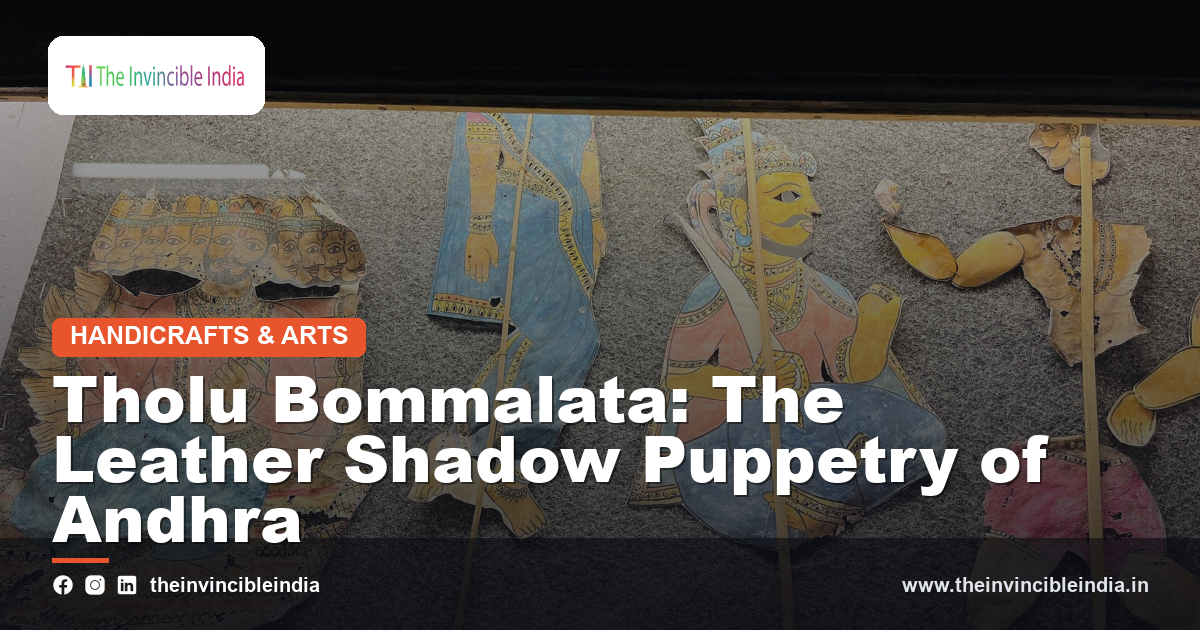
Tholu Bommalata is the traditional leather shadow-puppet theatre of Andhra Pradesh, in which large, translucent, brightly painted puppets made from treated animal hide are moved behind a backlit cloth screen to cast coloured shadows and enact stories. The name combines tholu, meaning leather, and bommalata, the play or dance of puppets, describing the art exactly. Performances most often enact episodes from the great epics, the Ramayana and the Mahabharata, accompanied by music, song and narration through the night. The puppets are admired as objects of craft in their own right, cut and painted with great skill, as well as for their role in performance. Tholu Bommalata has been recognised with a Geographical Indication. Readers who enjoy the folk art of Warli painting of Maharashtra will find in Tholu Bommalata a very different but equally rooted folk tradition. This guide describes the art, its name, its home, its history, its puppets, its performance, its stories, its artisans and its present-day place.
Quick answer: Tholu Bommalata is the traditional leather shadow-puppet theatre of Andhra Pradesh, India, in which large, translucent, painted puppets made from treated animal hide are moved behind a backlit cloth screen to enact stories. The name means leather (tholu) puppet-play (bommalata). It most often dramatises episodes from the Ramayana and the Mahabharata, accompanied by music and narration, and has been recognised with a Geographical Indication.
Key Takeaways
- Tholu Bommalata is the traditional leather shadow-puppet theatre of Andhra Pradesh, India.
- The name combines tholu (leather) and bommalata (the play or dance of puppets).
- Puppets are large, translucent and brightly painted, made from treated animal hide.
- They are moved behind a backlit cloth screen so their coloured shadows tell the story.
- Performances most often enact episodes from the Ramayana and the Mahabharata.
- Tholu Bommalata has been recognised with a Geographical Indication.
The sections below explain what Tholu Bommalata is, where its name and home lie, how the puppets are made, how a performance is staged, what stories it tells, who performs it and why it still matters.
Quick Facts
| Detail | Information |
|---|---|
| Craft type | Leather shadow-puppet theatre |
| Region of origin | Andhra Pradesh |
| Also known as | Tholu Bommalata (leather puppet-play) |
| Materials | Treated animal hide, dyes and paints, bamboo or cane sticks |
| Technique | Cutting, perforating and painting translucent hide puppets moved behind a backlit screen |
| Known for | Large translucent painted puppets enacting the Ramayana and Mahabharata |
| GI status | Recognised with a Geographical Indication; confirm details with the Registry |
| Community | Traditional puppeteer families of Andhra Pradesh |
What Is Tholu Bommalata?
Tholu Bommalata is the traditional leather shadow-puppet theatre of Andhra Pradesh, in which large, translucent, painted puppets made from animal hide are moved behind a lit cloth screen to tell stories. The puppets are held against a white cloth screen with a light behind them, so that their coloured, translucent forms cast glowing shadows that the audience watches from the front. Puppeteers move the figures, often jointed at the limbs, to act out scenes, while music, song and spoken narration carry the story. Performances most often dramatise episodes from the Ramayana and the Mahabharata and other tales, traditionally staged outdoors through the night. The puppets are works of craft in themselves, cut and painted with great care. Tholu Bommalata unites a visual craft with live performance. Its glowing leather puppets and epic storytelling define its character.
What Does the Name Tholu Bommalata Mean?
The name Tholu Bommalata means, in simple terms, the play of leather puppets, combining tholu, leather, with bommalata, the play or dance of puppets. The word tholu points to the animal hide from which the puppets are made, the defining material of the art. The word bommalata refers to the performance of puppets, their dance or play upon the screen. Together the name describes the art precisely as leather puppetry, distinguishing it from puppet forms made of wood, cloth or string. Using the traditional name connects the art to its material and its nature as performance. The name itself tells the audience what the art is. It ties the craft of the leather puppets to the living theatre in which they are used. The name captures both the object and the performance.
Where Is Tholu Bommalata Performed?
Tholu Bommalata is performed in Andhra Pradesh, with which the leather shadow-puppet tradition is especially identified, and it belongs to the wider family of shadow puppetry found across parts of southern India. The art became rooted in the region through communities of traditional puppeteers who carried the craft of making the puppets and the skill of performing them over generations. Puppeteers traditionally travelled to villages, staging all-night performances during festivals, fairs and religious occasions. The rural and devotional life of the region, with its love of the epics, provided both the audiences and the demand for the art. The concentration of puppeteer families in the region helped the tradition survive. Andhra Pradesh is therefore closely associated with this leather shadow puppetry. The region and the art are bound together. The tradition is part of the state’s folk heritage.
What Is the History of Tholu Bommalata?
Tholu Bommalata is an old folk-theatre tradition of Andhra Pradesh, part of the long history of shadow puppetry in India, though its precise early origins are not documented in exact detail. Shadow puppetry has deep roots in the subcontinent, tied to the telling of epic and devotional stories, and the leather puppet form developed its own character in the region. Traditionally, puppeteer families travelled from village to village, performing the epics through the night during festivals and religious occasions and depending on the patronage of rural audiences. With the spread of cinema, television and other entertainment, the demand for all-night puppet shows declined, and the tradition came under strain. Because much of the early story rests on tradition, it is best described in general terms as part of India’s folk-theatre heritage. What is clear is that the art became firmly rooted in Andhra Pradesh. Its history lies in travelling folk performance.
How Are the Leather Puppets Made?
The leather puppets of Tholu Bommalata are made by treating animal hide until it becomes thin and translucent, then cutting, perforating and painting it into figures. Artisans process the hide to make it fine and able to transmit light, which is essential for the coloured shadows the art depends on. The figure of a character is drawn and cut from the prepared hide, and fine details such as ornaments, features and costume are created by perforating the leather and by painting it in bright, translucent colours. The figures are often large and may be jointed at the shoulders, waist and limbs so that they can be moved in performance, with sticks of bamboo or cane attached for the puppeteer to hold. Making a single puppet is a skilled and time-consuming craft. Each puppet is both a performing figure and a work of art. The making is central to the tradition.
What Materials Are Used in Tholu Bommalata?
Tholu Bommalata uses treated animal hide for the puppets, dyes and paints for their colouring, and bamboo or cane sticks for moving them, along with a cloth screen and a light source for performance. The hide is the defining material, processed until it is thin and translucent so that light can pass through it to create coloured shadows. Bright, translucent dyes and paints give the puppets their vivid colours, which glow when lit from behind. Sticks of bamboo or cane are attached so that the puppeteer can hold and move the figures. A white cloth screen and a lamp or light behind it complete the setup, turning the painted hide into glowing shadows. Because practices vary, the exact materials and methods differ between puppeteer families. These materials together make the shadow theatre possible. The translucent painted hide is at the heart of the art.
How Is a Tholu Bommalata Performance Staged?
A Tholu Bommalata performance is staged by holding the translucent painted puppets against a lit white cloth screen so that the audience, seated in front, watches their glowing coloured shadows. A screen of white cloth is set up, with a light source behind it, and the puppeteers work behind the screen, pressing the puppets to the cloth and moving them to act out the scenes. Because the puppets are translucent and painted, their shadows appear in colour rather than as plain silhouettes. The puppeteers move the jointed figures, give voice to the characters, and are accompanied by music, song and narration that carry the story. Performances were traditionally held outdoors at night, often lasting through the night during festivals. The interplay of light, coloured hide and movement creates the theatre. The staging turns painted puppets into living drama. It is the essence of the art.
What Stories Does Tholu Bommalata Tell?
Tholu Bommalata most often tells episodes from the great Indian epics, the Ramayana and the Mahabharata, along with other mythological and devotional tales. The epics, with their gods, heroes, demons and great events, provide a rich store of dramatic episodes well suited to the colour and spectacle of shadow puppetry. Performances would enact chosen episodes, sometimes over successive nights, bringing the familiar stories to life through moving painted shadows, music and narration. Because the tales were well known and loved, audiences could follow and enjoy them even as the puppeteers added their own art and local flavour. The devotional and moral themes of the epics gave the performances meaning beyond entertainment. The epics are the heart of the repertoire. Whatever the episode, the hallmark is the glowing shadow enacting a well-loved tale. The stories connect the art to India’s epic heritage.
What Are the Puppets Like?
The puppets of Tholu Bommalata are large, translucent and brightly painted figures of hide, often jointed so that they can be moved in performance. Made from treated animal skin worked until it is thin enough to let light through, the figures are cut into the forms of gods, heroes, demons and other characters, with fine detail created by perforation and painting. The puppets are typically large, which adds to their impact on the screen, and their translucent, coloured surfaces glow when lit from behind. Joints at the limbs allow the puppeteer to animate the figures, and sticks of bamboo or cane are attached for handling. Beyond performance, the puppets are admired as striking works of craft, collected and displayed for their artistry. Each puppet is both a tool of theatre and a work of art. Their size, colour and translucency define them. The puppets are the glory of the tradition.
What Role Do Music and Narration Play?
Music, song and spoken narration play an essential role in Tholu Bommalata, carrying the story and giving voice and feeling to the puppets. As the puppeteers move the figures on the screen, they and their companions sing, speak the dialogue and narrate the events, so that the audience follows the drama through sound as well as sight. Musical instruments accompany the performance, marking its rhythm and mood and heightening its dramatic and devotional moments. The spoken and sung word brings the characters to life, as the puppets themselves cannot speak, and allows humour, emotion and commentary to enter the performance. This union of visual shadow play with music and narration is central to the art. The performance is as much heard as seen. Music and narration give the glowing shadows their voice. They complete the theatre. They are inseparable from the puppetry.
Who Are the Tholu Bommalata Puppeteers?
The Tholu Bommalata puppeteers are the traditional performing families of Andhra Pradesh who both make the leather puppets and stage the performances. The art requires a rare combination of skills, including processing and painting the hide, cutting and jointing the puppets, moving them on the screen, and singing, speaking and narrating the story, and these skills are passed down within families over generations. Traditionally, whole families travelled together, performing the epics through the night and depending on the patronage of villages, festivals and religious occasions. As demand declined with the rise of other entertainment, many families faced hardship, and the number of practising puppeteers fell. Support from cultural bodies and interest in the puppets as art have offered some encouragement. The knowledge held by these families is the art’s living heart. Their combined craft and performance keep the tradition alive. The puppeteer families sustain the art.
What Makes Tholu Bommalata Distinctive?
Tholu Bommalata is distinctive for its large, translucent, brightly painted leather puppets, its coloured shadows and its union of visual craft with all-night epic performance. Unlike plain silhouette shadow play, the translucent, painted hide of Tholu Bommalata casts glowing coloured shadows, which is one of its most striking features. The large size of the puppets and the fineness of their cutting and painting make them impressive both on the screen and as objects of art. The art combines a demanding craft of puppet-making with the live skills of movement, music and narration, drawing on the beloved epics. Its long association with the travelling puppeteer families of Andhra Pradesh roots it firmly in the region. These qualities together make Tholu Bommalata recognisable and valued. Its blend of coloured shadow, fine craft and epic storytelling is central to its appeal. The art is a proud folk tradition of Andhra.
Does Tholu Bommalata Have a GI Tag?
Tholu Bommalata has been recognised with a Geographical Indication, which ties the leather shadow-puppet tradition to Andhra Pradesh and its traditional puppeteers. A Geographical Indication protects a product whose qualities and reputation are linked to its place of origin, helping to safeguard genuine work and the makers behind it. For the puppeteer families, the recognition affirms that authentic Tholu Bommalata puppets and performances come from the region and its traditional craft. Because sources can differ on the exact registration details, the precise date and scope are best confirmed with the official Geographical Indications Registry. The recognition supports the reputation of the art and the livelihoods of its makers, and it has been part of wider efforts to protect and promote the tradition. It also helps buyers identify genuine puppets. The GI status underlines the strong bond between the art and its home. It affirms the tradition’s cultural value.
How Does Tholu Bommalata Compare with Other Indian Shadow Puppetry?
Tholu Bommalata belongs to a family of shadow-puppet traditions found in several parts of India, but it is distinguished by its large, translucent, coloured leather puppets. Shadow puppetry, in which figures are moved behind a lit screen, appears in various regional forms across southern and other parts of India, each with its own puppets, styles and repertoire. Tholu Bommalata of Andhra Pradesh is especially known for the large size of its puppets and for their translucent, brightly painted hide, which casts coloured rather than plain shadows. Comparing these traditions shows how the shared idea of shadow play is expressed differently across regions. Tholu Bommalata contributes a distinctive, colourful and large-scale voice to Indian shadow puppetry. Each regional form has its own character and repertoire. Tholu Bommalata, with its coloured leather puppets, is distinctly its own. It stands among the richest shadow-puppet traditions.
What Challenges Does the Art Face Today?
Tholu Bommalata faces serious challenges, including competition from cinema, television and digital entertainment, declining demand for all-night performances, and the difficulty of sustaining puppeteer families in the tradition. As other forms of entertainment became widely available, audiences for the traditional all-night shadow plays dwindled, reducing the livelihoods of the travelling puppeteers. The demanding nature of the art, which requires both puppet-making and performance skills, and the uncertain income it now offers, have led many younger members of puppeteer families to seek other work, threatening the passing on of skills. At the same time, interest in the puppets as works of art, support from cultural bodies, Geographical Indication recognition and new audiences at festivals and exhibitions offer encouragement. Adapting performances and selling puppets as art have helped some families. The art’s survival depends on sustaining both performers and audiences. Meeting these challenges is essential for its future.
Tholu Bommalata Today
Tholu Bommalata today survives as a treasured but endangered folk-theatre tradition of Andhra Pradesh and a proud emblem of Indian shadow puppetry. Traditional puppeteer families continue, where they can, to make the large translucent leather puppets and to stage performances of the epics, while the puppets themselves are increasingly valued and collected as works of art. Geographical Indication recognition, support from cultural bodies, and interest from festivals, museums and buyers have brought the art renewed attention. At the same time, it faces real challenges of competition from modern entertainment, declining demand for all-night shows and the need to sustain both performers and new makers. Readers can support Tholu Bommalata by attending performances where available, valuing the puppets as art and choosing genuine work from traditional makers. The art endures as a glowing expression of India’s epic storytelling. Its coloured leather shadows keep a demanding tradition alive.
Sources & Further Reading
- Development Commissioner (Handicrafts), Ministry of Textiles, Government of India (handicrafts.nic.in).
- Geographical Indications Registry, Government of India (ipindia.gov.in).
Frequently Asked Questions
What is Tholu Bommalata?
Tholu Bommalata is the traditional leather shadow-puppet theatre of Andhra Pradesh, in which large, translucent, painted puppets made from treated animal hide are moved behind a backlit cloth screen to enact stories. The name means leather puppet-play. It most often dramatises episodes from the Ramayana and the Mahabharata and has been recognised with a Geographical Indication.
What does the name Tholu Bommalata mean?
The name Tholu Bommalata means the play of leather puppets, combining tholu, meaning leather, with bommalata, the play or dance of puppets. The word tholu points to the animal hide from which the puppets are made. The name describes the art precisely as leather shadow puppetry.
How are Tholu Bommalata puppets made?
The puppets are made by treating animal hide until it is thin and translucent, then cutting it into figures and adding detail by perforating and painting it in bright, translucent colours. The figures are often large and jointed, with bamboo or cane sticks attached for movement. Making a single puppet is a skilled, time-consuming craft.
What stories does Tholu Bommalata tell?
Tholu Bommalata most often tells episodes from the great Indian epics, the Ramayana and the Mahabharata, along with other mythological and devotional tales. Performances enact chosen episodes, sometimes over successive nights, through moving coloured shadows, music and narration. The well-loved epics are the heart of the repertoire.
Does Tholu Bommalata have a GI tag?
Yes, Tholu Bommalata has been recognised with a Geographical Indication that ties the leather shadow-puppet tradition to Andhra Pradesh and its traditional puppeteers. The recognition helps safeguard genuine work and its makers. The exact registration details are best confirmed with the official Geographical Indications Registry.
How can I identify authentic Tholu Bommalata puppets?
Authentic Tholu Bommalata puppets are hand-made from treated translucent animal hide, cut, perforated and painted in bright translucent colours, usually large and jointed for performance. Mass-produced imitations may use synthetic materials, look uniform, or lack the fine cutting and translucency. Buying from traditional puppeteer families or recognised emporiums helps ensure authenticity.


