

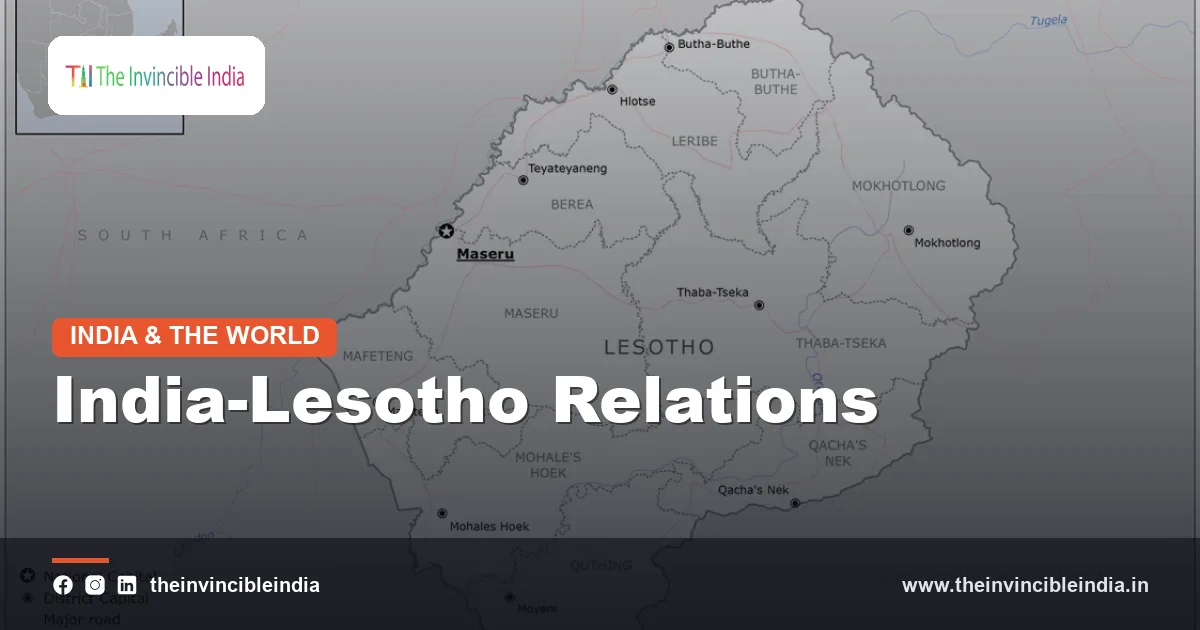
India-Lesotho relations are the cordial development-oriented ties between India and the Kingdom of Lesotho, a mountainous country completely surrounded by South Africa, that centre on capacity-building under the ITEC programme, information and communication technology (ICT) cooperation, health and pharmaceutical supplies, and trade in textiles and other goods. The relationship has no significant disputes and is part of India’s broader partnership with Southern Africa.
Lesotho, once known as Basutoland, is a small constitutional monarchy of roughly two million people, and it is known as the “Kingdom in the Sky” because of its high elevation. India engages it mainly as a development partner, offering training, technology links and concessional finance, while Lesotho looks to partners beyond its dominant neighbour for skills, markets and investment. Last reviewed: 21 October 2026.
| Item | Detail |
|---|---|
| Countries | India and the Kingdom of Lesotho (capital: Maseru) |
| Former name | Basutoland, a British protectorate |
| Independence | 4 October 1966, from the United Kingdom |
| Geography | Landlocked enclave inside South Africa, about 30,000 square kilometres, with the highest “lowest point” of any country (about 1,400 metres above sea level) |
| Population | Roughly two million, mostly Basotho |
| Government | Parliamentary constitutional monarchy, with King Letsie III as head of state |
| Currency | Loti (plural: maloti), pegged to the South African rand |
| Regional bodies | Southern African Development Community (SADC), Southern African Customs Union (SACU), African Union, Commonwealth |
| Main cooperation themes | ITEC training, ICT and e-network projects, health, lines of credit, textiles and trade |
Key Takeaways
- India-Lesotho relations are friendly and development-focused, with cooperation centred on training, technology, health and trade.
- Lesotho became independent from Britain on 4 October 1966, and it is entirely surrounded by South Africa, which shapes its economy and foreign policy.
- India supports Lesotho through the Indian Technical and Economic Cooperation (ITEC) programme, which has funded training for professionals from partner countries since 1964.
- Information and communication technology is a signature area of cooperation, linked to India’s Pan-African e-Network and its successor e-VidyaBharti and e-ArogyaBharti initiative.
- Lesotho’s textile and garment industry is a major employer, and its fortunes depend on preferential access to the United States and regional markets rather than on trade with India.
- The relationship is small in scale but stable, and its growth depends on practical projects rather than on high-level political events.
What are India-Lesotho relations based on?
India-Lesotho relations are based on shared Commonwealth membership, a common commitment to democratic and development goals, and India’s policy of south-south cooperation with African countries. Both governments support multilateralism, and neither carries any historical grievance about the other, which makes the relationship easy to manage.
India’s engagement with Lesotho follows the same template it uses with many small African states: capacity-building rather than large infrastructure, concessional loans for selected projects, and medicine and technology partnerships. The India-Africa Forum Summits, held in 2008, 2011 and 2015, gave Lesotho a platform to present its priorities, and the continental framework of the African Union provides an additional channel.
Lesotho’s own foreign policy emphasises regional integration with South Africa and the SADC, access to international development finance, and diversification of partners. India fits into this approach as a large democracy and emerging economy with relevant skills.
Why is Lesotho’s geography important to its foreign relations?
Lesotho’s geography is important to its foreign relations because the country is an enclave, completely surrounded by South Africa, which means that its trade, transport, labour migration and monetary policy are closely tied to its neighbour. All imports and exports travel through South African territory, and the loti is pegged to the rand within the Common Monetary Area.
The country is mountainous, with the Maloti and Drakensberg ranges covering most of its territory. Its highest peak, Thabana Ntlenyana, rises to about 3,480 metres, making it among the highest points in southern Africa. The highlands are a source of water, and the Lesotho Highlands Water Project, a large bilateral scheme with South Africa, supplies water to the Gauteng region while generating hydropower and royalties for Lesotho.
This dependency means that Lesotho values partners that can offer something different from the regional economy, such as training, technology access and markets outside Southern Africa. India, which has a presence in South Africa and a long record of engagement with the region, is one of those partners.
How did India and Lesotho establish diplomatic ties?
India and Lesotho established diplomatic ties after Lesotho’s independence in 1966, in the same period when India opened relations with newly independent Commonwealth states in Africa. India’s early contact was shaped by its strong support for decolonisation and its opposition to apartheid in neighbouring South Africa.
In the apartheid period, India had no diplomatic relations with Pretoria and strongly backed international sanctions, and Lesotho, an enclave in South Africa, was a front-line state with its own tensions with the apartheid government. This shared view of the era contributed to goodwill between India and the Basotho. After South Africa’s democratic transition in 1994, India and the entire region entered a new phase of cooperation.
The way the two countries maintain their missions has changed over time, with a mixture of resident and non-resident arrangements, and readers needing current details should consult the Ministry of External Affairs in New Delhi or the Lesotho Ministry of Foreign Affairs.
What is ITEC and how does it help Lesotho?
ITEC, the Indian Technical and Economic Cooperation programme, is India’s flagship capacity-building scheme, and it helps Lesotho by funding training in India for civil servants, teachers, health workers, engineers and entrepreneurs. The programme was launched by the Ministry of External Affairs in 1964 and now covers well over a hundred partner countries.
Courses last from a few weeks to a year, and cover fields such as information technology, rural development, public administration, renewable energy, small business management, banking and agriculture. Participants receive airfare, tuition and a living allowance. Lesotho officials and professionals are among the African participants, and many return to mid-career roles in which they can apply what they have learned.
India also offers scholarships through the Indian Council for Cultural Relations (ICCR) and general cultural scholarships for degree study. Training places do not create big headlines, but they are widely seen as one of the most cost-effective tools in India’s development diplomacy, because they build professional networks that last for decades.
How does ICT cooperation work between India and Lesotho?
ICT cooperation between India and Lesotho works mainly through tele-education, tele-medicine and e-governance links, building on the Pan-African e-Network that India launched in the late 2000s. The network used satellite and fibre connectivity to connect African universities and hospitals with Indian institutions, so that students could attend online courses and doctors could consult specialists.
Lesotho is reported to have been among the African countries that participated in this initiative. In 2019, India announced a successor framework, the e-VidyaBharti and e-ArogyaBharti (e-VBAB) Network Project, which offers free online education and tele-medical services to partner countries. The practical value of such projects depends on local connectivity, equipment and trained staff, which is why training and technology support go hand in hand.
Why ICT suits the partnership
- India has a large IT-services sector and a deep pool of trainers and software firms.
- Lesotho’s mountainous terrain makes physical access to schools and clinics difficult, so remote services can have outsized benefits.
- Digital tools can be scaled at relatively low cost compared with large infrastructure.
- Online education and tele-health are priorities for many African governments.
The record of such projects across Africa has been mixed, with some successes and some difficulties in sustaining equipment and connectivity, so impact should be assessed project by project.
What is the role of textiles and trade?
Textiles and garments play a central role in Lesotho’s economy, but they are linked mainly to the United States and regional markets rather than to India. The clothing industry has been Lesotho’s largest formal private-sector employer, with factories in Maseru and other towns producing jeans, T-shirts and other apparel, many of them owned by Asian investors.
Lesotho’s exports have benefited from preferential access to the United States under the African Growth and Opportunity Act (AGOA), whose renewal and terms have been subject to repeated political debate, which makes the sector sensitive to changes in trade policy. Lesotho is also part of the SACU and the SADC trade arrangements, which give it duty-free access to regional markets.
India’s trade with Lesotho
Trade between India and Lesotho is small, typically in the range of a few million to tens of millions of US dollars annually, and it fluctuates. India exports pharmaceuticals, machinery, vehicles, food products and textiles to Lesotho, while imports from Lesotho are limited. Some Indian-origin and Indian-linked businesses operate in retail and light manufacturing, but the community is small.
The textile context creates potential for cooperation in areas such as fabric supply, skills training in apparel production and technology for small manufacturers, because India is a major textile producer with a large range of fabrics and machinery. Any such cooperation would operate within the rules of origin of the preferential trade schemes that Lesotho depends on.
How important are health and pharmaceuticals?
Health and pharmaceuticals are among the most significant practical connections between India and Lesotho, because Lesotho has a high burden of HIV and tuberculosis and relies on affordable generic medicines. Indian manufacturers supply a considerable portion of the antiretroviral drugs and other essential medicines that African health systems purchase through international procurement programmes.
Lesotho has been among the countries with the highest HIV prevalence in the world, and its health authorities have worked with global partners to expand treatment access. Indian generics have helped to lower the cost of treatment across the continent since the early 2000s, which is why Indian pharmaceutical firms are widely known in African health policy circles.
During the COVID-19 pandemic, India’s vaccine diplomacy under the “Vaccine Maitri” initiative and its contributions to the COVAX facility supported many African countries. Details of what each country received differ, so Lesotho’s specific supply should be checked from official sources.
What are the main milestones in India-Lesotho relations?
The main milestones in India-Lesotho relations track India’s wider outreach to Africa, starting with Lesotho’s independence and continuing through the ITEC programme, the e-network projects and the India-Africa Forum Summits. The table below puts the key points in order.
| Year | Milestone |
|---|---|
| 1964 | India launches the ITEC programme |
| 1966 | Lesotho becomes independent; relations with India begin |
| 1994 | South Africa becomes a democracy, opening a new regional environment |
| 2008 | First India-Africa Forum Summit in New Delhi |
| Late 2000s | Pan-African e-Network launched by India, with African participation |
| 2015 | Third India-Africa Forum Summit in New Delhi |
| 2019 | e-VidyaBharti and e-ArogyaBharti (e-VBAB) Network Project announced |
| 2023 | African Union becomes a permanent G20 member during India’s presidency |
What challenges does the relationship face?
The relationship between India and Lesotho faces challenges of scale, distance and capacity, rather than political disagreement. Lesotho is a small and poor economy facing unemployment, health pressures and periodic political instability, and India’s attention is divided among many African partners.
- Economic scale: Lesotho’s small market limits large investments or trade volumes.
- Dependence on South Africa: Transit routes, currency links and labour flows all pass through the neighbour, so bilateral projects often depend on regional conditions.
- Political and governance stability: Lesotho has experienced political tensions and coalition changes in past decades, with regional mediation by the SADC, and these can disrupt long-term planning.
- Implementation capacity: Projects in ICT and training need follow-up, maintenance and trained staff to deliver lasting results.
- Trade policy exposure: The textile sector is sensitive to changes in preferential trade rules in major markets.
These are common issues in India’s partnerships with small African states, and they are usually addressed through steady programme management rather than dramatic initiatives.
What is the future outlook for India-Lesotho relations?
The future outlook for India-Lesotho relations is gradual and practical, with the most promising areas being skills training, digital education and tele-medicine, health supplies, agriculture and small-enterprise support. India’s broader strategy of deepening ties with Africa through the African Union and the G20 provides a supportive backdrop.
Opportunities include solar and renewable energy projects suited to Lesotho’s mountain environment, water and hydropower expertise, support for textile upgrading, and exchanges among universities. The growth of India’s engagement with the SADC region, and the possibility of closer cooperation with South Africa on triangular programmes, could also benefit Lesotho.
The relationship will probably remain modest in size, but it can have an outsized impact if projects are well chosen, locally owned and sustained for several years.
Bottom Line
India-Lesotho relations are cordial, stable and focused on practical development cooperation, including training, ICT, health and trade. The partnership is small in scale and its future depends on well-managed projects and on Lesotho’s economic stability within the wider Southern African region.
Frequently Asked Questions
What is the relationship between India and Lesotho?
India and Lesotho have friendly, cooperative relations centred on development partnership. Cooperation includes ITEC training, ICT and e-network projects, health and pharmaceutical supplies, and modest trade, and there are no significant disputes between the two countries.
Why is Lesotho surrounded by South Africa?
Lesotho is surrounded by South Africa because of nineteenth-century history, when the Basotho kingdom under King Moshoeshoe I became a British protectorate named Basutoland to protect it from encroachment by neighbouring settlers. Basutoland kept its separate status and became independent as Lesotho in 1966, while South Africa’s borders formed around it.
What does India offer Lesotho through ITEC?
India offers Lesotho fully funded training courses through the ITEC programme, which was started in 1964. Professionals from Lesotho can study subjects such as information technology, public administration, agriculture and small-business management at Indian institutions.
Does India trade with Lesotho?
Yes, India trades with Lesotho on a small scale, mainly exporting pharmaceuticals, machinery, vehicles, food products and textiles. Annual trade is modest and varies from year to year, and Lesotho sends little to India in return.
What is the Pan-African e-Network and was Lesotho part of it?
The Pan-African e-Network was an Indian initiative launched in the late 2000s to link African countries with Indian universities and hospitals through tele-education and tele-medicine services. Lesotho is reported to have been among the African countries that took part, and the project was later succeeded by the e-VidyaBharti and e-ArogyaBharti (e-VBAB) programme.
What is Lesotho known for?
Lesotho is known as the “Kingdom in the Sky” because it is a mountainous country with the highest lowest point of any nation, at about 1,400 metres above sea level. It is also known for its textile industry, the Lesotho Highlands Water Project and its enclave position inside South Africa.
{“@context”:”https://schema.org”,”@graph”:[{“@type”:”FAQPage”,”mainEntity”:[{“@type”:”Question”,”name”:”What is the relationship between India and Lesotho?”,”acceptedAnswer”:{“@type”:”Answer”,”text”:”India and Lesotho have friendly, cooperative relations centred on development partnership. Cooperation includes ITEC training, ICT and e-network projects, health and pharmaceutical supplies, and modest trade, and there are no significant disputes between the two countries.”}},{“@type”:”Question”,”name”:”Why is Lesotho surrounded by South Africa?”,”acceptedAnswer”:{“@type”:”Answer”,”text”:”Lesotho is surrounded by South Africa because of nineteenth-century history, when the Basotho kingdom under King Moshoeshoe I became a British protectorate named Basutoland to protect it from encroachment by neighbouring settlers. Basutoland kept its separate status and became independent as Lesotho in 1966, while South Africa’s borders formed around it.”}},{“@type”:”Question”,”name”:”What does India offer Lesotho through ITEC?”,”acceptedAnswer”:{“@type”:”Answer”,”text”:”India offers Lesotho fully funded training courses through the ITEC programme, which was started in 1964. Professionals from Lesotho can study subjects such as information technology, public administration, agriculture and small-business management at Indian institutions.”}},{“@type”:”Question”,”name”:”Does India trade with Lesotho?”,”acceptedAnswer”:{“@type”:”Answer”,”text”:”Yes, India trades with Lesotho on a small scale, mainly exporting pharmaceuticals, machinery, vehicles, food products and textiles. Annual trade is modest and varies from year to year, and Lesotho sends little to India in return.”}},{“@type”:”Question”,”name”:”What is the Pan-African e-Network and was Lesotho part of it?”,”acceptedAnswer”:{“@type”:”Answer”,”text”:”The Pan-African e-Network was an Indian initiative launched in the late 2000s to link African countries with Indian universities and hospitals through tele-education and tele-medicine services. Lesotho is reported to have been among the African countries that took part, and the project was later succeeded by the e-VidyaBharti and e-ArogyaBharti (e-VBAB) programme.”}},{“@type”:”Question”,”name”:”What is Lesotho known for?”,”acceptedAnswer”:{“@type”:”Answer”,”text”:”Lesotho is known as the “Kingdom in the Sky” because it is a mountainous country with the highest lowest point of any nation, at about 1,400 metres above sea level. It is also known for its textile industry, the Lesotho Highlands Water Project and its enclave position inside South Africa.”}}]}]}


