

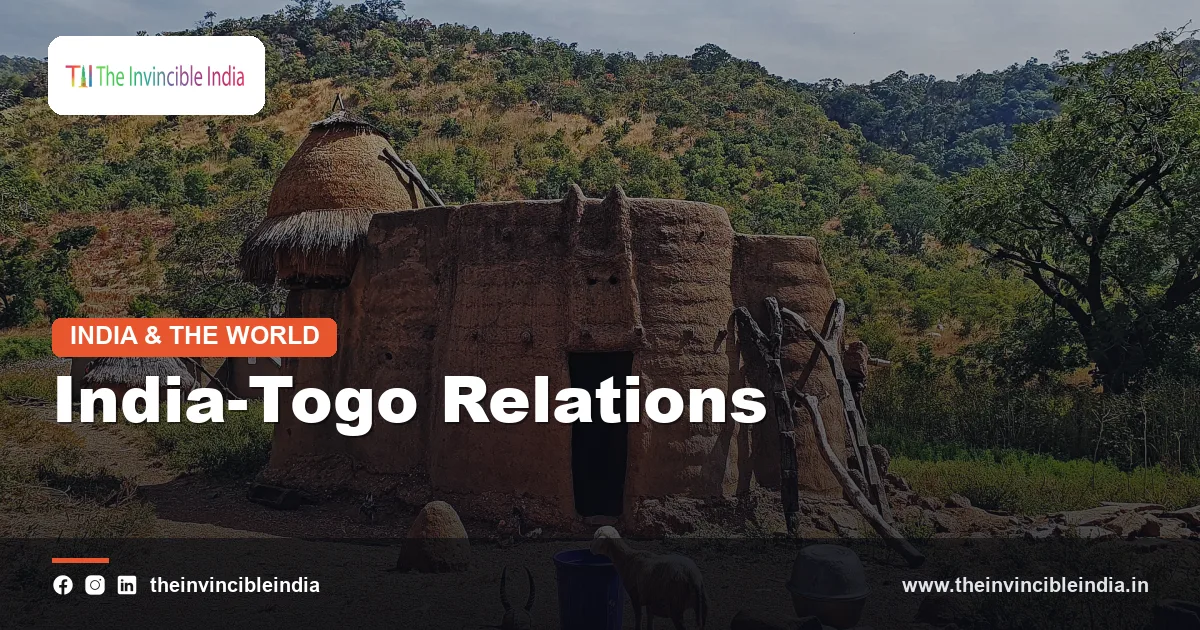
India-Togo relations are the bilateral ties between the Republic of India and the Republic of Togo, a small French-speaking West African country on the Gulf of Guinea, built mainly on commodity trade, development partnership and shared membership of multilateral platforms such as the International Solar Alliance. India is among the buyers of Togolese phosphate and cotton, while Togo imports Indian pharmaceuticals, machinery and other manufactured goods.
The relationship is modest in scale but steady, and it fits into India’s wider engagement with Africa under the India-Africa Forum Summit process, lines of credit and capacity-building programmes. This explainer sets out how the ties developed, what the two countries trade, where cooperation is growing and what the limits of the relationship are. All figures are approximate and are qualified as such. Last updated: 21 October 2026.
| Attribute | Detail |
|---|---|
| Countries | Republic of India and Togolese Republic (Togo) |
| Togo’s capital and main port | Lome, a deep-water port on the Gulf of Guinea |
| Togo’s independence | 1960, from French administration |
| Official language of Togo | French (with Ewe and Kabiye widely spoken) |
| Main Togolese exports to India | Phosphate products and cotton, with some other commodities |
| Main Indian exports to Togo | Pharmaceuticals, vehicles and machinery, textiles, rice and other goods |
| Development tools | Lines of credit, ITEC training slots and ICCR scholarships |
| Shared platforms | United Nations, International Solar Alliance, India-Africa Forum Summit process |
| Nature of ties | Cordial, development-oriented and commodity-led, at a modest scale |
Key Takeaways
- India-Togo relations are cordial and development-oriented, centred on commodity trade, lines of credit and training programmes.
- Togo is a significant producer of phosphate in West Africa, and Indian fertiliser and agriculture-linked buyers have been among its customers.
- Cotton is a traditional Togolese export, and India, as a large textile producer, is a natural market for African cotton.
- Togo and India are both linked to the International Solar Alliance, which India co-founded with France to promote solar energy in sun-rich countries.
- Indian pharmaceuticals, particularly generic medicines, form an important part of what Togo imports from India.
- India supports Togolese professionals through ITEC training courses and ICCR scholarships, which are the most visible people-to-people links.
What are India-Togo relations?
India-Togo relations are the diplomatic, economic and cultural links between two Global South countries that share a colonial past, a developing-country outlook and an interest in South-South cooperation. India gained independence in 1947 and Togo became independent in 1960, and both have since aligned on many issues at the United Nations and in other multilateral forums.
The relationship has no single defining event. It has grown gradually through trade in raw materials, development finance, training of civil servants and engineers, and high-level contact on the margins of multilateral meetings. India has historically managed much of its West African diplomacy through a limited number of resident missions, and arrangements for accreditation to smaller countries have varied over time. Readers should check the Ministry of External Affairs for the current position on resident representation.
For India, Togo is one of many partners in a West African region of many states, most of them ECOWAS members, that together offer markets, energy and mineral resources. For Togo, India is one of several Asian partners, alongside China, and a reliable source of affordable medicines and manufactured goods.
Who is Togo and why is it of interest to India?
Togo is a narrow, mostly low-lying West African country of roughly eight to nine million people, bordered by Ghana, Benin and Burkina Faso, with a short coastline on the Gulf of Guinea. Its capital Lome sits right on the coast, and its port has become one of the main transshipment hubs in the region.
Togo’s interest to India rests on three features. The first is natural resources, especially phosphate, which is the raw material for phosphatic fertiliser, a product of strategic importance to Indian agriculture. The second is its port, which serves both Togo and land-locked neighbours in the Sahel. The third is its diplomatic profile: Togo is an active member of the African Union and of ECOWAS, and participates in regional mediation and security discussions.
Togo is also a former German colony and later a French-administered territory, which explains its French-language administration and legal system. That linguistic context matters for India, because Indian training programmes and business delegations working in Togo often operate in French.
How did India-Togo relations develop?
India-Togo relations developed gradually after Togo’s independence in 1960, moving from early diplomatic recognition to a broader partnership shaped by India’s expanded Africa outreach in the 2000s and 2010s. In the decades after independence, contact was largely limited to diplomatic exchanges, scholarships and occasional trade.
A turning point for the whole continent was the India-Africa Forum Summit process, begun in 2008 and followed by further summits in 2011 and 2015. The third summit, held in New Delhi in 2015, invited leaders from every African country, and the Togolese delegation was among those taking part. These summits formalised commitments on lines of credit, scholarships, training slots and institution-building that apply to Togo along with other African partners.
The Pan-African e-Network project, India’s early digital connectivity initiative for tele-education and tele-medicine in Africa, and the later wave of concessional finance through the Export-Import Bank of India (EXIM Bank) are also part of the wider context in which Togo features. Specific project details should be verified from official announcements, as they change over time.
What does India import from Togo?
India imports phosphate-related products and cotton from Togo, and these two commodities have historically formed the core of Togolese exports to India. Phosphate rock and related materials are mined in the coastal region of Togo and are exported through the port of Kpeme and nearby facilities, with a number of Asian buyers, including Indian fertiliser makers, among the customers.
Cotton is the second pillar. Togo grows cotton in its northern and central regions, and it has long been one of the country’s main cash crops. India, which has a vast spinning and garment industry and is itself both an importer and exporter of cotton depending on the year, has at times been a buyer of West African cotton. The volumes vary with prices, harvests and trade policy, including Indian import duties on cotton.
Other Togolese products that sometimes appear in trade data include cashew nuts, oilseeds and some re-exports through Lome. Cashew is of particular interest because India is a major cashew processor and depends heavily on imported raw nuts from several African countries.
What does India export to Togo?
India exports pharmaceuticals, machinery, vehicles, textiles and food items such as rice to Togo, with pharmaceuticals usually among the most important categories. Indian generic medicines are widely used across West Africa because they are affordable and meet recognised quality standards, and Togo’s health system and private pharmacies draw on them.
Two-wheelers, three-wheelers and commercial vehicles are another visible category, since motorcycle taxis and light transport play a large role in West African towns, including Lome. Indian pumps, agricultural equipment, electrical items, plastics and basic consumer goods also reach Togo, often through intermediaries in Lome’s port, which acts as a gateway to the wider region.
Because Lome is a transshipment hub, a share of Indian goods that enter Togo are re-exported to Burkina Faso, Niger, Mali and other neighbours. This makes official bilateral trade figures a partial picture of the commercial footprint.
How large is India-Togo trade?
India-Togo trade is small in global terms but has been meaningful for Togo, generally running in the range of a few hundred million US dollars a year in recent periods, with large year-to-year swings. These swings arise because a few commodities, mainly phosphate products, dominate the totals, and shipment timing and prices move the figures sharply.
Official statistics have usually shown India as a net importer from Togo in some years and a net exporter in others, depending on how large fertiliser-related purchases were. Readers who need precise numbers should consult the Indian Department of Commerce trade database or the Togolese customs authority, since any single figure quoted without a date can be misleading.
The table below summarises the commercial relationship in broad terms rather than as exact statistics.
| Direction | Typical products | Why it matters |
|---|---|---|
| Togo to India | Phosphate products, cotton, cashew, oilseeds | Supports Indian fertiliser, textile and food-processing industries |
| India to Togo | Pharmaceuticals, vehicles, machinery, textiles, rice | Supplies affordable health and transport goods |
| Through Lome | Re-exports to landlocked Sahel neighbours | Extends the reach of Indian goods across the region |
How do lines of credit and development partnership work?
India extends lines of credit to African governments through EXIM Bank, which finances projects that are built or supplied by Indian companies, with repayment on concessional terms. Togo has been among the West African partners considered under such arrangements, and the sectors that lines of credit usually address include power, agriculture, water, rural infrastructure and public health.
A line of credit is not a grant. The borrowing government repays the loan over a long period at a low interest rate, while Indian firms deliver the goods and services. Supporters see it as a way to build infrastructure without the harsher terms of commercial borrowing, and critics note that tied procurement limits competition. Either view should be backed by specifics of each project, which are published by EXIM Bank and the Ministry of External Affairs.
Alongside credit, India offers technical cooperation, including training courses under the Indian Technical and Economic Cooperation (ITEC) programme and scholarships from the Indian Council for Cultural Relations (ICCR). Togolese officials, teachers, engineers and health workers have participated in these courses in areas such as information technology, rural development, entrepreneurship and public administration.
What is the International Solar Alliance link?
The International Solar Alliance (ISA) is a treaty-based organisation launched by India and France in 2015 on the sidelines of the Paris climate conference, and Togo is among the African countries linked to it through its framework agreement. The ISA aims to mobilise investment in solar energy for countries located between the Tropics of Cancer and Capricorn, and its secretariat is in Gurugram, Haryana.
For Togo, where electrification levels outside cities remain lower than in the capital, solar power offers a practical route to expand access. Under ISA programmes, member countries can seek support for solar pumping, rooftop systems, mini-grids and capacity building, as well as help with project preparation. India has also supported solar training and solar-related projects in several African countries.
The ISA connection is useful because it gives India and Togo a shared institutional platform that is not tied to bilateral loans. It also links the relationship to climate and energy-transition goals, an area in which both countries have declared commitments.
What other areas of cooperation exist?
Besides trade, credit and solar energy, India-Togo cooperation covers health and pharmaceuticals, education, agriculture, digital services and cultural exchange. These areas are shaped by general Indian programmes for Africa rather than by a single bilateral treaty.
Health and pharmaceuticals
Indian generics, vaccines and diagnostic products support Togolese public health needs, and Indian hospitals have attracted some African patients seeking specialised treatment. Cooperation on regulation and pharmaceutical quality is an area with scope for deepening.
Education and capacity-building
ITEC and ICCR slots, Indian-supported training centres elsewhere in Africa, and online courses give Togolese professionals access to Indian institutions. Alumni of these programmes often become informal ambassadors for India in their own fields.
Agriculture and food
India and Togo share an interest in cotton, cashew, rice and other crops, and in agricultural machinery, seed technology and post-harvest processing. Indian companies have shown interest in agro-processing across West Africa, though investment in Togo has been small compared with larger markets such as Nigeria, Ghana and Cote d’Ivoire.
People-to-people links
The Indian community in Togo is small and mostly engaged in trade and services. Cultural events, yoga days and Indian film screenings occasionally take place, and Indian-origin goods and brands are visible in Lome’s markets.
What are the challenges in India-Togo relations?
The main challenges in India-Togo relations are the small scale of trade, the limited number of direct links, the dependence on a few commodities and competition from larger partners. Togo’s economy is small, and Indian businesses tend to prioritise bigger West African markets.
Logistics add cost, since shipping from Indian ports to Lome takes several weeks and direct air connections are limited. Language differences, financing constraints, security concerns in the wider Sahel and the presence of well-established Chinese, European and Turkish competitors also shape the commercial environment.
On the other side, Togo’s location, port infrastructure and stable commodity base give it more strategic relevance than its size suggests. Observers generally see room for growth in processed agricultural goods, solar projects, pharmaceuticals and logistics partnerships, provided that financing and market information improve.
Bottom Line
India-Togo relations are a typical example of India’s South-South partnership with a small African state: limited in scale, practical in focus and anchored in commodities, credit, training and shared multilateral platforms. The strongest building blocks are phosphate and cotton imports, Indian pharmaceutical exports and solar-energy cooperation through the International Solar Alliance.
Frequently Asked Questions
What are India-Togo relations based on?
India-Togo relations are based mainly on commodity trade, development cooperation and shared membership of multilateral bodies. India buys phosphate products and cotton from Togo, while Togo imports Indian medicines, vehicles and manufactured goods. Training and scholarship programmes add a people-to-people dimension.
What does India buy from Togo?
India buys mainly phosphate-related products and cotton from Togo, with smaller purchases of items such as cashew nuts and oilseeds. These goods supply Indian fertiliser, textile and food-processing industries. The volumes change from year to year with prices and trade policy.
What does India sell to Togo?
India sells pharmaceuticals, vehicles, machinery, textiles and food items such as rice to Togo. Generic medicines are among the most significant categories because they are affordable. A share of Indian goods arriving at Lome is also re-exported to neighbouring landlocked countries.
Is Togo a member of the International Solar Alliance?
Togo is among the African countries associated with the International Solar Alliance through its framework agreement, according to ISA member listings, though readers should confirm the current status on the ISA website. The alliance was launched by India and France in 2015 and has its secretariat in Gurugram. Membership allows Togo to seek support for solar projects and training.
Does India give Togo financial assistance?
India offers Togo assistance mainly through concessional lines of credit via EXIM Bank, along with technical training and scholarships. Lines of credit are repayable loans rather than grants, and they typically finance projects delivered by Indian companies. Details of specific projects should be checked with official Indian sources.
How can Togolese students and officials study in India?
Togolese students and officials can study in India mainly through ICCR scholarships for degree courses and ITEC short-term training programmes. Applications are usually routed through the Indian diplomatic mission responsible for Togo or through Togolese government channels. Eligibility rules and available courses change each year, so applicants should check the latest notifications.
{“@context”:”https://schema.org”,”@graph”:[{“@type”:”FAQPage”,”mainEntity”:[{“@type”:”Question”,”name”:”What are India-Togo relations based on?”,”acceptedAnswer”:{“@type”:”Answer”,”text”:”India-Togo relations are based mainly on commodity trade, development cooperation and shared membership of multilateral bodies. India buys phosphate products and cotton from Togo, while Togo imports Indian medicines, vehicles and manufactured goods. Training and scholarship programmes add a people-to-people dimension.”}},{“@type”:”Question”,”name”:”What does India buy from Togo?”,”acceptedAnswer”:{“@type”:”Answer”,”text”:”India buys mainly phosphate-related products and cotton from Togo, with smaller purchases of items such as cashew nuts and oilseeds. These goods supply Indian fertiliser, textile and food-processing industries. The volumes change from year to year with prices and trade policy.”}},{“@type”:”Question”,”name”:”What does India sell to Togo?”,”acceptedAnswer”:{“@type”:”Answer”,”text”:”India sells pharmaceuticals, vehicles, machinery, textiles and food items such as rice to Togo. Generic medicines are among the most significant categories because they are affordable. A share of Indian goods arriving at Lome is also re-exported to neighbouring landlocked countries.”}},{“@type”:”Question”,”name”:”Is Togo a member of the International Solar Alliance?”,”acceptedAnswer”:{“@type”:”Answer”,”text”:”Togo is among the African countries associated with the International Solar Alliance through its framework agreement, according to ISA member listings, though readers should confirm the current status on the ISA website. The alliance was launched by India and France in 2015 and has its secretariat in Gurugram. Membership allows Togo to seek support for solar projects and training.”}},{“@type”:”Question”,”name”:”Does India give Togo financial assistance?”,”acceptedAnswer”:{“@type”:”Answer”,”text”:”India offers Togo assistance mainly through concessional lines of credit via EXIM Bank, along with technical training and scholarships. Lines of credit are repayable loans rather than grants, and they typically finance projects delivered by Indian companies. Details of specific projects should be checked with official Indian sources.”}},{“@type”:”Question”,”name”:”How can Togolese students and officials study in India?”,”acceptedAnswer”:{“@type”:”Answer”,”text”:”Togolese students and officials can study in India mainly through ICCR scholarships for degree courses and ITEC short-term training programmes. Applications are usually routed through the Indian diplomatic mission responsible for Togo or through Togolese government channels. Eligibility rules and available courses change each year, so applicants should check the latest notifications.”}}]}]}


