

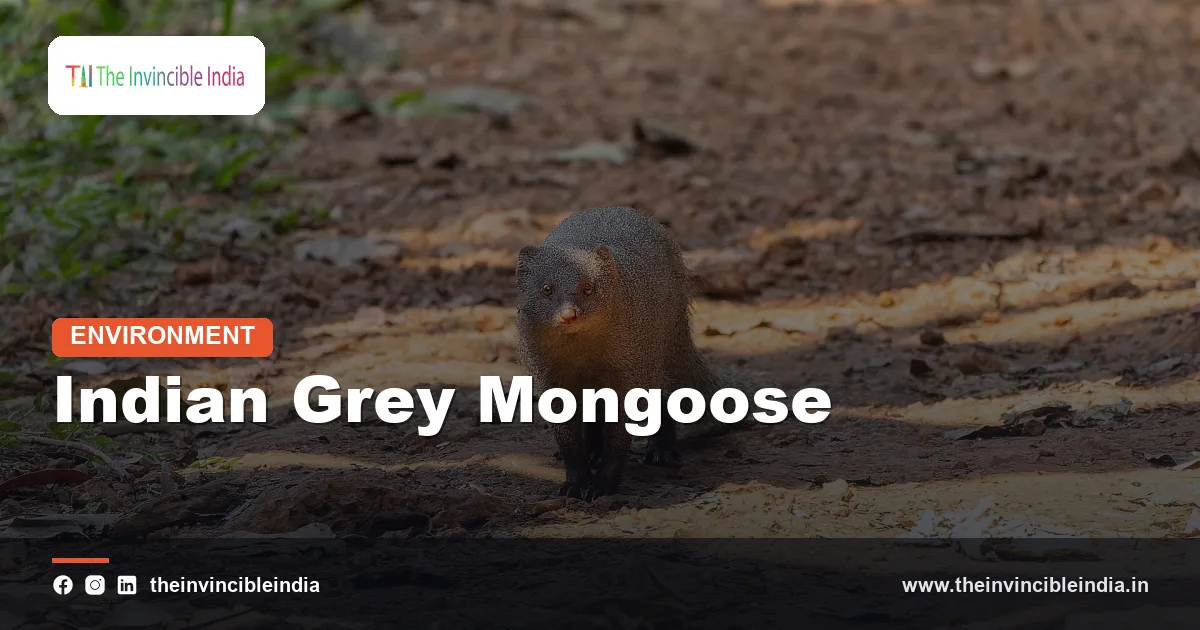
The Indian grey mongoose (Urva edwardsii) is a small, bold, ground-dwelling carnivore found across most of the Indian subcontinent, best known for its willingness to attack venomous snakes, including cobras. A slim, grizzled-grey animal with a long tapering tail, the Indian grey mongoose is also called the common mongoose, and it is among the most familiar wild mammals in Indian villages, farmland, scrub and town edges.
Its fame comes largely from Rudyard Kipling’s story “Rikki-Tikki-Tavi”, but the real animal faces a quieter, less heroic problem: it is hunted for the hair on its body and tail, which is turned into paintbrushes and similar products. The Indian grey mongoose is legally protected under the Wildlife (Protection) Act, 1972, yet the illegal hair trade means that even a common species needs steady enforcement and public awareness.
| Attribute | Detail |
|---|---|
| Common name | Indian grey mongoose (also common mongoose) |
| Scientific name | Urva edwardsii (formerly placed in the genus Herpestes) |
| Family and order | Herpestidae (mongoose family), order Carnivora |
| Approximate size | Head and body roughly 35 to 45 cm, with a tail of similar length; weight usually around 1 to 2 kg |
| Range | Most of India, Pakistan, Nepal, Bangladesh, Sri Lanka and parts of West Asia |
| Habitat | Scrub, farmland, open forest, village edges, rocky ground and grassland |
| Activity | Mainly diurnal (active by day) |
| IUCN status | Least Concern (global assessment) |
| Indian legal protection | Protected under the Wildlife (Protection) Act, 1972; schedule placement has changed between amendments, so check the current Schedules |
Key Takeaways
- The Indian grey mongoose (Urva edwardsii) is a small diurnal carnivore of the family Herpestidae that is widespread across India and much of South Asia.
- The Indian grey mongoose can survive snake bites because changes in its nerve-muscle receptors reduce the effect of cobra neurotoxins, but this resistance is partial, not absolute immunity.
- Snakes make up only a small part of the Indian grey mongoose’s diet, which is dominated by rodents, insects, lizards, eggs and fruit.
- The main deliberate threat to the Indian grey mongoose in India is illegal hunting for its hair, which is used in paintbrushes and shaving-style brushes.
- Capturing, killing, trading in or displaying the Indian grey mongoose, including in snake-and-mongoose fight shows, is prohibited under Indian wildlife law.
- The IUCN lists the Indian grey mongoose as Least Concern globally, but local declines from hunting and habitat loss are possible and are poorly measured.
What is the Indian grey mongoose?
The Indian grey mongoose is a medium-small mammal in the order Carnivora and the family Herpestidae, scientifically named Urva edwardsii. For many years it was known as Herpestes edwardsii, and older books and field guides still use that name; taxonomists later moved a group of Asian mongooses into the genus Urva after studying their genetic relationships.
Mongooses are not rodents, weasels or cats, although the Indian grey mongoose can resemble a long-bodied weasel at first glance. They belong to a distinct carnivore family that is related to civets and genets and is found mainly in Africa, southern Europe and Asia. The family name comes from the Greek-derived genus Herpestes, meaning a creeper, which suits the low, gliding way a mongoose moves through grass.
The English word “mongoose” is believed to derive from a word in an Indian language such as Marathi or Telugu, and the animal has many local names across India. Local names vary widely, which is one reason scientific names are used in wildlife law and research.
Where does the Indian grey mongoose live?
The Indian grey mongoose lives across most of peninsular and northern India, as well as in neighbouring countries such as Pakistan, Nepal, Bangladesh and Sri Lanka, and its range extends westwards into parts of Afghanistan and the Arabian region. It is absent from or rare in the dense wet forests and high mountains where other mongoose species replace it.
Within India, the Indian grey mongoose is a species of open and disturbed habitats. It is commonly seen in scrub jungle, dry deciduous forest edges, agricultural fields, plantations, rocky outcrops, grassland and the margins of villages and towns. It copes with human presence better than many carnivores and often shelters in burrows dug under bushes, termite mounds, stone walls, culverts and field bunds.
Habitat preference explains its coexistence with people. Farmland supplies rodents and insects, hedgerows supply cover, and old walls and mounds supply burrow sites. Dense wet evergreen forest, the high Himalaya and extremely arid desert are less suitable, and other species of the genus Urva, such as the stripe-necked mongoose and the brown mongoose in the Western Ghats or the crab-eating mongoose in the Northeast, occupy those niches instead.
Is the Indian grey mongoose found outside South Asia?
The Indian grey mongoose has been recorded as a natural resident in parts of West Asia and has been introduced by people to a few places outside its native range, including parts of southern Europe. Introduced mongooses elsewhere in the world, such as those on Caribbean islands and Hawaii, are mostly a different species, the small Indian mongoose (Urva auropunctata), which became an invasive pest on islands where it was released to control rats and snakes.
What does the Indian grey mongoose look like?
The Indian grey mongoose has a long, slender body, short legs, a pointed snout, small rounded ears and a long tail that tapers to a point, all covered in coarse grizzled fur that appears grey, greyish-brown or sometimes reddish-grey. Each guard hair is banded in light and dark tones, which creates the speckled “salt-and-pepper” look that gives the animal its name.
Adults typically measure around 35 to 45 cm from head to the base of the tail, with a tail about as long as the body, and weigh roughly 1 to 2 kg, with males generally somewhat larger than females. Exact measurements vary by region and by source, so these figures should be read as typical ranges rather than fixed values.
The feet carry five toes with long, non-retractable claws that are well suited to digging and scratching. The legs are short, the stride is quick and low, and the mongoose often stands upright on its hind legs, supported by its tail, to look over tall grass. The eyes are small and bright, and the sense of smell and hearing are sharp.
Several features help distinguish the Indian grey mongoose from other Indian mongooses. It lacks the black-tipped tail of some relatives, it lacks the bold neck stripe of the stripe-necked and crab-eating mongooses, and it is usually paler and greyer than the ruddy mongoose. The tail of the Indian grey mongoose is typically uniformly grey, sometimes with a slightly paler or reddish tip.
What does the Indian grey mongoose eat?
The Indian grey mongoose is an opportunistic omnivore-leaning carnivore that eats rodents, insects, lizards, frogs, birds, eggs, snakes, crabs and some fruit. Its diet changes with season and habitat, and it will take whatever small prey is easiest to catch.
Studies in India and Sri Lanka have generally shown that insects, small rodents and reptiles such as lizards make up most of what a mongoose eats, with snakes forming only a small share. This is important for correcting a popular myth: the Indian grey mongoose is not a dedicated snake hunter, although it will attack snakes when it meets them.
- Small mammals: field mice, rats and gerbils, which makes the mongoose useful around crops and granaries.
- Invertebrates: beetles, grasshoppers, termites, scorpions, centipedes and crabs.
- Reptiles and amphibians: lizards, skinks, frogs and occasionally snakes, including venomous species.
- Birds and eggs: ground-nesting birds and their eggs, which the mongoose opens by throwing them against a hard surface or breaking them with its forepaws.
- Plant matter: berries and other soft fruit, taken less often.
Through rodent and insect control, the Indian grey mongoose provides an ecological service in agricultural landscapes. At the same time, it may sometimes take poultry or eggs near homes, which can produce local conflict with people.
Can the Indian grey mongoose really kill cobras?
Yes, the Indian grey mongoose can kill and eat cobras, and it does so using speed, agility and a degree of venom resistance, but it is not immune and can die from a bite. The famous fight between a mongoose and a cobra is real in nature, though it is rare and dangerous for both animals.
Two factors work together. The first is behaviour: the mongoose is fast, keeps its head low, feints and darts in to bite the snake behind the head, and its thick, coarse fur and loose skin offer some protection against fangs. The second is physiology. Cobra venom contains neurotoxins that attach to nicotinic acetylcholine receptors, the molecular “docks” that carry nerve signals to muscles, and a bite normally causes paralysis. In mongooses, small changes in the structure of these receptors make it harder for the toxin to bind, so a bite that would paralyse another animal of the same size has a much weaker effect.
Researchers have found that similar receptor changes have evolved independently in several unrelated mammals that regularly meet venomous prey or predators, including honey badgers, hedgehogs and some other mongoose species. This pattern is an example of convergent evolution, in which different lineages arrive at the same solution under similar pressures.
Common myths about the mongoose and snakes
- Myth: the mongoose is completely immune to snake venom. Fact: its resistance is partial and mainly to neurotoxins, and large doses or well-placed bites can still kill it.
- Myth: the mongoose seeks out a special herb to cure itself after a bite. Fact: this is folklore with no scientific support.
- Myth: the mongoose mainly eats snakes. Fact: rodents, insects and lizards usually dominate its diet.
- Myth: snake-versus-mongoose shows are traditional entertainment. Fact: staged fights are cruel to both animals and are illegal in India.
How does the Indian grey mongoose live and breed?
The Indian grey mongoose is mostly solitary or found in pairs, is active during the day, and rests and breeds in burrows. It forages with its nose close to the ground, checking cracks and leaf litter, and stops now and then to stand upright and scan its surroundings.
Individual mongooses hold home ranges that may overlap, and they mark them with scent from anal glands, which communicates identity and breeding condition. Males are generally more wide-ranging than females. The species can be vocal, with chuckling, chattering and sharp alarm calls that vary with context.
Breeding can take place over much of the year in warmer parts of its range, although there are often seasonal peaks. After a gestation period of roughly two months, a female usually gives birth in a burrow to a small litter, commonly two to four young. The young are blind at birth and are cared for by the mother until they can forage independently. Figures for lifespan differ by source; individuals are thought to live several years in the wild and longer in captivity.
Natural predators of the Indian grey mongoose include large raptors, jackals, wild cats and big snakes such as pythons, and domestic dogs are an additional hazard in villages and on roads. Vehicle collisions are a notable cause of death near highways and farm tracks.
Why is the Indian grey mongoose hunted?
The Indian grey mongoose is hunted mainly for its hair, which is used to make artists’ paintbrushes, shaving brushes and similar products, and this illegal demand is the best documented human-driven threat to the species in India. The hair, particularly from the back and tail, is long, strong and springy enough to hold its shape, which makes it attractive to brush makers.
Wildlife-crime investigators, including the Wildlife Crime Control Bureau (WCCB) and state forest departments, have reported seizures of mongoose-hair brushes and raw hair in several parts of India. Because a single animal provides only a limited quantity of usable hair, a large consignment of brushes can represent many individual animals killed.
Poachers typically trap the animal using snares, cage traps or nets, kill it, and remove the hair for sale to middlemen. The hair then travels through informal supply chains to brush makers, art-supply sellers and online marketplaces. Because brushes carry no obvious sign of their origin, buyers may not know that a product contains wildlife material.
Other pressures linked to hunting and use
- Street shows: mongooses have been captured and used in staged snake fights and snake-charmer displays, which is illegal.
- Bushmeat and local use: in some regions small numbers are hunted for meat or for traditional beliefs.
- Retaliation: occasional killing by people who see the mongoose as a threat to poultry.
Is the Indian grey mongoose protected by law in India?
Yes, the Indian grey mongoose is a protected wild animal under India’s Wildlife (Protection) Act, 1972, which prohibits hunting, capture, killing, possession and trade without legal authority. The Act has been amended several times, and its Schedules, which rank species by level of protection, were reorganised by the Wildlife (Protection) Amendment Act, 2022.
Older references commonly place the Indian grey mongoose in a lower-protection schedule than species such as tigers or pangolins, while some conservation sources have argued for stronger listing because of the hair trade. Because schedule placements can change, readers who need the exact current position should consult the latest official text of the Act or the notifications of the Ministry of Environment, Forest and Climate Change. Penalties under the Act generally include imprisonment and fines, and they are heavier for species in the higher schedules.
Several mongoose species are also covered by international trade rules. The Convention on International Trade in Endangered Species of Wild Fauna and Flora (CITES) lists certain mongooses on its appendices, which regulates cross-border trade in parts and products. The international status of any particular mongoose species should be checked against the current CITES appendices.
The IUCN Red List classifies the Indian grey mongoose as Least Concern worldwide because it is widespread and adaptable. That classification describes the whole species, not every local population, and it does not mean the animal is free from hunting pressure.
How does the Indian grey mongoose compare with other Indian mongooses?
India is home to several mongoose species, and the Indian grey mongoose is the most widespread and best known of them. Comparing them helps with identification and with understanding why each one needs its own habitat protection.
| Species | Scientific name | Where it is mostly found in India | Distinguishing feature |
|---|---|---|---|
| Indian grey mongoose | Urva edwardsii | Widespread across open and agricultural country | Grizzled grey fur; tail without a black tip |
| Small Indian mongoose | Urva auropunctata | Northern and north-western India, plains and foothills | Smaller, olive-brown, finely speckled coat |
| Ruddy mongoose | Urva smithii | Peninsular India, forests and scrub | Reddish coat with a black-tipped tail |
| Stripe-necked mongoose | Urva vitticollis | Western Ghats | Large size; stripe along the side of the neck |
| Crab-eating mongoose | Urva urva | Northeast India and the eastern Himalaya | White neck stripe; strongly tied to water |
| Brown mongoose | Urva fusca | Western Ghats forests | Dark brown coat; forest dweller |
Range descriptions for the smaller or less-studied species are approximate, and local identification can be difficult without a clear view of the tail and neck. Photographs and camera-trap images submitted to citizen-science platforms have helped biologists map where each species actually occurs.
What threatens the Indian grey mongoose besides hunting?
Besides hunting, the Indian grey mongoose is affected by habitat conversion, road accidents, poisoned bait, dog attacks and disease, although none of these is known to threaten the species as a whole. Because the animal is adaptable, its main risk is a steady, hidden loss of individuals rather than collapse of its range.
- Habitat loss: conversion of scrub and field margins to roads, buildings and intensively farmed land removes burrow sites and prey.
- Pesticides and rodenticides: mongooses that eat poisoned rodents can be poisoned in turn through secondary exposure.
- Roads: vehicles kill many small carnivores that cross highways during daylight.
- Domestic dogs: free-ranging dogs attack mongooses near settlements.
- Illegal trade: the demand for hair and the use of live animals in shows remain the main intentional threats.
Precise national population figures do not exist, since the Indian grey mongoose is not systematically counted the way tigers or elephants are. Its numbers are described as stable or locally variable rather than measured precisely, and this lack of data is itself a conservation gap.
How can the Indian grey mongoose be protected?
Protecting the Indian grey mongoose depends on stronger enforcement against the hair trade, better consumer awareness, retention of natural scrub and field margins, and reduced use of rodent poison. Each of these actions is practical and does not require setting aside large protected areas.
- Check brush materials: artists and shopkeepers can choose synthetic or clearly certified plant or animal-free brushes, because natural hair of unknown origin may be illegal wildlife material.
- Report suspicious sales: offers of mongoose-hair brushes or live mongooses can be reported to the state forest department or the WCCB.
- Avoid shows: refusing to watch or pay for snake-and-mongoose displays removes the incentive to capture animals.
- Protect habitat: leaving hedgerows, rocky patches and bunds intact on farms keeps natural burrow sites.
- Use safer pest control: barn owls, traps and good grain storage reduce the need for rodenticides that harm predators.
- Support research: simple surveys using camera traps and community reports would give the first reliable picture of population trends.
Public education is particularly useful, since many people do not realise that a cheap, attractive brush can come from a protected animal. Wildlife organisations, museums and art schools can help by listing safe alternatives.
Bottom Line
The Indian grey mongoose is a common and adaptable carnivore that helps control rodents and insects, and its snake-fighting reputation is partly true and partly legend. Its main deliberate threat is the illegal hair trade, so the species benefits most from firm enforcement of the Wildlife (Protection) Act, 1972 and from buyers who avoid natural-hair brushes of unknown origin.
Frequently Asked Questions
Is the Indian grey mongoose immune to snake venom?
No, the Indian grey mongoose is not fully immune to snake venom, but it has strong resistance to cobra neurotoxins. Changes in its nerve-muscle receptors make the toxin bind poorly, and its speed helps it avoid deep bites. A large dose or a well-placed bite can still kill it.
Is it illegal to keep an Indian grey mongoose as a pet in India?
Yes, keeping an Indian grey mongoose as a pet is illegal in India without legal authority, because it is a protected wild animal under the Wildlife (Protection) Act, 1972. Capture, possession and trade can lead to imprisonment and fines. Anyone who finds an injured or orphaned mongoose should contact the state forest department or a recognised wildlife rescue organisation.
What does the Indian grey mongoose mainly eat?
The Indian grey mongoose mainly eats insects, rodents and lizards, and it takes snakes, birds, eggs, frogs and fruit less often. Its diet shifts with season and habitat. Snakes form only a small part of what it eats, despite the popular image.
Why is mongoose hair used in paintbrushes?
Mongoose hair is used in paintbrushes because it is long, strong and springy, and it holds a good shape. This demand drives illegal killing of mongooses in India. Synthetic fibres and other legal materials can replace it, so buyers do not need mongoose hair.
Is the Indian grey mongoose endangered?
No, the Indian grey mongoose is not endangered; the IUCN lists it as Least Concern because it is widespread and adaptable. However, it faces local hunting for its hair and other pressures. Reliable population counts for India are limited, so local declines may go unnoticed.
Who wrote the story Rikki-Tikki-Tavi about a mongoose?
The story was written by Rudyard Kipling, a British author born in Bombay, and “Rikki-Tikki-Tavi” it appeared in The Jungle Book in 1894. The story follows a pet mongoose that protects an English family in India from cobras. The tale popularised the idea of the snake-fighting mongoose, though the real animal eats mostly small prey other than snakes.
{“@context”:”https://schema.org”,”@graph”:[{“@type”:”FAQPage”,”mainEntity”:[{“@type”:”Question”,”name”:”Is the Indian grey mongoose immune to snake venom?”,”acceptedAnswer”:{“@type”:”Answer”,”text”:”No, the Indian grey mongoose is not fully immune to snake venom, but it has strong resistance to cobra neurotoxins. Changes in its nerve-muscle receptors make the toxin bind poorly, and its speed helps it avoid deep bites. A large dose or a well-placed bite can still kill it.”}},{“@type”:”Question”,”name”:”Is it illegal to keep an Indian grey mongoose as a pet in India?”,”acceptedAnswer”:{“@type”:”Answer”,”text”:”Yes, keeping an Indian grey mongoose as a pet is illegal in India without legal authority, because it is a protected wild animal under the Wildlife (Protection) Act, 1972. Capture, possession and trade can lead to imprisonment and fines. Anyone who finds an injured or orphaned mongoose should contact the state forest department or a recognised wildlife rescue organisation.”}},{“@type”:”Question”,”name”:”What does the Indian grey mongoose mainly eat?”,”acceptedAnswer”:{“@type”:”Answer”,”text”:”The Indian grey mongoose mainly eats insects, rodents and lizards, and it takes snakes, birds, eggs, frogs and fruit less often. Its diet shifts with season and habitat. Snakes form only a small part of what it eats, despite the popular image.”}},{“@type”:”Question”,”name”:”Why is mongoose hair used in paintbrushes?”,”acceptedAnswer”:{“@type”:”Answer”,”text”:”Mongoose hair is used in paintbrushes because it is long, strong and springy, and it holds a good shape. This demand drives illegal killing of mongooses in India. Synthetic fibres and other legal materials can replace it, so buyers do not need mongoose hair.”}},{“@type”:”Question”,”name”:”Is the Indian grey mongoose endangered?”,”acceptedAnswer”:{“@type”:”Answer”,”text”:”No, the Indian grey mongoose is not endangered; the IUCN lists it as Least Concern because it is widespread and adaptable. However, it faces local hunting for its hair and other pressures. Reliable population counts for India are limited, so local declines may go unnoticed.”}},{“@type”:”Question”,”name”:”Who wrote the story Rikki-Tikki-Tavi about a mongoose?”,”acceptedAnswer”:{“@type”:”Answer”,”text”:”The story was written by Rudyard Kipling, a British author born in Bombay, and “Rikki-Tikki-Tavi” it appeared in The Jungle Book in 1894. The story follows a pet mongoose that protects an English family in India from cobras. The tale popularised the idea of the snake-fighting mongoose, though the real animal eats mostly small prey other than snakes.”}}]}]}


