

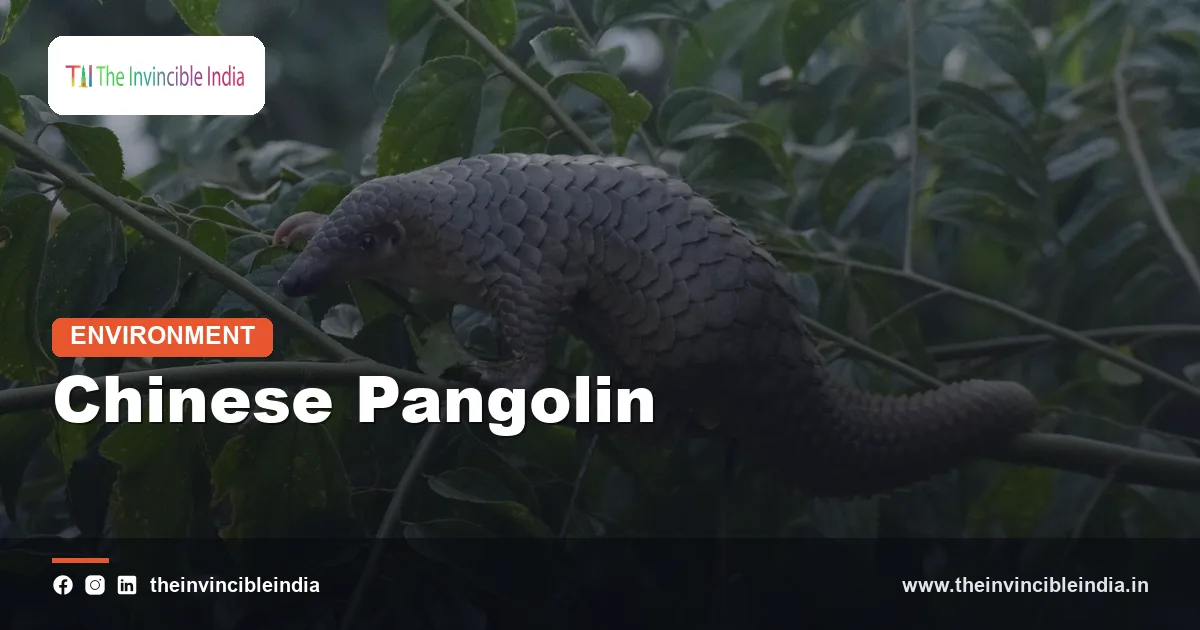
The Chinese pangolin (Manis pentadactyla) is a shy, nocturnal, scale-covered mammal that eats ants and termites, and in India it is found mainly in the north-eastern states, Sikkim and the eastern Himalayan foothills. It is one of two pangolin species native to India, the other being the Indian pangolin (Manis crassicaudata), and it is classed as Critically Endangered on the IUCN Red List because of heavy hunting and trafficking across Asia.
Pangolins are often described as the most heavily trafficked wild mammals in the world, with their scales and meat in demand in parts of East and Southeast Asia. The Chinese pangolin is fully protected under Indian law, yet its secretive habits, slow breeding and the profits of smuggling mean that it remains under severe pressure across its range, including along India’s eastern borders.
| Attribute | Detail |
|---|---|
| Common name | Chinese pangolin (also called the scaly anteater) |
| Scientific name | Manis pentadactyla |
| Order and family | Pholidota, family Manidae |
| Range in India | North-eastern states, Sikkim, northern West Bengal and Himalayan foothill forests |
| Wider range | Nepal, Bhutan, Bangladesh, Myanmar, southern China, Taiwan and parts of mainland Southeast Asia |
| Diet | Ants and termites |
| Activity | Nocturnal and mostly solitary |
| IUCN status | Critically Endangered |
| International trade rule | All pangolin species are listed on CITES Appendix I, which bans commercial international trade |
Key Takeaways
- The Chinese pangolin (Manis pentadactyla) is one of two pangolin species found in India and is the one native to the north-east and the eastern Himalaya.
- The Chinese pangolin is assessed as Critically Endangered on the IUCN Red List, mainly because of hunting for scales and meat.
- Pangolin scales are made of keratin, the same protein found in human fingernails, and have no scientifically proven medicinal value.
- All eight pangolin species have been listed on Appendix I of CITES since January 2017, which prohibits commercial international trade.
- Indian law gives the Chinese pangolin the highest level of protection under the Wildlife (Protection) Act, 1972, which makes hunting and trade a serious offence.
- A pangolin typically produces only one young at a time, so populations recover very slowly after poaching.
What is the Chinese pangolin?
The Chinese pangolin is a medium-small, burrowing, insect-eating mammal whose body is covered with overlapping, sharp-edged scales, and it belongs to the order Pholidota, which contains only the pangolin family Manidae. Despite looking like a reptile or an armadillo, a pangolin is a true mammal that suckles its young and has hair on its belly and between its scales.
Pangolins are not closely related to anteaters, armadillos or aardvarks, even though they share a similar diet and body plan. Their resemblance is a result of convergent evolution, in which unrelated animals develop similar features because they eat the same food. Genetic studies suggest that pangolins are most closely related to the order Carnivora, which includes cats, dogs and bears.
The name “pangolin” comes from a Malay word, pengguling, meaning “one who rolls up”, which describes the animal’s defence of curling into a tight ball when threatened. In India the animal is known by many local names, and these vary widely among the communities of the north-east and the rest of the country.
Where is the Chinese pangolin found in India?
In India, the Chinese pangolin is found mainly in the north-eastern states, in Sikkim, in the Himalayan foothills of northern West Bengal and in neighbouring forested hill country. Its records come from states such as Arunachal Pradesh, Assam, Meghalaya, Manipur, Mizoram, Nagaland and Tripura, and it also occurs in the adjoining countries of Bhutan, Nepal, Bangladesh and Myanmar.
The Chinese pangolin lives in forests and wooded hills, secondary growth, bamboo and grassland patches, and farmland near forests, usually at low to mid elevations. It needs soft soil in which to dig burrows and, above all, a reliable supply of ants and termites. Exact distribution within India is imperfectly known, because pangolins are rarely seen, are active at night and live at naturally low densities.
The Chinese pangolin and the Indian pangolin are separated geographically in India. The Indian pangolin occupies much of the peninsula and plains, from the Himalayan foothills to the south, while the Chinese pangolin replaces it in the eastern Himalaya and the north-eastern hills. The two overlap near the edges of their ranges, and records from the borderlands are valuable for researchers.
What does the Chinese pangolin look like?
The Chinese pangolin has a long, tapering body covered by rows of hard, brownish scales, a small pointed head, a toothless snout, short strong legs with long claws and a thick tail that is almost as long as its body. It differs from the Indian pangolin by having more rows of scales and visible external ears.
Adult Chinese pangolins generally weigh a few kilograms, and measurements vary with region and the source consulted. The scales are made of keratin, the same material as hair and fingernails, and they grow continuously and wear down at the edges, rather like nails. They are not bone, and they are not attached by joints, so the animal can lift or flex them.
The belly, the inner limbs and the face are covered by skin with only sparse hair and lack scales. This is why a rolled-up pangolin is so well protected: it tucks the soft face and underside inside the ball, and only armoured scales are exposed. The overlapping scale edges can cut a predator that tries to unroll it.
Which features help tell Indian and Chinese pangolins apart?
- Scale rows: the Chinese pangolin has more rows of scales on the body than the Indian pangolin.
- External ears: the Chinese pangolin has noticeable ear flaps, while the Indian pangolin has very small or nearly absent external ears.
- Range: the Chinese pangolin is typically recorded in the north-eastern hills and eastern Himalaya, while the Indian pangolin occurs widely in peninsular India.
- Habit: both are nocturnal, but the Chinese pangolin commonly lives in hillier, forested terrain.
How does the Chinese pangolin feed and behave?
The Chinese pangolin feeds almost entirely on ants and termites, which it locates by smell, tears open from nests with its strong foreclaws and collects with a long, sticky, tube-like tongue. A pangolin has no teeth, so its stomach does the grinding, using hardened keratin spines inside the stomach and small stones or grit that the animal swallows.
Behaviour is secretive. The Chinese pangolin sleeps in burrows during the day, often in a tunnel it digs itself, and emerges at night to forage. It is mostly solitary, except for a mother with a young pup, and it walks with its front claws curled under, often on the hind legs and tail, to protect them. When alarmed, it rolls into a ball, and it can release a foul-smelling fluid from glands near the tail, a defence similar to that of a skunk but weaker.
The ecological role of the Chinese pangolin is that of a natural regulator of ant and termite colonies. Estimates of how many insects a single pangolin eats each year are rough, but the numbers are widely described as very large. Its burrows also create shelter for other small animals and mix the soil, although the extent of this effect has not been well measured in Indian forests.
How does the Chinese pangolin reproduce?
The Chinese pangolin reproduces slowly: a female usually gives birth to a single young, called a pup, after a gestation of several months, and the pup rides on her tail or back for early life. The mother carries it, nurses it and protects it by curling around it when threatened.
Pups are born with soft, pale scales that harden within days. They stay with the mother for several months while they learn to find ant and termite nests, and then become independent. Because a female may produce only one young per year, or even less often, the loss of a few adults can reduce a local population quickly, and recovery takes many years.
This slow reproductive pace is a central reason why pangolins cannot sustain heavy hunting. Wildlife managers often point out that pangolin conservation cannot depend on captive breeding, since pangolins breed poorly in captivity and feed on specialised diets that are hard to supply.
Why is the Chinese pangolin trafficked?
The Chinese pangolin is trafficked mainly for its scales, which are used in some traditional medicines, and for its meat, which is eaten as a luxury food in parts of East and Southeast Asia. Pangolin scales are made of keratin and have not been shown by scientific research to treat any disease, yet the demand has driven a large illegal trade across Asia and Africa.
As Asian pangolin numbers have fallen, traffickers have also turned to African species, so the trade is now global. A widely cited estimate holds that more than a million pangolins were taken from the wild in the decade up to the mid-2010s, though precise figures are impossible to confirm because most trade is hidden.
In north-eastern India, enforcement officials have reported seizures of pangolin scales and live animals that were believed to be heading towards Myanmar and onwards to China and other East Asian markets. Porous borders, forested terrain and poorly monitored trade routes make interception difficult. The same smuggling networks often handle several species at once.
How are pangolins used or sold?
- Scales: dried and sold by weight, then used in traditional remedies or for jewellery and charms.
- Meat: considered a delicacy in some restaurants in consumer markets abroad.
- Live animals: captured in the forest, transported across borders and often die in transit from stress and injury.
- Local use: some communities have traditionally hunted pangolins for food or ritual use, which adds a smaller, local pressure.
In recent years, some consumer countries have restricted the use of pangolin scales in official medicine and strengthened protection, and campaigns have tried to cut demand. How effective these changes have been on the ground is still debated.
What other threats does the Chinese pangolin face?
Beyond trafficking, the Chinese pangolin is threatened by habitat loss, forest degradation, land conversion, the loss of ant and termite food sources, and accidental killing in traps and fences. Each of these pressures reduces a population that is already small and thinly spread.
- Deforestation and shifting land use: clearing of forest for plantations, roads, mining and settlements removes burrowing habitat.
- Agrochemicals: pesticides can reduce ant and termite prey and may poison animals that feed on contaminated insects.
- Snares and traps: pangolins are caught in traps set for other wildlife and are easy to pick up because they roll up rather than flee.
- Electrified fences and roads: these can injure or kill slow-moving animals at night.
- Rescue stress: animals confiscated from traffickers often die in care because of dehydration, injuries and difficulty in feeding.
Because the Chinese pangolin is so hard to observe, scientists lack firm population numbers in India. Most knowledge comes from rescue records, seizure data, camera-trap photographs and reports from local communities.
Is the Chinese pangolin protected in India?
Yes, the Chinese pangolin is protected in India under the Wildlife (Protection) Act, 1972, which has listed pangolins in Schedule I, the highest tier of protection, and hunting or trading them is a serious offence punishable by imprisonment and a fine. The Act was amended in 2022 and its Schedules were reorganised, so the current official Schedule text should be checked for exact placement and penalties.
At the international level, the Convention on International Trade in Endangered Species of Wild Fauna and Flora (CITES) moved all eight pangolin species to Appendix I at its 2016 meeting in Johannesburg, with the change taking effect from January 2017. This bans commercial international trade in pangolins and their parts. India is a party to CITES and enforces these rules through agencies such as the Wildlife Crime Control Bureau (WCCB), the forest departments of the states, customs authorities and border forces.
| Level | Protection or status | What it means |
|---|---|---|
| IUCN Red List | Critically Endangered | Very high risk of extinction in the wild, driven by hunting and trade |
| CITES | Appendix I | Commercial international trade is prohibited |
| Indian law | Wildlife (Protection) Act, 1972, highest-tier schedule | Hunting, possession and trade are prohibited with severe penalties |
| Global awareness | World Pangolin Day, third Saturday of February | An annual campaign to raise public awareness |
What is being done to save the Chinese pangolin in India?
Efforts to save the Chinese pangolin in India include anti-trafficking enforcement, community-based conservation, field surveys, forensic identification of scales and careful rescue and release, although the work is still small compared with the scale of the threat. Success depends on collaboration among forest departments, researchers, local communities and border authorities.
- Enforcement: agencies track and intercept trafficking networks and seize scales and live animals.
- Scientific research: surveys, radio-tagging and camera-trapping help establish where pangolins live and how many remain.
- Forensics: DNA analysis of seized scales can identify the species and sometimes the region of origin, which helps trace trade routes.
- Community engagement: village groups in the north-east have been encouraged to protect pangolins and to report poaching.
- Rescue and release: wildlife rescue teams return healthy animals to suitable forest, as captive survival is poor.
- Public awareness: campaigns correct the myth that scales have medicinal power.
Cross-border cooperation matters because the Chinese pangolin ranges across several countries, and poachers exploit gaps between national systems. Joint action between India, Nepal, Bhutan, Bangladesh and Myanmar would make trafficking riskier.
How can ordinary people help pangolins?
Ordinary people can help pangolins by never buying or using pangolin products, reporting any suspicious sale or sighting to the forest department or the WCCB, and supporting habitat protection. Reducing demand is among the most important steps because poaching continues only as long as a market exists.
- Do not buy scales, meat or products said to contain pangolin material, and discourage others from doing so.
- If you find a pangolin in a village or field, do not handle it roughly or keep it; call the nearest forest office or a rescue group.
- Pass on the fact that pangolin scales are only keratin and have no proven healing value.
- Support organisations that fund anti-poaching, rescue and community work.
- Share pangolin awareness on days such as World Pangolin Day in February.
Bottom Line
The Chinese pangolin is a secretive, slow-breeding anteater that is Critically Endangered and fully protected in India, and its survival in the north-east depends on stopping the scale and meat trade. Strong enforcement, border cooperation, forest protection and a drop in consumer demand are all needed to keep this unusual mammal from disappearing.
Frequently Asked Questions
Is the Chinese pangolin found in India?
Yes, the Chinese pangolin is found in India, mainly in the north-eastern states, Sikkim and the eastern Himalayan foothills. It lives in forested hill country and is rarely seen because it is nocturnal and secretive. India’s other pangolin species is the Indian pangolin, which is more widespread in the peninsula.
Why is the Chinese pangolin Critically Endangered?
The Chinese pangolin is Critically Endangered mainly because of intense hunting and trafficking for its scales and meat. Habitat loss and slow breeding make the problem worse. A female usually has only one young at a time, so populations cannot recover quickly.
Are pangolin scales medicinal?
No, pangolin scales have no scientifically proven medicinal value. They are made of keratin, the same protein as human hair and fingernails. Their use in some traditional remedies has driven large-scale poaching.
Is it illegal to kill or trade pangolins in India?
Yes, killing, capturing or trading pangolins is illegal in India under the Wildlife (Protection) Act, 1972, which places them in its highest-protection category. Offenders face imprisonment and fines. International commercial trade is also banned under CITES Appendix I.
What does a pangolin eat?
A pangolin eats almost entirely ants and termites. It finds nests by smell, breaks them open with strong claws and collects insects with a long sticky tongue. Pangolins have no teeth and grind their food using hard spines in the stomach and swallowed grit.
How can you tell a Chinese pangolin from an Indian pangolin?
The Chinese pangolin can be told apart from the Indian pangolin mainly by its visible external ears and its greater number of scale rows. The two also differ in range, with the Chinese pangolin found in the north-east and eastern Himalaya. The Indian pangolin has very small or hardly visible ears and is more widespread across peninsular India.
{“@context”:”https://schema.org”,”@graph”:[{“@type”:”FAQPage”,”mainEntity”:[{“@type”:”Question”,”name”:”Is the Chinese pangolin found in India?”,”acceptedAnswer”:{“@type”:”Answer”,”text”:”Yes, the Chinese pangolin is found in India, mainly in the north-eastern states, Sikkim and the eastern Himalayan foothills. It lives in forested hill country and is rarely seen because it is nocturnal and secretive. India’s other pangolin species is the Indian pangolin, which is more widespread in the peninsula.”}},{“@type”:”Question”,”name”:”Why is the Chinese pangolin Critically Endangered?”,”acceptedAnswer”:{“@type”:”Answer”,”text”:”The Chinese pangolin is Critically Endangered mainly because of intense hunting and trafficking for its scales and meat. Habitat loss and slow breeding make the problem worse. A female usually has only one young at a time, so populations cannot recover quickly.”}},{“@type”:”Question”,”name”:”Are pangolin scales medicinal?”,”acceptedAnswer”:{“@type”:”Answer”,”text”:”No, pangolin scales have no scientifically proven medicinal value. They are made of keratin, the same protein as human hair and fingernails. Their use in some traditional remedies has driven large-scale poaching.”}},{“@type”:”Question”,”name”:”Is it illegal to kill or trade pangolins in India?”,”acceptedAnswer”:{“@type”:”Answer”,”text”:”Yes, killing, capturing or trading pangolins is illegal in India under the Wildlife (Protection) Act, 1972, which places them in its highest-protection category. Offenders face imprisonment and fines. International commercial trade is also banned under CITES Appendix I.”}},{“@type”:”Question”,”name”:”What does a pangolin eat?”,”acceptedAnswer”:{“@type”:”Answer”,”text”:”A pangolin eats almost entirely ants and termites. It finds nests by smell, breaks them open with strong claws and collects insects with a long sticky tongue. Pangolins have no teeth and grind their food using hard spines in the stomach and swallowed grit.”}},{“@type”:”Question”,”name”:”How can you tell a Chinese pangolin from an Indian pangolin?”,”acceptedAnswer”:{“@type”:”Answer”,”text”:”The Chinese pangolin can be told apart from the Indian pangolin mainly by its visible external ears and its greater number of scale rows. The two also differ in range, with the Chinese pangolin found in the north-east and eastern Himalaya. The Indian pangolin has very small or hardly visible ears and is more widespread across peninsular India.”}}]}]}


