

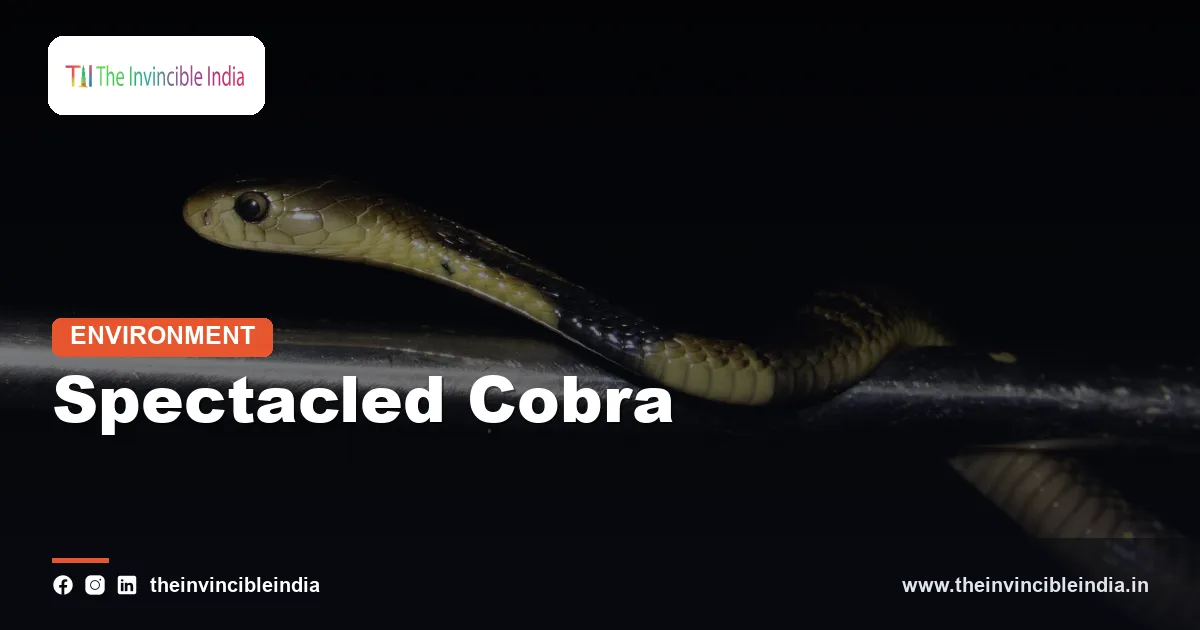
The spectacled cobra is the Indian cobra (Naja naja), a large venomous elapid snake of the Indian subcontinent that is easily recognised by the spectacle-shaped mark on the back of its spread hood. It is one of the “Big Four” venomous snakes of India, together with the common krait, Russell’s viper and saw-scaled viper, and it is also the snake most deeply woven into Indian religion, folklore and street performance.
This explainer covers how to identify the spectacled cobra, how its neurotoxic venom works, why it matters in India’s snakebite problem, what to do after a bite, and how the species is protected under Indian law. It also explains the cultural role of the cobra, from Nag Panchami to the vanished tradition of snake charming. Information was last reviewed on 22 October 2026.
Quick Facts
| Common name | Spectacled cobra, Indian cobra, common cobra (Hindi: nag, naag) |
|---|---|
| Scientific name | Naja naja (Linnaeus, 1758) |
| Family | Elapidae (cobras, kraits, mambas, coral snakes and sea snakes) |
| Typical adult length | Roughly 1.2 to 1.8 metres; larger individuals are occasionally reported |
| Distinctive feature | Spectacle-like mark on the back of the expandable hood |
| Venom type | Mainly neurotoxic, with significant local tissue-damaging (cytotoxic) effects |
| Range | India, Pakistan, Nepal, Bangladesh and Sri Lanka |
| Legal status in India | Protected under the Wildlife (Protection) Act, 1972; killing, capture and trade are offences |
| Cultural role | Worshipped on Nag Panchami; associated with Shiva and Vishnu |
Key Takeaways
- The spectacled cobra (Naja naja) is one of India’s “Big Four” medically important venomous snakes and is identified by a spectacle-shaped mark on its hood.
- The venom of the Indian cobra is predominantly neurotoxic and can paralyse the muscles that control breathing, so a cobra bite is a medical emergency.
- Bites from the spectacled cobra are treated with polyvalent antivenom, which in India is manufactured to neutralise the venom of the Big Four species.
- The correct first aid after any suspected snakebite in India is to keep the person calm and still, immobilise the bitten limb, and reach a hospital with antivenom without delay.
- The Indian cobra is protected under the Wildlife (Protection) Act, 1972, and snake charming with wild cobras is illegal in India.
- The spectacled cobra is a rodent-eating snake that helps limit pests in farmland and villages, which is why it is often found close to human settlements.
What is the spectacled cobra?
The spectacled cobra is a medium-to-large venomous snake in the genus Naja, found across most of the Indian subcontinent and known in English as the Indian cobra. It belongs to the family Elapidae, a group of front-fanged snakes that deliver venom through short, fixed fangs at the front of the upper jaw.
The scientific name Naja naja was given by the Swedish naturalist Carl Linnaeus in 1758, and the snake is among the earliest South Asian reptiles described in Western science. Because the species has such a wide range, its colour varies considerably. Individuals may be brown, black, grey, olive or yellowish, and some are almost uniformly dark with little pattern.
The Indian cobra is usually active at dusk, at night and in the early morning, although it can also be seen basking or moving in daylight. It is a terrestrial snake that is also a competent swimmer and can climb low walls and shrubs. In Hindi it is called nag or naag, and many regional languages have their own names for it, such as naaga paambu in Tamil and nagu havu in Kannada.
How can you identify a spectacled cobra?
A spectacled cobra can be identified mainly by its ability to flatten and spread a broad hood and by the paired, spectacle-like marking on the back of that hood. When the snake feels threatened, it raises the front part of its body off the ground and spreads its neck ribs outward, producing the familiar hood.
The mark on the hood is formed by two roughly circular patches joined by a curved line, resembling a pair of spectacles. This marking is clearest in some populations and faint or missing in others, so it should not be treated as a perfect test. Other features that help are:
- A smooth, glossy body with a rounded snout and a relatively small head that is only slightly wider than the neck
- A round pupil and large, dark eyes
- Pale or dark bands on the underside of the neck, often visible when the hood is raised
- A deep, drawn-out hiss when disturbed
Which snakes are mistaken for the cobra?
The most common look-alike is the Indian rat snake (Ptyas mucosa), known as dhaman, which is a large, fast, non-venomous snake. The rat snake can be similar in size and colour but does not spread a hood and has a longer, more slender tail. Several other cobras also occur in India, including the monocled cobra (Naja kaouthia), which has a single ring-shaped mark, and the king cobra (Ophiophagus hannah), which belongs to a different genus and is much larger. Anyone unsure about a snake should keep their distance and contact a trained local rescuer or the forest department rather than handle it.
Where does the Indian cobra live and what does it eat?
The Indian cobra lives across the Indian subcontinent, including India, Pakistan, Nepal, Bangladesh and Sri Lanka, in a wide range of habitats from forests and grasslands to farmland and the edges of cities. It generally avoids very dense rainforest and very high mountains, but it thrives where rodents and amphibians are abundant.
In India the species is found in nearly every state, in plains, scrub, plantations, paddy fields and rural villages. It commonly shelters in termite mounds, rodent burrows, rock piles, tree hollows, stone walls and gaps in old buildings. Because grain stores and rubbish heaps attract rats, cobras often follow their prey into human settlements, which is the main reason encounters occur.
Seasonal patterns are noticeable. Heavy rain can flood burrows and drive snakes into houses and onto higher ground, and the monsoon is also a period of increased field work, so bites in farming regions tend to rise in the warmer, wetter months. Taxonomists have also split off some populations that were once treated as the same species, so the range given for Naja naja has been refined over time.
What does the spectacled cobra eat and how does it breed?
The spectacled cobra mainly eats rodents, frogs and toads, but it also takes lizards, birds, eggs and other snakes. Rats and mice form a large part of its diet in agricultural areas, which gives the snake a useful role in limiting crop and grain pests.
The cobra kills its prey by biting and injecting venom, then swallowing it whole, head first. Like other snakes, it has a flexible jaw that allows it to swallow animals wider than its head.
Breeding generally takes place after the cooler months, and the female lays a clutch of eggs, commonly somewhere between a dozen and a few dozen, in a burrow or hollow. The female often stays near the eggs and may defend them. The eggs hatch after roughly two months, and the young are venomous from birth. Hatchlings are only around 20 to 30 centimetres long but are capable of delivering a venomous bite.
How does cobra venom affect the body?
Cobra venom affects the body mainly by attacking the nervous system, and it can also damage the tissue around the bite. The key components are neurotoxins, which block the signals between nerves and muscles, and cytotoxins, which break down cells near the wound.
Typical clinical effects reported for Indian cobra envenoming include:
- Pain, swelling and sometimes blistering or tissue death (necrosis) at the bite site
- Drooping eyelids (ptosis), blurred or double vision and difficulty opening the mouth
- Difficulty swallowing and slurred speech
- Weakness that spreads through the limbs and chest, which can progress to paralysis of the breathing muscles
The speed of onset varies with the amount of venom delivered, the bite site and the victim’s size. Some bites are “dry” and deliver little or no venom, but nobody can safely tell this at the scene, so every suspected cobra bite must be treated as serious until a doctor has assessed it. Because the main life-threatening risk is respiratory failure, hospitals may need to support breathing with a ventilator while antivenom takes effect.
What should you do after a cobra bite?
After a suspected cobra bite, the person should be kept calm and still, the bitten limb should be immobilised, and the patient should be taken to the nearest hospital that can give antivenom as quickly as possible. Time matters, so transport should begin at once rather than waiting to see whether symptoms appear.
Recommended first-aid steps
- Move the person away from the snake and ask them to sit or lie down and stay as still as possible.
- Immobilise the bitten limb, in the same way as for a fractured limb, using a splint or sling and keeping movement to a minimum.
- Remove rings, bangles, watches and tight clothing from the bitten limb before swelling begins.
- Call an ambulance, for example 108 in many states, or arrange the fastest safe transport to a hospital with antivenom and ventilator support.
- Note the time of the bite and any symptoms, and if it can be done safely from a distance, take a photograph of the snake to help doctors.
What should be avoided?
People should not cut the wound, try to suck out venom, tie a tight tourniquet, apply ice, or use herbs, stones, oils or other home or folk preparations. These practices do not neutralise venom, can cause infection or damage, and waste the time needed to reach treatment. Visiting a faith healer or exorcist before a hospital has repeatedly been linked to avoidable deaths. The only proven treatment for snake envenoming is timely medical care with antivenom and supportive care.
How is cobra envenoming treated?
Cobra envenoming is treated in hospital with polyvalent antivenom, which is given by intravenous infusion, together with supportive care such as airway management and, if needed, mechanical ventilation. Antivenom contains antibodies that bind and neutralise venom components circulating in the blood.
In India, the standard polyvalent antivenom is produced by immunising horses with venom from the Big Four species: the spectacled cobra, common krait, Russell’s viper and saw-scaled viper. Doctors usually follow national snakebite management guidelines, which describe the dose, the monitoring of symptoms and the management of allergic reactions to antivenom. Patients are usually observed for an extended period, even if they appear well at first, because paralysis can develop hours after the bite.
A drug called neostigmine is sometimes used alongside antivenom in some cobra cases to help restore nerve-to-muscle signalling, but it is a medical decision made by the treating team. Wound care, tetanus prophylaxis and surgical review for tissue damage are further parts of treatment. Researchers and public-health agencies also stress that outcomes depend heavily on how fast the patient reaches a facility that stocks antivenom.
Why does the spectacled cobra matter in India’s snakebite burden?
The spectacled cobra matters in India’s snakebite burden because it is one of the four species responsible for most medically significant bites, in a country that is widely reported to have the highest number of snakebite deaths in the world. Exact figures are uncertain because many bites occur in remote areas and are never recorded by hospitals.
A widely cited national mortality study published in 2020 estimated that India lost well over a million people to snakebite across the period 2000 to 2019, an average of roughly 58,000 deaths a year, with the burden concentrated among rural and agricultural communities. The World Health Organization has listed snakebite envenoming among the neglected tropical diseases, and India has since developed a national action plan on snakebite prevention and control, aiming to cut deaths sharply by 2030.
Within that burden, the cobra is one of several species. Different regions have different leading species, and bites from cobras are generally associated with neurotoxic paralysis, while Russell’s viper and the saw-scaled viper cause bleeding and kidney problems. Public health experts emphasise that education, rapid transport, hospital readiness and reliable antivenom stocks matter more than any single snake. Attribution to a particular species is often difficult, so published splits between species should be read with caution.
Why is the cobra sacred in India?
The cobra is sacred in India because Hindu tradition links it with the gods Shiva and Vishnu, with fertility and protection, and with the guardians of the underworld known as the nagas. The cobra is worshipped in temples, shrines and village groves across the country.
In Hindu iconography Shiva wears a cobra around his neck, and Vishnu reclines on the serpent Shesha (Sheshnag), whose hoods form a canopy over him. Serpent stones, called nagakals in parts of South India, are placed under trees and in sacred groves, and many families keep customs connected to nagas for protection of children and lineage.
What is Nag Panchami?
Nag Panchami is a Hindu festival dedicated to snake worship, observed on the fifth day (panchami) of the bright fortnight of the month of Shravana, which usually falls in July or August. Devotees offer milk, flowers and turmeric to images of snakes or to anthills and snake shrines, and many fast and pray for protection from snakebite. Wildlife experts consistently advise against feeding milk to live snakes, as snakes do not drink milk and it can harm them. Capturing cobras for display during the festival is also illegal, and conservationists encourage devotion directed at images and shrines instead.
Is snake charming legal in India?
Snake charming is not legal in India, because the Wildlife (Protection) Act, 1972 prohibits capturing, keeping and exhibiting protected wild snakes, and later amendments closed the exemption that had allowed charmers to perform. The practice nonetheless remains a part of India’s popular image of itself.
Traditional snake charmers, often from communities known as the Sapera, historically caught cobras, removed or damaged their fangs, and displayed them to crowds by playing a flute-like instrument called the pungi. Cobras have no external ears and are largely insensitive to airborne sound, so the snake follows the movement of the instrument and the performer’s swaying rather than the tune. Many captive cobras suffered from malnutrition and poor handling.
After the ban, many charmers lost their livelihoods, and several government and non-governmental programmes have tried to rehabilitate such families, including employing them for snake rescue and public education. Several of these former charmers now assist forest departments and wildlife rescue organisations.
How is the Indian cobra protected?
The Indian cobra is protected in India under the Wildlife (Protection) Act, 1972, which makes it an offence to hunt, kill, capture or trade the species without legal authority. The act has been amended several times, including a major revision in 2022, so the exact schedule listing should be checked against the current text of the law.
Internationally, Naja naja is listed in Appendix II of CITES, which regulates international trade in the species’ skins and live animals. On the IUCN Red List the Indian cobra has been assessed as Least Concern, but local populations face pressure from habitat loss, road mortality, retaliatory killing and trade in skins, venom and body parts.
The law does allow protection of human life, and trained rescuers can remove cobras from homes and release them in suitable habitat. Conservation groups advise the public to contact a forest department helpline or an accredited rescuer rather than kill a snake found indoors.
How can people reduce the risk of cobra bites?
People can reduce the risk of cobra bites by keeping homes and yards free of rodents and clutter, using a torch and footwear at night, and sleeping off the floor under a properly tucked mosquito net. Because cobras follow their prey, removing the food supply is the most effective prevention.
The table below summarises practical precautions used in public-health advice for rural India.
| Situation | Sensible precaution |
|---|---|
| Walking outdoors at night | Carry a torch and wear closed footwear; watch the ground ahead |
| Working in fields or clearing brush | Wear boots and gloves; use a stick to move debris; avoid reaching into holes |
| Storing grain and fodder | Keep stores sealed and raised; control rats to remove the cobra’s food |
| Sleeping | Use a cot or bed rather than the floor; tuck in a mosquito net |
| Meeting a snake | Stay still, step back slowly and give the snake room to leave; never try to catch or kill it |
Community training in first aid, awareness that bites need hospital care, and well-stocked primary health centres are considered core parts of reducing deaths.
Bottom Line
The spectacled cobra is a protected, ecologically useful and culturally revered snake whose neurotoxic venom makes any bite an emergency. The sensible response to a suspected bite is to stay calm, immobilise the limb and reach a hospital with antivenom quickly, avoiding all folk remedies.
Frequently Asked Questions
What is a spectacled cobra?
The spectacled cobra is another name for the Indian cobra, Naja naja, a venomous snake of the Indian subcontinent. It is named for the spectacle-shaped mark on its spread hood. It is one of the “Big Four” snakes responsible for most serious snakebites in India.
Is the spectacled cobra deadly?
The spectacled cobra has potent neurotoxic venom that can be fatal if a bite is not treated, mainly because it can paralyse the breathing muscles. Not every bite delivers venom, and prompt treatment with antivenom and supportive care greatly improves the chance of recovery. Any suspected cobra bite should be treated as an emergency.
What should I do if a cobra bites someone?
Keep the person calm and still, immobilise the bitten limb, remove tight items such as rings, and take them to a hospital that stocks antivenom immediately. Do not cut the wound, suck the venom, apply a tight tourniquet or use herbal or folk remedies. If possible, note the time of the bite and the symptoms.
Is the Indian cobra protected by law?
Yes, the Indian cobra is protected under the Wildlife (Protection) Act, 1972, and killing, capturing or trading it is an offence. The Act has been amended several times, so the exact schedule should be checked against the current law. The species is also listed in Appendix II of CITES.
Why are cobras worshipped in India?
Cobras are worshipped in India because Hindu tradition associates them with Shiva, Vishnu and the nagas, and with fertility and protection. The festival of Nag Panchami, held in the month of Shravana, is dedicated to snake worship. Wildlife experts advise that live snakes should not be offered milk.
Can a cobra hear the snake charmer’s flute?
No, a cobra cannot hear the flute in the way humans do, because it has no external ears and is largely insensitive to airborne sound. The snake follows the movement of the pungi and the performer. Snake charming with wild cobras has also been illegal in India since the Wildlife (Protection) Act, 1972 was strengthened.
{“@context”:”https://schema.org”,”@graph”:[{“@type”:”FAQPage”,”mainEntity”:[{“@type”:”Question”,”name”:”What is a spectacled cobra?”,”acceptedAnswer”:{“@type”:”Answer”,”text”:”The spectacled cobra is another name for the Indian cobra, Naja naja, a venomous snake of the Indian subcontinent. It is named for the spectacle-shaped mark on its spread hood. It is one of the “Big Four” snakes responsible for most serious snakebites in India.”}},{“@type”:”Question”,”name”:”Is the spectacled cobra deadly?”,”acceptedAnswer”:{“@type”:”Answer”,”text”:”The spectacled cobra has potent neurotoxic venom that can be fatal if a bite is not treated, mainly because it can paralyse the breathing muscles. Not every bite delivers venom, and prompt treatment with antivenom and supportive care greatly improves the chance of recovery. Any suspected cobra bite should be treated as an emergency.”}},{“@type”:”Question”,”name”:”What should I do if a cobra bites someone?”,”acceptedAnswer”:{“@type”:”Answer”,”text”:”Keep the person calm and still, immobilise the bitten limb, remove tight items such as rings, and take them to a hospital that stocks antivenom immediately. Do not cut the wound, suck the venom, apply a tight tourniquet or use herbal or folk remedies. If possible, note the time of the bite and the symptoms.”}},{“@type”:”Question”,”name”:”Is the Indian cobra protected by law?”,”acceptedAnswer”:{“@type”:”Answer”,”text”:”Yes, the Indian cobra is protected under the Wildlife (Protection) Act, 1972, and killing, capturing or trading it is an offence. The Act has been amended several times, so the exact schedule should be checked against the current law. The species is also listed in Appendix II of CITES.”}},{“@type”:”Question”,”name”:”Why are cobras worshipped in India?”,”acceptedAnswer”:{“@type”:”Answer”,”text”:”Cobras are worshipped in India because Hindu tradition associates them with Shiva, Vishnu and the nagas, and with fertility and protection. The festival of Nag Panchami, held in the month of Shravana, is dedicated to snake worship. Wildlife experts advise that live snakes should not be offered milk.”}},{“@type”:”Question”,”name”:”Can a cobra hear the snake charmer’s flute?”,”acceptedAnswer”:{“@type”:”Answer”,”text”:”No, a cobra cannot hear the flute in the way humans do, because it has no external ears and is largely insensitive to airborne sound. The snake follows the movement of the pungi and the performer. Snake charming with wild cobras has also been illegal in India since the Wildlife (Protection) Act, 1972 was strengthened.”}}]}]}


