

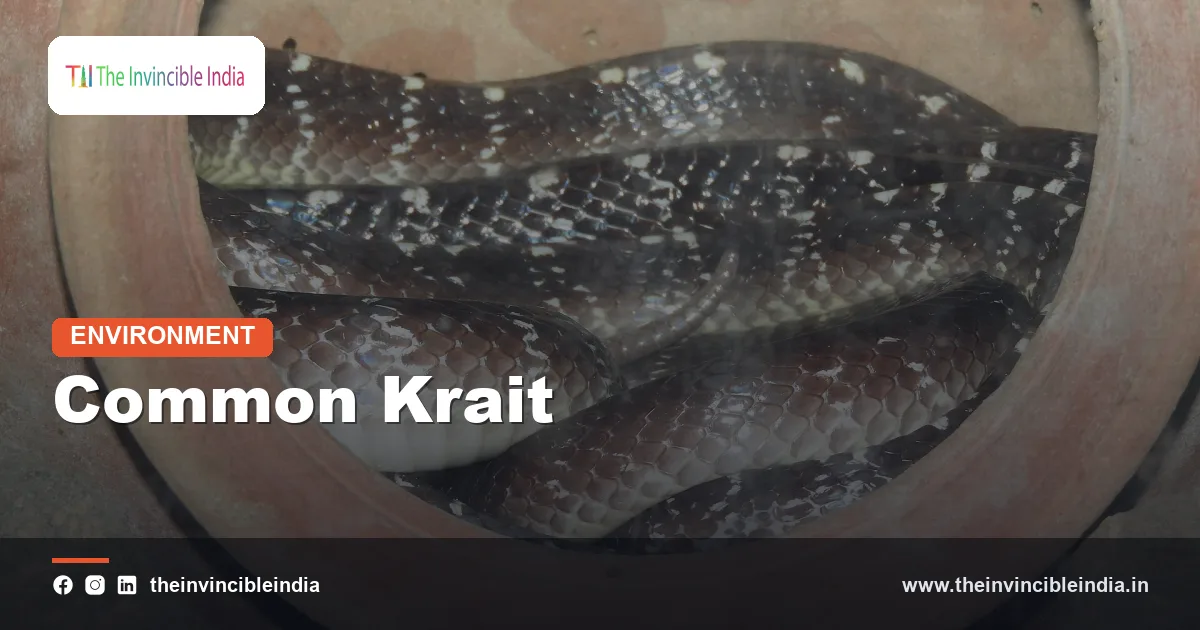
The common krait is Bungarus caeruleus, a nocturnal, steel-blue elapid snake of the Indian subcontinent that carries highly potent neurotoxic venom and is one of the “Big Four” venomous snakes of India. It is feared in rural India less for its temperament, which is shy and docile by day, than for its habit of biting sleeping people at night, often so painlessly that the victim does not realise how serious the bite is.
This explainer covers how to identify the common krait, why its bite is deceptive, what the venom does, which first-aid steps are recommended, and how treatment works in hospital. It also explains how the krait differs from harmless look-alikes and how families can cut their risk at night. The information was last reviewed on 22 October 2026.
Quick Facts
| Common name | Common krait, Indian krait, blue krait (Marathi: manyar) |
|---|---|
| Scientific name | Bungarus caeruleus (Schneider, 1801) |
| Family | Elapidae |
| Typical adult length | Around 0.9 to 1.2 metres; occasionally longer |
| Colour and pattern | Glossy blue-black or steel-blue body with narrow white crossbands, often incomplete on the front half of the body |
| Activity | Nocturnal; sluggish and shy in daylight |
| Venom type | Predominantly neurotoxic, acting at the nerve endings; produces progressive paralysis |
| Range | India, Pakistan, Nepal, Bangladesh and Sri Lanka |
| Main hazard | Painless bites to people sleeping on the floor, with delayed paralysis |
Key Takeaways
- The common krait (Bungarus caeruleus) is one of India’s “Big Four” medically important venomous snakes and has highly potent neurotoxic venom.
- A common krait bite is often painless and may leave only tiny marks with little swelling, so a serious envenoming can be mistaken for an insect bite.
- Common krait bites occur mostly at night to people sleeping on the floor, and paralysis may only appear several hours later, often by early morning.
- Any person who may have been bitten by a krait must be taken to a hospital with antivenom and ventilator support even if they feel well, because breathing muscles can fail without warning.
- Sleeping on a raised cot under a properly tucked mosquito net is a widely recommended way to reduce krait bites in rural India.
- The common krait is harmless to humans when left alone in daylight and mainly feeds on other snakes, lizards and small rodents.
What is the common krait?
The common krait is a medium-sized, highly venomous snake in the genus Bungarus, native to the Indian subcontinent and responsible for a significant number of serious snakebites in India. It was scientifically described in 1801 and belongs to the family Elapidae, the same family as cobras.
It is the most widely distributed krait in India and the one most often encountered by people. The snake is usually between about 0.9 and 1.2 metres long, with a slender, cylindrical body, a smooth glossy skin and a short tail. The head is flattened and barely distinct from the neck, and the eyes are small with round pupils.
Other krait species also live in India, including the banded krait (Bungarus fasciatus), the black krait (Bungarus niger), the Sind krait (Bungarus sindanus), the lesser black krait (Bungarus lividus) and the northeast Indian hill krait (Bungarus bungaroides). The common krait is the species counted among the Big Four.
How can you identify a common krait?
A common krait can be identified by its glossy bluish-black body crossed by thin white bands, its flat head, and the row of enlarged, hexagonal scales running down the middle of its back. These features distinguish it from the wolf snakes that resemble it.
The white bands are narrow and often appear in pairs or fade toward the head, so they may be missing or indistinct on the forebody and become clearer toward the tail. The belly is plain white. Some individuals are almost uniformly black or dark brown with faint bands.
Which harmless snakes look like a krait?
The most common look-alike is the common wolf snake (Lycodon aulicus), a non-venomous snake with a similar dark body and pale bands. The wolf snake has a broader, more distinct head, no enlarged middle row of back scales, and bands that are usually wider and fade toward the tail. Because these differences are hard to judge in a dark room, people should not rely on identification and should treat any bite from an unidentified banded snake at night as potentially dangerous. Photographing the snake from a safe distance can help doctors if it is easy and safe to do so.
Where does the common krait live?
The common krait lives across most of the Indian subcontinent, including India, Pakistan, Nepal, Bangladesh and Sri Lanka, from dry scrub and farmland to the edges of villages and towns. It is mostly absent from dense rainforest and from high mountain areas.
The snake spends the day hidden in termite mounds, rodent holes, piles of bricks or stones, woodpiles, crevices in walls and cracks in the floors of houses. It becomes active after dusk and may travel into dwellings in search of prey or a cooler place. Bite reports in India often peak in the warmer and wetter parts of the year, when snakes are more mobile and people sleep outdoors or on the ground.
The krait is found in a range of settings, including rural homes with mud floors, farm sheds, courtyards and the surroundings of paddy fields. Because it follows its prey, it is more commonly found where rodents and other snakes are abundant, which links the risk of bites to housing quality and sanitation.
What does the common krait eat?
The common krait mainly eats other snakes, but it also feeds on lizards, frogs and small rodents. It is sometimes described as ophiophagous, meaning that snake-eating is a major part of its diet, and it will eat other kraits.
The krait hunts at night, finding prey by smell and touch, and subdues it with a quick bite. Its venom paralyses the animal, which is then swallowed. This role makes the species a predator of other snakes and rodents around villages.
The female lays a clutch of eggs, usually in a hole or termite mound during the warmer months, and generally stays with the eggs until they hatch. The young are venomous from birth and look similar to adults, though they may appear more strongly banded.
What is the temperament of a krait?
The common krait is generally timid and sluggish in daylight, but it becomes more alert and can bite readily at night if it is disturbed or trapped. During the day the snake tends to coil up and tuck its head beneath its body, and it often tries to slip away rather than fight.
This behaviour has contributed to the false belief that the snake is harmless. After dark, however, it is more active and nimble, and it can strike if accidentally rolled on, stepped on, or touched by a sleeping person. In many reported cases the snake had simply crawled across or next to a person lying on the ground and bit in self-defence.
Experts therefore stress that the krait should never be handled, teased or killed by untrained people. Their advice is to leave the animal alone and contact a trained rescuer or the forest department.
How does krait venom work?
Krait venom works mainly by blocking the transmission of signals between nerves and muscles, which causes weakness and paralysis that begins in the facial and neck muscles and can spread to the muscles of breathing. The venom contains potent neurotoxins, including presynaptic toxins of the bungarotoxin family, that act at the nerve endings.
On laboratory measures in mice, krait venom is among the most toxic of any Indian land snake, although such comparisons do not translate directly into human risk, which also depends on the amount injected and how soon treatment starts. Many bites inject a small amount of venom, but even those can be dangerous.
What symptoms follow a krait bite?
The characteristic features of a krait bite include very little pain at the bite site, minimal swelling, and a delay of hours before the first signs of paralysis appear. Symptoms reported in clinical studies include:
- Severe abdominal pain or cramps, which can be an early clue
- Drooping eyelids, double vision, and difficulty opening the eyes or mouth
- Difficulty swallowing, slurred speech, and trouble breathing
- Weakness in the neck and limbs, progressing to complete paralysis
Some patients wake up with a drooping face or inability to move, and the diagnosis may be missed if the possibility of a snakebite is not considered. Because the pain is small and the marks are tiny, many victims and families do not realise a snake was involved.
Why is a krait bite so dangerous at night?
A krait bite is especially dangerous at night because the victim is usually asleep, may not feel the bite, and may not seek help until paralysis has already begun. Without treatment, the weakness can progress to respiratory failure within hours.
The combination of a painless bite, a delay in symptoms and the habit of sleeping on the floor explains why krait bites are often missed or mistaken for other illnesses. Families in rural areas have sometimes treated the early signs as a stroke, a fit or ordinary illness, or tried folk remedies first. Public-health teams repeatedly warn that this loss of time is among the main causes of preventable deaths.
Anyone who wakes up with unexplained abdominal pain, eyelid drooping, double vision or difficulty speaking, particularly in an area where kraits occur and especially after sleeping on the floor, should be taken to a hospital immediately and asked whether a snake might have been present. A medical team can then decide whether to give antivenom and begin monitoring.
What should you do after a suspected krait bite?
After a suspected krait bite, the person should be kept calm and still, the affected limb immobilised, and the person taken to a hospital with antivenom and ventilator facilities without delay. The person should go even if they feel completely well, because paralysis may be delayed for several hours.
First-aid steps
- Keep the person lying or sitting still and reassure them; movement and panic can speed the spread of venom.
- Immobilise the bitten limb like a fracture, and remove rings, bangles and tight clothing.
- Arrange urgent transport, calling an ambulance such as 108 in many states, and tell the staff in advance that a snakebite is suspected.
- Note the time of the bite or the time the person was found, and watch for drooping eyelids, difficulty speaking or breathing.
- If breathing becomes weak, follow the instructions of emergency responders, and lay the person on their side if they are unconscious.
What must not be done?
Do not cut or squeeze the wound, suck the venom, apply a tight tourniquet, use ice, or rely on herbs, stones, oils, mantras or other folk and home remedies. These measures do not neutralise venom and delay proper treatment. The only proven remedy is antivenom together with supportive care in a hospital, and time lost on non-medical treatment is a leading reason that people die from snakebite.
How is a krait bite treated in hospital?
A krait bite is treated in hospital with intravenous antivenom and, when breathing muscles are affected, with mechanical ventilation until the venom wears off. Close monitoring of breathing and nerve function is as important as the antivenom itself.
In India the standard polyvalent antivenom is made from horse serum using venom from the Big Four, and it is intended to cover the common krait. However, because the neurotoxins of kraits act at the nerve endings and may be hard to reverse once bound, antivenom is most useful when given early, and doctors often need to provide long periods of ventilation. Some studies suggest that the neutralising capacity of existing antivenoms against krait venom varies between regions, which is an area of continuing research, so supportive care remains central.
Patients are usually admitted for observation even if they appear well. Intensive care teams manage the airway, give fluids and nutrition, and wait for recovery of muscle strength, which can take days. With early treatment and good intensive care, many patients recover fully, which is why rapid transport to a capable hospital is so strongly emphasised.
How can people prevent krait bites?
People can prevent most krait bites by sleeping on a raised cot under a mosquito net tucked beneath the mattress, keeping floors clear of rubbish, and sealing holes where snakes and rodents can enter. Studies from rural South Asia have linked sleeping on the floor to a higher risk of krait bites.
| Measure | Why it helps |
|---|---|
| Sleep on a cot or raised bed | Keeps the body off the ground where kraits crawl |
| Use a mosquito net tucked in on all sides | Forms a physical barrier against crawling snakes, with the added benefit of malaria protection |
| Seal cracks, holes and gaps in walls and floors | Removes hiding places and entry routes |
| Control rats and keep grain stores clean | Reduces the rodents and snakes that follow them |
| Use a torch and footwear after dark | Helps people see and avoid snakes outdoors |
| Do not handle or kill snakes | Prevents bites that occur when people try to catch or attack snakes |
Health workers also stress community awareness: families should know the nearest hospital that stocks antivenom and should be prepared to travel there without waiting.
Is the common krait protected in India?
The common krait is a wild animal protected in India under the Wildlife (Protection) Act, 1972, which restricts hunting, capture and trade in snakes. The Act has been amended several times and its schedule listings have changed, so the exact schedule should be checked against the current text.
The International Union for Conservation of Nature does not consider the species globally threatened, because it is widespread. Even so, snakes in general are often killed on sight, and habitat disturbance and road traffic add to losses. The law allows the removal of snakes from homes by trained rescuers who release them in suitable habitat, which is considered the safest course for both people and the animal.
Bottom Line
The common krait is a shy but dangerous snake whose painless night-time bites can cause delayed paralysis. Sleeping off the floor under a tucked net lowers the risk, and anyone who may have been bitten should go to a hospital with antivenom and ventilation at once, without waiting for symptoms or trying folk remedies.
Frequently Asked Questions
What is a common krait?
The common krait is Bungarus caeruleus, a nocturnal, steel-blue venomous snake with narrow white bands that lives across the Indian subcontinent. It is one of the “Big Four” venomous snakes of India. Its venom is strongly neurotoxic and can cause paralysis.
Why are krait bites painless?
Krait bites are often painless because the venom acts mainly on the nerves and causes little local swelling or tissue damage. The bite marks are small and may be hard to see. This is why a serious envenoming can be mistaken for an insect bite or missed altogether.
What should I do if I think a krait has bitten me?
Stay as still as possible, immobilise the limb and go to a hospital with antivenom and ventilator facilities immediately, even if you feel well. Paralysis can appear hours after the bite. Do not use folk remedies, cut the wound, suck out venom or tie a tight tourniquet.
How can I tell a common krait from a wolf snake?
The common krait has a flat head barely wider than its neck, a glossy bluish-black body with narrow white bands, and an enlarged row of hexagonal scales along its back. The harmless wolf snake has a more distinct head and no such scale row. Because the differences are hard to judge at night, any bite from a banded snake should be treated as an emergency.
Does antivenom work for a krait bite?
Yes, polyvalent antivenom is used for krait bites in India, and it works best when given early. Patients also often need supportive care such as ventilation because paralysis may continue after antivenom is given. Effectiveness can vary, so treatment in a well-equipped hospital is essential.
How can I stop kraits from biting me while I sleep?
Sleep on a raised cot under a mosquito net that is tucked in on all sides, and keep floors free of clutter and rodents. Seal gaps in walls and floors where snakes could enter. These steps reduce the chance of a snake crawling onto a sleeping person.
{“@context”:”https://schema.org”,”@graph”:[{“@type”:”FAQPage”,”mainEntity”:[{“@type”:”Question”,”name”:”What is a common krait?”,”acceptedAnswer”:{“@type”:”Answer”,”text”:”The common krait is Bungarus caeruleus, a nocturnal, steel-blue venomous snake with narrow white bands that lives across the Indian subcontinent. It is one of the “Big Four” venomous snakes of India. Its venom is strongly neurotoxic and can cause paralysis.”}},{“@type”:”Question”,”name”:”Why are krait bites painless?”,”acceptedAnswer”:{“@type”:”Answer”,”text”:”Krait bites are often painless because the venom acts mainly on the nerves and causes little local swelling or tissue damage. The bite marks are small and may be hard to see. This is why a serious envenoming can be mistaken for an insect bite or missed altogether.”}},{“@type”:”Question”,”name”:”What should I do if I think a krait has bitten me?”,”acceptedAnswer”:{“@type”:”Answer”,”text”:”Stay as still as possible, immobilise the limb and go to a hospital with antivenom and ventilator facilities immediately, even if you feel well. Paralysis can appear hours after the bite. Do not use folk remedies, cut the wound, suck out venom or tie a tight tourniquet.”}},{“@type”:”Question”,”name”:”How can I tell a common krait from a wolf snake?”,”acceptedAnswer”:{“@type”:”Answer”,”text”:”The common krait has a flat head barely wider than its neck, a glossy bluish-black body with narrow white bands, and an enlarged row of hexagonal scales along its back. The harmless wolf snake has a more distinct head and no such scale row. Because the differences are hard to judge at night, any bite from a banded snake should be treated as an emergency.”}},{“@type”:”Question”,”name”:”Does antivenom work for a krait bite?”,”acceptedAnswer”:{“@type”:”Answer”,”text”:”Yes, polyvalent antivenom is used for krait bites in India, and it works best when given early. Patients also often need supportive care such as ventilation because paralysis may continue after antivenom is given. Effectiveness can vary, so treatment in a well-equipped hospital is essential.”}},{“@type”:”Question”,”name”:”How can I stop kraits from biting me while I sleep?”,”acceptedAnswer”:{“@type”:”Answer”,”text”:”Sleep on a raised cot under a mosquito net that is tucked in on all sides, and keep floors free of clutter and rodents. Seal gaps in walls and floors where snakes could enter. These steps reduce the chance of a snake crawling onto a sleeping person.”}}]}]}


