

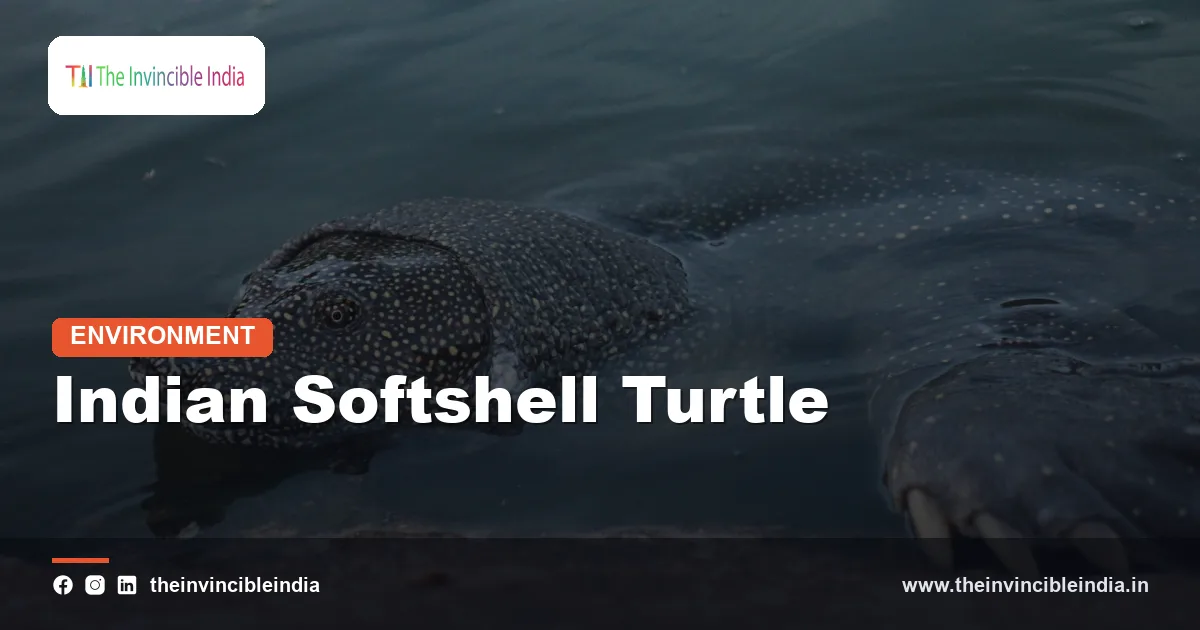
The Indian softshell turtle (Nilssonia gangetica), also called the Ganges softshell turtle, is a large freshwater turtle of the Ganga, Indus and Mahanadi river systems that has a leathery, flexible shell instead of hard bony plates, and it is an important scavenger and predator in South Asian rivers. Its flat, olive-green body, long neck and snorkel-like snout make it easy to tell apart from the hard-shelled turtles that share its waters.
The Indian softshell turtle helps keep rivers cleaner by eating fish, molluscs and carrion, but it is threatened by hunting for meat, entanglement in fishing nets, sand mining and river pollution. This explainer covers its biology, role in the river ecosystem, presence in temple ponds, threats and legal protection.
| Attribute | Detail |
|---|---|
| Scientific name | Nilssonia gangetica (family Trionychidae) |
| Common names | Indian softshell turtle, Ganges softshell turtle, Gangetic softshell turtle, Indian narrow-headed softshell turtle |
| Type | Large freshwater softshell turtle with a leathery carapace and no horny scutes |
| Typical size | Large individuals can exceed 60 cm in shell length and weigh many kilograms; some reports are larger |
| Range | Ganga and Mahanadi basins in India, the Indus basin in Pakistan, and parts of Nepal and Bangladesh |
| Habitat | Large rivers with sandy banks, deep pools, canals, reservoirs, ponds and village tanks |
| Diet | Carnivorous and scavenging: fish, molluscs, crustaceans, amphibians and carrion |
| Legal and conservation status | Protected under the Wildlife (Protection) Act, 1972 (schedule placement has been revised, so check the current text); listed in CITES Appendix I; assessed by the IUCN in a threatened category in recent assessments |
Key Takeaways
- The Indian softshell turtle (Nilssonia gangetica) is a large freshwater turtle whose shell is covered by flexible, leathery skin rather than hard scutes.
- The Indian softshell turtle is an opportunistic carnivore and scavenger that eats fish, molluscs and carrion, thereby helping to clean river waters.
- The Indian softshell turtle can breathe through its long, snorkel-like nose and absorb some oxygen through skin in the throat and cloaca, which lets it stay under water for long periods.
- The Indian softshell turtle is threatened by poaching for meat, accidental capture in fishing nets, egg collection, sand mining and pollution of rivers.
- The Indian softshell turtle has been reared and released in programmes linked to the Ganga Action Plan, including the Kashi Turtle Sanctuary at Varanasi.
- The Indian softshell turtle is protected under the Wildlife (Protection) Act, 1972, and its international trade is restricted by CITES.
What Is the Indian Softshell Turtle?
The Indian softshell turtle is a member of the family Trionychidae, which is the group of softshell turtles found in rivers, lakes and ponds across Asia, Africa and North America. Nilssonia gangetica is one of the largest freshwater turtles in India, and it is generally olive, brown or greenish above and paler below, with a smooth, almost round to oval shell.
Juvenile animals have distinctive eye-like spots on the shell and dark markings on the head, which tend to fade as they grow. Adults are heavy, strong swimmers with webbed feet, three claws on each foot and a long neck that can be stretched far out. The head is relatively narrow, and the snout ends in a short fleshy tube with nostrils at the tip.
The common names reflect its range and form. “Ganges softshell turtle” and “Gangetic softshell turtle” emphasise the river basin, while “Indian softshell turtle” stresses its national association. Local names differ across regions, and the animal is often described simply as a river turtle or a “kachua” in Hindi-speaking areas.
What Does a Softshell Turtle’s Shell Look Like?
The shell of the Indian softshell turtle is a flat, leathery carapace made of bone covered by soft skin, with no horny plates and a flexible rim at the edges. This design makes the animal lighter and more streamlined than hard-shelled turtles, which helps it to swim fast and bury itself in sand and mud.
Some key shell and body features are:
- Leathery carapace: smooth skin over bone, with a soft, pliable margin.
- Reduced bone: the shell is thinner than in most land or pond turtles.
- Snorkel nose: a fleshy tube lets the turtle breathe while its body is hidden in water.
- Powerful jaws: sharp horn-covered edges cut through fish and shellfish.
- Long neck: can strike quickly at prey and can reach back toward the shell.
Because the shell is soft, the turtle depends on camouflage and burrowing rather than armour. It often lies buried in sand with only its eyes and nose exposed, waiting for fish to pass.
Where Does the Indian Softshell Turtle Live?
The Indian softshell turtle lives mainly in the large rivers of northern and eastern India, including the Ganga system and its tributaries, the Indus basin in Pakistan and the Mahanadi, with additional populations in Nepal and Bangladesh. It prefers deep, slow-flowing stretches with sandy or muddy bottoms and nearby sandbanks for basking and nesting.
The species also lives in canals, reservoirs, village tanks and ponds, which helps it to persist where rivers are heavily modified. Its distribution has shrunk in many stretches owing to dams, barrages and the loss of sandbars, and numbers in the wild are not precisely known. Different assessments have described it as declining, and recent evaluations place it in a threatened category.
The turtle is a strong swimmer and can move considerable distances along a river, but barrages that block the flow can split populations. Seasonal floods change the shape of riverbanks and sandbars, and nesting animals depend on these habitats.
What Does the Indian Softshell Turtle Eat?
The Indian softshell turtle eats a wide range of animal food, including fish, snails, mussels, crabs, frogs and carrion, and it also feeds on dead animals that sink or float in the river. It hunts by ambush, lying buried and then striking forward with its long neck, and it scavenges whenever it finds a carcass.
Younger turtles lean more on insects, small fish and invertebrates, whereas adults are able to take larger prey and tear apart carrion. Unlike many hard-shelled turtles, softshells are mainly carnivorous. Plant matter forms only a minor part of the diet.
This varied diet makes the Indian softshell turtle a key part of the river food web. It controls the numbers of molluscs and small fish, and its scavenging helps to recycle nutrients and remove dead matter that would otherwise decay in the water.
How Does the Indian Softshell Turtle Help Clean Rivers?
The Indian softshell turtle helps clean rivers by scavenging on dead fish, animal carcasses and organic waste, which reduces decaying matter in the water. This scavenger role has been highlighted in Indian conservation work on the Ganga, where releasing turtles was explored as a biological supplement to cleaning efforts.
The turtles are reported to consume remains that enter the river, including carcasses and partially cremated human remains in some stretches of the Ganga near ritual sites. This has led to a sensitive public debate. Supporters of turtle-based cleaning point out that the animals reduce decomposing waste, while critics note that turtles cannot offset industrial pollution, sewage or chemical contamination.
A fair reading of the evidence is that the Indian softshell turtle is a useful part of a healthy river ecosystem, but it is not a substitute for treating sewage and controlling pollution. Healthy turtle populations are better seen as a sign of a recovering river than as a cleaning machine by themselves.
The Ganga Action Plan, launched in 1986, included turtle rearing and release among its biological approaches. The Kashi Turtle Sanctuary, established around 1989 along a stretch of the Ganga at Varanasi, was set up in this context, and hatchlings reared at centres such as those near Lucknow were released into the river.
Why Does the Indian Softshell Turtle Live in Temple Ponds?
The Indian softshell turtle is found in some temple ponds and sacred tanks because communities have long protected turtles as part of religious tradition, and these ponds offer safe, food-rich refuges. In parts of the Ganga plains and Assam, softshell turtles in temple tanks are fed and protected by devotees, who often regard them as sacred and as a link to Vishnu’s tortoise incarnation, Kurma.
Temple and shrine ponds have even become unexpected refuges for rare species. In Assam and in neighbouring Bangladesh, for example, ponds attached to shrines are known for holding the highly threatened black softshell turtle (Nilssonia nigricans), a close relative that is almost entirely restricted to such ponds. Although the black softshell turtle is a different species, its story shows how cultural protection can preserve turtles.
Temple ponds are not a complete solution. Overcrowding, feeding of unsuitable food, pollution and the dumping of unwanted pet turtles can harm the animals. Genetic mixing between species and the lack of connection to wild populations also limit their conservation value. They work best as safe havens alongside wild-river protection.
How Does the Indian Softshell Turtle Breed?
The Indian softshell turtle breeds by laying eggs in nests dug in sandbanks along rivers, usually during the drier months when sandbars are exposed. The female comes ashore, digs a nest chamber in loose sand with her hind feet, lays a clutch that can reach dozens of round, hard-shelled eggs and covers the nest before returning to the water.
Eggs incubate for roughly two to three months, depending on temperature, and the hatchlings emerge and run to the water. Monsoon floods can wash away nests that are placed too low, so nest-site choice matters. Exact clutch sizes and seasons vary between regions and are not equally documented.
Because the nests lie in open sand, they are exposed to egg collectors, dogs, monitor lizards and farm work. Cultivation of sandbars for melons and other crops, and sand mining, destroy nesting areas. Conservation groups therefore protect nests, relocate eggs to safe hatcheries and release the hatchlings.
What Are the Threats to the Indian Softshell Turtle?
The main threats to the Indian softshell turtle are hunting for meat, accidental entanglement in fishing gear, destruction of nesting sandbars and pollution or damming of rivers. Because the turtle is large and meaty, it is targeted by poachers and traders, and parts of its range have seen demand from regional meat and shell trade.
| Threat | How it harms the turtle |
|---|---|
| Hunting and trade | Adults are taken for meat, and the shell and body parts are used in trade and local medicine |
| Fishing nets and hooks | Turtles become entangled and drown, or are killed as unwanted catch |
| Egg collection | Nests on sandbanks are dug up for food |
| Sand mining and bank farming | Nesting sandbars are removed or cultivated |
| Dams and barrages | River flow is changed and populations are fragmented |
| Pollution | Toxins and sewage reduce water quality and food supply |
| Pet trade | Young turtles are collected and sold illegally |
The cumulative effect of these pressures has caused declines in many river stretches. Several of India’s freshwater turtles have been listed among the world’s most threatened reptiles, and softshell species are prominent among them.
Is the Indian Softshell Turtle Protected by Law?
Yes, the Indian softshell turtle is protected in India under the Wildlife (Protection) Act, 1972, so hunting, possessing and trading it are punishable offences. The Act has been revised several times, including in 2022, so readers should check the current official schedule text for exact placement.
The turtle is also covered by international trade controls, and the species has been listed in CITES Appendix I, which restricts commercial international trade. The IUCN Red List has assessed the Indian softshell turtle in a threatened category in recent assessments, reflecting declines driven by exploitation and habitat loss.
Law alone has not ended illegal trade. Enforcement agencies have repeatedly seized turtles in transit, and conservation experts stress awareness among fishing communities, safer fishing practices and the protection of nesting sandbars as parts of a workable plan.
Bottom Line
The Indian softshell turtle is a large, leathery-shelled river turtle that works as a natural scavenger and predator in the Ganga and neighbouring rivers. It cannot replace sewage treatment, but its survival depends on clean, free-flowing rivers with undisturbed sandbars, and legal protection works best when combined with community support.
Frequently Asked Questions
What is the Indian softshell turtle?
The Indian softshell turtle (Nilssonia gangetica) is a large freshwater turtle of South Asian rivers with a flat, leathery shell instead of hard plates. It lives mainly in the Ganga, Indus and Mahanadi systems. It eats fish, molluscs and carrion.
Does the Indian softshell turtle really clean the Ganga?
The Indian softshell turtle helps by eating carrion and organic waste, but it does not clean polluted water on its own. Programmes linked to the Ganga Action Plan released turtles for this reason. Experts say that turtles support river health but cannot replace sewage treatment.
Is the Indian softshell turtle endangered?
The Indian softshell turtle is considered threatened and has been assessed by the IUCN in a threatened category in recent assessments. Poaching, fishing accidents, sand mining and pollution have reduced numbers. The exact category may change as assessments are updated.
Can you keep an Indian softshell turtle as a pet?
No, it is illegal to keep the Indian softshell turtle as a pet in India because it is protected under the Wildlife (Protection) Act, 1972. International trade is also restricted under CITES. Softshell turtles also grow large and need clean, deep water, so they do poorly in small tanks.
How is a softshell turtle different from a regular turtle?
A softshell turtle differs from a regular hard-shelled turtle because its shell is covered with leathery skin instead of horny plates. It also has a long neck and a tubular snout for breathing underwater. This makes it a fast swimmer, though it has less armour.
Why do some temples keep softshell turtles?
Some temples keep softshell turtles in ponds because of religious reverence for turtles and their association with Kurma, the tortoise avatar of Vishnu. Devotees feed and protect them, which often gives the turtles a safe refuge. Such ponds can help conservation but do not replace protection of wild river populations.
{“@context”:”https://schema.org”,”@graph”:[{“@type”:”FAQPage”,”mainEntity”:[{“@type”:”Question”,”name”:”What is the Indian softshell turtle?”,”acceptedAnswer”:{“@type”:”Answer”,”text”:”The Indian softshell turtle (Nilssonia gangetica) is a large freshwater turtle of South Asian rivers with a flat, leathery shell instead of hard plates. It lives mainly in the Ganga, Indus and Mahanadi systems. It eats fish, molluscs and carrion.”}},{“@type”:”Question”,”name”:”Does the Indian softshell turtle really clean the Ganga?”,”acceptedAnswer”:{“@type”:”Answer”,”text”:”The Indian softshell turtle helps by eating carrion and organic waste, but it does not clean polluted water on its own. Programmes linked to the Ganga Action Plan released turtles for this reason. Experts say that turtles support river health but cannot replace sewage treatment.”}},{“@type”:”Question”,”name”:”Is the Indian softshell turtle endangered?”,”acceptedAnswer”:{“@type”:”Answer”,”text”:”The Indian softshell turtle is considered threatened and has been assessed by the IUCN in a threatened category in recent assessments. Poaching, fishing accidents, sand mining and pollution have reduced numbers. The exact category may change as assessments are updated.”}},{“@type”:”Question”,”name”:”Can you keep an Indian softshell turtle as a pet?”,”acceptedAnswer”:{“@type”:”Answer”,”text”:”No, it is illegal to keep the Indian softshell turtle as a pet in India because it is protected under the Wildlife (Protection) Act, 1972. International trade is also restricted under CITES. Softshell turtles also grow large and need clean, deep water, so they do poorly in small tanks.”}},{“@type”:”Question”,”name”:”How is a softshell turtle different from a regular turtle?”,”acceptedAnswer”:{“@type”:”Answer”,”text”:”A softshell turtle differs from a regular hard-shelled turtle because its shell is covered with leathery skin instead of horny plates. It also has a long neck and a tubular snout for breathing underwater. This makes it a fast swimmer, though it has less armour.”}},{“@type”:”Question”,”name”:”Why do some temples keep softshell turtles?”,”acceptedAnswer”:{“@type”:”Answer”,”text”:”Some temples keep softshell turtles in ponds because of religious reverence for turtles and their association with Kurma, the tortoise avatar of Vishnu. Devotees feed and protect them, which often gives the turtles a safe refuge. Such ponds can help conservation but do not replace protection of wild river populations.”}}]}]}


