

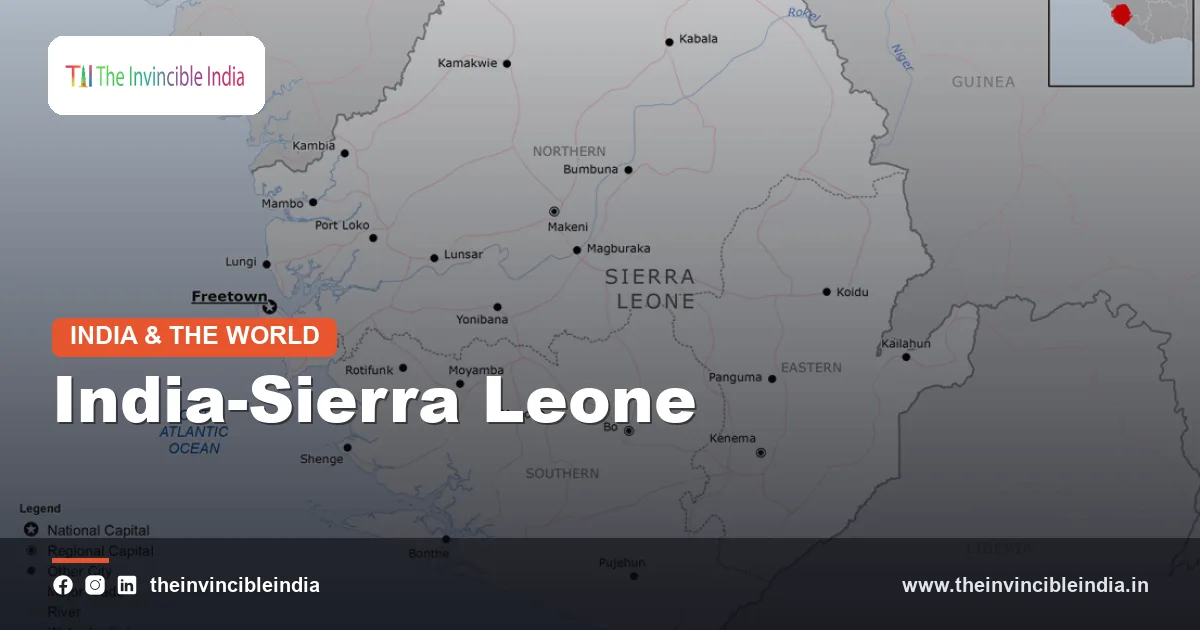
India-Sierra Leone relations are the bilateral political, development and people-to-people ties between the Republic of India and the Republic of Sierra Leone, a West African country whose recovery from civil war was supported by a large Indian peacekeeping presence in the United Nations mission UNAMSIL. The partnership is friendly and development-oriented, combining peacekeeping memories, Indian lines of credit, training programmes and trade, along with a small Indian-origin trading community.
India-Sierra Leone relations are shaped by shared Commonwealth membership, a common colonial-era legacy and India’s wider outreach to Africa under frameworks such as the India-Africa Forum Summit. The relationship is modest in trade value but carries considerable goodwill because of the Indian role during one of the UN’s most closely watched peace operations.
| Attribute | Detail |
|---|---|
| Sierra Leone independent since | 27 April 1961 (from British rule) |
| Capital of Sierra Leone | Freetown |
| Region | West Africa, on the Atlantic coast, bordering Guinea and Liberia |
| Population (approximate) | Around 8 million people |
| Civil war | 1991 to 2002, formally declared over in January 2002 |
| UN peacekeeping mission | United Nations Mission in Sierra Leone (UNAMSIL), 1999 to 2005 |
| Indian role in UNAMSIL | One of the largest contingents, including the rescue effort known as Operation Khukri in 2000 |
| Shared memberships | United Nations, Commonwealth, Non-Aligned Movement, Group of 77 |
| Main cooperation areas | Peacekeeping legacy, lines of credit, power and agriculture, capacity-building, trade |
Key Takeaways
- India-Sierra Leone relations were deepened by India’s large troop contribution to UNAMSIL, the United Nations mission that operated in Sierra Leone from 1999 to 2005.
- Operation Khukri in July 2000 was an Indian-led effort to relieve Indian peacekeepers besieged by rebel forces in eastern Sierra Leone and remains a well-known episode in Indian military history.
- India has extended concessional lines of credit to Sierra Leone for development projects, with sectors such as power and agriculture featuring in the cooperation.
- Sierra Leone is a beneficiary of Indian capacity-building programmes, notably Indian Technical and Economic Cooperation (ITEC) training and scholarships.
- A small community of Indian-origin traders and professionals lives in Sierra Leone, and Sierra Leoneans also study and seek medical care in India.
- Bilateral trade between India and Sierra Leone is modest and fluctuates, with Indian exports of pharmaceuticals, rice and machinery set against imports of commodities such as ores and diamonds.
What are India-Sierra Leone relations?
India-Sierra Leone relations are the formal and informal links between New Delhi and Freetown, which date to Sierra Leone’s independence in 1961 and have been strengthened since the end of the civil war in 2002. Both countries belong to the Commonwealth and the Non-Aligned Movement, and both have historically supported decolonisation and a more equitable international order.
India maintains a High Commission in Freetown, and Sierra Leone is represented in New Delhi, which allows regular political contact on development, trade and multilateral questions. The relationship has no significant disputes, and ministers from both sides have met on the sidelines of United Nations and India-Africa meetings.
The ties are anchored in practical cooperation. Instead of geopolitics, they are defined by the concrete areas where India can offer skills, finance and experience as a fellow developing country.
How did India become involved in Sierra Leone’s peace process?
India became involved in Sierra Leone’s peace process through its contribution of troops, military observers and officers to UNAMSIL, which the United Nations Security Council created in October 1999 to help implement a peace agreement ending the civil war. The mission grew to become one of the largest UN peacekeeping operations of its time, and India provided one of its biggest contingents.
Sierra Leone’s civil war began in 1991 when the Revolutionary United Front (RUF) launched an insurgency, and it became notorious for atrocities against civilians. Regional forces from the Economic Community of West African States (ECOWAS), led largely by Nigeria, intervened first through the ECOMOG force. A peace agreement was signed in Lome, Togo, in 1999, and UNAMSIL was created to support it.
Indian troops arrived in 1999 and operated in several parts of the country. Indian officers also held senior positions in the mission, and at different times Indian generals served as its Force Commander. The final UNAMSIL contingents withdrew by the end of 2005, after Sierra Leone held elections and began rebuilding its army and police.
What was Operation Khukri?
Operation Khukri was an Indian military operation in July 2000 to rescue roughly two hundred Indian peacekeepers who had been surrounded by RUF fighters at Kailahun in eastern Sierra Leone. The peacekeepers, drawn from an Indian infantry battalion, were besieged for weeks after the rebels attacked UN positions in May 2000.
The rescue involved Indian Army troops, including special forces, and support from helicopters in a difficult, forested environment. The besieged force was relieved without the heavy losses that many feared at the time, and the operation became a frequently cited example of Indian peacekeeping professionalism.
The episode also had a political side. It demonstrated that the UN mission could be tested by well-armed rebels, and it helped lead to a stronger mandate and reinforcement of UNAMSIL, which then supported the disarmament and demobilisation of former combatants. Accounts differ on the details, including exact numbers, and official histories and UN records provide the most reliable account.
What has been the Indian peacekeeping legacy in Sierra Leone?
The Indian peacekeeping legacy in Sierra Leone is a record of large-scale troop service, medical outreach and community projects that built lasting goodwill. India has been one of the largest and longest-serving troop contributors to UN peacekeeping worldwide, and Sierra Leone was among the missions where the Indian role was most visible.
Indian contingents provided security, supported disarmament, and conducted civic assistance such as medical camps and local infrastructure repair. Indian military engineers and doctors worked in towns where basic services had collapsed. Sierra Leoneans have often recalled this support when speaking about India.
The mission also had costs. Indian peacekeepers were killed or injured during UNAMSIL, and the country commemorates its United Nations peacekeepers through memorials and official events. The legacy continues in training links, since Sierra Leonean military and police personnel have attended courses in India.
What development cooperation does India provide to Sierra Leone?
India provides development cooperation to Sierra Leone through concessional lines of credit, grant projects, training under the ITEC programme and scholarships. Lines of credit are loans offered by the Export-Import Bank of India (EXIM Bank) on easy terms and funded in part by the Indian government, and they typically require Indian firms to execute the project work.
The credit lines extended to Sierra Leone have covered projects in sectors such as power, agriculture and information and communication technology, though specific amounts and progress vary by project and should be checked against official sources. Implementation challenges, including delays, cost changes and capacity limits, have affected some African projects of this kind.
Training and scholarships
Under ITEC and related schemes such as the Indian Council for Cultural Relations (ICCR) scholarships, Sierra Leonean civil servants, engineers, teachers and military personnel attend courses in India. These programmes cover fields ranging from agriculture and rural development to information technology and public administration.
Health and humanitarian assistance
India has supplied medicines and medical goods to Sierra Leone, and Indian pharmaceutical companies are major sources of affordable generic drugs across West Africa. During the Ebola outbreak that struck Sierra Leone, Guinea and Liberia in 2014 and 2015, India contributed supplies and financial support, as did many other countries.
How much trade is there between India and Sierra Leone?
Trade between India and Sierra Leone is modest, generally measured in the tens to low hundreds of millions of dollars in a given year, and it varies with commodity prices and shipments. Exact figures differ by source, so any specific number should be treated as indicative.
Indian exports to Sierra Leone usually include pharmaceuticals, rice and other foodstuffs, machinery, vehicles, plastics and textiles. Imports from Sierra Leone have included minerals and ores, wood, and sometimes cashew and other agricultural goods. Diamonds, a major Sierra Leonean export, are traded globally, and India is a large centre for diamond cutting and polishing.
Sierra Leone has large mineral reserves, including iron ore, bauxite and rutile, and its government seeks diversified investment. Indian companies have shown interest in sectors such as mining, agribusiness, pharmaceuticals and small-scale manufacturing, but total Indian investment remains limited compared with that of some other countries.
Who are the Indian-origin community in Sierra Leone?
The Indian-origin community in Sierra Leone is a small group of traders, professionals and long-term residents of Indian or South Asian descent. It is considerably smaller than the Lebanese-origin community, which has historically dominated much of Sierra Leone’s retail and trading economy.
Many Indian-origin residents are involved in commerce, import and distribution, construction supplies and small businesses. Some families have lived in the country for generations, while others arrived more recently on work contracts. Indian pharmaceutical, engineering and education professionals are also present.
The community is not large enough to be a decisive factor in bilateral politics, but it contributes to commercial links and acts as an informal bridge. Exact numbers are not widely published, and estimates vary.
How do the two countries cooperate in multilateral forums?
India and Sierra Leone cooperate in multilateral forums such as the United Nations, the Commonwealth and the India-Africa Forum Summit, where they generally support development-focused and reform-oriented positions. Sierra Leone, like other African states, has supported a reformed UN Security Council that gives more representation to developing regions, and it has voiced support for India’s claim to a permanent seat.
The third India-Africa Forum Summit, held in New Delhi in 2015, brought together leaders from all 54 African countries. Sierra Leone took part, and the summit’s declarations set priorities such as capacity-building, trade, agriculture, health and peacekeeping. Sierra Leone is also a member of the African Union and ECOWAS, which shape its regional policy.
India has additionally worked with African states on climate and energy through bodies such as the International Solar Alliance. Sierra Leone’s interest in clean energy makes this a potential growth area.
What is the current outlook and what challenges remain?
The outlook for India-Sierra Leone relations is steady and gradual growth in development cooperation and trade, though challenges include limited connectivity, small market size and competition from other partners. China, Gulf states, European countries and Turkey also seek influence in West Africa, so India often competes on the quality and affordability of its offer.
| Dimension | Strength | Limitation |
|---|---|---|
| Political | Goodwill from peacekeeping, Commonwealth ties | Few high-level visits compared with larger partners |
| Economic | Pharmaceuticals, rice and machinery exports | Small market and financing constraints |
| Development | Lines of credit, ITEC training and scholarships | Project delays and capacity limits |
| People-to-people | Students, patients and traders linking the countries | Limited direct flights and a small diaspora |
| Security | Training links with the military and police | Sierra Leone’s own security needs are now largely domestic |
Both sides have said they want to widen cooperation in agriculture, health, digital services and energy. Progress depends on financing, implementation quality and sustained political attention, which are not guaranteed.
Bottom Line
India-Sierra Leone relations rest on a strong foundation of goodwill from India’s UNAMSIL service, supported by development credits, training and modest trade. The partnership is cordial, free of disputes and likely to grow slowly, with outcomes depending on how well projects are delivered.
Frequently Asked Questions
What was India’s role in the UN mission in Sierra Leone?
India contributed one of the largest troop contingents to the UN Mission in Sierra Leone (UNAMSIL), which operated from 1999 to 2005. Indian soldiers, observers and senior officers helped enforce the peace agreement, supported disarmament and carried out civic assistance. Indian generals also served in the mission’s senior command at different points.
What was Operation Khukri?
Operation Khukri was the July 2000 Indian operation to rescue roughly two hundred Indian peacekeepers besieged by RUF rebels at Kailahun in eastern Sierra Leone. It involved Indian infantry, special forces and helicopter support. It is widely regarded as a notable example of Indian peacekeeping, though exact details vary between accounts.
Does India give financial assistance to Sierra Leone?
India provides concessional lines of credit through the Export-Import Bank of India (EXIM Bank) and some grant assistance to Sierra Leone. Projects have covered sectors such as power, agriculture and information technology. The amounts and implementation status differ by project, so official Indian government sources should be consulted for current details.
How much do India and Sierra Leone trade?
Trade between India and Sierra Leone is modest, typically in the tens to low hundreds of millions of dollars a year. Indian exports include pharmaceuticals, rice, machinery and vehicles, while imports from Sierra Leone have included ores, timber and some agricultural goods. Annual figures vary with commodity prices.
Are there Indians living in Sierra Leone?
A small community of Indian-origin traders and professionals lives in Sierra Leone. It is smaller than the Lebanese-origin community, and reliable numbers are not widely published. Some families have been there for generations, while others are recent arrivals in business, medicine and education.
Can Sierra Leoneans study in India?
Sierra Leoneans can study in India through scholarships such as ICCR awards and training under the ITEC programme, as well as by enrolling privately. Courses range from short professional training to full degrees. These programmes are one of the most direct people-to-people links between the two countries.
{“@context”:”https://schema.org”,”@graph”:[{“@type”:”FAQPage”,”mainEntity”:[{“@type”:”Question”,”name”:”What was India’s role in the UN mission in Sierra Leone?”,”acceptedAnswer”:{“@type”:”Answer”,”text”:”India contributed one of the largest troop contingents to the UN Mission in Sierra Leone (UNAMSIL), which operated from 1999 to 2005. Indian soldiers, observers and senior officers helped enforce the peace agreement, supported disarmament and carried out civic assistance. Indian generals also served in the mission’s senior command at different points.”}},{“@type”:”Question”,”name”:”What was Operation Khukri?”,”acceptedAnswer”:{“@type”:”Answer”,”text”:”Operation Khukri was the July 2000 Indian operation to rescue roughly two hundred Indian peacekeepers besieged by RUF rebels at Kailahun in eastern Sierra Leone. It involved Indian infantry, special forces and helicopter support. It is widely regarded as a notable example of Indian peacekeeping, though exact details vary between accounts.”}},{“@type”:”Question”,”name”:”Does India give financial assistance to Sierra Leone?”,”acceptedAnswer”:{“@type”:”Answer”,”text”:”India provides concessional lines of credit through the Export-Import Bank of India (EXIM Bank) and some grant assistance to Sierra Leone. Projects have covered sectors such as power, agriculture and information technology. The amounts and implementation status differ by project, so official Indian government sources should be consulted for current details.”}},{“@type”:”Question”,”name”:”How much do India and Sierra Leone trade?”,”acceptedAnswer”:{“@type”:”Answer”,”text”:”Trade between India and Sierra Leone is modest, typically in the tens to low hundreds of millions of dollars a year. Indian exports include pharmaceuticals, rice, machinery and vehicles, while imports from Sierra Leone have included ores, timber and some agricultural goods. Annual figures vary with commodity prices.”}},{“@type”:”Question”,”name”:”Are there Indians living in Sierra Leone?”,”acceptedAnswer”:{“@type”:”Answer”,”text”:”A small community of Indian-origin traders and professionals lives in Sierra Leone. It is smaller than the Lebanese-origin community, and reliable numbers are not widely published. Some families have been there for generations, while others are recent arrivals in business, medicine and education.”}},{“@type”:”Question”,”name”:”Can Sierra Leoneans study in India?”,”acceptedAnswer”:{“@type”:”Answer”,”text”:”Sierra Leoneans can study in India through scholarships such as ICCR awards and training under the ITEC programme, as well as by enrolling privately. Courses range from short professional training to full degrees. These programmes are one of the most direct people-to-people links between the two countries.”}}]}]}


