

India-Honduras relations are the bilateral diplomatic, economic and multilateral ties between the Republic of India and the Republic of Honduras, a Central American country of roughly 10 million people, built on modest but growing trade, shared positions at the United Nations and an emerging agenda on climate and renewable energy. The relationship has no history of dispute, and it has been shaped less by geography than by the steady expansion of India’s engagement with Latin America and the Caribbean.
For most of their shared history, India and Honduras dealt with each other through non-resident diplomatic accreditation and occasional ministerial contact. In recent years, the move towards resident embassies, rising Indian exports of medicines, vehicles and textiles, and cooperation on climate platforms such as the International Solar Alliance (ISA) have given the relationship a clearer shape. This explainer sets out what is established, what is still developing and where figures are only approximate.
Quick Facts
| Attribute | Detail |
|---|---|
| Countries | Republic of India and Republic of Honduras |
| Type of relationship | Bilateral diplomatic, trade and development partnership |
| Region | South Asia (India) and Central America (Honduras) |
| Honduran capital and currency | Tegucigalpa; lempira (HNL) |
| Indian nodal ministry | Ministry of External Affairs (MEA), Latin America and Caribbean division |
| Main Indian exports | Pharmaceuticals, vehicles and motorcycles, textiles and apparel |
| Main Honduran exports | Coffee, bananas, palm oil, shrimp, apparel and minerals (in small volumes to India) |
| Key multilateral overlaps | United Nations, climate negotiations, International Solar Alliance outreach |
| Scale of trade | Small in absolute terms (well under one billion US dollars a year), with India usually the larger exporter |
Key Takeaways
- India-Honduras relations are friendly and free of bilateral disputes, with cooperation concentrated on trade, capacity-building, the United Nations and climate action.
- Honduras is a Central American republic with a Caribbean coastline and a short Pacific coast on the Gulf of Fonseca, and it gained independence from Spain in 1821.
- India’s exports to Honduras are led by pharmaceuticals, vehicles and textiles, while the trade balance has generally favoured India.
- The establishment of resident embassies is the most important institutional step in the relationship, because it replaces non-resident accreditation with a permanent diplomatic presence.
- Honduras is highly exposed to hurricanes, drought and climate shocks, which makes India’s work on solar energy and disaster-resilient infrastructure relevant to the partnership.
- The main limits on India-Honduras relations are distance, small market size, limited direct shipping and low mutual awareness rather than any political friction.
What Are India-Honduras Relations?
India-Honduras relations are the formal links between New Delhi and Tegucigalpa, covering diplomacy, commerce, development cooperation and coordination in international organisations. They are classified within India’s wider Latin America and Caribbean outreach, which the Ministry of External Affairs has expanded since the 1990s through trade fairs, line-of-credit diplomacy, training slots and high-level visits.
The relationship is asymmetric in size but not in goodwill. India is the world’s most populous country and one of its largest economies, while Honduras is a small, lower-middle-income economy with heavy dependence on agriculture, apparel assembly and remittances. Because neither side has a conflicting claim on the other, the ties are best described as cordial and opportunity-driven.
Three pillars define the partnership. The first is trade, led by Indian manufactured goods. The second is multilateral coordination, especially at the United Nations. The third is a newer agenda on climate resilience and clean energy, where Honduran vulnerability meets Indian institutional offers.
Where Is Honduras and Why Does It Matter to India?
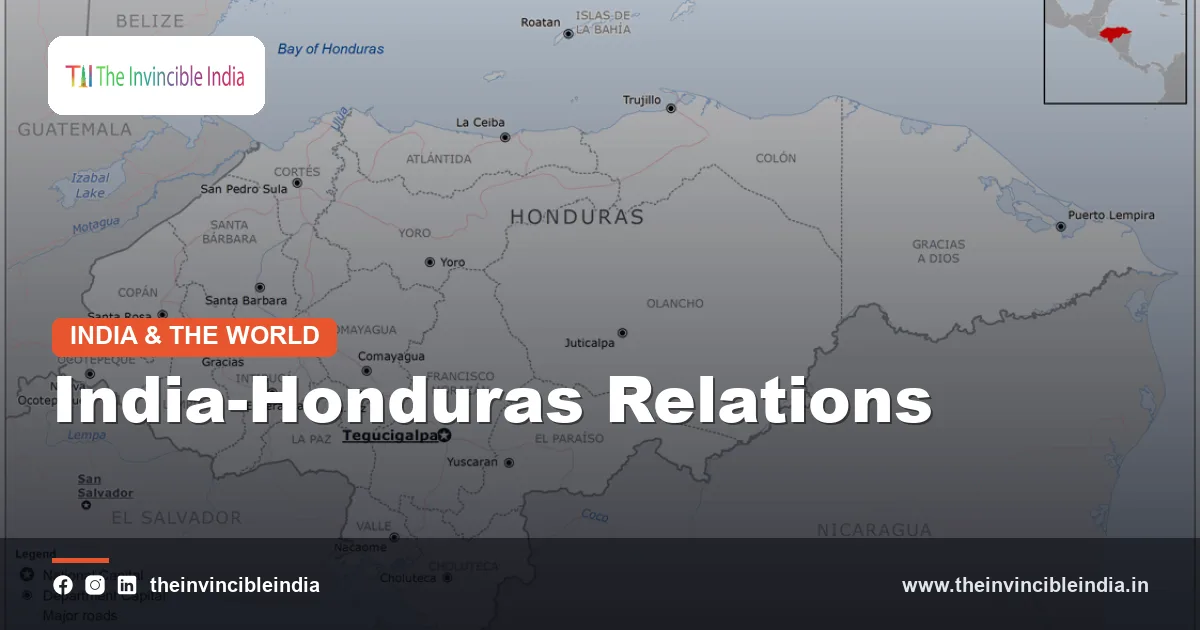
Honduras is a Central American country bordered by Guatemala, El Salvador and Nicaragua, with a long Caribbean coast and a short Pacific outlet on the Gulf of Fonseca. Its capital is Tegucigalpa, its official language is Spanish and its currency is the lempira, named after a sixteenth-century indigenous leader.
Honduras matters to India for three reasons. First, it is part of the Central American market, a region India often treats as a cluster for trade promotion. Second, Honduras is a member of the United Nations and of regional groupings such as the Central American Integration System (SICA), so it carries a vote and a voice in the forums where India seeks support. Third, Honduras is a case study of the climate vulnerability that India raises in global talks on adaptation and finance.
Honduras also has trade links of its own that shape what India can sell there. The country belongs to a free trade arrangement with the United States and Central American neighbours, which makes American goods price-competitive, and Indian exporters therefore compete mainly on cost in medicines, motorcycles and fabrics.
How Did India-Honduras Relations Develop?
India-Honduras relations developed in stages from formal recognition after Indian independence, through decades of low-intensity contact, to a more active phase in the twenty-first century. India became independent in 1947 and Honduras had been independent since 1821, so the two entered the post-war United Nations system as sovereign members with no colonial or territorial baggage between them.
Diplomatic ties were established in the decades after Indian independence, and for a long time the relationship ran through accreditation from other capitals in the region rather than a resident mission. Contact picked up as India widened its outreach to Latin America and the Caribbean through trade promotion programmes, technical training and the Indian Technical and Economic Cooperation (ITEC) scheme.
A simplified timeline
| Period | Development |
|---|---|
| 1821 | Honduras becomes independent of Spain as part of the wider Central American independence movement. |
| 1947 | India becomes independent and begins building diplomatic relations across Latin America. |
| Mid-twentieth century | Formal diplomatic relations are established, with accreditation largely handled from other regional capitals. |
| 1990s | India’s economic liberalisation opens new export channels, and outreach to Latin America is formalised. |
| 2000s-2010s | ITEC training slots, visits and participation in joint United Nations positions expand contact. |
| Recent years | Both sides move to open or strengthen resident embassies, and climate and solar cooperation enter the agenda. |
Exact dates of individual agreements and visits should be checked against official Ministry of External Affairs records, because ministerial schedules and mission openings change from year to year.
What Does India Trade With Honduras?
India exports pharmaceuticals, vehicles and textiles to Honduras, and it imports a smaller range of agricultural and mineral products. India’s pharmaceutical sector, often described as the pharmacy of the developing world, supplies affordable generic medicines that suit the budget of Honduran public and private buyers.
Indian motorcycles, scooters and light vehicles are visible on Central American roads, and Honduras has a large two-wheeler market where Indian brands compete on price and fuel economy. Indian cotton yarn, fabrics and made-ups also reach the country, partly feeding Honduras’s own apparel assembly sector, which exports mainly to the United States.
Main trade flows
| Direction | Typical goods | Comment |
|---|---|---|
| India to Honduras | Pharmaceutical formulations, motorcycles and vehicles, textiles and yarn, machinery parts, chemicals | Largest share of bilateral trade; led by medicines and vehicles |
| Honduras to India | Agricultural items, minerals and selected commodities in small quantities | Volumes remain low and vary year to year |
| Services | Training, IT and consultancy offers through Indian programmes | Mostly capacity-building rather than commercial exports |
The total value of trade has fluctuated and is better described by order of magnitude than by a single figure. It has been in the range of tens to low hundreds of millions of US dollars in many recent years, which is a small fraction of India’s trade with larger Latin American partners such as Brazil, Mexico or Argentina.
How Do Embassies and Diplomatic Missions Work Between India and Honduras?
Embassies in each other’s capitals allow India and Honduras to maintain permanent diplomatic channels, issue visas, promote trade and serve citizens abroad. For many years, India covered Honduras from a mission elsewhere in the region, with the ambassador accredited non-resident, which limited the number of visits and the speed of follow-up.
The opening of resident embassies is therefore significant. A resident mission can hold regular meetings with Honduran ministries, organise business delegations, manage scholarships and training offers under ITEC and support the small Indian community. Honduras, in turn, benefits from having a direct diplomatic address in New Delhi, where it can engage the Ministry of External Affairs, trade bodies and multilateral organisations.
Readers should treat the current staffing and exact opening dates of missions as matters for official notices from the Ministry of External Affairs and the Honduran foreign ministry. In diplomatic practice, a non-resident accreditation can be converted to a resident one, and honorary consuls can supplement a mission, so the level of representation may change over time.
How Do India and Honduras Cooperate at the United Nations?
India and Honduras cooperate at the United Nations through mutual support on resolutions, elections and development issues, and both countries belong to the wider group of developing states that emphasise sovereign equality and sustainable development. Honduras was a founding member of the United Nations in 1945, and India joined at the same time as a British-ruled territory before becoming an independent member in 1947.
Cooperation takes several forms:
- Voting support for each other’s candidatures to United Nations bodies, which is a regular feature of Latin American and Asian diplomacy.
- Shared interest in reform of multilateral institutions and a more representative Security Council, a theme on which India has sought wide support.
- Coordination in the General Assembly on development finance, humanitarian response and the Sustainable Development Goals (SDGs).
- Joint participation in international conferences on climate, disaster risk and health.
Because Honduras also participates in Latin American and Caribbean groupings such as the Community of Latin American and Caribbean States (CELAC), India often engages it as part of collective dialogues with the region rather than in purely bilateral settings.
What Is the Climate and International Solar Alliance Connection?
The climate link between India and Honduras rests on Honduras’s high exposure to extreme weather and India’s leadership of the International Solar Alliance (ISA), a treaty-based organisation headquartered in Gurugram, India. The ISA was launched by India and France at the 2015 Paris climate conference and operates under a Framework Agreement that entered into force in December 2017.
Honduras sits in the Central American Dry Corridor, where drought and erratic rainfall affect smallholder farmers, and it has repeatedly been struck by hurricanes, including the devastating Hurricane Mitch in 1998 and the Eta and Iota storms of 2020. These events have raised the importance of resilience, early warning and decentralised energy.
India’s offers relevant to this agenda include:
- The International Solar Alliance, which promotes solar deployment, finance and technical assistance for member countries, mainly in the tropics.
- The Coalition for Disaster Resilient Infrastructure (CDRI), an Indian-led platform launched in 2019 to help countries build resilient infrastructure.
- The Global Biofuels Alliance, launched during India’s 2023 G20 presidency, and the broader International Solar Alliance training programmes.
The ISA has been opened to all United Nations member states, and many Latin American and Caribbean governments have engaged with it. Honduras’s formal status in each of these bodies should be verified from the organisations’ own membership lists, as accessions change over time.
What Development and Capacity-Building Cooperation Exists?
India-Honduras development cooperation consists mainly of training, scholarships and technical exchanges offered under Indian government programmes rather than large infrastructure lending. The flagship channel is the Indian Technical and Economic Cooperation (ITEC) programme, through which Honduran civil servants, engineers and professionals can attend short and medium courses in India.
Typical areas of cooperation include:
- Public administration, e-governance and digital public infrastructure, where India’s experience with identity and payment systems attracts interest.
- Agriculture and food processing, including climate-resilient farming and post-harvest management.
- Health, with generic medicines and public health training.
- Renewable energy, small-scale solar and disaster management.
The scale of such programmes is modest compared with India’s engagement in Africa or neighbouring South Asian states. The relationship benefits, however, from the low cost and flexibility of training offers, which continue even when trade is small.
Who Are the Indian Community and People-to-People Links?
The Indian community in Honduras is very small, and people-to-people links rest mainly on a handful of resident Indian businesses, students, volunteers and cultural interest in yoga, Bollywood and Indian cuisine. Honduras is not a major destination for Indian migrants or tourists, and Indian tourism to Central America is a niche segment compared with Europe or Southeast Asia.
Cultural diplomacy therefore relies on events organised by embassies, yoga days, film screenings and academic exchanges. India’s International Day of Yoga, endorsed by the United Nations in 2014, is celebrated in many Latin American capitals, and it is one of the most visible soft-power tools in the region. Language is also a factor: Spanish dominates in Honduras, so Spanish-language Indian studies programmes and translation initiatives help to build mutual familiarity.
What Are the Challenges in India-Honduras Relations?
The main challenges in India-Honduras relations are geographic distance, the small size of the two-way market, limited direct shipping and flights, and low public awareness in each country. Goods travel long routes, often via transshipment hubs, which raises freight costs and delivery times for Indian exporters.
Additional constraints include:
- Strong competition from United States and Mexican suppliers who benefit from regional trade agreements and proximity.
- Lack of a bilateral trade agreement or preferential tariff arrangement, which means Indian goods generally pay normal tariffs.
- Regulatory hurdles in registering pharmaceuticals and vehicles for the Honduran market.
- Security, governance and political volatility in parts of Central America, which can affect investor confidence.
These are structural issues rather than disagreements between governments, and they can be eased through a stronger resident diplomatic presence, trade fairs, and agreements on customs and regulatory cooperation.
What Is the Outlook for India-Honduras Relations?
The outlook for India-Honduras relations is of gradual, incremental growth, anchored in resident embassies, a broader pharmaceutical and automotive trade basket and cooperation on climate resilience. No dramatic shift is expected, since both governments have limited bandwidth and many competing priorities.
Areas with the clearest potential include:
- Pharmaceutical and medical device regulation, where recognition of Indian quality standards could widen market access.
- Renewable energy projects supported through ISA mechanisms and development finance.
- Agricultural trade, including Indian imports of Honduran specialty products and Indian technology for smallholder farmers.
- Digital public goods, in which India offers low-cost platforms for identity, payments and service delivery.
Any projection should be treated cautiously, because trade values, project announcements and diplomatic arrangements are updated by governments regularly. The page was last reviewed on 22 October 2026.
Bottom Line
India-Honduras relations are friendly, low-key and trade-led, with Indian medicines, vehicles and textiles at the centre and the United Nations and climate platforms providing common ground. The move to resident embassies and the shared interest in disaster resilience and solar energy give the partnership room to grow, even though distance and market size will keep its scale modest.
Frequently Asked Questions
What are India-Honduras relations?
India-Honduras relations are the bilateral diplomatic, trade and development ties between India and the Central American republic of Honduras. They are cordial, free of disputes and centred on trade in pharmaceuticals, vehicles and textiles, as well as cooperation at the United Nations. In recent years the relationship has also expanded to include climate, solar energy and training programmes.
What does India export to Honduras?
India mainly exports pharmaceuticals, vehicles and motorcycles, and textiles to Honduras. Generic medicines are especially competitive on price, and Indian two-wheelers have a visible market share in Central America. Smaller flows include chemicals, machinery parts and yarn, and the total value is modest compared with India’s trade with larger Latin American economies.
Does India have an embassy in Honduras?
India and Honduras have moved towards resident embassies in each other’s capitals, replacing the older practice of non-resident accreditation from other regional capitals. A resident mission supports trade promotion, visas, training programmes and political dialogue. The exact opening dates and staffing should be confirmed on the Ministry of External Affairs website, because mission arrangements are updated from time to time.
How do India and Honduras cooperate on climate and solar energy?
India and Honduras cooperate on climate through shared interest in the International Solar Alliance, disaster-resilient infrastructure and adaptation to extreme weather. Honduras is highly exposed to hurricanes and drought, while India leads the ISA from its headquarters in Gurugram and offers technical assistance and training. Formal membership status in specific bodies should be checked against the organisations’ official lists.
Is there a free trade agreement between India and Honduras?
No broad free trade agreement between India and Honduras is generally recognised, so most Indian exports face normal Honduran tariffs. Honduras is part of a free trade arrangement with the United States and Central American neighbours, which gives competing suppliers an advantage. Any future preferential arrangement would require negotiations through the respective trade ministries.
Why does Honduras matter to India?
Honduras matters to India because it is a United Nations member whose support counts in multilateral forums, a small but real export market and a partner in climate-resilience diplomacy. It also forms part of India’s wider outreach to Central America and the Caribbean. The relationship is modest in scale but strategically useful as India diversifies its partnerships in Latin America.
{“@context”:”https://schema.org”,”@graph”:[{“@type”:”FAQPage”,”mainEntity”:[{“@type”:”Question”,”name”:”What are India-Honduras relations?”,”acceptedAnswer”:{“@type”:”Answer”,”text”:”India-Honduras relations are the bilateral diplomatic, trade and development ties between India and the Central American republic of Honduras. They are cordial, free of disputes and centred on trade in pharmaceuticals, vehicles and textiles, as well as cooperation at the United Nations. In recent years the relationship has also expanded to include climate, solar energy and training programmes.”}},{“@type”:”Question”,”name”:”What does India export to Honduras?”,”acceptedAnswer”:{“@type”:”Answer”,”text”:”India mainly exports pharmaceuticals, vehicles and motorcycles, and textiles to Honduras. Generic medicines are especially competitive on price, and Indian two-wheelers have a visible market share in Central America. Smaller flows include chemicals, machinery parts and yarn, and the total value is modest compared with India’s trade with larger Latin American economies.”}},{“@type”:”Question”,”name”:”Does India have an embassy in Honduras?”,”acceptedAnswer”:{“@type”:”Answer”,”text”:”India and Honduras have moved towards resident embassies in each other’s capitals, replacing the older practice of non-resident accreditation from other regional capitals. A resident mission supports trade promotion, visas, training programmes and political dialogue. The exact opening dates and staffing should be confirmed on the Ministry of External Affairs website, because mission arrangements are updated from time to time.”}},{“@type”:”Question”,”name”:”How do India and Honduras cooperate on climate and solar energy?”,”acceptedAnswer”:{“@type”:”Answer”,”text”:”India and Honduras cooperate on climate through shared interest in the International Solar Alliance, disaster-resilient infrastructure and adaptation to extreme weather. Honduras is highly exposed to hurricanes and drought, while India leads the ISA from its headquarters in Gurugram and offers technical assistance and training. Formal membership status in specific bodies should be checked against the organisations’ official lists.”}},{“@type”:”Question”,”name”:”Is there a free trade agreement between India and Honduras?”,”acceptedAnswer”:{“@type”:”Answer”,”text”:”No broad free trade agreement between India and Honduras is generally recognised, so most Indian exports face normal Honduran tariffs. Honduras is part of a free trade arrangement with the United States and Central American neighbours, which gives competing suppliers an advantage. Any future preferential arrangement would require negotiations through the respective trade ministries.”}},{“@type”:”Question”,”name”:”Why does Honduras matter to India?”,”acceptedAnswer”:{“@type”:”Answer”,”text”:”Honduras matters to India because it is a United Nations member whose support counts in multilateral forums, a small but real export market and a partner in climate-resilience diplomacy. It also forms part of India’s wider outreach to Central America and the Caribbean. The relationship is modest in scale but strategically useful as India diversifies its partnerships in Latin America.”}}]}]}


