

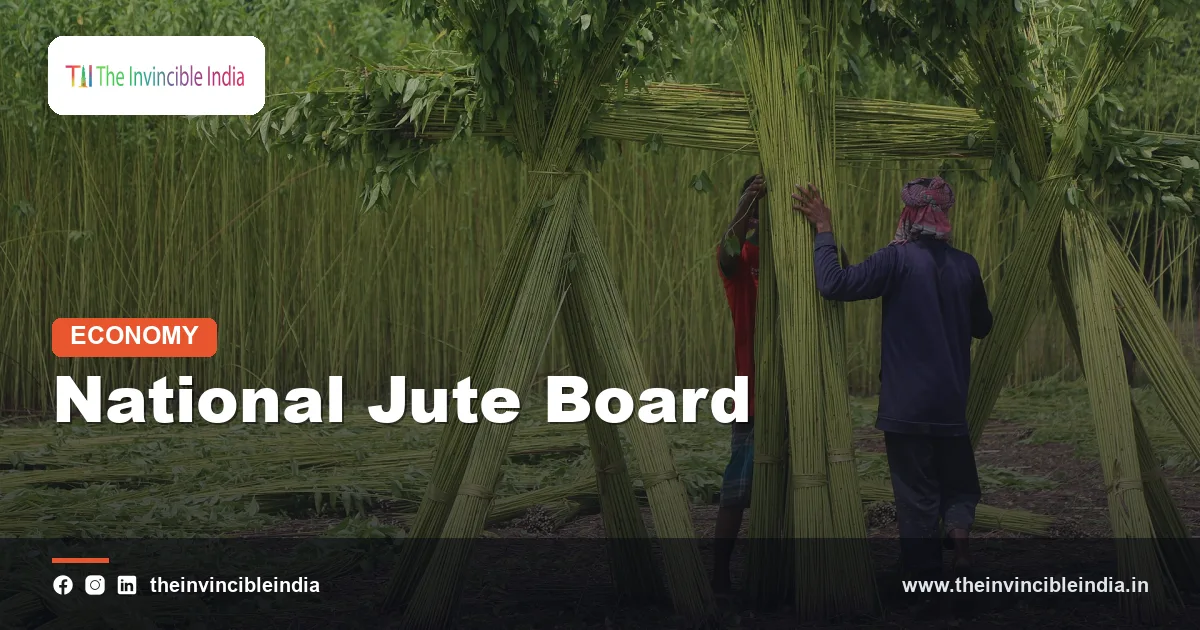
The National Jute Board (NJB) is a statutory body of the Government of India, headquartered in Kolkata and functioning under the Ministry of Textiles, that promotes the growth of India’s jute sector from the farm to the factory to the export market. The Board was constituted under the National Jute Board Act, 2008, began functioning in 2010, and works for a country that is the world’s largest producer of raw jute.
The National Jute Board supports jute growers with better seed and retting practices, helps mills modernise, promotes new products beyond traditional sacking, and represents the industry in export promotion. This explainer describes how the Board was formed, what it does, how the compulsory jute packaging norms work and why jute remains important to eastern India. It was last reviewed on 22 October 2026.
| Attribute | Details |
|---|---|
| Full name | National Jute Board (NJB) |
| Legal basis | National Jute Board Act, 2008 |
| Started functioning | 2010 |
| Headquarters | Kolkata, West Bengal |
| Administrative ministry | Ministry of Textiles, Government of India |
| Predecessor body | Jute Manufactures Development Council (JMDC), set up in the 1980s |
| Main mandate | Development of raw jute, jute manufacturing, product diversification, research, training and exports |
| India’s position in jute | World’s largest producer of raw jute, with Bangladesh as the leading exporter of raw jute and a close competitor in goods |
Key Takeaways
- The National Jute Board is a statutory body established under the National Jute Board Act, 2008, and it began functioning in 2010 from its headquarters in Kolkata.
- The National Jute Board works under the Ministry of Textiles and replaced the earlier Jute Manufactures Development Council.
- India is the world’s largest producer of jute, and West Bengal alone accounts for the greater part of the country’s raw jute output.
- The Jute Packaging Materials (Compulsory Use in Packing Commodities) Act, 1987 requires certain foodgrains and sugar to be packed in jute bags, which creates a large assured domestic market.
- Jute Diversified Products (JDP) such as bags, home furnishings, geotextiles and handicrafts are a key focus of the National Jute Board’s promotion work.
- The National Jute Board runs programmes for farmers, such as improved retting and quality seed support, and helps exporters through fairs, market studies and branding.
What is the National Jute Board?
The National Jute Board is a government-established organisation whose purpose is to develop and promote the jute industry in India. It is a statutory body, meaning it derives its powers and structure from an Act of Parliament, and it is administered by the Ministry of Textiles through its Chairman, a Secretary and a board of members representing the government, growers, mills, traders and experts.
The Board’s remit covers the full jute value chain: raw jute cultivation, fibre quality, processing, manufacture of yarn and fabrics, product design, market development and exports. In practice, the NJB acts as the sector’s coordinating agency, funding schemes, running training programmes, supporting technology upgrades and advising the central government on policy.
How was the National Jute Board formed?
The National Jute Board was formed by the National Jute Board Act, 2008, which created a single statutory body to take over the functions of the earlier Jute Manufactures Development Council (JMDC). The Board began functioning in 2010, with its seat at Kolkata, the historic centre of the jute trade.
The JMDC had been set up in the early 1980s as a promotional body for jute manufacturing, funded through a levy on jute goods. The 2008 Act widened the mandate to cover raw jute as well as manufactured goods, and gave the new Board a firm statutory footing, a defined governing structure and a clearer role in development, promotion and advice.
Why did India need a statutory jute board?
- Jute is an agricultural crop and an industrial raw material, so growers and mills share a common interest but face different problems.
- A single body could coordinate research, training, and market development across both sides of the chain.
- Competition from synthetic packaging and from other jute-producing countries required a sustained promotional effort.
- Many jute households are small and marginal farmers, who benefit from structured extension support.
What does the National Jute Board do?
The National Jute Board carries out functions in five broad areas: supporting growers, modernising mills, developing diversified products, building markets and advising the government. These functions are carried out through its headquarters, regional offices and partnerships with research institutes and state governments.
- Advises the central government on policies for raw jute, jute goods and related trade matters.
- Supports improvement of jute productivity, fibre quality and retting techniques.
- Promotes technology upgrading and modernisation among jute mills and small units.
- Develops and promotes jute diversified products, including through design and product-development centres.
- Organises training and skill-development programmes for farmers, artisans and entrepreneurs.
- Supports domestic marketing and exports through trade fairs, buyer-seller meets and branding.
- Collects data and publishes information on jute production, prices and trade.
Why is jute called the golden fibre, and where is it grown?
Jute is called the “golden fibre” because of its natural golden-brown shine and because it has long been one of eastern India’s most valuable cash crops. Jute is a bast fibre taken from the stem of plants of the genus Corchorus, mainly white jute (Corchorus capsularis) and tossa jute (Corchorus olitorius).
Jute grows best in warm, humid conditions with plenty of rainfall and alluvial soil, which is why it is concentrated in the Ganga-Brahmaputra delta region. The crop is sown in spring, harvested around the monsoon and then “retted” in water so that the fibre can be separated from the stalk.
| State | Role in jute |
|---|---|
| West Bengal | Largest producing state, with the bulk of India’s raw jute and most of the jute mills along the Hooghly river |
| Bihar | Second major producer, especially in the north-eastern districts such as Purnea, Katihar and Araria |
| Assam | Significant production in the Brahmaputra valley |
| Odisha, Andhra Pradesh, Tripura and Meghalaya | Smaller producing states with localised cultivation |
Jute cultivation supports several million farming families, and jute mills and related trades employ a large workforce, mostly in West Bengal. The exact figures vary by year and by source, so they are best read as approximate.
What are the jute packaging norms?
The jute packaging norms are rules under the Jute Packaging Materials (Compulsory Use in Packing Commodities) Act, 1987 that require specified commodities to be packed in jute materials. The Act exists to protect the jute industry by guaranteeing demand and to give farmers a stable market for raw jute.
Under the Act, the central government issues reservation orders that specify which commodities and what proportion of production must be packed in jute. Foodgrains such as rice and wheat have historically been reserved for jute packaging in full, while sugar has been reserved at a lower share, and the norms are reviewed periodically. The government sources jute bags for foodgrain procurement through its agencies, making it by far the largest buyer of the industry.
Why are the norms controversial and why do they persist?
- Supporters argue that the norms protect millions of jute workers and farmers and promote a renewable, biodegradable material.
- Critics point out that mandatory use can raise costs for packers and limit choice, particularly when jute supply or prices fluctuate.
- The norms are therefore revisited from time to time, with the government balancing the needs of growers, mills and users of packaging.
The National Jute Board does not itself frame the reservation orders, but it contributes data, analysis and industry inputs that help the Ministry of Textiles and other departments to decide on them.
What are Jute Diversified Products (JDP)?
Jute Diversified Products, or JDP, are jute items other than traditional sacking and hessian, including bags, home furnishings, floor coverings, fashion accessories, geotextiles, composites and handicrafts. JDP is a priority area for the National Jute Board because sacking demand is limited by the packaging norms and competition from synthetics, while diversified products can reach new and higher-value markets.
| JDP category | Examples |
|---|---|
| Bags and accessories | Shopping bags, promotional bags, wine bags, fashion bags, wallets |
| Home furnishing | Carpets, rugs, curtains, cushion covers, table linen |
| Floor and wall coverings | Jute mats, wall panels, decorative fabrics |
| Technical textiles | Jute geotextiles for soil erosion control, road construction and embankments |
| Composites and others | Jute-reinforced boards, paper, stationery and handicrafts |
Jute geotextiles in particular are valued in civil engineering because they are biodegradable, strong when wet and inexpensive for erosion control on slopes and river banks. The NJB has worked with road-building agencies, state governments and research institutes to demonstrate such uses.
How does the National Jute Board help farmers?
The National Jute Board helps farmers mainly by supporting better cultivation practices, quality seed and improved retting, which together raise yield and fibre quality. One of its best-known farmer-focused efforts is the Jute ICARE programme (Improved Cultivation and Advanced Retting Exercise), which promotes line sowing, use of simple weeders and microbial retting to shorten the time and improve the quality of the fibre.
The Board works with research institutions, notably the ICAR institute at Barrackpore that focuses on jute and allied fibres, to develop and disseminate improved crop varieties. It also conducts field demonstrations, farmer training and awareness programmes in major jute districts.
- Distribution or promotion of certified seed of improved varieties.
- Training in line sowing, weeding, harvesting and retting.
- Promotion of microbial consortia that speed up retting and give cleaner fibre.
- Information on prices and market access.
Raw jute price support is a separate government mechanism. The Union cabinet announces a minimum support price (MSP) for raw jute on the recommendation of the Commission for Agricultural Costs and Prices, and the Jute Corporation of India, a public sector agency, undertakes price-support operations when market prices fall below the MSP.
How does the National Jute Board support exports?
The National Jute Board supports exports by organising participation in international trade fairs, arranging buyer-seller meets, commissioning market studies and promoting a unified identity for Indian jute products. Exports include hessian, sacking, yarn and diversified products such as bags, carpets and floor coverings, sent to destinations in Europe, North America, the Middle East and other regions.
The Board has also promoted quality marks and branding, including a “Jute Mark” initiative intended to help buyers recognise genuine jute products. In addition, the Ministry of Textiles has used online platforms to improve the transparency of government purchases of jute bags, and the NJB has helped small producers register and access such channels.
Global interest in sustainable and plastic-free packaging is a tailwind for the sector, although exporters also face competition from Bangladesh, which is a leading supplier of jute goods, and from lower-cost synthetic materials. Trade-remedy measures such as anti-dumping duties on certain jute products from neighbouring countries have also shaped the market from time to time.
Who governs the National Jute Board?
The National Jute Board is governed by a Chairman and a body of members appointed by the central government, with a Secretary managing day-to-day affairs. The Chairman is appointed by the Government of India and the Board draws members from the Ministry of Textiles, other central ministries, state governments, parliament, jute growers, mills, traders and workers’ organisations.
The Board is financed mainly through government grants and, in earlier arrangements, through a levy on jute goods that funded its predecessor. It operates regional or field offices in jute-producing areas and runs programmes in association with the Ministry of Textiles, the Ministry of Agriculture and state agencies.
Related bodies in the jute ecosystem include the Jute Commissioner’s Organisation, which handles statutory regulation and statistics, the Jute Corporation of India for price support and procurement, and the Indian Jute Mills Association (IJMA), a trade body of mills. Understanding these distinctions helps avoid confusing the roles of each organisation.
What challenges does the jute sector face?
The jute sector faces challenges from competition with synthetic packaging, fluctuating raw jute prices, ageing mills and the shortage of good retting water. Each of these affects the livelihood of small growers as well as the profitability of mills.
- Competition from polypropylene and other synthetic packaging, which is cheaper in many uses.
- Volatile raw jute prices, which can hurt either growers or mills depending on the year.
- Old machinery in many mills, requiring modernisation to improve productivity and quality.
- Declining water availability for retting and the labour intensity of the process.
- Heavy dependence on government orders for jute bags, which links the industry to procurement cycles.
- Competition from Bangladesh and other producers in export markets.
The National Jute Board’s emphasis on diversification, technology and quality is meant to reduce dependence on sacking and to widen the sector’s market base over the long term.
Bottom Line
The National Jute Board is the statutory body that develops India’s jute sector from its Kolkata headquarters, working under the Ministry of Textiles since 2010. Its mix of farmer support, mill modernisation, diversified product promotion and export marketing aims to keep jute competitive as a natural, biodegradable fibre in a world increasingly looking for sustainable materials.
Frequently Asked Questions
What is the National Jute Board?
The National Jute Board is a statutory body of the Government of India that develops and promotes the jute sector. It was created under the National Jute Board Act, 2008, began functioning in 2010 and is headquartered in Kolkata. It works under the Ministry of Textiles and replaced the earlier Jute Manufactures Development Council.
Which ministry controls the National Jute Board?
The National Jute Board functions under the Ministry of Textiles, Government of India. The Ministry appoints the Chairman and nominates members, and it provides the Board with most of its funding. The Board also works with the Ministry of Agriculture, state governments and research institutes on farmer-focused programmes.
Is India the largest producer of jute?
Yes, India is the world’s largest producer of raw jute, with West Bengal contributing the largest share of the national output. Bihar, Assam, Odisha and a few other states also grow jute. Bangladesh is the other major jute country and is a leading exporter of raw jute and jute goods.
What are the mandatory jute packaging norms?
The mandatory jute packaging norms are reservation orders issued under the Jute Packaging Materials (Compulsory Use in Packing Commodities) Act, 1987. They require specified commodities, such as foodgrains and sugar, to be packed in jute bags in stated proportions. The government reviews the norms periodically, and they guarantee a large domestic market for jute mills.
What are Jute Diversified Products?
Jute Diversified Products, or JDP, are jute items other than traditional sacking and hessian. They include bags, carpets, home furnishings, geotextiles, composites, fashion accessories and handicrafts. The National Jute Board promotes JDP to create higher-value markets and reduce dependence on packaging demand.
How does the National Jute Board help jute farmers?
The National Jute Board helps jute farmers through training, quality seed support and programmes such as Jute ICARE, which promotes line sowing and microbial retting. These practices aim to raise yield and fibre quality, which in turn improves farm income. Raw jute price support is handled separately through the minimum support price system and the Jute Corporation of India.
{“@context”:”https://schema.org”,”@graph”:[{“@type”:”FAQPage”,”mainEntity”:[{“@type”:”Question”,”name”:”What is the National Jute Board?”,”acceptedAnswer”:{“@type”:”Answer”,”text”:”The National Jute Board is a statutory body of the Government of India that develops and promotes the jute sector. It was created under the National Jute Board Act, 2008, began functioning in 2010 and is headquartered in Kolkata. It works under the Ministry of Textiles and replaced the earlier Jute Manufactures Development Council.”}},{“@type”:”Question”,”name”:”Which ministry controls the National Jute Board?”,”acceptedAnswer”:{“@type”:”Answer”,”text”:”The National Jute Board functions under the Ministry of Textiles, Government of India. The Ministry appoints the Chairman and nominates members, and it provides the Board with most of its funding. The Board also works with the Ministry of Agriculture, state governments and research institutes on farmer-focused programmes.”}},{“@type”:”Question”,”name”:”Is India the largest producer of jute?”,”acceptedAnswer”:{“@type”:”Answer”,”text”:”Yes, India is the world’s largest producer of raw jute, with West Bengal contributing the largest share of the national output. Bihar, Assam, Odisha and a few other states also grow jute. Bangladesh is the other major jute country and is a leading exporter of raw jute and jute goods.”}},{“@type”:”Question”,”name”:”What are the mandatory jute packaging norms?”,”acceptedAnswer”:{“@type”:”Answer”,”text”:”The mandatory jute packaging norms are reservation orders issued under the Jute Packaging Materials (Compulsory Use in Packing Commodities) Act, 1987. They require specified commodities, such as foodgrains and sugar, to be packed in jute bags in stated proportions. The government reviews the norms periodically, and they guarantee a large domestic market for jute mills.”}},{“@type”:”Question”,”name”:”What are Jute Diversified Products?”,”acceptedAnswer”:{“@type”:”Answer”,”text”:”Jute Diversified Products, or JDP, are jute items other than traditional sacking and hessian. They include bags, carpets, home furnishings, geotextiles, composites, fashion accessories and handicrafts. The National Jute Board promotes JDP to create higher-value markets and reduce dependence on packaging demand.”}},{“@type”:”Question”,”name”:”How does the National Jute Board help jute farmers?”,”acceptedAnswer”:{“@type”:”Answer”,”text”:”The National Jute Board helps jute farmers through training, quality seed support and programmes such as Jute ICARE, which promotes line sowing and microbial retting. These practices aim to raise yield and fibre quality, which in turn improves farm income. Raw jute price support is handled separately through the minimum support price system and the Jute Corporation of India.”}}]}]}


