

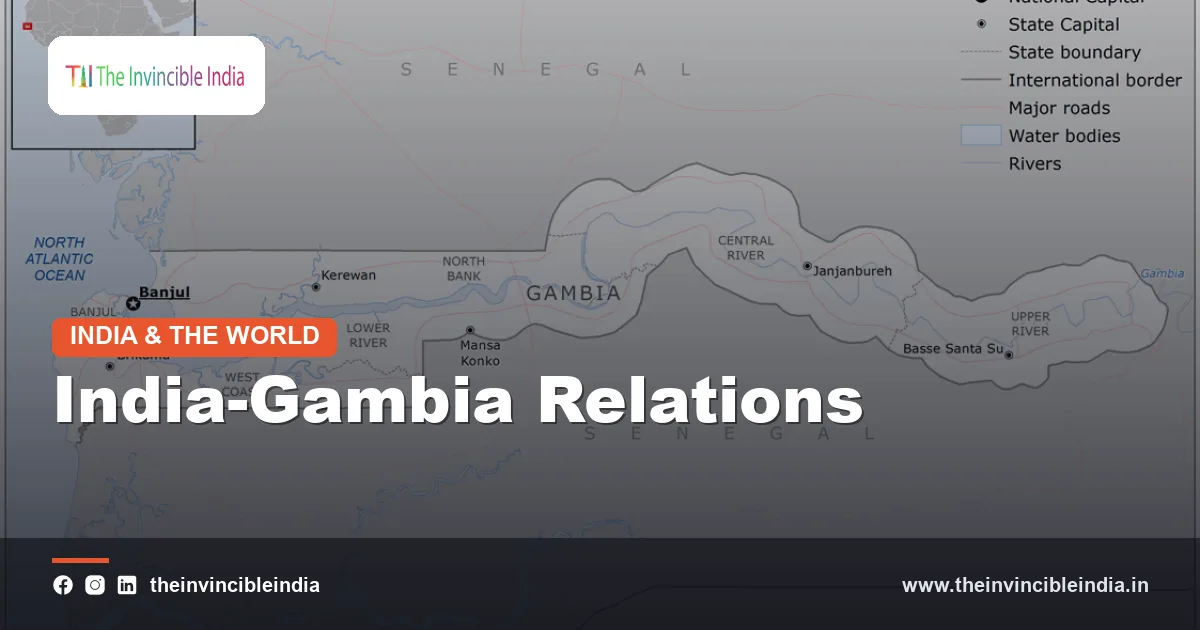
India-Gambia relations are the friendly, development-focused partnership between the Republic of India and The Gambia, a small West African country, built on lines of credit, pharmaceutical trade, capacity-building under the ITEC programme, and a small Indian-origin business community. The two countries share a Commonwealth link and a record of cordial diplomacy that dates to The Gambia’s independence from Britain in 1965.
Although The Gambia is one of Africa’s smallest countries, it has an outsized place in India’s wider engagement with the continent, because it shows how India combines concessional finance, training and affordable medicines in its South-South cooperation. The relationship has also faced tests, notably the 2022 controversy over contaminated cough syrups, which led to tighter export checks in India. This explainer sets out how the relationship works, where it has delivered, and where its limits lie.
| Attribute | Detail |
|---|---|
| The Gambia’s independence | 18 February 1965, from British rule |
| Diplomatic ties | Established soon after The Gambia’s independence in the mid-1960s |
| The Gambia’s capital | Banjul |
| Geography | A narrow country along the River Gambia, almost fully surrounded by Senegal, with a short Atlantic coastline |
| Population | Roughly 2.5 million people, according to recent estimates |
| Shared memberships | Commonwealth, United Nations, Non-Aligned Movement, International Solar Alliance (as signatories or members) |
| Main pillars | Lines of credit through EXIM Bank, pharmaceutical exports, ITEC training, humanitarian and health support |
| Indian-origin community | Small, largely engaged in trade and services |
Key Takeaways
- India-Gambia relations began after The Gambia became independent from Britain on 18 February 1965, and have remained cordial and largely non-controversial since.
- India supports The Gambia mainly through development cooperation, including concessional lines of credit routed through the Export-Import Bank of India (EXIM Bank) and scholarships and training under the ITEC programme.
- Pharmaceuticals are among the most visible parts of India-Gambia trade, and the 2022 cough syrup deaths in The Gambia led India to tighten testing rules for exported cough syrups.
- The Gambia and India are both members of the Commonwealth, which provides a shared institutional language, legal tradition and diplomatic forum.
- India-Gambia relations sit within the broader India-Africa framework, including the India-Africa Forum Summits and the African Union’s permanent membership of the G20 from 2023.
- Bilateral trade between India and The Gambia is modest in absolute terms and is small compared with India’s trade with larger African economies.
What is the background of India-Gambia relations?
The background of India-Gambia relations is a shared colonial past under British rule, followed by the establishment of diplomatic ties after The Gambia gained independence on 18 February 1965. Both countries took part in the wave of decolonisation and joined the Commonwealth and the United Nations system, which gave them a common platform for dialogue.
India’s early approach to newly independent African states rested on solidarity, support for self-determination and a commitment to economic cooperation without political conditions. The Gambia, a small agrarian economy dependent on groundnuts and, later, tourism and remittances, fits the type of partner for which India’s development model of capacity-building and affordable technology has been most relevant.
For much of the period since the 1960s, India has managed relations with The Gambia through its mission in neighbouring Senegal, with the Indian High Commissioner or Ambassador in Dakar being accredited to The Gambia on a concurrent basis, according to published arrangements. This model is common for India’s engagement with small African states, where a single resident mission covers several countries.
Who are the key actors in India-Gambia relations?
The key actors in India-Gambia relations are the two governments’ foreign ministries, India’s Ministry of External Affairs (MEA), the Export-Import Bank of India (EXIM Bank) as the financing arm, and Indian pharmaceutical and trading firms. On the Gambian side, the presidency, the foreign ministry and sector ministries such as health, agriculture and energy lead the engagement.
- Ministry of External Affairs (MEA): sets policy, runs the Africa division and manages the Development Partnership Administration, which oversees India’s grant and credit projects abroad.
- EXIM Bank of India: extends lines of credit on behalf of the Government of India for projects executed by Indian companies.
- Indian Technical and Economic Cooperation (ITEC) programme: offers training slots for officials and professionals from partner countries.
- Indian companies and traders: supply medicines, vehicles, machinery, foodstuffs and consumer goods.
- The Gambian government agencies: including the Medicines Control Agency, the ministry of finance and sector ministries that sign and implement projects.
The two countries also meet in multilateral forums such as the UN General Assembly, the Commonwealth and the Non-Aligned Movement, where Gambian and Indian positions on development finance, climate change and reform of global institutions often overlap.
What are the lines of credit under India-Gambia relations?
The lines of credit under India-Gambia relations are concessional loans offered by the Government of India through EXIM Bank, which finance development projects in The Gambia that are carried out largely by Indian contractors and suppliers. These credits are a core instrument of India’s development partnership with Africa, and The Gambia has been among the smaller recipients.
A line of credit works in a simple pattern. The Government of India subsidises the interest rate, and EXIM Bank lends to the partner government on favourable terms, including a long repayment period and a grace period. The money is tied in practice to goods and services from India, with a minimum share of Indian content. Sectors that have been associated with Indian credits to The Gambia in published accounts include agriculture and agricultural mechanisation, infrastructure and information technology; readers should check current EXIM Bank and MEA records for the latest project list and amounts.
Supporters of this approach argue that it delivers visible assets, builds skills and opens markets for Indian firms. Critics, including some African economists, note that tied credits can limit competition, and that smaller countries must manage debt carefully. India’s own policy statements describe the credits as demand-driven, with projects chosen by the partner country.
How does ITEC capacity-building help The Gambia?
ITEC capacity-building helps The Gambia by giving Gambian civil servants, diplomats, health workers, police officers and other professionals fully or largely funded training in India, usually in short courses of a few weeks to several months. The Indian Technical and Economic Cooperation programme was launched in 1964 and now covers dozens of partner countries across Africa, Asia, Latin America and the Pacific.
Training areas relevant to The Gambia typically include public administration, information technology, agriculture and food processing, renewable energy, small enterprise development, healthcare and banking. Courses are offered at Indian institutions across the country, and some can also be taken online. Past participants frequently serve as informal ambassadors of India on return to The Gambia, which supports people-to-people ties.
Alongside ITEC, India offers scholarships through the Indian Council for Cultural Relations (ICCR) and other schemes, and Gambian students also study at Indian universities as self-financed students. The Gambia also benefits from broader India-Africa initiatives, such as the Pan-African e-Network project, which linked African countries to Indian hospitals and universities through satellite and fibre-based telemedicine and tele-education, according to its published description.
Why are pharmaceuticals central to India-Gambia trade?
Pharmaceuticals are central to India-Gambia trade because India is among the world’s largest producers of low-cost generic medicines, and The Gambia imports a large part of its medical supplies from international and regional suppliers, including Indian manufacturers. Affordable Indian medicines have played a role in treating infectious diseases such as malaria, tuberculosis and HIV across Africa.
The relationship, however, was shaken in 2022. In October 2022, the World Health Organization issued an alert about four cough and cold syrups, made by an Indian manufacturer, that were linked to acute kidney injury and the deaths of dozens of children in The Gambia. The WHO said laboratory analysis found unacceptable levels of diethylene glycol and ethylene glycol, which are toxic contaminants.
The Indian authorities investigated, and their public statements varied over time, with Indian regulators initially reporting that some tested samples met standards, while the state drug authority later suspended the manufacturer’s licence. Investigations in The Gambia and by international health bodies continued. India subsequently made pre-export testing of cough syrup compulsory from mid-2023 and tightened its oversight of drug manufacturing. The episode is a reminder that trust in a pharmaceutical relationship depends on quality assurance as well as price.
What is the trade relationship between India and The Gambia?
The trade relationship between India and The Gambia is modest in size and is heavily tilted toward Indian exports, with pharmaceuticals, vehicles, machinery, textiles and food items going to The Gambia and agricultural commodities, notably nuts, coming back. Actual figures vary from year to year, so any single number should be taken as indicative only.
| Direction | Typical product groups |
|---|---|
| Indian exports to The Gambia | Pharmaceuticals, vehicles and spare parts, machinery, electrical goods, textiles, rice and other foodstuffs, consumer goods |
| Gambian exports to India | Agricultural commodities such as cashew nuts and groundnut products, and small volumes of other raw materials |
West Africa is an important supplier of raw cashew nuts to India’s processing industry, and The Gambia is among the smaller producers in the region. The Gambia’s re-export trade, which serves neighbouring markets through the port of Banjul, also gives Indian exporters a limited regional gateway. India is not among The Gambia’s very largest partners, but its role in affordable goods is significant for households and public health systems.
Who are the Indian-origin community in The Gambia?
The Indian-origin community in The Gambia is a small group of traders, professionals and business families, many of whom are engaged in wholesale and retail trade, hospitality and services, and they act as a modest bridge between the two countries. Estimates of the community’s size vary, and it is far smaller than the Indian diasporas in East or Southern Africa.
Indian traders have long been active in West African commerce, importing textiles, food products and consumer goods and distributing them locally. In The Gambia, such businesses are concentrated in the Greater Banjul area. Indian community associations, along with the Indian mission in Dakar, organise cultural events such as Independence Day and Republic Day gatherings and the International Day of Yoga programmes.
The community’s small size means that India-Gambia relations are driven more by governments, training programmes and commercial supply chains than by large-scale diaspora networks, in contrast with India’s ties to Kenya, Tanzania, Mauritius or South Africa.
How does India-Gambia cooperation fit into India-Africa relations?
India-Gambia cooperation fits into India-Africa relations as one strand of a continent-wide effort that includes the India-Africa Forum Summit process, concessional credits, training programmes and, since 2023, support for the African Union’s permanent membership of the G20. The Gambia, as an AU member, takes part in these frameworks alongside every other African country.
India held the third India-Africa Forum Summit in New Delhi in October 2015, to which all 54 African countries were invited. India also supported the African Union’s inclusion in the G20 as a permanent member at the New Delhi summit in September 2023, a move widely seen as strengthening Africa’s voice in global economic governance. At the same time, regional organisations such as the Economic Community of West African States (ECOWAS) shape The Gambia’s trade and security choices.
India has also promoted the International Solar Alliance, headquartered in Gurugram, as a platform for renewable energy cooperation with African states, including those in West Africa. Many African countries, including The Gambia, have been involved in this initiative, and renewable energy remains an area where a small country with high electricity costs can gain from Indian technology and finance.
What are the challenges and prospects for India-Gambia relations?
The challenges for India-Gambia relations are small trade volumes, the need to rebuild confidence in medicine quality after 2022, limited diplomatic presence and strong competition from other partners such as China, the European Union, Turkey and Gulf states. The prospects lie in health, agriculture, digital services, renewable energy and training, where India’s low-cost, scalable solutions match The Gambia’s needs.
Main challenges
- Scale: The Gambia’s economy is small, which limits the size of any single project or trade flow.
- Trust in pharmaceuticals: Strong quality checks and transparent communication are needed to maintain confidence in Indian medicines.
- Competition: Several larger partners offer finance, infrastructure and trade deals in The Gambia.
- Debt sustainability: Concessional loans still add to public debt and must be managed prudently.
Areas of opportunity
- Agricultural processing and mechanisation, particularly for groundnuts, rice and horticulture
- Digital public infrastructure, including payments and identity systems, an area in which India shares its experience with partner countries
- Solar energy and rural electrification
- Healthcare training, telemedicine and quality-assured medicine supply
Bottom Line
India-Gambia relations are small in scale but steady in purpose, resting on development credit, training and affordable medicines. The partnership’s future depends on quality assurance in pharmaceuticals, careful project selection and the continued use of India’s wider Africa platforms.
Frequently Asked Questions
When did India and The Gambia establish diplomatic relations?
India and The Gambia established diplomatic relations soon after The Gambia became independent on 18 February 1965. Both are Commonwealth members, and relations have been consistently cordial. India has generally handled its Gambia relationship through its mission in neighbouring Senegal.
What does India do for The Gambia?
India supports The Gambia mainly through concessional lines of credit, training and scholarships under the ITEC programme, and exports of affordable medicines and goods. India also runs wider Africa initiatives that include Gambian participation. The details of individual projects can be checked with the Ministry of External Affairs and EXIM Bank.
What was the Gambia cough syrup controversy?
The cough syrup controversy was a 2022 public health crisis in which dozens of children in The Gambia died of acute kidney injury after taking certain syrups made by an Indian manufacturer. The World Health Organization reported toxic contaminants in the products. India later made pre-export testing of cough syrups mandatory and tightened drug oversight.
What does India import from The Gambia?
India imports small quantities of agricultural commodities from The Gambia, notably cashew nuts and groundnut products. Trade volumes are modest, and the balance of trade favours India. West Africa as a whole is a major source of raw cashew for Indian processors.
Is there a large Indian community in The Gambia?
No, the Indian-origin community in The Gambia is small, and it is mainly involved in trade, hospitality and services. It is much smaller than the Indian diaspora in East and Southern Africa. India-Gambia relations are therefore driven mostly by government programmes and commercial supply chains.
How does India-Gambia cooperation relate to the African Union and the G20?
India-Gambia cooperation sits within the wider India-Africa partnership, in which The Gambia participates as an African Union member. India supported the African Union’s permanent membership of the G20 at the 2023 New Delhi summit. The Gambia benefits from this broader platform alongside other African countries.
{“@context”:”https://schema.org”,”@graph”:[{“@type”:”FAQPage”,”mainEntity”:[{“@type”:”Question”,”name”:”When did India and The Gambia establish diplomatic relations?”,”acceptedAnswer”:{“@type”:”Answer”,”text”:”India and The Gambia established diplomatic relations soon after The Gambia became independent on 18 February 1965. Both are Commonwealth members, and relations have been consistently cordial. India has generally handled its Gambia relationship through its mission in neighbouring Senegal.”}},{“@type”:”Question”,”name”:”What does India do for The Gambia?”,”acceptedAnswer”:{“@type”:”Answer”,”text”:”India supports The Gambia mainly through concessional lines of credit, training and scholarships under the ITEC programme, and exports of affordable medicines and goods. India also runs wider Africa initiatives that include Gambian participation. The details of individual projects can be checked with the Ministry of External Affairs and EXIM Bank.”}},{“@type”:”Question”,”name”:”What was the Gambia cough syrup controversy?”,”acceptedAnswer”:{“@type”:”Answer”,”text”:”The cough syrup controversy was a 2022 public health crisis in which dozens of children in The Gambia died of acute kidney injury after taking certain syrups made by an Indian manufacturer. The World Health Organization reported toxic contaminants in the products. India later made pre-export testing of cough syrups mandatory and tightened drug oversight.”}},{“@type”:”Question”,”name”:”What does India import from The Gambia?”,”acceptedAnswer”:{“@type”:”Answer”,”text”:”India imports small quantities of agricultural commodities from The Gambia, notably cashew nuts and groundnut products. Trade volumes are modest, and the balance of trade favours India. West Africa as a whole is a major source of raw cashew for Indian processors.”}},{“@type”:”Question”,”name”:”Is there a large Indian community in The Gambia?”,”acceptedAnswer”:{“@type”:”Answer”,”text”:”No, the Indian-origin community in The Gambia is small, and it is mainly involved in trade, hospitality and services. It is much smaller than the Indian diaspora in East and Southern Africa. India-Gambia relations are therefore driven mostly by government programmes and commercial supply chains.”}},{“@type”:”Question”,”name”:”How does India-Gambia cooperation relate to the African Union and the G20?”,”acceptedAnswer”:{“@type”:”Answer”,”text”:”India-Gambia cooperation sits within the wider India-Africa partnership, in which The Gambia participates as an African Union member. India supported the African Union’s permanent membership of the G20 at the 2023 New Delhi summit. The Gambia benefits from this broader platform alongside other African countries.”}}]}]}


