

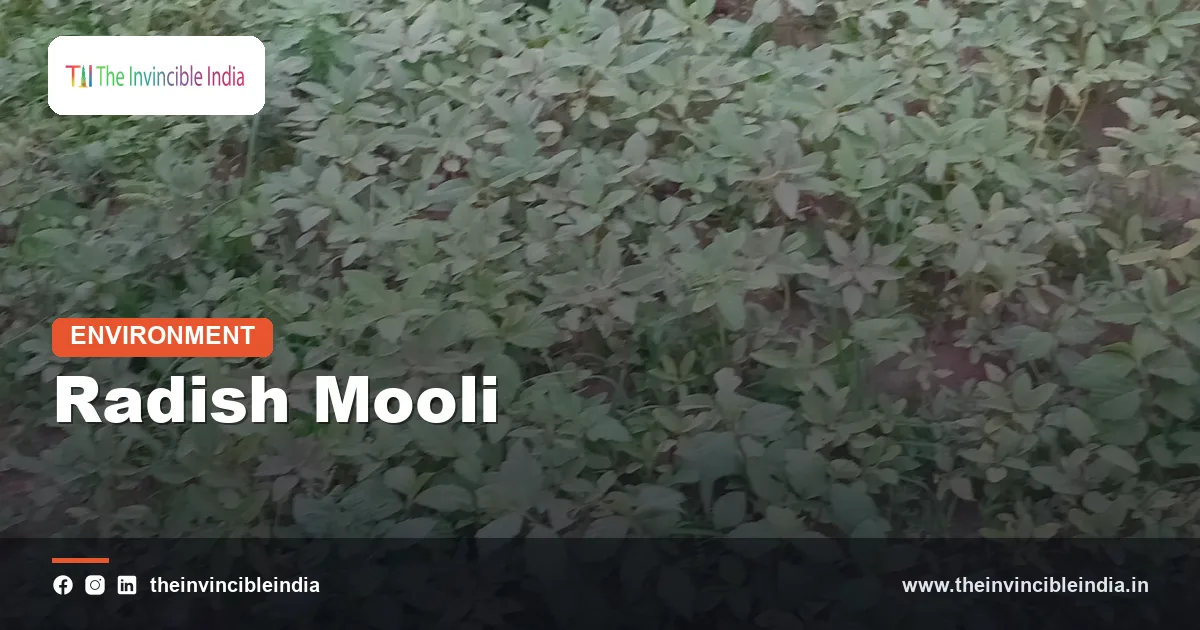
The radish (Raphanus sativus), called mooli in Hindi, is a fast-growing, cool-season root vegetable of the mustard family, valued for its crisp, peppery root that is eaten raw, cooked, pickled and stuffed into parathas. In India the radish is typically a long, white, tapering root rather than the small red globe common in Europe, and it is among the quickest vegetables to go from seed to harvest.
Radish has been grown in India since ancient times, and the Hindi name mooli comes from the Sanskrit word for root. This article explains what the radish is, how its Indian types differ from European ones, where and how it is grown, and how it is used in Indian kitchens.
Radish Quick Facts
| Attribute | Detail |
|---|---|
| Common names | Radish, mooli (Hindi), mullangi (Tamil and Telugu), mula (Marathi), mulo (Gujarati) |
| Scientific name | Raphanus sativus (also treated as Raphanus raphanistrum subsp. sativus) |
| Family | Brassicaceae (the mustard or cabbage family) |
| Where grown in India | Throughout the country, with large areas in Haryana, Punjab, Uttar Pradesh, Bihar, West Bengal, Gujarat and Assam |
| Season | Mainly a winter (rabi) crop sown from about September to January, with heat-tolerant types sown in other months |
| Part used | The swollen root; the leaves and the young seed pods are also eaten |
| Uses | Salads, parathas, sabzi, sambar, pickles, mooli ke patte ki sabzi |
| Nutrition | Very low in calories; contains vitamin C, folate, potassium and fibre, and pungent glucosinolate compounds |
Key Takeaways
- The radish is a fast-growing root vegetable of the mustard family that can be harvested within about one to two months of sowing, depending on the type.
- Indian radish, or mooli, is usually a long white root, while the small red globe radish is known as the European type.
- Radish gets its sharp, peppery taste from sulphur-containing compounds called glucosinolates, which turn into isothiocyanates when the root is cut or chewed.
- Radish leaves and tender seed pods, known as mogri in parts of western India, are eaten as vegetables in several regions.
- Radish grows best in cool weather, and roots left too long in the field turn hollow and woody, a disorder called pithiness.
- Radish has been cultivated in India since ancient times and is a staple of winter cooking, notably mooli paratha.
What Is a Radish and Where Did It Come From?
A radish is the swollen root of Raphanus sativus, an annual or biennial herb of the mustard family grown for its crisp, pungent flesh. The plant is known only in cultivation, and its wild ancestry is debated, with scholars pointing to the wild radish (Raphanus raphanistrum) of the Mediterranean region and western Asia.
Radish was among the earliest vegetables cultivated across Eurasia. It was grown in the ancient Mediterranean world and in China, and it has long been part of South Asian agriculture. Its Hindi name mooli comes from the Sanskrit mula, meaning root, and classical Sanskrit texts on food and medicine mention radish. Today several distinct groups of radish are recognised, including the Asian long white types, the European small types and the Japanese daikon.
Because the radish matures so quickly, it was historically a useful filler crop for farmers, who could grow it between or before longer-duration crops.
What Does a Radish Plant Look Like?
A radish plant has a rosette of rough, lobed leaves above ground and a swollen root below that may be round, oval, cylindrical or long and tapering, depending on the type. The leaves are hairy and bear a deeply cut edge, and they can be eaten when young.
The root skin is white, red, pink or purple in different varieties, while the flesh inside is almost always white and juicy. If allowed to bolt in warm weather, or left long enough in the ground, the plant sends up a tall flowering stalk with white to pale violet four-petalled flowers, followed by pods that contain the seed. In one subtype, the rat-tail radish (Raphanus sativus var. caudatus), the root is poor but the long, thin edible pods are the harvested crop.
- Root: crisp, juicy and mildly to strongly pungent.
- Leaves: edible when young, with a slightly bitter, peppery taste.
- Flowers and pods: flowers are small; pods are eaten in some regions before the seeds harden.
- Growth habit: a quick annual in most Indian conditions.
What Are the Main Types of Radish Grown in India?
The main types of radish in India are the Asiatic long white type, the tropical summer type, the European small red type and the Japanese daikon type, and they differ in size, season and pungency. Most of the mooli sold in the Indian winter belongs to the long white group.
| Type | Description | Season and notes |
|---|---|---|
| Asiatic long white | Long, white, tapering root, often 30 cm or more | Main winter mooli; some varieties tolerate mild warmth |
| Tropical or summer type | Shorter white or white-tipped root that tolerates heat | Sown in warmer months; Pusa Chetki is a well-known example |
| European small red | Small red or pink round to oval root | Fast-maturing, used in salads, grown near cities |
| Japanese daikon | Large white cylindrical root, milder in taste | Grown in smaller areas and for specialist markets |
| Rat-tail radish | Grown for its long edible pods | Pods are called mogri in parts of western India |
The Indian Agricultural Research Institute (IARI), New Delhi, has released several radish varieties under the Pusa name, including Pusa Himani, Pusa Desi and Pusa Chetki, each meant for a specific sowing window. Private seed companies also supply many hybrids with uniform white roots.
Where Is Radish Grown in India?
Radish is grown across India, with large areas in Haryana, Punjab, Uttar Pradesh, Bihar, West Bengal, Gujarat and Assam, among others. The crop is grown in both rural fields and peri-urban farms because it matures quickly and sells easily in nearby cities.
Radish is mostly a winter crop in northern and eastern India, with the main supply between November and February. Heat-tolerant types and hill cultivation allow production in other months. Statistics are published by the Ministry of Agriculture and Farmers Welfare and the National Horticulture Board, and rankings change with the season.
India is counted among the leading radish-growing countries, although world statistics often group radish with other minor roots and exact comparisons are difficult. Most of the Indian crop is sold fresh in local markets, with little processing beyond home pickling.
How Is Radish Cultivated in India?
Radish is cultivated by sowing seed directly in loose, well-drained soil, because it develops best in a deep, friable sandy loam with plenty of organic matter. The crop is not transplanted, since moving seedlings damages the root.
Sowing and spacing
Seeds are sown on ridges or flat beds in rows roughly 30 to 45 cm apart, and seedlings are thinned to a few centimetres apart in the row so that each root has room. Germination is quick, often within three to five days in suitable weather. Many farmers sow in batches a week or two apart to stagger harvests.
Water and nutrients
Radish needs regular, even moisture. Dry spells followed by heavy watering can crack the root, and drought makes the root woody and strongly pungent. Well-rotted manure suits the crop, but too much fresh manure or nitrogen makes the roots hairy and the tops excessive.
Harvest
Harvest typically takes place within about 25 to 60 days after sowing, depending on the variety and temperature. Small European types are ready first, while long white types take longer. Roots must be pulled promptly, because those left in the soil become pithy, meaning the interior turns spongy and hollow.
Which Pests and Diseases Affect Radish?
Radish is affected by aphids, flea beetles, the mustard sawfly and diseases such as white rust, Alternaria leaf spot and downy mildew. Many of these also attack mustard, cabbage and cauliflower, which are relatives in the same family.
- Aphids: small insects that colonise leaves and flower stalks and reduce plant vigour.
- Flea beetles: tiny jumping beetles that make small holes in the leaves of seedlings.
- Mustard sawfly: larvae that feed on leaves and can strip young plants.
- White rust (Albugo candida): a fungal disease producing white blisters on leaves.
- Root cracking and pithiness: physiological disorders linked to uneven watering, heat or late harvest rather than to pathogens.
Crop rotation with cereals, clean seed, timely sowing and field hygiene help limit infestations. Because radish is a short-duration crop that is often eaten raw, farmers are advised to follow label directions and pre-harvest intervals closely if pesticides are used.
How Is Radish Used in Indian Cooking?
Radish is used in Indian cooking raw in salads, grated into parathas, cooked as a sabzi, added to sambar and pickled, and its leaves are cooked as a green. Its sharp flavour softens considerably when cooked.
- Mooli paratha: grated radish mixed with salt and spices and stuffed into wheat dough, a popular winter breakfast in northern India, usually served with curd or pickle.
- Mooli sabzi: sliced or grated radish stir-fried with turmeric, cumin and green chilli, sometimes along with its leaves.
- Sambar and kootu: chunks of radish, known as mullangi in Tamil, are cooked in lentil-based stews in South India.
- Salad: thick slices or rounds sprinkled with salt, lemon juice and chaat masala, a common accompaniment to winter meals and Punjabi dishes.
- Pickles: mooli is part of mixed winter pickles with carrot and cauliflower.
- Mooli ke patte: the leaves are cooked as a leafy vegetable, often with gram flour or in saag.
- Mogri: the crisp pods are eaten as a vegetable or pickled in Gujarat and Rajasthan.
Radish is often paired with ghee, curd or buttermilk in meals, and the root is also grated into chutneys and relishes.
Why Does Radish Taste Pungent?
Radish tastes pungent because its cells contain glucosinolates, sulphur compounds that an enzyme called myrosinase converts into sharp-tasting isothiocyanates when the root is cut, grated or chewed. The same chemistry gives mustard, horseradish and wasabi their bite.
Pungency varies with variety, growing conditions and age. Roots grown in hot, dry weather or left in the soil too long are hotter and more bitter, while roots grown in cool, moist conditions are mild and sweet. Cooking breaks down the isothiocyanates and removes much of the bite, which is why cooked mooli is far gentler than raw.
The odour of cooked radish, sometimes noticed in sambar and parathas, is also due to sulphur compounds. Finely grated radish can be squeezed to remove excess water and some pungency before it is used in stuffing.
What Nutrients Does Radish Provide?
Radish provides vitamin C, folate, potassium and fibre while containing very few calories, since it is about 90 percent water. The leaves are often richer in vitamin C, calcium and iron than the root itself, which is a reason many households cook them as well.
Radish contains glucosinolates and other plant compounds that are studied by nutrition scientists. Red radishes also contain anthocyanins in the skin. In traditional Indian medicine, radish has long been valued as a digestive vegetable, although such uses are folk or traditional claims and not medical treatments. People with digestive complaints or thyroid conditions should seek the guidance of a doctor about eating large quantities of cruciferous vegetables.
How Should Radish Be Selected and Stored?
A good radish is firm, smooth and heavy for its size, with a glossy skin and fresh, green leaves if they are still attached. Roots that are soft, spongy, cracked or very large may be pithy inside.
For storage, the leaves should be cut off, because they draw moisture from the root. The roots keep in a refrigerator for about a week in a perforated bag or wrapped in a damp cloth. The leaves, which wilt quickly, should be used within a day or two. A soft radish can often be revived by soaking it in cold water for a short time.
Why Does Radish Matter to Indian Farmers?
Radish matters to Indian farmers because it gives a quick cash return within one to two months, fits between other crops and meets steady winter demand. Its short cycle suits small plots and peri-urban farms close to cities.
The crop’s challenges are price drops when many farmers harvest at once, the short shelf life of fresh roots and the sensitivity of quality to weather. Improved heat-tolerant varieties, staggered sowing and better handling help growers reduce losses. For households, radish remains an inexpensive vegetable that links regional cuisines from the north to the south.
Bottom Line
The radish, or mooli, is a quick-growing, peppery root vegetable of the mustard family that has been part of Indian farming and food for centuries. It suits winter kitchens, supplies useful nutrients and gives farmers a fast crop, though timely harvest is essential to avoid pithy roots.
Frequently Asked Questions
What is radish called in Hindi?
Radish is called mooli in Hindi. The word comes from the Sanskrit mula, meaning root. Other Indian names include mullangi in Tamil and Telugu, mula in Marathi and mulo in Gujarati.
How long does radish take to grow?
Radish usually takes about 25 to 60 days from sowing to harvest, depending on the variety and the weather. Small European types mature fastest, while long white Indian types take longer. Roots left in the soil too long become hollow and woody.
Why is my radish hollow or woody inside?
A radish becomes hollow or woody when it is harvested late or grown in heat or uneven moisture. This disorder is called pithiness. Pulling roots promptly at the right size and watering evenly reduce the problem.
Can radish leaves be eaten?
Yes, radish leaves are edible and are cooked as a green in many parts of India. Young leaves are tender and mildly peppery, and they are used in sabzi, saag and parathas. They are best used fresh, because they wilt within a day or two.
Which season is best for growing radish in India?
Winter is the best season for growing radish in most of India, with sowing from about September to January. Radish prefers cool weather, which produces mild, crisp roots. Heat-tolerant varieties such as Pusa Chetki allow sowing in warmer months.
Is radish related to cabbage and mustard?
Yes, radish belongs to the Brassicaceae family, which also includes cabbage, cauliflower, mustard and turnip. Radish is a different species, Raphanus sativus, but it shares the pungent glucosinolate chemistry of the family. Many of its pests and diseases are also shared with these crops.
{“@context”:”https://schema.org”,”@graph”:[{“@type”:”FAQPage”,”mainEntity”:[{“@type”:”Question”,”name”:”What is radish called in Hindi?”,”acceptedAnswer”:{“@type”:”Answer”,”text”:”Radish is called mooli in Hindi. The word comes from the Sanskrit mula, meaning root. Other Indian names include mullangi in Tamil and Telugu, mula in Marathi and mulo in Gujarati.”}},{“@type”:”Question”,”name”:”How long does radish take to grow?”,”acceptedAnswer”:{“@type”:”Answer”,”text”:”Radish usually takes about 25 to 60 days from sowing to harvest, depending on the variety and the weather. Small European types mature fastest, while long white Indian types take longer. Roots left in the soil too long become hollow and woody.”}},{“@type”:”Question”,”name”:”Why is my radish hollow or woody inside?”,”acceptedAnswer”:{“@type”:”Answer”,”text”:”A radish becomes hollow or woody when it is harvested late or grown in heat or uneven moisture. This disorder is called pithiness. Pulling roots promptly at the right size and watering evenly reduce the problem.”}},{“@type”:”Question”,”name”:”Can radish leaves be eaten?”,”acceptedAnswer”:{“@type”:”Answer”,”text”:”Yes, radish leaves are edible and are cooked as a green in many parts of India. Young leaves are tender and mildly peppery, and they are used in sabzi, saag and parathas. They are best used fresh, because they wilt within a day or two.”}},{“@type”:”Question”,”name”:”Which season is best for growing radish in India?”,”acceptedAnswer”:{“@type”:”Answer”,”text”:”Winter is the best season for growing radish in most of India, with sowing from about September to January. Radish prefers cool weather, which produces mild, crisp roots. Heat-tolerant varieties such as Pusa Chetki allow sowing in warmer months.”}},{“@type”:”Question”,”name”:”Is radish related to cabbage and mustard?”,”acceptedAnswer”:{“@type”:”Answer”,”text”:”Yes, radish belongs to the Brassicaceae family, which also includes cabbage, cauliflower, mustard and turnip. Radish is a different species, Raphanus sativus, but it shares the pungent glucosinolate chemistry of the family. Many of its pests and diseases are also shared with these crops.”}}]}]}


