

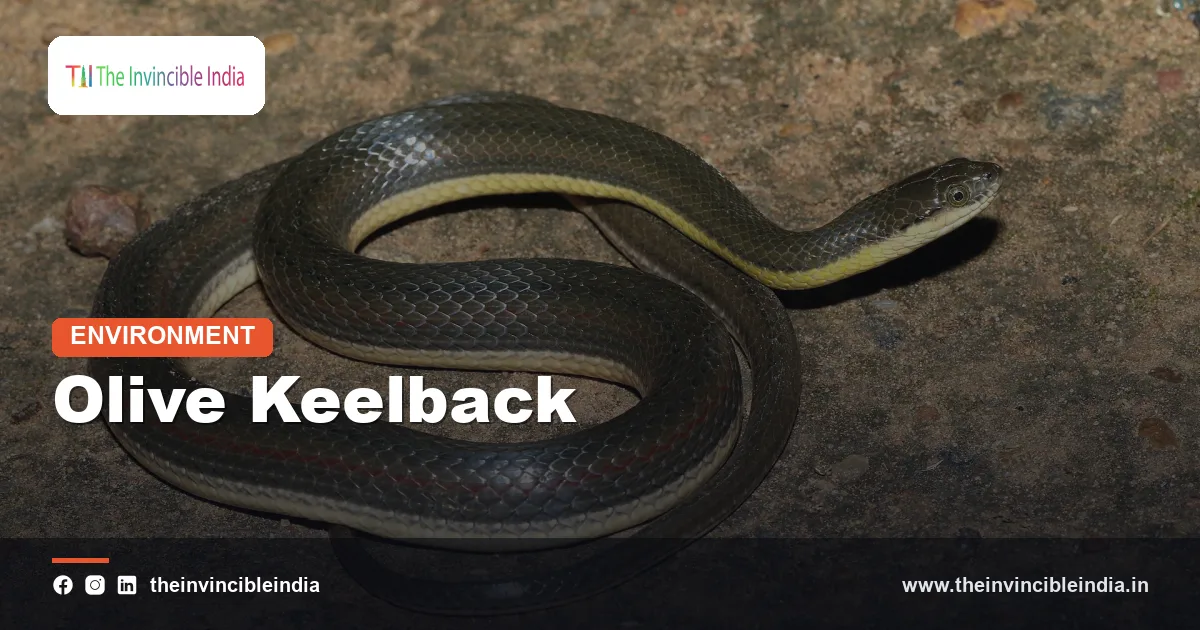
The olive keelback (Atretium schistosum) is a small, olive-coloured water snake of the Indian subcontinent that lives in paddy fields, ponds, canals and slow streams and feeds mainly on fish, frogs and tadpoles. Although the olive keelback has weak venom delivered by fangs at the back of its mouth, it is considered harmless to people and is not responsible for any medically significant bites.
Because the olive keelback spends most of its life in or beside water, it is often noticed during the monsoon, when flooded fields and drains bring it into view. Many people mistake it for a dangerous snake, so understanding what the olive keelback looks like, how it behaves and why it is useful helps prevent needless killings.
Quick Facts About the Olive Keelback
| Common name | Olive keelback, also called olive keelback water snake |
|---|---|
| Scientific name | Atretium schistosum |
| Family | Colubridae (subfamily Natricinae, the keelbacks and water snakes; some authors place it in Natricidae) |
| Size | Usually under about 90 cm in total length; slender to moderately stout body |
| India range and habitat | Widely reported across peninsular, eastern and north-eastern India; paddy fields, ponds, marshes, canals and slow streams in the plains and low hills |
| Diet | Fish, frogs, tadpoles and occasionally other small aquatic animals |
| Breeding | Egg-laying; breeds mainly around the rainy season, with small clutches laid in moist hiding places |
| Danger to humans | Mildly venomous (rear-fanged) but considered harmless; bites are rare and not medically significant |
| Conservation status | Least Concern on the IUCN Red List; protected as a wild snake under Indian wildlife law |
Key Takeaways
- The olive keelback is a small water snake, Atretium schistosum, that is found in paddy fields, ponds and slow streams across much of India.
- The olive keelback has venom glands and rear fangs, yet it is regarded as harmless to humans because its venom is weak and its bites are very rare.
- An olive keelback feeds mostly on fish, frogs and tadpoles, so the species helps keep wetland prey populations in balance.
- The name keelback comes from the ridge, or keel, running down the centre of each dorsal scale, which gives the olive keelback a rough, matt texture.
- Olive keelbacks are often confused with venomous snakes, and many are killed for no reason; the species is Least Concern but still protected by law.
- Rice cultivation has quietly benefited the olive keelback, because flooded fields provide both food and shelter.
What Is the Olive Keelback?
The olive keelback is a non-dangerous, semi-aquatic snake belonging to the keelback group of the family Colubridae, and its scientific name is Atretium schistosum. The word keelback describes the keeled dorsal scales, each carrying a small ridge along its length, which makes the skin look slightly rough rather than glossy.
Indian herpetologists also refer to the species as the olive keelback water snake. In older books it may appear under alternative scientific names, because the classification of the keelbacks and their relatives has been revised several times. The genus Atretium is small, and the olive keelback is its best-known member in the region.
The olive keelback is a modest animal. It does not hood, does not rear up dramatically and does not have bold warning colours. Its camouflage works well against muddy water, floating plants and damp earth, which is exactly where it spends its time.
What Does an Olive Keelback Look Like?
An olive keelback is a slender to moderately stout snake with an olive-green, olive-brown or greyish-brown back and a paler, yellowish or cream belly. The colour is usually uniform, although the body can carry faint darker markings and a slightly lighter tone along the sides.
Several features help in identification:
- The head is slightly distinct from the neck and moderately flattened, with eyes set toward the top of the head.
- The pupils are round, a trait shared by most non-venomous snakes of the region.
- The dorsal scales are keeled and arranged in rows around the body, giving a rough surface.
- The belly is pale and often has a yellowish or whitish tone, sometimes with darker edges to the ventral scales.
- The tail is relatively short and tapers to a point.
Young olive keelbacks can appear slightly more patterned than adults, with fainter crossbands or spots. The overall impression of an adult, however, is a plain olive snake with a small head and a quiet manner.
Where Does the Olive Keelback Live in India?
The olive keelback lives across a wide belt of the Indian subcontinent, with records from peninsular India, the Gangetic plains, the east and the north-east, and it also occurs in neighbouring countries such as Nepal, Bangladesh and Sri Lanka. Within this range it is tied firmly to water, so its presence follows the pattern of wetlands rather than climate zones.
Typical habitats of the olive keelback include:
- Flooded paddy fields and the bunds that separate them
- Village ponds, tanks and irrigation channels
- Marshes, swamps and the edges of lakes
- Slow-flowing streams and drainage ditches in the plains and foothills
- Gardens near water, especially during the monsoon
The species is generally found at low to moderate elevations. It is less likely to be seen in dry, treeless areas far from permanent water, though it may travel across wet ground after heavy rain.
What Does the Olive Keelback Eat?
The olive keelback eats mainly fish, frogs and tadpoles, which it hunts in shallow water and along muddy margins. The snake usually hunts by moving slowly through the shallows, flicking its tongue to pick up chemical traces, and then striking quickly at prey it has detected.
Prey is usually swallowed whole and often alive. The snake does not constrict. Its rear fangs and mild venom may help to subdue slippery prey such as frogs and small fish once they are held in the mouth, but the venom plays no role in dealing with large animals, because the olive keelback does not eat any.
The diet makes the olive keelback a useful predator in agricultural wetlands. By feeding on frogs and small fish, the species forms one link in a food chain that includes insects, amphibians, birds and larger snakes. In turn, the olive keelback is itself prey for herons, egrets, kingfishers, raptors and larger snakes such as the king cobra and rat snakes.
Is the Olive Keelback Poisonous or Dangerous?
The olive keelback is not dangerous to humans: it is technically mildly venomous because it has rear fangs and venom-producing glands, but it is considered harmless. In everyday language, people often say poisonous when they mean venomous; a poisonous animal harms when eaten or touched, whereas a venomous animal injects toxins through a bite.
Snakes of this kind are called rear-fanged, or opisthoglyphous. Their enlarged teeth sit at the back of the upper jaw, so a quick defensive nip rarely delivers venom. The olive keelback also has a gentle temperament, and its first response to disturbance is to flee into water or vegetation.
If an olive keelback does bite, a person may notice small puncture or scratch marks and mild local discomfort. Standard first aid applies: wash the area with clean water and soap, keep the person calm, and seek medical advice if there is any doubt about the species. A snake bite should never be treated with cuts, suction, tourniquets or home remedies.
How Can You Tell an Olive Keelback From a Dangerous Snake?
An olive keelback can be told apart from India’s dangerous snakes by its plain olive colour, keeled scales, small head, round pupils and strong association with water. A reliable identification, however, always needs a good look at the whole animal, and the safest rule is to keep distance from any unidentified snake.
The table below compares the olive keelback with two animals it is commonly mistaken for.
| Feature | Olive keelback | Checkered keelback | Common krait |
|---|---|---|---|
| Scientific name | Atretium schistosum | Fowlea piscator | Bungarus caeruleus |
| Typical colour | Plain olive or brownish | Olive with a chequered, dark pattern | Bluish-black with thin white bands |
| Habitat | Ponds, paddy, slow water | Ponds, paddy, wetlands | Dry areas, fields, houses |
| Danger to humans | Harmless | Considered harmless | Highly venomous |
| Activity | Mostly day and dusk, in or near water | Day and night, in or near water | Largely nocturnal |
The checkered keelback is much more common and is the snake most often seen in village ponds. Both keelbacks are harmless to people, but in practice any wild snake should be left alone instead of being handled.
How Does the Olive Keelback Behave and Breed?
The olive keelback is a mostly diurnal and crepuscular snake, meaning it is active during the day and at dusk, and it spends much of that time foraging in shallow water or basking on banks. When threatened, the snake typically dives, hides under plants or flattens its body, and it may flare its neck a little in a bluff display.
The olive keelback is an egg-laying species. Breeding is linked to the rainy season, when food is plentiful, and females deposit small clutches of eggs in moist, protected spots such as damp soil, rotting vegetation, mud banks or beneath debris. The eggs hatch after a period of incubation, and the hatchlings fend for themselves from the start, feeding on tiny fish and tadpoles.
The life of an olive keelback follows a simple yearly rhythm:
- Dry season: reduced activity, with snakes sheltering near permanent water, in mud or under cover.
- Early monsoon: movement increases as fields flood and frogs begin breeding.
- Peak monsoon: breeding, egg-laying and abundant feeding on tadpoles.
- Post-monsoon: hatchlings disperse into ponds, paddy and drainage channels.
Why Is the Olive Keelback Important to Wetlands and Farms?
The olive keelback is important because it is a mid-level predator that links amphibians and fish with birds and larger reptiles, helping to keep wetland food webs stable. Farmers who grow rice benefit indirectly, because healthy populations of water snakes, frogs and fish are part of the community that keeps pests and diseases in check.
Snakes as a group help control rodents and amphibian numbers, and water snakes are one of the few reptiles that thrive in cultivated wetlands. The presence of an olive keelback is a sign that a pond or paddy field still supports a functioning ecosystem, with prey animals, clean enough water and cover.
Is the Olive Keelback Protected, and What Threatens It?
The olive keelback is listed as Least Concern on the IUCN Red List because it is widespread and adaptable, but wild snakes in India are legally protected, so killing or capturing an olive keelback is not allowed. The Wildlife (Protection) Act, 1972 regulates the capture and harming of wild animals, and different species fall under different schedules.
The main threats to the olive keelback are not hunting but human behaviour and land change:
- Killing out of fear, because a harmless snake is mistaken for a dangerous one
- Road deaths when snakes cross roads on wet nights during the monsoon
- Draining and filling of ponds, marshes and village tanks
- Pesticide and fertiliser runoff that reduces frogs and fish, the snake’s food
- Pollution of water bodies by waste and industrial discharge
Even so, the olive keelback copes better than many species. Rice paddies, irrigation systems and village ponds act as surrogate wetlands that sustain the snake across large areas.
What Should You Do If You Find an Olive Keelback?
If you find an olive keelback, the best response is to keep a safe distance, allow it to move away on its own and avoid handling or harming it. A snake moving across a courtyard or garden after rain is usually just passing through on the way to water.
These simple steps keep both people and snakes safe:
- Stay calm and keep children and pets away from the animal.
- Do not try to catch, corner or kill the snake, as most bites happen during such attempts.
- Switch on lights and give the snake a clear path to leave.
- If the snake is inside a house, call a trained local rescuer or the forest department rather than attempting removal.
- Reduce attractions by clearing standing water, rubbish piles and dense clutter near doors.
A photograph taken from a distance helps experts to identify the species later. Learning to recognise the common harmless snakes, such as the olive keelback, the checkered keelback and the rat snake, is one of the most effective ways of reducing needless snake deaths.
Bottom Line
The olive keelback is a quiet, plain-coloured water snake that feeds on frogs and fish and poses no real danger to people. Recognising it and leaving it alone protects a useful wetland predator, and it also removes one common reason for panic during the monsoon.
Frequently Asked Questions
Is the olive keelback poisonous?
No, the olive keelback is not poisonous, and it is considered harmless to humans. It is technically mildly venomous because it has rear fangs and weak venom, but bites are rare and are not medically significant. Poisonous and venomous are different things, and the olive keelback is neither a danger when left alone.
What does an olive keelback eat?
An olive keelback eats mainly fish, frogs and tadpoles. It hunts in shallow water and along muddy banks, striking at prey it detects by sight and smell. The prey is swallowed whole, and the snake does not constrict.
Where is the olive keelback found in India?
The olive keelback is found in wet habitats across much of India, including peninsular, eastern and north-eastern regions. It lives in paddy fields, ponds, marshes, canals and slow streams, usually in the plains and low hills. The species also occurs in neighbouring countries such as Nepal, Bangladesh and Sri Lanka.
How big does an olive keelback grow?
An olive keelback typically grows to under about 90 cm in total length. Males and females are similar in appearance, and the body is slender to moderately stout. Hatchlings are much smaller and feed on tiny fish and tadpoles.
How can I tell an olive keelback from a krait or cobra?
An olive keelback is plain olive or brownish, has keeled scales, round pupils and a small head, and it is almost always seen in or near water. A common krait is bluish-black with thin white bands, while a cobra has a distinctive hood. Because identification can be tricky, it is safest to keep away from any snake you cannot recognise with certainty.
Should I kill an olive keelback found near my house?
No, an olive keelback should not be killed, because it is harmless and ecologically useful. Wild snakes are also protected under Indian wildlife law. Keep your distance, let the snake leave, and contact a trained rescuer or the forest department if it stays indoors.
{“@context”:”https://schema.org”,”@graph”:[{“@type”:”FAQPage”,”mainEntity”:[{“@type”:”Question”,”name”:”Is the olive keelback poisonous?”,”acceptedAnswer”:{“@type”:”Answer”,”text”:”No, the olive keelback is not poisonous, and it is considered harmless to humans. It is technically mildly venomous because it has rear fangs and weak venom, but bites are rare and are not medically significant. Poisonous and venomous are different things, and the olive keelback is neither a danger when left alone.”}},{“@type”:”Question”,”name”:”What does an olive keelback eat?”,”acceptedAnswer”:{“@type”:”Answer”,”text”:”An olive keelback eats mainly fish, frogs and tadpoles. It hunts in shallow water and along muddy banks, striking at prey it detects by sight and smell. The prey is swallowed whole, and the snake does not constrict.”}},{“@type”:”Question”,”name”:”Where is the olive keelback found in India?”,”acceptedAnswer”:{“@type”:”Answer”,”text”:”The olive keelback is found in wet habitats across much of India, including peninsular, eastern and north-eastern regions. It lives in paddy fields, ponds, marshes, canals and slow streams, usually in the plains and low hills. The species also occurs in neighbouring countries such as Nepal, Bangladesh and Sri Lanka.”}},{“@type”:”Question”,”name”:”How big does an olive keelback grow?”,”acceptedAnswer”:{“@type”:”Answer”,”text”:”An olive keelback typically grows to under about 90 cm in total length. Males and females are similar in appearance, and the body is slender to moderately stout. Hatchlings are much smaller and feed on tiny fish and tadpoles.”}},{“@type”:”Question”,”name”:”How can I tell an olive keelback from a krait or cobra?”,”acceptedAnswer”:{“@type”:”Answer”,”text”:”An olive keelback is plain olive or brownish, has keeled scales, round pupils and a small head, and it is almost always seen in or near water. A common krait is bluish-black with thin white bands, while a cobra has a distinctive hood. Because identification can be tricky, it is safest to keep away from any snake you cannot recognise with certainty.”}},{“@type”:”Question”,”name”:”Should I kill an olive keelback found near my house?”,”acceptedAnswer”:{“@type”:”Answer”,”text”:”No, an olive keelback should not be killed, because it is harmless and ecologically useful. Wild snakes are also protected under Indian wildlife law. Keep your distance, let the snake leave, and contact a trained rescuer or the forest department if it stays indoors.”}}]}]}


