

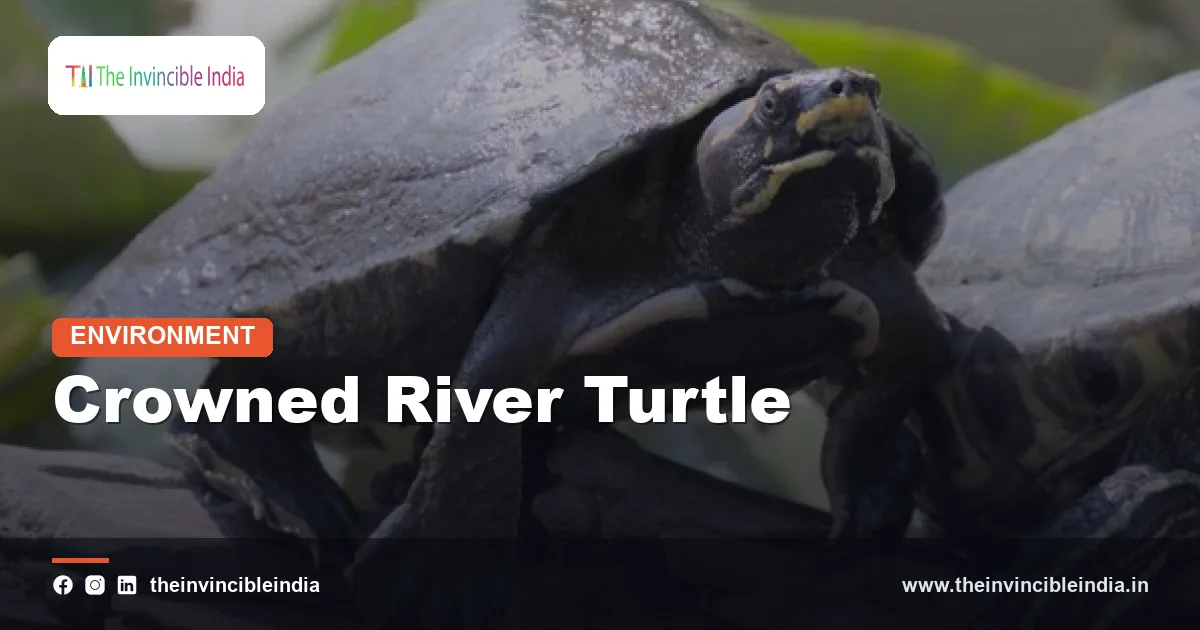
The crowned river turtle (Hardella thurjii) is a large freshwater turtle of the Ganges, Brahmaputra and Indus river systems, known for the crown-like pattern on its head and for a diet made up mostly of aquatic plants. The crowned river turtle is a basking species of slow rivers, oxbow lakes, ponds and floodplain wetlands, and it is listed as Endangered on the IUCN Red List.
The crowned river turtle is less famous than the gharial or the Ganges river dolphin, yet it shares the same threatened river habitat. Understanding how the crowned river turtle lives, what it eats and why its numbers have fallen shows how much of India’s freshwater life depends on clean water, undisturbed banks and sandy nesting sites.
Quick Facts About the Crowned River Turtle
| Common name | Crowned river turtle (a regional population in the Indus system has sometimes been treated as a subspecies) |
|---|---|
| Scientific name | Hardella thurjii |
| Family | Geoemydidae (Asian river turtles, leaf turtles and relatives); the genus Hardella has few species |
| Size | Females reach roughly 50 to 60 cm in shell length; males are much smaller, often around 20 to 30 cm |
| India range and habitat | Ganges and Brahmaputra basins of northern and north-eastern India; slow rivers, oxbow lakes, ponds and floodplain wetlands |
| Diet | Mostly aquatic plants, with some molluscs, insects and other small animals |
| Breeding | Egg-laying; females dig nests on sandy or earthen banks, mainly in the cooler months, and lay several eggs per clutch |
| Conservation status | Endangered (IUCN); listed in CITES Appendix II; protected under Indian wildlife law |
Key Takeaways
- The crowned river turtle, Hardella thurjii, is a large freshwater turtle found mainly in the Ganges and Brahmaputra river systems and their wetlands.
- The crowned river turtle is named for the pattern of stripes and markings on its head, which resembles a crown.
- Female crowned river turtles grow much larger than males, which is a striking example of sexual size difference in reptiles.
- The crowned river turtle eats mostly aquatic plants, so it plays a role in recycling vegetation in slow-moving waters.
- The crowned river turtle is listed as Endangered on the IUCN Red List because of habitat loss, hunting and accidental capture in fishing gear.
- Safe river banks, clean slow water and undisturbed sandy nesting sites are the main requirements for the survival of the crowned river turtle.
What Is the Crowned River Turtle?
The crowned river turtle is a medium-to-large freshwater turtle in the family Geoemydidae, and its scientific name is Hardella thurjii. It belongs to a small genus of South Asian turtles that live in slow rivers, ponds and oxbow lakes rather than in fast, rocky streams.
The species is a hard-shelled, water-loving reptile that breathes air and must come to the surface regularly. Like other turtles, it has a bony shell made of an upper carapace and a lower plastron, and it lays eggs on land. Unlike marine turtles, the crowned river turtle spends its whole life in fresh water apart from nesting and basking trips onto the shore.
Local names vary across the Gangetic plains and the north-east, and the animal is sometimes grouped loosely with other river turtles by villagers and fishers. Scientists, however, treat Hardella thurjii as a distinct species, and its relationship to nearby populations has been revised over time.
Why Is It Called the Crowned River Turtle?
The crowned river turtle gets its name from the pattern on its head, where bold stripes and markings meet in a way that resembles a crown. The colouring helps scientists and naturalists to recognise the species easily, particularly in adult females.
The head of this turtle is usually dark with pale streaks, with light lines running along the snout and neck. In many individuals, the markings radiate from the top of the head and give a crowned or hooded look. The effect is strongest in sexually mature animals and may differ between individuals and between regions.
The shell, in contrast, is plain. The carapace of an adult is typically brown to dark olive, often with a distinct ridge or keel running down the centre, and the plastron is paler. This combination of a keeled, rather high-domed shell and a striped head separates the species from the soft-shelled turtles and the flat-shelled roofed turtles of the same rivers.
How Big Does the Crowned River Turtle Grow?
A female crowned river turtle grows up to roughly 50 to 60 cm in shell length, whereas a male usually stays below about 30 cm, so females are several times heavier than males. This marked difference in size is called sexual dimorphism and is common among river turtles.
Several differences between the sexes can be noted:
- Females have large, broad heads and strong jaws, and they carry the most striking head pattern.
- Males are smaller and slimmer, with longer, thicker tails and a more subdued head pattern.
- Large females can live many years and are the most valuable animals for the survival of a local population.
The size of a female is also important for conservation. Large females are collected preferentially for meat, and their loss removes the individuals that lay the most eggs. Removing a few adult females from a small river stretch can therefore have a large effect on the whole population.
Where Does the Crowned River Turtle Live in India?
The crowned river turtle lives mainly in the Ganges and Brahmaputra basins of northern and north-eastern India, and its range extends into neighbouring Nepal, Bangladesh and Pakistan, with records from the Indus system. The turtle prefers deep, slow-flowing or still water with soft bottoms and plenty of vegetation.
Typical habitats include:
- Large, slow-moving stretches of the Ganges, Yamuna, Chambal, Ghaghara, Gandak and Brahmaputra systems
- Oxbow lakes and backwaters left behind when rivers change course
- Ponds, tanks and temple ponds in the plains
- Floodplain wetlands, marshes and canals connected to rivers
- Sandbars and low banks used for basking and nesting
The turtle is rarely found in fast hill streams or in strongly polluted water. Because it depends on the river and its floodplain together, damage to either part can reduce the local population.
What Does the Crowned River Turtle Eat?
The crowned river turtle eats mostly aquatic plants, along with smaller quantities of molluscs, insects and other small animals, so it is best described as a plant-dominated omnivore. Younger animals are generally more carnivorous, while adults lean more strongly toward vegetation.
Plants taken by the species include algae, floating weeds and the leaves and shoots of submerged and emergent vegetation. Animal foods are eaten opportunistically when found. In this way the turtle contributes to the cycling of plant material in slow-flowing water, and in turn becomes food for larger predators when young.
The feeding habits of the crowned river turtle differ from those of its neighbours in the same river:
| Species | Scientific name | Main diet |
|---|---|---|
| Crowned river turtle | Hardella thurjii | Mostly aquatic plants, some animal food |
| Indian softshell turtle | Nilssonia gangetica | Mainly fish, molluscs and carrion |
| Indian flapshell turtle | Lissemys punctata | Omnivore: plants, insects, snails, small fish |
| Three-striped roofed turtle | Batagur dhongoka | Mostly plants, with some animal food |
How Does the Crowned River Turtle Breed?
The crowned river turtle breeds by laying eggs in nests dug on land, with nesting occurring mainly in the cooler months of the year in northern India. The female leaves the water at night or in the early morning, selects a suitable bank, digs a hole and deposits her eggs before covering them.
The eggs are elliptical with hard shells and are left to develop in the warmth of the soil. The incubation period lasts several weeks to a few months depending on temperature, after which the hatchlings dig out and head for the nearest water. Exact clutch sizes and dates differ from place to place, but the general pattern of bank nesting is the same.
The stages of the life cycle are:
- Courtship and mating in the water
- Nest digging and egg laying on sandy or earthen banks
- Incubation in the soil, with sex often influenced by temperature in many turtles
- Hatching and the dash to water, when young turtles are most vulnerable
- Slow growth to maturity, with females maturing later and at a larger size than males
Because turtles mature slowly and have many threats from egg to adult, even small increases in adult mortality can cause a population to decline.
Why Does the Crowned River Turtle Bask?
The crowned river turtle basks to raise its body temperature, dry its shell and reduce algae and parasites, since reptiles depend on external heat rather than producing their own. Basking is a common sight on sunny winter mornings along north Indian rivers.
Turtles typically climb onto logs, rocks, sandbars or low banks, sometimes in groups, and slip back into the water at the first disturbance. This wary behaviour is why the species is often difficult to approach. Basking sites are therefore important habitat features, and removal of fallen trees or heavy human traffic on banks can reduce their availability.
Is the Crowned River Turtle Endangered?
Yes, the crowned river turtle is classified as Endangered on the IUCN Red List, which means it faces a very high risk of extinction in the wild if current pressures continue. It is also listed in Appendix II of CITES, the international agreement that regulates trade in wild species, and it is protected under the Wildlife (Protection) Act, 1972 in India.
The main threats to the species are:
- Hunting and collection for meat, local use and illegal trade
- Loss and degradation of river banks, oxbow lakes and wetlands
- Sand mining, which destroys nesting banks
- Accidental capture and drowning in fishing nets and lines
- Pollution, siltation and the reduction of river flow by dams and abstraction
- Predation of eggs and hatchlings by animals such as dogs, jackals and monitor lizards, made worse where habitat is small
Because many of these pressures are tied to rivers, helping the crowned river turtle also benefits fish, birds, dolphins and the people who depend on healthy rivers.
How Is the Crowned River Turtle Being Protected?
The crowned river turtle is protected through legal safeguards, protected areas, and conservation work by government agencies and non-governmental organisations. Legal protection makes hunting and trade an offence, while sanctuaries along rivers such as the Chambal safeguard banks and water used by turtles.
Conservation measures that help river turtles in general include:
- Protecting nesting banks and limiting sand mining during nesting season
- Collecting eggs from vulnerable nests, hatching them safely and releasing the young, a method known as head-starting or hatchery protection
- Working with fishing communities to reduce accidental capture and promote turtle-friendly practices
- Enforcing laws against the trade in turtle meat and live animals
- Maintaining clean flows and restoring wetlands
Temple ponds and community wetlands also contribute to conservation where local belief and care protect the turtles that live there.
What Can People Do to Help River Turtles?
People can help river turtles by avoiding the purchase of turtles or their products, reporting illegal trade, keeping rivers clean and supporting protection of river banks. Simple everyday choices make a difference, particularly in villages and towns near rivers.
- Never buy, keep or release pet turtles taken from the wild.
- Avoid dumping plastic, fishing line and waste in rivers and ponds.
- Report suspected turtle poaching to the forest department or the local wildlife helpline.
- If a turtle is found stuck in a net, release it gently and let it return to the water.
- Support community and scientific efforts that protect nesting banks and wetlands.
Bottom Line
The crowned river turtle is a large, plant-eating freshwater turtle of the Ganges and Brahmaputra basins, recognised by its crown-like head pattern and its basking habit. As an Endangered species, it depends on slow clean water, protected banks and communities willing to leave it alone.
Frequently Asked Questions
What is a crowned river turtle?
A crowned river turtle is a large freshwater turtle, Hardella thurjii, found in the Ganges, Brahmaputra and related river systems. It is named for the crown-like pattern on its head. It lives in slow rivers, oxbow lakes, ponds and floodplain wetlands.
What does the crowned river turtle eat?
The crowned river turtle eats mostly aquatic plants. It also takes small amounts of molluscs, insects and other small animals. Young turtles tend to eat more animal food than adults.
How big is a crowned river turtle?
Female crowned river turtles can reach roughly 50 to 60 cm in shell length, while males are much smaller, usually below about 30 cm. The females are therefore several times heavier than males. This size difference is typical of river turtles.
Is the crowned river turtle endangered?
Yes, the crowned river turtle is listed as Endangered on the IUCN Red List. Threats include hunting, loss of river banks and wetlands, sand mining and accidental capture in fishing nets. It is also listed in CITES Appendix II and protected under Indian wildlife law.
Where can you find the crowned river turtle in India?
The crowned river turtle is found mainly in the Ganges and Brahmaputra basins of northern and north-eastern India. It lives in slow rivers, oxbow lakes, ponds and floodplain wetlands. Its range also extends into Nepal, Bangladesh and Pakistan.
How does the crowned river turtle breed?
The crowned river turtle breeds by laying eggs in nests that the female digs on sandy or earthen river banks. Nesting takes place mainly in the cooler months, and the eggs hatch after several weeks to a few months. The hatchlings then make their way to the water on their own.
{“@context”:”https://schema.org”,”@graph”:[{“@type”:”FAQPage”,”mainEntity”:[{“@type”:”Question”,”name”:”What is a crowned river turtle?”,”acceptedAnswer”:{“@type”:”Answer”,”text”:”A crowned river turtle is a large freshwater turtle, Hardella thurjii, found in the Ganges, Brahmaputra and related river systems. It is named for the crown-like pattern on its head. It lives in slow rivers, oxbow lakes, ponds and floodplain wetlands.”}},{“@type”:”Question”,”name”:”What does the crowned river turtle eat?”,”acceptedAnswer”:{“@type”:”Answer”,”text”:”The crowned river turtle eats mostly aquatic plants. It also takes small amounts of molluscs, insects and other small animals. Young turtles tend to eat more animal food than adults.”}},{“@type”:”Question”,”name”:”How big is a crowned river turtle?”,”acceptedAnswer”:{“@type”:”Answer”,”text”:”Female crowned river turtles can reach roughly 50 to 60 cm in shell length, while males are much smaller, usually below about 30 cm. The females are therefore several times heavier than males. This size difference is typical of river turtles.”}},{“@type”:”Question”,”name”:”Is the crowned river turtle endangered?”,”acceptedAnswer”:{“@type”:”Answer”,”text”:”Yes, the crowned river turtle is listed as Endangered on the IUCN Red List. Threats include hunting, loss of river banks and wetlands, sand mining and accidental capture in fishing nets. It is also listed in CITES Appendix II and protected under Indian wildlife law.”}},{“@type”:”Question”,”name”:”Where can you find the crowned river turtle in India?”,”acceptedAnswer”:{“@type”:”Answer”,”text”:”The crowned river turtle is found mainly in the Ganges and Brahmaputra basins of northern and north-eastern India. It lives in slow rivers, oxbow lakes, ponds and floodplain wetlands. Its range also extends into Nepal, Bangladesh and Pakistan.”}},{“@type”:”Question”,”name”:”How does the crowned river turtle breed?”,”acceptedAnswer”:{“@type”:”Answer”,”text”:”The crowned river turtle breeds by laying eggs in nests that the female digs on sandy or earthen river banks. Nesting takes place mainly in the cooler months, and the eggs hatch after several weeks to a few months. The hatchlings then make their way to the water on their own.”}}]}]}


