

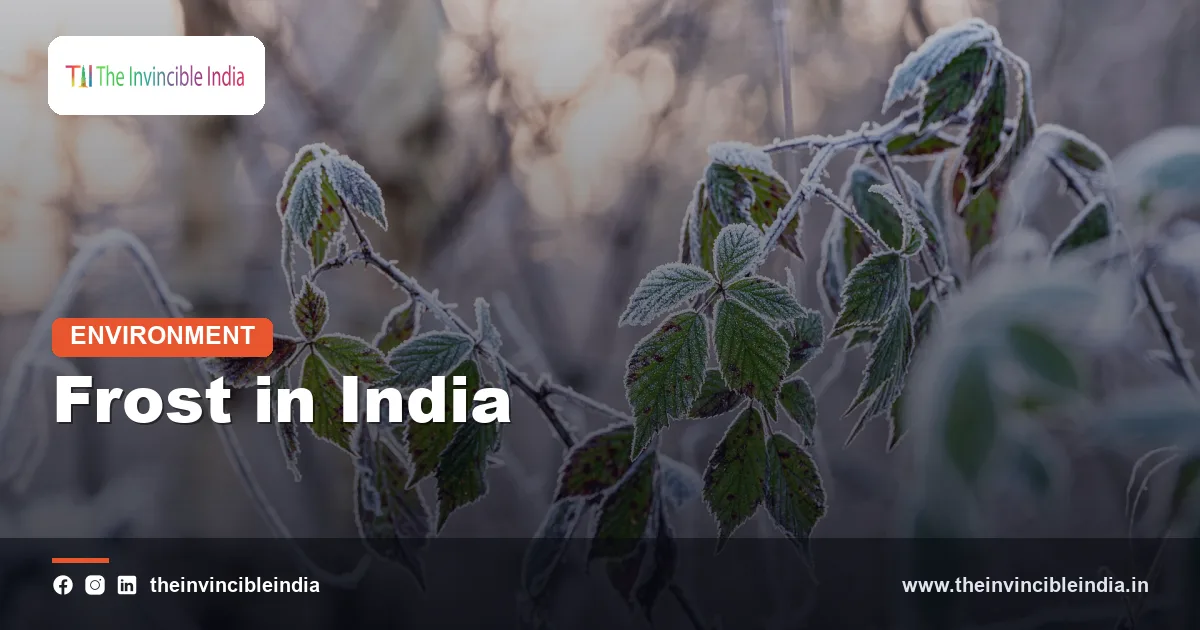
Frost is the thin layer of ice crystals that forms on the ground, plants and other surfaces when their temperature falls to freezing point or below on a cold night, and in India it is a winter hazard for the northern plains, the Himalayan foothills and a few southern hill valleys, where it can scorch or kill crops such as potato, mustard, peas and tea. Frost does not need a snowy landscape. A calm, clear night in December or January, with the air temperature just a few degrees above zero, is enough to freeze the leaves of a field.
The word frost is used in two ways, and the difference matters to farmers. It can mean the visible white deposit of ice, and it can also mean the freezing of plant tissue, which may occur even without a white coating. This explainer covers how frost forms, where and when it occurs in India, why some nights are riskier than others, how it damages crops, and the practical methods used to protect fields and orchards.
Quick Facts
| Phenomenon | Frost, ice deposit or freezing of plant tissue at or below 0 degrees Celsius |
|---|---|
| Main type in India | Radiation frost on clear, calm, dry winter nights |
| Other types | Advection frost (cold air mass arrives), hoar frost (white ice crystals) and black frost (freezing without a white deposit) |
| Peak season | Roughly December to February, most often in late December and January |
| Regions affected | Punjab, Haryana, Rajasthan, Uttar Pradesh, Bihar, Madhya Pradesh, Himachal Pradesh, Jammu and Kashmir, Uttarakhand and the Nilgiris |
| Crops at risk | Potato, mustard, peas, chickpea, tomato, brinjal, chilli, mango and papaya in flowering, banana, and tea in the hills |
| Frost-prone microsites | Low-lying hollows, valley floors and open fields where cold air collects |
| Protection methods | Light irrigation, smoke and heaters, covers and mulches, windbreaks and well-chosen sowing dates |
| Alerts and advisories | India Meteorological Department (IMD) forecasts and agromet advisories, including through mobile apps such as Meghdoot |
Key Takeaways
- Frost is ice that forms on surfaces, or the freezing of plant tissue, when temperature reaches 0 degrees Celsius or lower, and in India it is most common between December and February.
- Most Indian frost is radiation frost, which occurs on clear, still nights when the ground loses heat to space and the air close to the surface becomes colder than the air a few metres higher.
- Low-lying fields and valley floors are the coldest because cold, dense air drains downhill and settles there, so frost damage often appears in patches within the same farm.
- Frost kills plant cells when ice crystals form and rupture them, with flowering and young leafy stages the most sensitive, as seen in potato, mustard, peas, chickpea and vegetables.
- Farmers can reduce losses by applying a light irrigation before a cold night, using smoke or covers, setting up windbreaks and following IMD advisories.
- Fog and cloud keep the ground warmer, so frost is more likely under a clear sky than during dense fog, even though both occur in a cold spell.
What is frost?
Frost is a deposit of ice, or the freezing of moisture on plants and surfaces, that occurs when the temperature of the surface falls to 0 degrees Celsius or lower. In everyday weather it appears as a white, feathery coating on grass, car roofs and leaves in the early morning.
The ice does not come from frozen rain. When air close to a cold surface is chilled, water vapour changes directly into ice crystals on the surface, a process called deposition. This is like dew, which forms at temperatures above zero, except that the surface is below freezing. Where there is not enough moisture in the air, plants can still freeze without a white coating. Farmers call this black frost because the damaged leaves turn dark, and it is easy to underestimate because nothing white warns the farmer that the plants have frozen.
Meteorologists also distinguish air frost, when the thermometer in the standard shelter at about 1.2 metres records 0 degrees Celsius or less, from ground frost, when the temperature at grass level is at or below freezing while the air at shelter height is a little higher. Plants close to the ground can freeze on a night that the weather report calls merely very cold.
How does frost form?
Frost forms when a clear, calm night allows the ground and plants to lose heat by radiation until their surface temperature falls below freezing, even if the air a little higher up is slightly warmer. The sequence is simple and predictable.
- During the day, the ground and plants absorb heat from the Sun.
- After sunset, they radiate this heat to the sky as infrared radiation.
- If the sky is clear, little of that heat is returned by clouds, so the surface cools quickly.
- Calm air allows the coldest air to stay in contact with the surface, rather than mixing with warmer air above.
- Dry air means that less water vapour is present to hold heat, so cooling is faster.
- By early morning, surfaces fall below 0 degrees Celsius, and moisture freezes on them.
The coldest moment is usually just after sunrise, when the Sun has not yet warmed the ground. A long winter night in north India lasts well over twelve hours, and this long cooling period explains why December and January produce the worst frost.
What is the difference between radiation frost and advection frost?
Radiation frost is caused by local cooling of the surface under clear, calm skies, whereas advection frost is caused by the arrival of a large mass of very cold air, usually accompanied by wind. In India, radiation frost is by far the more common type, but the two often combine.
A cold wave from the north, brought by a western disturbance followed by dry northwesterly winds, can bring the cold air mass that sets the stage. Once the winds drop and the sky clears, radiation cooling can push the surface temperature below freezing. Advection frost is harder to fight because the wind prevents protection methods like smoke or irrigation from working well, and the cold affects a large area, not just low-lying spots. Radiation frost, in contrast, is local, shallow and variable, and so can be partly managed.
The second distinction is between white hoar frost, which forms where the air is moist, and black frost, which occurs when the air is very dry. Both can kill plants, so the absence of white deposits should never be taken as a sign of safety.
Where and when does frost occur in India?
Frost occurs mainly over the northern plains and hills of India from December to February, in states such as Punjab, Haryana, Rajasthan, Uttar Pradesh, Bihar, Madhya Pradesh, Himachal Pradesh, Uttarakhand and Jammu and Kashmir, with isolated frost in the Nilgiris of the south.
In the north-west, parts of Rajasthan such as Churu and Sri Ganganagar and the plains of Punjab and Haryana often record the lowest temperatures in the country outside the mountains during cold waves. The Indo-Gangetic Plain, being flat and open, allows cold air to settle and has long, clear nights between spells of fog. In the Himalayan states, frost begins earlier, from November, and combines with snow. Further south, the high hills of the Nilgiris, including the Udhagamandalam area, record ground frost in December and January, which affects tea and vegetable gardens.
Western disturbances, the eastward-moving weather systems of winter, are an important trigger. A disturbance brings rain and snow to the hills, and once it passes, a clear, dry spell with cold northerly winds often follows, which is when frost nights are the most likely. Years with several such sequences in the main cold months are the ones in which farmers report heavy losses.
Why does frost settle in low-lying areas?
Frost settles in low-lying areas because cold air is denser than warm air and flows downhill like water, collecting in hollows, valley floors and the lowest corners of fields. These places are called frost pockets, and they may be several degrees colder than higher ground nearby.
On a still night, a temperature inversion develops, meaning that the air is coldest at the ground and warmer a few metres higher up. The cold layer flows slowly down any slope and pools at the bottom. A farmer may therefore see healthy crop on a slight rise and scorched plants on lower ground a few hundred metres away. Obstacles such as hedges, embankments, railway lines and dense orchards can trap the cold air and make a pocket worse, while a break in the barrier lets the cold air escape.
The same principle explains why orchards in hill regions are planted on mid-slopes, and not on the valley floor, and why tea estates in the Nilgiris often find frost risk concentrated in particular valleys and hollows.
How does frost damage plants?
Frost damages plants because ice forms in the spaces between and inside cells, drawing water out and rupturing the cell walls, so that the tissue dehydrates, collapses and turns brown or black. The damage generally appears hours after the frost, once the plant thaws in the morning sun.
The severity depends on how low the temperature falls, how long it stays there and how the plant has adapted. Plants that have gone through a gradual cooling are hardier than those exposed to a sudden fall. Young tissue, flowers and fruit set are the most sensitive, and a few hours at slightly below zero can destroy a flowering crop. Wet leaves, plants under moisture stress and plants that have been over-fertilised with nitrogen are often more prone to injury.
Frost also causes indirect losses. It can make leaves more susceptible to diseases such as late blight in potato, reduce the quality and shelf life of produce, delay the next stage of growth and disturb pollination. In perennial crops, even a partial burn of new shoots can lower the following season’s yield.
Which Indian crops are most at risk from frost?
The Indian crops most at risk from frost are potato, mustard, peas, chickpea, vegetables such as tomato, brinjal and chilli, tropical fruit like papaya, banana and mango in flower, and tea in the hills. The risk is highest when frost coincides with flowering or early fruit set.
| Crop | Sensitive stage | Typical frost damage |
|---|---|---|
| Potato | Vegetative growth and tuber bulking in December-January | Blackened, scorched foliage; lower tuber yield and increased blight risk |
| Mustard | Flowering and pod setting | Flower drop, shrivelled pods and poor seed filling |
| Peas and chickpea | Flowering and pod formation | Flower and pod abortion, reduced yield |
| Tomato, brinjal, chilli | Seedling to fruiting | Leaf burn, fruit damage and plant death in nurseries |
| Mango | Flowering and fruit set (January-February) | Flower and young fruit drop |
| Papaya and banana | All stages, especially young plants | Leaf scorch, stunted growth, bunch damage |
| Tea (Nilgiris, Darjeeling foothills) | New flush and young bushes | Burnt shoots and a loss of leaf harvest for weeks |
| Wheat | Flowering and grain filling | Generally hardier, but a hard freeze at flowering can cause sterile ears |
The wheat crop, central to north India’s winter farming, is generally more tolerant of cold than the crops above, but it is harmed by an abnormal late-season temperature swing. Potato and mustard, in contrast, have been the focus of many frost advisories issued to farmers in the north.
Does fog protect crops from frost?
Fog can partly protect crops from frost because it acts like a blanket, reducing the heat the ground loses to the sky, so nights under dense fog are often a little warmer than clear nights at the same time of year. Yet fog brings its own problems, since it cuts sunlight and encourages fungal diseases.
The Indo-Gangetic Plain often experiences long spells of dense fog in late December and January. During these spells, the daytime temperature stays low because sunlight is blocked, and nights are mild relative to the day. The most dangerous frost nights typically come when the fog clears and a clear, still sky follows, especially after a western disturbance. For farmers, the answer is not to relax during fog but to track the forecast for the break in the weather that produces clear-sky cooling.
How can farmers protect crops from frost?
Farmers can protect crops from frost by applying a light irrigation just before a cold night, creating smoke or covering plants, shielding fields from cold winds with windbreaks, and choosing sowing dates and varieties that avoid the coldest weeks. These methods work best against radiation frost.
- Light irrigation: moist soil holds and conducts more heat than dry soil, and water releases heat as it cools and freezes, so irrigating a field a day before a forecast frost can keep the crop a degree or two warmer.
- Smoke and heat: burning straw or crop residue to create smoke, or using heaters in orchards, can reduce heat loss on a still night, though its benefit is limited and burning crop residue raises air-pollution concerns.
- Covers and mulch: straw, thatch, paddy husk, polythene or cloth over nurseries and young plants trap warmth, and the covers are removed in the morning once the temperature rises.
- Windbreaks: rows of trees or screens on the side from which cold winds blow reduce advection, and leaving gaps in barriers lets cold air drain away.
- Sowing time and variety: adjusting sowing dates so that flowering avoids the coldest weeks, and using more tolerant varieties.
- Crop care: avoiding late heavy nitrogen, and in some state advisories, spraying dilute sulphur or thiourea solutions to improve resistance.
The actions should follow the forecast. When the IMD issues a cold wave or ground frost alert for a district, the district’s agricultural science centre and state agriculture department usually pass on crop-specific advice. Farmers who irrigate and cover nurseries on the night before the alert are usually better placed than those who react after damage.
How do forecasters warn of frost?
Forecasters warn of frost by predicting night-time minimum temperatures, sky conditions and wind, and the India Meteorological Department issues cold wave and ground frost warnings and agromet advisories for districts through bulletins and mobile applications. The warnings aim to give farmers one to several days to prepare.
The IMD declares a cold wave using thresholds for the minimum temperature and its departure from normal, with different limits for the plains and for the hills, and it also warns of ground frost where conditions suit it. Under the Gramin Krishi Mausam Sewa programme, district-level agromet units translate the forecasts into farm advisories, which are shared by text message, radio and apps such as Meghdoot. Farmers can improve the accuracy of local warnings by keeping a simple minimum thermometer at crop height, because the temperature near the plants can be several degrees below the official reading taken in a standard shelter.
Is frost changing with climate change?
Frost is changing with climate change in complicated ways, as winters in much of India have warmed, which reduces the number of frost nights in many areas, while warm spells followed by sudden cold snaps can expose crops that have developed early. The evidence is still being worked out, and trends differ by region.
Warmer winter nights tend to reduce the length of the frost season in the long term. At the same time, the risk shifts when plants flower early in a warm spell and a late cold wave then arrives, a mismatch that can be more damaging than a normal frost. Changes in western disturbances, which bring winter rain and cold spells, are also a subject of active research, and the findings are not settled. Farmers and planners should therefore not assume frost will simply disappear, and continued monitoring and flexible advisories remain important.
Bottom Line
Frost in India is a short, sharp winter hazard rooted in a simple physical process: clear, calm nights let the ground lose its heat until moisture and plant tissue freeze. It is local, patchy and often predictable, which makes it manageable. Timely forecasts, a light irrigation, covers, smoke and sensible sowing dates can save a crop, while understanding the difference between frost and fog can prevent costly mistakes. Last updated: 2 November 2026.
Frequently Asked Questions
What is frost in simple words?
Frost is a thin coating of ice that forms on the ground and plants when their surface temperature drops to 0 degrees Celsius or below. It is common on clear, still winter nights. Plants can also freeze and be damaged without any visible white coating.
Which parts of India get frost?
Frost is common in the northern plains and hills, including Punjab, Haryana, Rajasthan, Uttar Pradesh, Bihar, Madhya Pradesh, Himachal Pradesh, Uttarakhand and Jammu and Kashmir. Ground frost also occurs in the Nilgiris in the south, mostly in December and January.
Why does frost damage potato and mustard?
Frost freezes the water inside plant cells, which breaks the cell walls and kills tissue. Potato leaves are scorched, which lowers tuber yield and invites blight, while mustard flowers and pods drop or fail to fill. Flowering stages are the most sensitive.
What is the difference between frost and fog?
Frost is ice on a surface that forms at or below freezing point, while fog is a cloud of tiny water droplets near the ground that cuts visibility. Fog acts like a blanket and reduces frost, and frost is most likely under a clear sky.
How can farmers protect crops from frost?
Farmers can give a light irrigation before a cold night, cover nurseries and young plants with straw or polythene, create smoke, plant windbreaks and adjust sowing dates. Following IMD cold wave and ground frost advisories lets them prepare in advance.
Does it frost when the temperature is above zero?
Yes, frost can form on the ground and plants even when the official air temperature is a few degrees above zero. Surfaces cool faster than the air at shelter height on clear, calm nights, so ground frost may occur while the weather report shows a small positive temperature.
{“@context”:”https://schema.org”,”@graph”:[{“@type”:”FAQPage”,”mainEntity”:[{“@type”:”Question”,”name”:”What is frost in simple words?”,”acceptedAnswer”:{“@type”:”Answer”,”text”:”Frost is a thin coating of ice that forms on the ground and plants when their surface temperature drops to 0 degrees Celsius or below. It is common on clear, still winter nights. Plants can also freeze and be damaged without any visible white coating.”}},{“@type”:”Question”,”name”:”Which parts of India get frost?”,”acceptedAnswer”:{“@type”:”Answer”,”text”:”Frost is common in the northern plains and hills, including Punjab, Haryana, Rajasthan, Uttar Pradesh, Bihar, Madhya Pradesh, Himachal Pradesh, Uttarakhand and Jammu and Kashmir. Ground frost also occurs in the Nilgiris in the south, mostly in December and January.”}},{“@type”:”Question”,”name”:”Why does frost damage potato and mustard?”,”acceptedAnswer”:{“@type”:”Answer”,”text”:”Frost freezes the water inside plant cells, which breaks the cell walls and kills tissue. Potato leaves are scorched, which lowers tuber yield and invites blight, while mustard flowers and pods drop or fail to fill. Flowering stages are the most sensitive.”}},{“@type”:”Question”,”name”:”What is the difference between frost and fog?”,”acceptedAnswer”:{“@type”:”Answer”,”text”:”Frost is ice on a surface that forms at or below freezing point, while fog is a cloud of tiny water droplets near the ground that cuts visibility. Fog acts like a blanket and reduces frost, and frost is most likely under a clear sky.”}},{“@type”:”Question”,”name”:”How can farmers protect crops from frost?”,”acceptedAnswer”:{“@type”:”Answer”,”text”:”Farmers can give a light irrigation before a cold night, cover nurseries and young plants with straw or polythene, create smoke, plant windbreaks and adjust sowing dates. Following IMD cold wave and ground frost advisories lets them prepare in advance.”}},{“@type”:”Question”,”name”:”Does it frost when the temperature is above zero?”,”acceptedAnswer”:{“@type”:”Answer”,”text”:”Yes, frost can form on the ground and plants even when the official air temperature is a few degrees above zero. Surfaces cool faster than the air at shelter height on clear, calm nights, so ground frost may occur while the weather report shows a small positive temperature.”}}]}]}


