

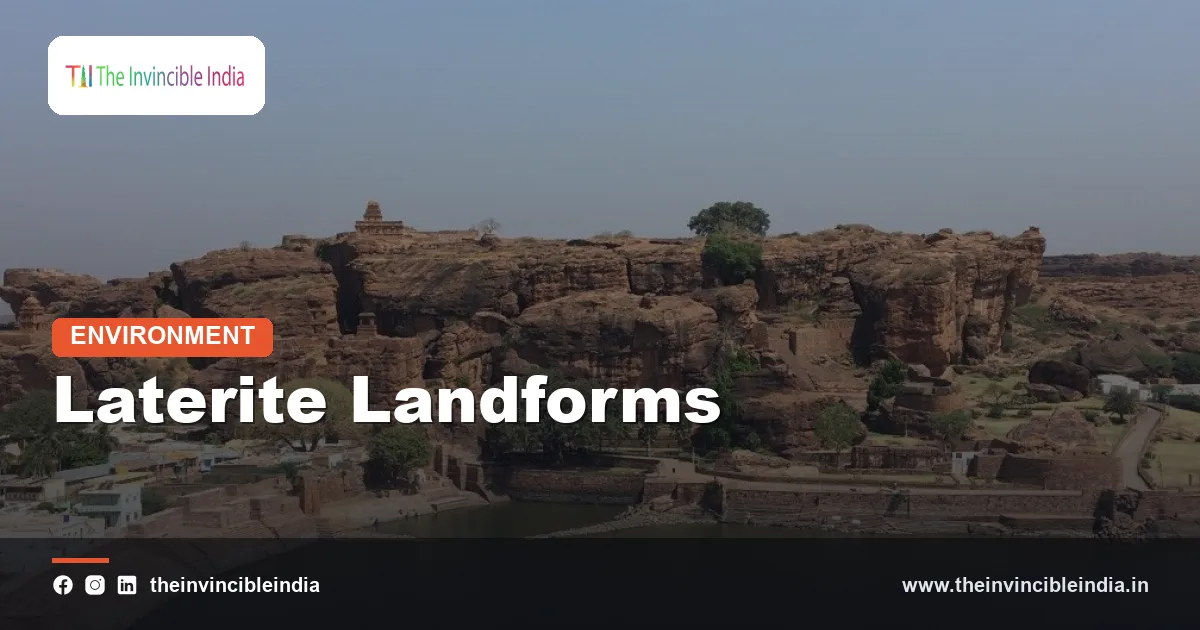
In India, laterite landforms are the flat-topped red plateaus, low cliffs and rusty hill caps built from laterite, an iron- and aluminium-rich rock that forms when heavy tropical rain washes silica and other soluble minerals out of older rock and leaves the metal oxides behind. You meet them on the coastal plateaus of the Konkan, along the Malabar coast of Kerala, on the high tablelands of the Western Ghats and across parts of Odisha, Jharkhand and the Chotanagpur region. Last reviewed: 3 November 2026.
These landscapes look barren in the dry months and spectacular in the monsoon, and they have shaped how people build, farm and mine for centuries. The very word “laterite” was coined from the Latin word for brick after a British surgeon described the red stone of Malabar, where villagers cut it fresh from the ground and let the sun harden it into building blocks. Below we explain what laterite is, how it forms, where it caps India’s uplands, and why it matters for soils, wildlife, bauxite and heritage.
| Feature | Quick fact |
|---|---|
| What it is | A red-brown, iron- and aluminium-rich weathering product that hardens into a rocky crust |
| How it forms | Intense chemical weathering and leaching under hot, wet-and-dry tropical climates |
| Main Indian regions | Konkan coast, Malabar coast, Western Ghats tablelands, Odisha, Jharkhand, Chotanagpur, Meghalaya and pockets of the Eastern Ghats |
| Typical landform | Flat-topped plateau or mesa with steep edges, locally called a sada in parts of the Konkan |
| Colour | Brick-red, rusty brown, yellow or mottled |
| Soil character | Acidic, leached, low in nutrients and humus, but well drained |
| Human uses | Cut blocks for houses, forts and temples, road metal, and a source of bauxite in some places |
| Main concerns | Quarrying, mining, land-use change, and mislabelling of plateaus as wasteland |
Key Takeaways
- Laterite is a rock formed by deep tropical weathering in which iron and aluminium oxides stay behind while silica and nutrients are leached away.
- Laterite landforms in India are mainly flat-topped plateaus and low scarps found along the Konkan and Malabar coasts, the Western Ghats uplands, Odisha, Jharkhand and the Chotanagpur plateau.
- Fresh laterite is soft enough to cut with an iron tool, but it hardens on exposure to air, which is why it became a traditional building stone in Kerala, Goa and the Konkan.
- Laterite soils are acidic and poor in nutrients, so they suit cashew, tapioca, rubber and plantation crops better than cereals unless they are carefully managed.
- Bauxite, the main ore of aluminium, is often a more extreme product of the same weathering and frequently sits beneath or within laterite caps.
- Laterite plateaus are ecologically rich, with seasonal wildflowers and rock pools, yet they are often wrongly classed as wasteland and opened to quarrying or development.
What exactly is laterite?
Laterite is a rock-like layer of reddish, iron- and aluminium-rich material produced by long and intense chemical weathering of the underlying bedrock in a warm, rainy climate. It is not a rock in the way granite or basalt is, because it is not a primary rock cooled from magma or laid down as sediment. It is a weathering product, a kind of rusted, leached skeleton that remains after water has carried away most of the original minerals.
Geologists describe laterite as being dominated by iron oxides such as goethite and hematite, by aluminium minerals such as gibbsite and kaolinite, and by quartz that survived the leaching. The iron gives the rock its typical red, orange and brown colour, much like rust on an old gate. Because the mix varies from place to place, laterite can be dense and iron-rich in one quarry and chalky and aluminium-rich in the next.
The name comes from the Latin word later, meaning brick. It was first used in the early nineteenth century by Francis Buchanan, who saw the soft red material being dug out in Malabar and cut into rectangular blocks that hardened in the sun. That origin matters because it captures the single most unusual property of laterite: it can be soft when freshly cut and rock-hard after it dries.
How do laterite landforms form?
Laterite landforms form when a stable land surface sits for a very long time under a hot climate with heavy seasonal rain, so that groundwater slowly dissolves and removes the soluble parts of the rock beneath it. The process is called lateritisation, and it needs three ingredients: warmth, plenty of water and time.
In a typical sequence, rain soaks into basalt, granite or gneiss and percolates downward through cracks. The water is mildly acidic because it picks up carbon dioxide and organic acids from the soil. It dissolves calcium, magnesium, sodium, potassium and much of the silica and carries them away in drainage. Iron and aluminium are far less soluble, so they are left behind and concentrate near the surface.
A pattern of alternating wet and dry seasons is especially helpful. During the rains the water table rises and the upper layers are leached and saturated. In the dry months the water table falls, and iron compounds dry out and precipitate as hard, cement-like nodules and crusts. Repeated cycles over millions of years build a thick hard cap known as a duricrust or cuirass. Many Indian laterites are thought to have developed during the warm, humid phases of the Palaeogene and Neogene periods, though dating is difficult and studies disagree on exact ages.
Once the cap forms, it protects the soft weathered material beneath from erosion. As rivers cut valleys around it, the resistant cap is left standing as a plateau or mesa with steep sides. That is how a weathering crust turns into a landform.
What are the layers of a laterite profile?
A complete laterite profile has distinct layers, with the hard iron-rich crust at the top, a mottled clay zone below, a pale leached zone under that and fresh bedrock at the bottom. The thickness ranges from a few metres to several tens of metres, depending on climate, rock type and the age of the surface. The table below sets out the usual sequence from top to bottom.
| Layer | What it looks like | What it tells us |
|---|---|---|
| Duricrust or cap | Hard, pitted, rusty crust that rings like brick when struck | Iron oxides cemented the top during dry seasons |
| Mottled zone | Clay with red, yellow and white patches | The water table rose and fell here, moving iron around |
| Pallid zone | Pale, bleached clay-rich material, often low in iron | Iron has been dissolved and carried away from this layer |
| Saprolite | Rotten, crumbly rock that still shows the original rock texture | The bedrock has chemically decayed in place |
| Fresh bedrock | Unweathered basalt, granite or gneiss | The starting material for the whole profile |
Where are laterite landforms found in India?
Laterite landforms are concentrated in the high-rainfall belts of peninsular and eastern India, with the finest examples on the Konkan coast, in Kerala and Karnataka, and on the plateaus of Odisha and Jharkhand. Rainfall of roughly 1,500 millimetres or more, combined with a pronounced dry season, is the common thread.
Along the Konkan in Maharashtra, laterite plateaus sit above the narrow coastal plain in districts such as Ratnagiri and Sindhudurg and stretch south into Goa. Their basalt bedrock, part of the great Deccan volcanic province, has been rusted and capped by laterite. In Kerala and coastal Karnataka, laterite forms low rolling hills and terraces between the Western Ghats and the sea, and it is the commonest rock of the Malabar plains.
The tablelands of the Western Ghats provide further examples. Hill stations such as Matheran, Mahabaleshwar and Panchgani are famous for their flat, red-capped tops. Farther inland and east, laterite and bauxite caps crown the Chotanagpur plateau in Jharkhand, the Eastern Ghats and plateau country of Odisha, parts of Chhattisgarh and Madhya Pradesh such as Amarkantak, and the Meghalaya plateau. Laterite also occurs in Tamil Nadu, Andhra Pradesh, West Bengal and Assam, though less spectacularly.
What do laterite plateaus look like on the ground?
A laterite plateau looks like a broad, nearly flat tableland of bare red-brown rock with thin soil, scattered shrubs and abrupt edges where the crust ends in a small cliff. The surface is often pitted and honeycombed, dotted with shallow depressions that fill with rainwater in the monsoon.
In the Konkan, these plateaus are known as sadas, and many stand a few tens to a couple of hundred metres above sea level. In the dry season they seem empty, with cracked rock, short grass and a hot glare. After the first heavy rains they change dramatically. Carpets of small annual herbs bloom in succession, and temporary pools support insects, frogs and migratory birds. The Kaas plateau near Satara, part of the Western Ghats World Heritage listing, is the best-known example of this seasonal flowering, although its rock is mainly basalt with a lateritic cover rather than thick laterite.
Edges and quarry faces reveal the internal layers. You can often see the hard rusty cap on top and softer, mottled, clay-rich material below. Where the cap is cut through, the softer layers erode quickly, which is why laterite scarps retreat slowly and unevenly. Laterite plateaus also carry cultural marks. In parts of the Konkan, ancient petroglyphs have been carved into the flat rock surfaces, and several sites have been placed on India’s tentative list for World Heritage consideration.
Why is laterite soil poor for most crops?
Laterite soil is poor for most crops because the same heavy rain that built it also leached away nitrogen, calcium, potassium and humus, leaving an acidic, iron-rich soil that holds few nutrients. Red laterite soils cover large parts of Kerala, Karnataka, Tamil Nadu, Odisha, Assam and the Konkan, and they are widely mapped as a distinct soil group in India.
The soil is porous and drains fast, so water and fertiliser are quickly lost. Its iron and aluminium also bind phosphorus, making this essential nutrient hard for plants to absorb. In the dry season the surface can harden into a crust that is difficult to plough. For these reasons cereals such as wheat do poorly without heavy inputs.
Farmers have adapted by choosing crops that tolerate acid, low-fertility ground. Cashew is the signature crop of the Konkan and Kerala laterites, and tapioca, coconut, arecanut, rubber, tea, coffee and spices are grown on laterite-derived soils in the Western Ghats foothills. Where there is irrigation and organic matter, yields can improve. Adding compost, green manure and lime, planting trees and leaving crop residue on the ground all rebuild fertility. Hardpan layers can be broken up by deep tillage, and mulching reduces moisture loss.
How have people used laterite as a building stone?
People have used laterite for centuries as a cheap building stone, cutting soft blocks straight from the ground with iron tools and letting them harden in the open air. This tradition survives in the Konkan, where the stone is known as jambha, and in Kerala, where laterite blocks are called chenkal or red stone.
Because the blocks are cut fresh, quarrying is relatively simple, and the resulting walls are porous and thermally comfortable. Houses, temple platforms, boundary walls, wells, forts and churches across Goa, the Konkan and Kerala are built of the stone. Many older Portuguese-era churches in Goa and countless traditional Kerala homes show its warm brick-red colour. The rock also does well in humid climates, where the stone takes on a rough, mossy patina in the monsoon.
The trade-offs are practical. Laterite is relatively weak compared with granite and absorbs water, so builders often plaster it or coat it with lime. Cutting is labour-intensive, and large pits left behind by quarrying can become dangerous or fill with water. Even so, the stone has become more valued by architects interested in local, low-carbon materials, and modern builders increasingly use laterite for cladding and landscaping alongside concrete.
What is the link between laterite and bauxite?
Bauxite, the main ore of aluminium, is essentially an extreme form of laterite in which leaching has removed so much silica and iron that aluminium hydroxides dominate. The two are neighbours in the same weathering family, and bauxite is frequently found as lenses or layers within or beneath a laterite cap.
Whether a profile ends up as iron-rich laterite or aluminium-rich bauxite depends on the parent rock, the drainage and the length of weathering. Rocks rich in aluminium and poor in iron, such as certain granites, gneisses and khondalites, tend to yield bauxite where drainage is good and leaching is complete. In India, such bauxite caps cover the tops of plateaus and hills in Odisha, Jharkhand, Chhattisgarh, Gujarat, Maharashtra and Madhya Pradesh, and Odisha holds a large share of the country’s reserves.
This link makes laterite plateaus economically and politically sensitive. A hill that locals regard as sacred, forested and a source of streams may also lie on a valuable ore body. The debates over bauxite mining in the Niyamgiri hills of Odisha, which reached the Supreme Court and involved village councils, are a well-known example of how a geological resource can collide with livelihoods and culture. Mining a plateau cap removes the very layer that sustains its seasonal wetlands.
Why are laterite plateaus ecologically important?
Laterite plateaus are ecologically important because their thin soils, seasonal pools and open rock support specialised plants and animals, hold rainwater for recharge, and act as grazing commons for villages. They are among the most distinctive habitats of the Western Ghats region, which is a recognised global biodiversity hotspot.
Many plant species on these plateaus are small annuals and herbs that complete their life cycle within the short wet season, then survive the dry months as seed or underground storage organs. Some are found nowhere else. The shallow rock pools support amphibians, aquatic insects and invertebrates that need temporary water. Grassy patches feed grazing animals, and the open ground provides habitat for ground-nesting birds.
The rock also performs a water function. Weathered laterite is porous and holds water in pores and cracks, so plateau surfaces absorb monsoon rain and release it slowly as springs and seepages on the slopes below. Many villages in the Konkan and Kerala depend on laterite-fed wells and springs, which is why plateau quarrying and soil removal can affect local water supply downstream.
What threatens laterite landscapes today?
Laterite landscapes today are threatened mainly by quarrying, bauxite and other mining, plantations, wind and real-estate projects, and by a long habit of treating them as useless wasteland. In revenue records, many plateau lands in Maharashtra and elsewhere have been classed as barren or wasteland, which makes it easy to approve conversion for other uses.
Ecologists argue that this classification misses their value as seasonal wetlands, grasslands and aquifer recharge zones. Excavating the cap can destroy the shallow pools and the unique flora in a single season, and recovery may take very long because the soil forms so slowly. Quarry pits also cause local erosion and, in some places, safety hazards and dust.
Protection has been uneven. Some sites enjoy cover as part of protected areas or the Western Ghats World Heritage listing, while many others have no formal status. Conservation proposals include mapping plateaus, recognising them as distinct ecosystems in land records, regulating quarrying as a minor mineral through clear permits, and involving gram sabhas in management. Rehabilitating quarries as ponds or restored grassland is a practical way to reduce damage where extraction has already taken place.
How old are India’s laterites, and do they record climate change?
India’s laterites are generally considered to be many millions of years old, and they record episodes of warm, humid climate in the geological past. Researchers use their chemistry, magnetic properties and position in the landscape to estimate when they formed, though the results vary by site and method.
Because laterite needs a long, stable and humid history, a thick profile suggests that the land surface was not eroded or stripped for a great span of time. Some profiles have been dated using methods based on iron and manganese minerals, which indicate repeated phases of weathering. These records help scientists reconstruct how the peninsula drifted northward after separating from other landmasses and how the monsoon has changed. Studies suggest that parts of the Western Ghats and the southern peninsula went through more than one wet phase, but no single date fits all of India.
Laterites can also be recycled. Once uplifted and eroded, fragments of the crust wash downhill and are redeposited as gravelly material, sometimes cemented again into secondary laterite. This explains why some Indian laterites occur not on plateaus but on slopes, valley edges and coastal terraces.
Bottom Line
Laterite landforms are slow-made, wet-tropics landscapes: rusted caps that outlast the softer rock around them and stand as plateaus, scarps and tablelands. They give India a distinctive building stone, a modest cashew-and-plantation soil, a link to its bauxite wealth and a seasonal habitat of wildflowers and rock pools. Treating them as wasteland overlooks their water, biodiversity and cultural value. Understanding how they formed is the first step in deciding which plateaus to quarry, which to farm and which to protect.
Frequently Asked Questions
What is laterite in simple words?
Laterite is a red-brown, iron- and aluminium-rich rock that forms when heavy tropical rain leaches silica and nutrients out of older rock. It is soft when freshly cut and hardens on exposure to air, which is why it was long used as a building stone.
Which states in India have laterite plateaus?
Laterite plateaus are most common in Maharashtra’s Konkan, Goa, Kerala and Karnataka along the west coast, and in Odisha, Jharkhand and Chhattisgarh in the east. Smaller areas occur in Tamil Nadu, Andhra Pradesh, West Bengal, Assam and Meghalaya.
Why is laterite soil not good for farming?
Heavy rain leaches nutrients and humus from laterite soil, leaving it acidic, porous and low in nitrogen, phosphorus and potassium. It suits cashew, rubber, tapioca and plantation crops, and it needs organic matter and careful management for other crops.
How is laterite different from bauxite?
Laterite is mostly iron-rich weathered material, while bauxite is aluminium-rich and is the main ore of aluminium. Bauxite is formed by more complete leaching and often occurs inside or below laterite caps.
Why is laterite used to make building blocks?
Fresh laterite is soft enough to be cut with iron tools straight from the ground, then it hardens when exposed to air and sun. That makes it a cheap, locally available stone, widely used in Goa, the Konkan and Kerala.
Are laterite plateaus wastelands?
No. Although they are often labelled wasteland in land records, laterite plateaus host seasonal wildflowers, rock pools and grazing commons, and they recharge groundwater. Ecologists argue they should be recognised and protected as distinct ecosystems.
{“@context”:”https://schema.org”,”@graph”:[{“@type”:”FAQPage”,”mainEntity”:[{“@type”:”Question”,”name”:”What is laterite in simple words?”,”acceptedAnswer”:{“@type”:”Answer”,”text”:”Laterite is a red-brown, iron- and aluminium-rich rock that forms when heavy tropical rain leaches silica and nutrients out of older rock. It is soft when freshly cut and hardens on exposure to air, which is why it was long used as a building stone.”}},{“@type”:”Question”,”name”:”Which states in India have laterite plateaus?”,”acceptedAnswer”:{“@type”:”Answer”,”text”:”Laterite plateaus are most common in Maharashtra’s Konkan, Goa, Kerala and Karnataka along the west coast, and in Odisha, Jharkhand and Chhattisgarh in the east. Smaller areas occur in Tamil Nadu, Andhra Pradesh, West Bengal, Assam and Meghalaya.”}},{“@type”:”Question”,”name”:”Why is laterite soil not good for farming?”,”acceptedAnswer”:{“@type”:”Answer”,”text”:”Heavy rain leaches nutrients and humus from laterite soil, leaving it acidic, porous and low in nitrogen, phosphorus and potassium. It suits cashew, rubber, tapioca and plantation crops, and it needs organic matter and careful management for other crops.”}},{“@type”:”Question”,”name”:”How is laterite different from bauxite?”,”acceptedAnswer”:{“@type”:”Answer”,”text”:”Laterite is mostly iron-rich weathered material, while bauxite is aluminium-rich and is the main ore of aluminium. Bauxite is formed by more complete leaching and often occurs inside or below laterite caps.”}},{“@type”:”Question”,”name”:”Why is laterite used to make building blocks?”,”acceptedAnswer”:{“@type”:”Answer”,”text”:”Fresh laterite is soft enough to be cut with iron tools straight from the ground, then it hardens when exposed to air and sun. That makes it a cheap, locally available stone, widely used in Goa, the Konkan and Kerala.”}},{“@type”:”Question”,”name”:”Are laterite plateaus wastelands?”,”acceptedAnswer”:{“@type”:”Answer”,”text”:”No. Although they are often labelled wasteland in land records, laterite plateaus host seasonal wildflowers, rock pools and grazing commons, and they recharge groundwater. Ecologists argue they should be recognised and protected as distinct ecosystems.”}}]}]}


