

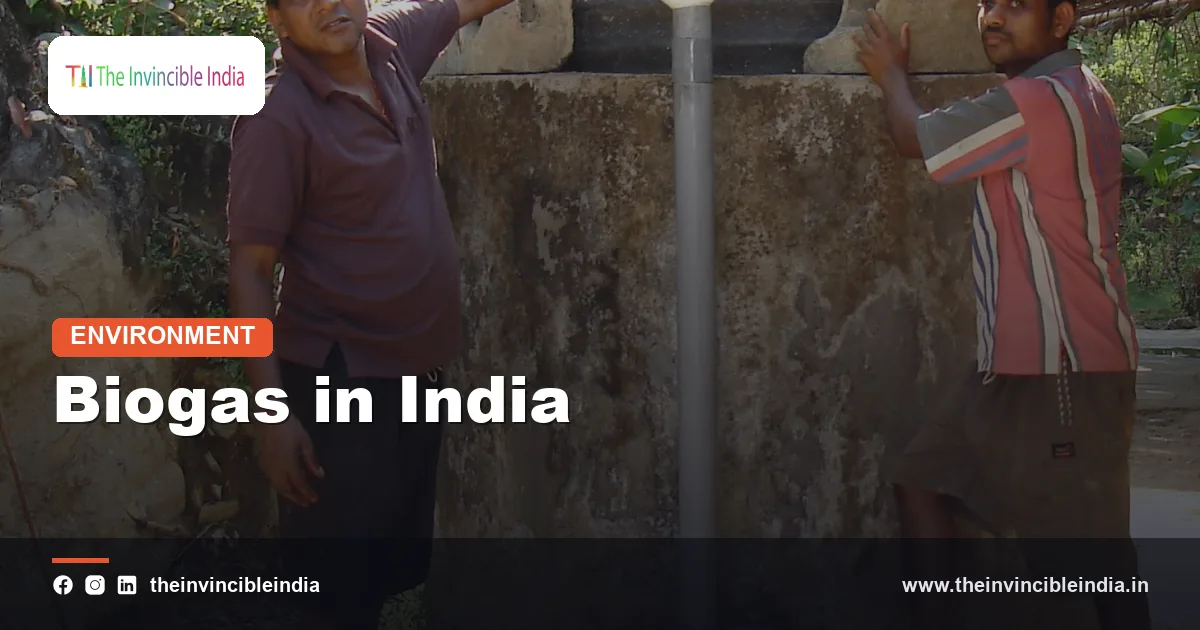
In India, biogas is a renewable fuel gas, rich in methane, produced when bacteria break down organic waste such as cattle dung, kitchen scraps, crop residue and sewage in the absence of air. India has used it for decades in village gobar-gas plants that turn dung into cooking fuel, and it is now being scaled up into compressed biogas for vehicles and industry, so that a waste problem becomes an energy and fertiliser opportunity.
This explainer sets out how biogas is made, how the classic gobar-gas plant works, what compressed biogas and the SATAT scheme are, what GOBARdhan aims to do, and what biogas means for farmers, clean cooking and the climate. It also looks at why many earlier plants stopped working and what has to change for the technology to deliver at scale. Last updated: 3 November 2026.
| What it is | A mixture of methane and carbon dioxide produced by anaerobic digestion of organic waste |
|---|---|
| Typical composition | Roughly 55 to 65 per cent methane, 35 to 45 per cent carbon dioxide, and traces of hydrogen sulphide |
| Feedstocks | Cattle dung, food and kitchen waste, crop residue, press mud, sewage and poultry litter |
| By-product | Digested slurry, a nutrient-rich organic manure |
| Traditional form | Gobar-gas plant: a family-size digester feeding a kitchen stove |
| Upgraded form | Compressed biogas (CBG), purified to a high methane content and sold like CNG |
| Key programmes | National biogas programmes, GOBARdhan (launched in 2018) and SATAT for CBG |
| Main challenges | Feedstock supply, plant upkeep, cold weather, capital cost and gas leakage |
Key Takeaways
- Biogas is a methane-rich gas made by bacteria digesting organic waste without oxygen, and it can be burnt for cooking, lighting, electricity or, once purified, used as vehicle fuel.
- Every biogas plant also produces slurry, a nutrient-rich organic fertiliser, so the technology gives farmers both fuel and manure from waste they already have.
- Traditional gobar-gas plants run on cattle dung and have supplied clean cooking gas to millions of rural households, though many have fallen into disuse for lack of feed and repair.
- Compressed biogas, or CBG, is purified biogas that can replace CNG, and the SATAT scheme and the GOBARdhan initiative aim to build a network of plants that turn farm, city and dairy waste into fuel.
- Biogas cuts the smoke from firewood and dung cakes, reduces methane that would escape from rotting waste, and displaces fossil fuel, but leaks of unburnt methane can undo some of these gains.
- The technology works best when feedstock is reliable, plants are well designed and maintained, and local users are involved from the start.
What is biogas and how is it made?
Biogas is made by anaerobic digestion, a natural process in which communities of microbes break down organic matter in a sealed, oxygen-free tank and release a mixture of methane and carbon dioxide. The same process occurs in marshes and in the stomachs of cattle, and a biogas plant simply gathers it in a controlled container so that the gas can be captured and used.
The digestion happens in four overlapping stages. In hydrolysis, large molecules such as starches, fats and proteins are split into smaller ones. In acidogenesis, other bacteria turn these into organic acids, alcohols, hydrogen and carbon dioxide. In acetogenesis, the acids are converted mainly into acetic acid. Finally, in methanogenesis, a group of microbes called methanogens turn acetic acid and hydrogen into methane, the energy-rich part of the gas. The whole process takes days to weeks depending on the feed and temperature.
Temperature matters a great deal. Most village plants work in the mesophilic range, roughly between 25 and 40 degrees Celsius, where the microbes are happiest, which is why biogas performs well in much of peninsular India and slows during cold northern winters. The gas contains some hydrogen sulphide, which smells like rotten eggs and can corrode metal parts, so larger plants clean it out. Burnt in a simple stove the gas gives a clean blue flame with little smoke, and it can also run engines for electricity.
What is gobar gas and how does a traditional plant work?
Gobar gas is the Indian name for biogas made from cow and buffalo dung, and a traditional plant works by mixing fresh dung with water, feeding it into an underground digester, and collecting the gas in a dome or drum to pipe it to the kitchen. The word gobar simply means cow dung in Hindi, and for generations dung has been India’s most common rural fuel and fertiliser, so using it in a digester was a natural step.
A family plant has a few basic parts: an inlet tank where dung and water are mixed, a digester chamber below ground, a gas holder, an outlet for the spent slurry and a pipe to the stove. Dung is fed in daily, gas collects above the slurry, and an equal volume of digested slurry is displaced out through the outlet into a pit, where it can be used as manure. The system needs no electricity and few moving parts, which made it suitable for villages.
The scale is modest but meaningful. A small plant of about two cubic metres capacity, fed by dung from a few cattle, can supply much of a family’s daily cooking gas, and it replaces firewood or dung cakes that would otherwise be burnt. As a rough guide, one cubic metre of biogas holds about as much cooking energy as half a kilogram of LPG. The family stirs in clean water, avoids feeding in things like detergent, citrus or large quantities of disinfectant, and keeps the plant free of leaks.
What are the main types of biogas plant used in India?
India’s family-size biogas plants have mostly followed three designs, the floating-drum KVIC model, the fixed-dome Janata model and the cheaper fixed-dome Deenbandhu model, each balancing cost, durability and ease of use differently. All three are fed with dung, but they differ in how the gas is stored and how much they cost to build.
| Design | How the gas is stored | Strengths and drawbacks |
|---|---|---|
| KVIC floating drum | A steel drum rises and falls over the digester as gas accumulates | Steady gas pressure and easy to read gas level, but the steel drum is costly and can rust |
| Janata fixed dome | Masonry dome fixed over the digester; slurry is pushed out as gas builds | No steel, long life, but gas pressure varies and cracks in masonry can cause leaks |
| Deenbandhu fixed dome | A curved, compact masonry dome and base | Lower cost and strong shape, which helped spread plants to poorer households |
| Prefabricated or portable units | Moulded tanks or flexible bags | Quick to install and suit small spaces, but durability depends on material quality |
The floating-drum design was developed in the 1950s by the Khadi and Village Industries Commission, and the fixed-dome designs followed in later decades to cut the cost of steel and improve durability. Modern programmes also support larger community and institutional plants for schools, dairies, farms and temples, along with newer modular plants that suit kitchen waste in cities.
What waste can be used to make biogas?
A wide range of organic waste can be turned into biogas, from cattle dung and poultry droppings to kitchen scraps, crop residue, sugar-mill by-products and sewage sludge. Dung remains the traditional feedstock because it already contains the right bacteria, but food and farm waste often yield more gas per tonne.
- Cattle and buffalo dung: the classic village feed, rich in microbes and widely available where livestock are kept.
- Kitchen and food waste: from households, hotels, markets and canteens, and especially valuable for city plants.
- Crop residue: paddy straw, maize stalks and other residues, which can reduce the burning of stubble after harvest if collected and processed.
- Press mud and bagasse: by-products of sugar mills that can feed large plants.
- Napier and other energy grasses: grown on marginal land as dedicated feed.
- Sewage and poultry waste: sludge from treatment plants and litter from poultry farms.
Mixing different feeds, a practice known as co-digestion, often boosts gas output. Tough materials such as straw need pre-treatment because they break down slowly, and material contaminated with plastic, stones or chemicals can harm the digester. Keeping the feed clean, regular and well mixed is the single most important habit for a healthy plant.
What is compressed biogas and the SATAT scheme?
Compressed biogas, or CBG, is biogas that has been purified to remove carbon dioxide and impurities, leaving a gas that is mostly methane and chemically equivalent to compressed natural gas, so it can fuel vehicles and feed gas networks. It is sometimes called bio-CNG, and it turns a local waste stream into a drop-in replacement for an imported fossil fuel.
SATAT, which stands for Sustainable Alternative Towards Affordable Transportation, was launched by the petroleum ministry in 2018 to encourage entrepreneurs to set up CBG plants, with oil marketing companies agreeing to buy the output under long-term arrangements. The original ambition was to build thousands of plants and produce millions of tonnes of CBG a year within a few years. Progress has been slower than hoped, but the number of operating plants has been growing, and several large plants are now in operation.
Policy has since added pressure from the demand side. The government has announced blending obligations that require gas-selling companies to mix rising shares of CBG into the CNG and piped cooking gas they supply, to create assured demand. Plants in cities such as Indore, built around municipal solid waste, and plants in Punjab and Haryana looking at crop residue, show the range of models. Large plants face challenges in sourcing feed, getting finance and managing the by-product, but they point to a market in which waste has a price.
What is GOBARdhan?
GOBARdhan, short for Galvanizing Organic Bio-Agro Resources Dhan, is a national initiative launched in 2018 to convert cattle dung and other organic waste in villages and towns into biogas, compressed biogas and organic manure, creating wealth from waste. The word dhan means wealth, and the name plays on gobar, dung.
The scheme began under the drinking water and sanitation department as part of rural cleanliness efforts, linking waste management to clean energy and village income. Its approach is to build biogas plants of different sizes, from household to community to large commercial ones, and to connect them to farmers who supply dung, to cooperatives and self-help groups who run plants, and to buyers of gas and manure. Later announcements broadened it, with budget support for a large number of new waste-to-wealth plants including CBG plants, and a push to include urban waste.
The idea is that cattle owners earn money from dung that would otherwise be dried for fuel or left to pile up, villages become cleaner, and farmers receive quality organic manure. A portal brings together plant owners and registered buyers. Success will depend on whether the supply chains for dung and the markets for gas and manure work reliably, because a plant that cannot sell its products or fill its digester will quickly stop.
How does biogas help farmers and rural households?
Biogas helps farmers by turning dung and crop waste into both cooking fuel and high-quality organic manure, which cuts spending on firewood, LPG and chemical fertiliser while keeping villages cleaner. For a household with a few cattle, a small plant can convert a daily chore into a steady supply of gas.
The slurry that leaves a digester is a real benefit. It keeps most of the nitrogen, phosphorus and potassium of the original dung, in a form plants can use more quickly, and it carries less smell and fewer weed seeds and pathogens than raw dung. Farmers apply it to fields or dry it into a solid manure, and fermented organic manure is increasingly promoted as a substitute for part of the chemical fertiliser that the government subsidises heavily. Better soil organic matter also helps crops cope with heat and dry spells.
Biogas can also create income. Dairy cooperatives and farmer groups can sell gas, electricity or manure, and processing crop residue can earn farmers money instead of leaving them to burn it, which causes smoke across north India in the post-harvest months. Rural entrepreneurs gain work in construction, operation and transport. For landless families without cattle, the benefits come indirectly, through community plants and cleaner villages.
How does biogas support clean cooking and health?
Biogas supports clean cooking by giving households a smokeless fuel that can replace firewood, crop waste and dung cakes, which fill kitchens with fine particles and carbon monoxide that damage lungs and eyes. Indoor air pollution from solid-fuel cooking is a significant health burden in India, and it falls most heavily on women and young children, who spend the most time near the fire.
A biogas stove burns cleanly, lights quickly and is easy to control, and it saves hours that women would spend gathering fuel and tending smoky fires. Because the gas is made at home, it is not affected by the price or delivery delays of LPG cylinders, which poorer families can find hard to refill. Studies of household biogas often report fewer respiratory complaints and eye problems, along with time savings and less pressure on nearby forests where firewood is collected.
It should be said that India has also expanded LPG connections to many households, and biogas is not the only clean option. Its special strength is that it uses a resource families already have. The best results come where plants are matched to the number of cattle, kitchens are connected with good pipes and burners, and families are trained to use and maintain the system, so that the stove remains in daily use.
What are the climate benefits and risks of biogas?
Biogas helps the climate by capturing methane that would otherwise escape from rotting dung and waste, and by replacing fossil fuels and unsustainable firewood, but it carries a risk because methane itself is a potent greenhouse gas if it leaks. Over a century, a tonne of methane warms the planet many times more than a tonne of carbon dioxide, so what happens to every cubic metre of gas matters.
When organic waste decomposes in open dumps or heaps, methane drifts into the air. A sealed digester captures that gas and burns it, converting methane into less warming carbon dioxide while delivering useful energy. Burning biogas is also considered part of a short carbon cycle, since the carbon came recently from plants and animals rather than from fossil deposits. Projects can sometimes earn carbon credits for avoided emissions, which can help finance them.
The risks come from poor design and handling. Cracked domes, leaky pipes, open slurry pits and gas vented when not used can all release methane. Studies suggest that even small leakage rates can cut into the climate benefit, which is a reason for good construction, regular checks and covered storage of slurry. When properly built and maintained, biogas remains one of the most cost-effective ways to cut emissions from waste and cooking.
Why have many biogas plants failed, and what is needed for success?
Many biogas plants in India have failed mainly because feedstock supply dried up, repairs were neglected and users were not properly trained or supported, not because the technology itself is unsound. India has built millions of family-size plants over several decades, but surveys have repeatedly found that a sizeable share are not working.
Common causes include owners selling or losing cattle, so the plant lacks dung; families preferring cheap or subsidised LPG; poor masonry causing leaks; blocked pipes and corroded drums; and no nearby mechanic for repairs. Cold weather in north India slows digestion, and water shortages make it hard to prepare the feed. Large plants face other risks, including contract delays, rising feedstock costs, difficulty selling manure and the need for steady finance.
The lessons are well understood. Plants should be sized to the real feed available, built by trained masons using standard designs, and covered by service contracts. Community plants need clear rules on who supplies dung, who runs the plant and how benefits are shared. For CBG plants, long-term offtake agreements, a reliable supply of crop residue or municipal waste and a market for slurry are crucial. With those pieces in place, biogas can move from a scattered set of village units to a mainstream part of India’s energy and waste systems.
Bottom Line
Biogas turns waste that India has in abundance into clean fuel and organic manure, and it does so at every scale, from a single-family gobar-gas plant to a city-sized compressed biogas facility. It offers cleaner kitchens, extra farm income, fewer methane emissions and less reliance on imported fuel. Its record shows that success depends less on the digester than on the ecosystem around it: dependable feedstock, good construction, local training and fair markets for gas and slurry.
Frequently Asked Questions
What is biogas?
Biogas is a methane-rich gas produced when bacteria digest organic waste such as dung, food scraps and crop residue in a sealed tank without oxygen. It can be burnt for cooking, lighting or power, or purified into vehicle fuel.
What is gobar gas?
Gobar gas is biogas made from cow and buffalo dung, usually in a small underground plant at a farm or home. It is piped to the kitchen as cooking fuel, and the leftover slurry is used as manure.
What is compressed biogas and how is it different from biogas?
Compressed biogas, or CBG, is biogas that has been cleaned of carbon dioxide and impurities and compressed so that it is mostly methane. This makes it a substitute for CNG, while raw biogas is used mainly for cooking and power near the source.
What is the SATAT scheme?
SATAT, or Sustainable Alternative Towards Affordable Transportation, is a scheme launched in 2018 to encourage private entrepreneurs to build compressed biogas plants, with oil marketing companies agreeing to buy the gas. It aims to turn waste into vehicle fuel.
What is GOBARdhan?
GOBARdhan is a national initiative, started in 2018, that aims to convert cattle dung and other organic waste into biogas, compressed biogas and manure. It links villages and towns to clean energy and creates income from waste.
Is biogas safe to use at home?
Yes, biogas is safe when the plant and pipes are well built and kept leak-free, since the gas is non-toxic and burns cleanly. Like any fuel gas it is flammable, so good ventilation, proper fittings and regular checks are important.
{“@context”:”https://schema.org”,”@graph”:[{“@type”:”FAQPage”,”mainEntity”:[{“@type”:”Question”,”name”:”What is biogas?”,”acceptedAnswer”:{“@type”:”Answer”,”text”:”Biogas is a methane-rich gas produced when bacteria digest organic waste such as dung, food scraps and crop residue in a sealed tank without oxygen. It can be burnt for cooking, lighting or power, or purified into vehicle fuel.”}},{“@type”:”Question”,”name”:”What is gobar gas?”,”acceptedAnswer”:{“@type”:”Answer”,”text”:”Gobar gas is biogas made from cow and buffalo dung, usually in a small underground plant at a farm or home. It is piped to the kitchen as cooking fuel, and the leftover slurry is used as manure.”}},{“@type”:”Question”,”name”:”What is compressed biogas and how is it different from biogas?”,”acceptedAnswer”:{“@type”:”Answer”,”text”:”Compressed biogas, or CBG, is biogas that has been cleaned of carbon dioxide and impurities and compressed so that it is mostly methane. This makes it a substitute for CNG, while raw biogas is used mainly for cooking and power near the source.”}},{“@type”:”Question”,”name”:”What is the SATAT scheme?”,”acceptedAnswer”:{“@type”:”Answer”,”text”:”SATAT, or Sustainable Alternative Towards Affordable Transportation, is a scheme launched in 2018 to encourage private entrepreneurs to build compressed biogas plants, with oil marketing companies agreeing to buy the gas. It aims to turn waste into vehicle fuel.”}},{“@type”:”Question”,”name”:”What is GOBARdhan?”,”acceptedAnswer”:{“@type”:”Answer”,”text”:”GOBARdhan is a national initiative, started in 2018, that aims to convert cattle dung and other organic waste into biogas, compressed biogas and manure. It links villages and towns to clean energy and creates income from waste.”}},{“@type”:”Question”,”name”:”Is biogas safe to use at home?”,”acceptedAnswer”:{“@type”:”Answer”,”text”:”Yes, biogas is safe when the plant and pipes are well built and kept leak-free, since the gas is non-toxic and burns cleanly. Like any fuel gas it is flammable, so good ventilation, proper fittings and regular checks are important.”}}]}]}


