

The atmospheric brown cloud is a vast, layered haze of soot, sulphates, organic particles and dust that hangs over South Asia and the northern Indian Ocean for much of the year, dimming sunlight, harming health and disturbing the rhythm of the monsoon. Seen from an aircraft over the Indo-Gangetic Plain in winter, it looks like a dirty brown ceiling that blots out the horizon, and satellite images show it drifting out over the Bay of Bengal and the Arabian Sea.
This explainer, last reviewed on 4 November 2026, covers what the brown cloud is made of, how scientists discovered it, where it comes from, what it does to sunlight, rainfall, crops and lungs, and what India is doing to clear the air. Because climate effects of aerosols are intricate, the article presents findings as tendencies supported by research rather than as settled certainties.
| What it is | A large-scale haze of pollution particles over South Asia |
|---|---|
| Main ingredients | Black carbon, organic carbon, sulphates, nitrates, fly ash and dust |
| Typical thickness | Often a few kilometres deep, reported up to about 3 km |
| Naming | Popularised by UNEP assessments in the early 2000s as the Asian Brown Cloud |
| Landmark study | Indian Ocean Experiment (INDOEX), 1999 |
| Peak season | Dry season, roughly October to May; washed out by monsoon rain |
| Main hotspot | Indo-Gangetic Plain, also parts of eastern China and Southeast Asia |
| Key effects | Surface dimming, atmospheric warming, health harm, crop losses, altered rainfall |
Key Takeaways
- The atmospheric brown cloud is a regional haze of soot, sulphate, organic particles and dust, produced mainly by burning fossil fuels, biomass and waste across South Asia.
- It was brought to global attention by the 1999 Indian Ocean Experiment and later UNEP assessments, which showed pollution travelling hundreds of kilometres out to sea.
- The haze dims sunlight reaching the ground while heating the lower atmosphere, a combination that can disturb winds, evaporation and monsoon rainfall.
- Studies link the haze to reduced crop yields and to large numbers of premature deaths from air pollution across India.
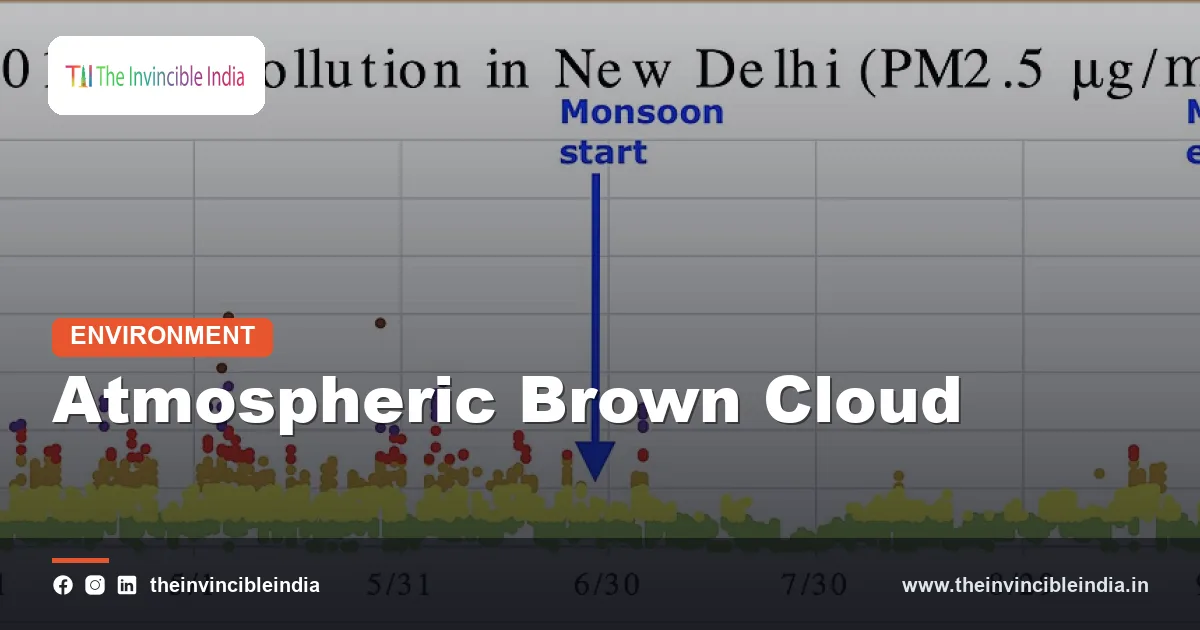
- Monsoon rains wash particles out of the air, so the brown cloud is thickest in the dry season and clears during heavy rain.
- Cleaner cooking fuels, tighter vehicle and industry standards, and better crop-residue and waste management can thin the haze, bringing health and climate benefits together.
What is the atmospheric brown cloud?
The atmospheric brown cloud is a thick, regional layer of air pollution made of tiny particles called aerosols that give the sky a brownish tint and spread across thousands of kilometres. It is not a single cloud in the meteorological sense. It is a persistent plume of haze that forms when particles from many sources pile up in the lower atmosphere, especially when winds are weak and rain is absent.
The brown colour arises because some of the particles, particularly soot and certain organic compounds, absorb sunlight and scatter the light that remains. The haze is most striking in the Indo-Gangetic Plain, which stretches from Punjab and Haryana through Delhi, Uttar Pradesh and Bihar to West Bengal. Its geography is shaped by the Himalaya, which act as a wall, trapping the pollution against the foothills instead of letting it escape northwards. Similar clouds hang over eastern China and parts of Southeast Asia, and the phenomenon is therefore often described as the Asian Brown Cloud, with a South Asian branch that matters most for India.
How was the atmospheric brown cloud discovered?
The atmospheric brown cloud was brought to scientific attention by the Indian Ocean Experiment, or INDOEX, a major field campaign in 1999 that found a dense haze over the northern Indian Ocean far from any city. Researchers had expected clean marine air in the winter monsoon season but instead found pollution drifting from the Indian subcontinent over the sea.
INDOEX brought together scientists from India, the United States and Europe, with aircraft, ships, a research station in the Maldives and satellite data. They found a layer of haze roughly a few kilometres thick containing a mix of sulphates, nitrates, organic matter, soot and fly ash, and showed that it was mostly man-made. The haze was so extensive that it reduced the sunlight reaching the ocean surface by a measurable amount and warmed the layer of air above it.
The United Nations Environment Programme then took up the story. Its early-2000s assessment, built on the work of the climate scientist V. Ramanathan and many colleagues, introduced the term Asian Brown Cloud to a global audience and launched a programme of regional observatories and studies on atmospheric brown clouds. This work also helped shift attention from carbon dioxide alone to short-lived pollutants like soot and ozone.
What is the atmospheric brown cloud made of?
The atmospheric brown cloud is made of a mixture of black carbon, organic carbon, sulphate and nitrate aerosols, fly ash and mineral dust, and the proportions vary by place and season. Each ingredient affects sunlight differently.
| Ingredient | Main sources | Effect on sunlight |
|---|---|---|
| Black carbon (soot) | Diesel engines, cookstoves, brick kilns, crop burning | Absorbs sunlight and warms the air |
| Organic carbon | Biomass burning, vehicles | Mostly scatters; some “brown carbon” absorbs |
| Sulphates | Coal power plants, industry | Scatter sunlight and cool the surface |
| Nitrates | Vehicle and industrial emissions, farm ammonia | Scatter sunlight |
| Fly ash | Coal burning | Scatters and absorbs |
| Mineral dust | Thar Desert, West Asia, construction | Scatters and absorbs |
The mix matters because scattering particles such as sulphates tend to cool the ground by sending sunlight back to space, while absorbing particles such as soot heat the air that holds them. In the brown cloud both processes happen at once. The net result is a haze that cools the surface but warms the lower atmosphere, a pattern that has consequences for winds and rainfall.
Where does the haze come from?
The haze comes from the burning of fossil fuels, wood, dung, crop residue and waste across South Asia, along with dust and industrial emissions. India’s size and population mean its emissions are a very large contributor to the regional haze.
Household cooking with wood, crop waste and dung is a major source of soot and organic particles, especially in rural India, where millions of families have long relied on traditional stoves. Diesel trucks, buses and generators add more black carbon, as do brick kilns, many of which use inefficient technology and burn coal or biomass. Coal-fired power stations and industries emit sulphur dioxide that turns into sulphate particles. In October and November, burning of paddy stubble in Punjab and Haryana releases enormous quantities of smoke that drifts across the plain, and open burning of waste adds a further layer. Natural dust from deserts and the construction industry contributes too.
Weather decides how long pollution lingers. In winter, a cold, still layer of air near the ground often traps pollutants under a lid, a condition known as a temperature inversion. Winds are light, there is little rain, and the pollution builds up over days. When the monsoon arrives, rain scavenges the particles from the air, which is why the haze weakens through July to September.
How does the brown cloud dim sunlight?
The brown cloud dims sunlight by absorbing some of it and scattering some back to space, reducing the radiation that reaches the ground, a phenomenon often called surface dimming. Studies in South Asia have reported that the haze can cut the sunlight reaching the surface by around ten percent or more in heavily polluted areas during the dry season, though the figure depends on location and method.
This effect has been documented in long-term records. Observations from several parts of India indicate that the amount of solar radiation at the surface declined over the late twentieth century, a trend usually called “global dimming”, and that it later levelled off or varied regionally as emissions patterns shifted. Dimming also matters for solar power, because dusty, hazy skies reduce the output of solar panels and require more frequent cleaning. Studies of Indian solar plants have found that airborne dust and haze can noticeably lower output.
The dimming creates a paradox. By blocking sunlight, aerosols have probably masked some of the warming that greenhouse gases would otherwise have caused over South Asia, particularly at the surface. That does not make pollution beneficial: the same particles damage health, farming and rainfall, and cutting greenhouse gases remains essential. Scientists emphasise that cleaning up pollution without cutting carbon dioxide would reveal more warming, so both strategies must go together.
How does the brown cloud affect the monsoon?
The brown cloud affects the monsoon by cooling the land surface and warming the atmosphere above it, which tends to weaken the heating contrast that drives the monsoon circulation and may shift rainfall patterns. This is one of the most actively researched aspects of the topic.
The monsoon depends on land heating faster than the ocean. When aerosols reduce sunlight reaching the ground and the northern Indian Ocean, they can reduce that contrast, particularly in the pre-monsoon and early monsoon period. Several modelling studies, including influential work published in the early 2010s, linked rising aerosol pollution to a decline in South Asian summer monsoon rainfall in the second half of the twentieth century. Another line of research proposes the opposite effect in the pre-monsoon season: dust and soot heating the air along the Himalayan foothills could draw in more moist air and enhance early-season rain. This idea is sometimes called the “elevated heat pump” hypothesis.
These competing mechanisms show why scientists describe the monsoon response as complex and model-dependent. The broad agreement is that aerosols influence the timing, distribution and intensity of rainfall, and may contribute to regional changes such as weaker rainfall over parts of the Indo-Gangetic Plain and shifts in extreme events. The size of those effects, compared with greenhouse warming and natural variability such as El Nino, is still debated.
What does the haze do to crops and water?
The haze harms crops by cutting the sunlight plants need for photosynthesis and by carrying surface ozone, a toxic gas that damages leaves, and studies suggest it reduces yields of staples like rice and wheat. It also affects water through its influence on rainfall and snowmelt.
Research by Burney and Ramanathan, published in 2014, estimated that the combined effect of dimming and ozone has reduced wheat and rice yields in India by meaningful amounts compared with a cleaner atmosphere. Exact numbers vary between studies, but the finding that pollution costs farmers harvest is consistent. Ground-level ozone forms when sunlight acts on vehicle and industrial emissions, and it enters leaf pores to damage tissue.
The haze also darkens snow. Soot carried from the plains settles on Himalayan snow and glaciers, lowering their reflectivity and tending to speed up melting. Since rivers like the Ganga and Indus depend on glacier and snowmelt as well as monsoon rain, changes in melt timing affect irrigation, hydropower and drinking water for hundreds of millions of people. The warming of the air over the Himalaya by absorbing aerosols may reinforce this effect.
How does the brown cloud affect human health?
The brown cloud harms human health because its fine particles, especially PM2.5, penetrate deep into the lungs and bloodstream, raising the risk of heart disease, stroke, lung disease, cancer and respiratory infections. It is one of the biggest environmental health threats in South Asia.
A widely cited analysis in The Lancet Planetary Health estimated that air pollution was linked to well over a million deaths in India in 2019, which is a substantial share of all deaths in the country. Household air pollution from cooking fires and outdoor pollution both contribute. Children, older people and those with asthma are especially vulnerable, and long-term exposure can stunt lung growth and shorten lives. Many Indian cities, particularly in the Indo-Gangetic Plain, regularly record air quality in the poor to severe categories during winter.
Smog and haze also disrupt daily life. Dense winter fog mixed with pollution, sometimes called smog, grounds flights, delays trains, and causes road accidents across northern India. Reduced visibility, school closures and health advisories have become a regular winter feature in the plains.
What is India doing to reduce the brown cloud?
India is reducing the sources of the brown cloud through programmes for cleaner cooking fuel, cleaner vehicles, the National Clean Air Programme, and measures against crop-residue burning. Progress has been real but uneven.
The Pradhan Mantri Ujjwala Yojana, launched in 2016, has provided LPG connections to many crores of households, cutting smoke from traditional stoves, although continued use of LPG and the cost of refills remain issues. Bharat Stage VI emission norms, introduced for vehicles nationwide in 2020, sharply reduce particulate and sulphur emissions from new vehicles. India has also tightened emission rules for coal power plants, though implementation of sulphur-removal technology has been gradual. The National Clean Air Programme, launched in 2019, targets city-level reductions in particulate pollution through local action plans, with goals revised in later years.
On farms, schemes to supply machines like the Happy Seeder and to convert paddy straw into fuel pellets or compost aim to curb stubble burning. Cleaner brick kiln technology such as zig-zag kilns reduces soot per brick. International cooperation, including the UNEP-led work on atmospheric brown clouds and regional monitoring, helps track results. Because many pollutants travel across borders, experts argue that South Asian countries must coordinate their clean-air action.
Will the atmospheric brown cloud disappear?
The atmospheric brown cloud will not disappear on its own, but it can be thinned significantly because most of its particles are short-lived and stay in the air only for days to weeks. This is encouraging because it means cuts in emissions produce relatively quick improvements in air quality.
Evidence from other regions supports this. Europe and North America cut sulphate and soot emissions through regulation and saw visible improvements in air quality and, in some places, a brightening of the sky. India faces larger challenges, with a bigger population, rising energy demand and a heavy reliance on coal and biomass, but it also has a major opportunity to leapfrog technologies, from clean cooking to electric mobility and renewable power.
The central policy lesson from climate scientists is to treat air pollution and climate change together. Cutting soot and methane brings fast benefits for both health and warming, while cutting carbon dioxide is needed for long-term stability. An Indian strategy that reduces coal burning, eliminates smoky cooking, cleans up transport and manages farm residues would shrink the brown cloud and, at the same time, support the country’s climate commitments.
Bottom Line
The atmospheric brown cloud is a man-made haze that links air pollution, climate and the monsoon. It shades the ground, heats the air, shortens lives and may cost farmers part of their harvest. It is also reversible, since the particles do not linger for years the way carbon dioxide does. Clean fuels, cleaner engines, smarter farming and honest monitoring can lift the veil within a generation.
Frequently Asked Questions
What is the Asian Brown Cloud?
It is a large layer of air pollution over Asia, made of soot, sulphates, organic particles and dust, that was highlighted in United Nations Environment Programme assessments in the early 2000s. Its South Asian branch covers the Indo-Gangetic Plain and the northern Indian Ocean.
What colour is the atmospheric brown cloud and why?
It looks brownish-grey because the particles absorb and scatter sunlight, and some, such as black carbon and brown carbon, absorb the shorter blue wavelengths. The effect is strongest when the haze is thick and the air is still.
Does the brown cloud go away in the monsoon?
It largely thins out during heavy monsoon rain because rain washes particles out of the air. It builds up again once the dry season returns in October and November.
How does the brown cloud affect the monsoon?
Studies suggest the haze cools the land surface and warms the air above, which can weaken the land-sea heating contrast and shift rainfall. The exact impact is debated, and other factors like El Nino and greenhouse warming also play a large role.
Is the brown cloud responsible for deaths in India?
The fine particles that make up the haze are a leading risk factor for disease, and research has linked air pollution to well over a million premature deaths a year in India. These deaths come from long-term exposure, which raises heart, lung and stroke risks.
Can the atmospheric brown cloud be cleaned up?
Yes, because its particles stay in the air only for days to weeks, cutting emissions brings faster improvement than for carbon dioxide. Cleaner cooking fuels, vehicle standards, cleaner brick kilns and ending crop-residue burning are key measures.
{“@context”:”https://schema.org”,”@graph”:[{“@type”:”FAQPage”,”mainEntity”:[{“@type”:”Question”,”name”:”What is the Asian Brown Cloud?”,”acceptedAnswer”:{“@type”:”Answer”,”text”:”It is a large layer of air pollution over Asia, made of soot, sulphates, organic particles and dust, that was highlighted in United Nations Environment Programme assessments in the early 2000s. Its South Asian branch covers the Indo-Gangetic Plain and the northern Indian Ocean.”}},{“@type”:”Question”,”name”:”What colour is the atmospheric brown cloud and why?”,”acceptedAnswer”:{“@type”:”Answer”,”text”:”It looks brownish-grey because the particles absorb and scatter sunlight, and some, such as black carbon and brown carbon, absorb the shorter blue wavelengths. The effect is strongest when the haze is thick and the air is still.”}},{“@type”:”Question”,”name”:”Does the brown cloud go away in the monsoon?”,”acceptedAnswer”:{“@type”:”Answer”,”text”:”It largely thins out during heavy monsoon rain because rain washes particles out of the air. It builds up again once the dry season returns in October and November.”}},{“@type”:”Question”,”name”:”How does the brown cloud affect the monsoon?”,”acceptedAnswer”:{“@type”:”Answer”,”text”:”Studies suggest the haze cools the land surface and warms the air above, which can weaken the land-sea heating contrast and shift rainfall. The exact impact is debated, and other factors like El Nino and greenhouse warming also play a large role.”}},{“@type”:”Question”,”name”:”Is the brown cloud responsible for deaths in India?”,”acceptedAnswer”:{“@type”:”Answer”,”text”:”The fine particles that make up the haze are a leading risk factor for disease, and research has linked air pollution to well over a million premature deaths a year in India. These deaths come from long-term exposure, which raises heart, lung and stroke risks.”}},{“@type”:”Question”,”name”:”Can the atmospheric brown cloud be cleaned up?”,”acceptedAnswer”:{“@type”:”Answer”,”text”:”Yes, because its particles stay in the air only for days to weeks, cutting emissions brings faster improvement than for carbon dioxide. Cleaner cooking fuels, vehicle standards, cleaner brick kilns and ending crop-residue burning are key measures.”}}]}]}


