

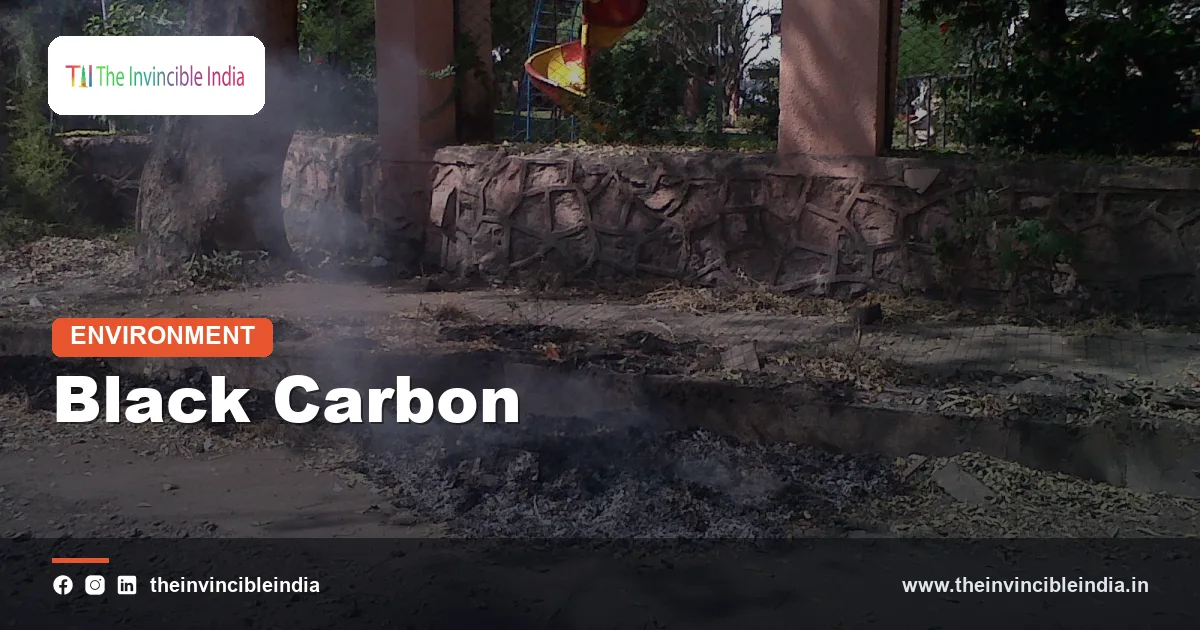
Black carbon is the fine, sooty particle released when fuels and biomass burn incompletely, which makes black carbon one of the strongest short-lived warming agents in India’s air as well as a major health hazard. It is the black residue on a kitchen wall above a wood-fired chulha, the smoke puffing from a diesel truck and the dark plume rising from a burning paddy field in Punjab. Because it absorbs sunlight so effectively, it warms the air it floats in and darkens the Himalayan snow it settles on.
This explainer, last reviewed on 4 November 2026, looks at what black carbon is, where it comes from in India, how it warms the climate, why it is a threat to glaciers and lungs, and which practical measures can cut it. Climate and health figures are presented as rounded estimates or tendencies, since measurements and models of soot carry real uncertainty.
| What it is | Sooty carbon particles from incomplete combustion; a component of PM2.5 |
|---|---|
| Particle size | Typically less than one micrometre across |
| Lifetime in air | Days to a few weeks |
| Main Indian sources | Household cookstoves, diesel vehicles, brick kilns, crop and waste burning, industry |
| Climate effect | Absorbs sunlight and warms the air; darkens snow and ice |
| Health effect | Deep lung and heart harm; marker of combustion pollution |
| Key hotspot | Indo-Gangetic Plain, with transport to the Himalaya |
| Best-known fixes | Clean cooking fuel, cleaner diesel engines, efficient kilns, ending stubble burning |
Key Takeaways
- Black carbon is soot produced when diesel, coal, wood, dung and crop residue burn without enough oxygen, and it is one of the main components of fine particle pollution.
- It absorbs sunlight strongly, so it warms the atmosphere, and when it settles on snow and ice it lowers their reflectivity and tends to speed up melting.
- Unlike carbon dioxide, which lingers for centuries, black carbon stays in the air only for days to weeks, so cutting it brings quick climate and health benefits.
- In India the largest sources are generally estimated to be household burning of solid fuels, followed by diesel transport, brick kilns, industry and open burning.
- Black carbon is bad for the lungs and heart, and exposure to combustion particles is linked to a large burden of illness and premature death.
- Clean cooking fuels, cleaner engines, efficient brick kilns and better crop-residue management are proven ways to reduce it.
What is black carbon?
Black carbon is a form of nearly pure carbon in the shape of tiny soot particles, created when carbon-based fuels burn incompletely, and it is a major part of the fine particles known as PM2.5. It is what remains when there is not enough oxygen or heat for fuel to burn cleanly, producing smoke instead of just carbon dioxide and water.
Each particle is typically less than a micrometre across, far finer than a human hair, which lets it travel deep into the lungs and remain suspended in the air for days or weeks. It is intensely black because it absorbs almost all the visible light that hits it. Scientists distinguish it from related substances: organic carbon, which is usually lighter and scatters light, brown carbon, which absorbs some light at shorter wavelengths, and elemental carbon, a term used when it is measured by different methods. In everyday language, black carbon is simply soot.
It is rarely emitted alone. Smoke from burning wood or crop waste carries black carbon together with organic compounds, sulphates and gases, so it is part of a pollution cocktail. Different sources release different mixtures. Diesel exhaust is rich in black carbon, while smouldering biomass gives out more organic carbon, which is why measurement of black carbon is often used as a tracer for combustion-related pollution.
Where does black carbon in India come from?
Black carbon in India comes mainly from burning solid fuels in homes, diesel engines, brick kilns, industries and open fires, with household cooking and heating usually estimated as the single largest source. Emission inventories differ in detail, but they agree on the general picture.
| Source | Why it emits black carbon |
|---|---|
| Household cookstoves and heating | Wood, crop waste and dung burn inefficiently in traditional stoves |
| Diesel vehicles and generators | Older engines without particulate filters release soot |
| Brick kilns | Many use coal or biomass in simple, inefficient kilns |
| Crop residue burning | Open burning of paddy and wheat straw after harvest |
| Industry and power | Boilers, furnaces and small units burning coal or oil |
| Open waste burning | Plastic, garbage and leaves burned in the open |
| Forest fires | Seasonal wildfires, especially in dry months |
Cooking is central to the story. Surveys have shown that hundreds of millions of Indians historically depended on firewood, dung or crop residue for cooking, and a large share of the country’s black carbon has been traced to that use. The stoves are often simple three-stone fires or mud chulhas that burn inefficiently. In winter, many people also burn fuel for heating, adding to the load.
Transport contributes heavily in cities and along highways. Diesel trucks, buses, tractors and generator sets are significant emitters of soot. The brick industry, concentrated in the Indo-Gangetic Plain, is another important source: India is one of the world’s largest brick producers, and traditional fixed-chimney or clamp kilns often burn dirty fuel. Seasonal burning of paddy stubble in Punjab, Haryana and neighbouring areas in October and November produces dense smoke in a short window.
Why is black carbon such a strong warming agent?
Black carbon is a strong warming agent because it absorbs sunlight very efficiently, turning it into heat in the atmosphere, and gram for gram it is far more powerful than carbon dioxide over the short term. Assessments, including a widely cited 2013 study, ranked its climate forcing as one of the largest after carbon dioxide and possibly methane, though with wide uncertainty.
The warming happens in three ways. First, floating soot directly absorbs sunlight and heats the air around it. Second, soot inside clouds can alter how clouds form and last, sometimes burning them off and sometimes making them longer-lived, effects that are harder to pin down. Third, when black carbon lands on snow and ice, it darkens them and reduces their reflectivity, a change in albedo that makes the surface absorb more sunlight.
There is a complication. In the brown cloud over South Asia, black carbon shares the sky with reflective particles such as sulphates that cool the surface. The combined haze dims sunlight at the ground while warming the lower atmosphere, which can disturb winds and rainfall. This means that black carbon’s regional effects on the monsoon and temperatures are not as simple as a straightforward warming effect. Scientists therefore speak of it as a powerful but uncertain climate agent, with the strongest case for warming in the atmosphere and over snow.
How does black carbon affect Himalayan glaciers and snow?
Black carbon affects Himalayan glaciers by settling on snow and ice, darkening the surface so it absorbs more sunlight and melts sooner. Because the Himalaya, Karakoram and Hindu Kush hold one of the largest stores of ice outside the poles, this matters for rivers that sustain hundreds of millions of people.
Soot reaches the mountains from the Indo-Gangetic Plain below, carried upslope by valley winds, especially in the pre-monsoon season when pollution is heavy and snow is starting to melt. Measurements near Himalayan glaciers, including studies around the Gangotri region and sites in the central Himalaya and Nepal, have detected black carbon in the air and in snow. Research suggests the effect is often most visible on the glacier surface in spring, when old snow with accumulated impurities is exposed and sunlight is strong.
Glacier retreat in the Himalaya has several causes, led by rising air temperatures. Black carbon, dust and other impurities are widely regarded as contributing factors, but studies disagree about how much they add. In some analyses, soot is a secondary driver compared with warming; in others, it can speed up melting locally by a noticeable margin. The sensible conclusion is that cutting soot would help slow melt in the near term, while limiting greenhouse gases remains the only way to address the main cause.
The downstream stakes are large. Changes in the timing and volume of snowmelt can affect river flows, irrigation, hydropower and flood risk in the Ganga, Indus and Brahmaputra basins. Early melt could mean more water in spring and less in the late dry season, a shift that farmers and dam operators would need to manage.
How does black carbon harm human health?
Black carbon harms human health because its ultrafine particles penetrate deep into the lungs and enter the bloodstream, and it is associated with heart disease, stroke, chronic lung disease and respiratory infections. It also carries toxic chemicals on its surface.
Health researchers often use black carbon as a marker of harmful combustion particles, since it is closely tied to diesel exhaust and smoky household fires. Studies in several countries link exposure to black carbon with increased cardiovascular and respiratory problems, even when total PM2.5 is controlled for, though this is an active research area. In India, household air pollution from cooking with solid fuels has been identified as a major risk factor for illness, particularly for women and young children who spend long hours near the stove. Children exposed to indoor smoke face a greater risk of pneumonia and other lung infections, and long-term exposure raises the risk of chronic obstructive pulmonary disease.
Outdoor exposure is also significant. People who live near busy roads, brick kilns and burning sites, along with traffic police, street vendors and drivers, breathe higher concentrations. During the autumn burning season across north India, urban air quality can worsen sharply, which is partly a black carbon story and partly a story of other particles and gases. Overall, health studies estimate that air pollution is linked to well over a million premature deaths a year in India, though black carbon is only one piece of that burden.
Why is cutting black carbon a climate quick win?
Cutting black carbon is a climate quick win because it lasts only days to weeks in the air, so reducing emissions lowers its warming effect almost immediately, while also improving health. This sets it apart from carbon dioxide, which accumulates and lingers for centuries.
Climate experts call black carbon, methane, ground-level ozone and some hydrofluorocarbons short-lived climate pollutants. Reducing them cannot replace the deep cuts in carbon dioxide that stabilising the climate demands, but it can slow the near-term rate of warming and protect snow and ice while the longer-term transition proceeds. The UN Environment Programme and the World Meteorological Organization highlighted this in a joint assessment around 2011, concluding that a set of practical measures could deliver quick benefits for health and food production as well as the climate.
For India the case is especially strong because the sources of black carbon are mostly the same activities that cause health and development problems, such as smoky kitchens and inefficient kilns. The measures that cut soot therefore tend to pay off in saved lives, saved time and lower fuel costs. The “co-benefit” argument is the main reason many Indian policymakers and researchers advocate acting on black carbon alongside carbon dioxide.
What is India doing to reduce black carbon?
India is reducing black carbon mainly through clean cooking programmes, cleaner vehicle standards, improved brick kiln technology and measures against crop-residue burning. None of these is aimed only at soot, but all of them reduce it.
The Pradhan Mantri Ujjwala Yojana, launched in 2016, has distributed LPG connections to a very large number of poor households, with the aim of replacing smoky solid fuels. Research shows that many families still keep using firewood alongside LPG, often because of the cost of refills, so the benefit depends on sustained clean use. Bharat Stage VI standards, which came into force across India in 2020, require much stricter limits on particulate matter from new vehicles and the use of diesel particulate filters, which can capture most soot from the exhaust. Zig-zag brick kilns, now promoted by pollution control authorities and a number of states, cut emissions significantly compared with traditional kilns. Biogas, improved biomass stoves and induction cooking supplement LPG in some regions.
Agriculture is another front. Machines such as the Happy Seeder let farmers sow wheat directly into rice stubble without burning it, and state and central schemes support the supply of such equipment and the use of straw in power plants, biofuel, compost and animal feed. The National Clean Air Programme sets targets for reducing fine particle pollution in dozens of cities, providing a framework for local action. Sustained enforcement, affordable clean fuel and farmer support are what determine whether these measures actually work on the ground.
Can individuals and communities help cut black carbon?
Individuals and communities can help cut black carbon by switching to clean cooking fuel, maintaining vehicles, avoiding open burning, and supporting local efforts to manage waste and crop residue. Everyday choices add up, especially where thousands of homes or farms act together.
At home, using LPG, biogas, electric or induction cooking, or at least an improved stove with a chimney or a better ventilated kitchen, reduces both soot and personal exposure. Keeping diesel vehicles and generators serviced, not idling engines, and shifting to public transport, cycling or electric vehicles reduce urban soot. Burning garbage, leaves or plastic in the open should be avoided, and proper waste collection and composting offer alternatives. Farmers can take up residue management methods or sell straw rather than burn it, and communities can share equipment.
Residents can also push local authorities for enforcement against illegal burning, dirty kilns and unchecked diesel generators, and for the installation of air quality monitors. Public awareness matters because black carbon is hard to see as a separate pollutant, and its impact on the climate and the glaciers is not obvious to someone breathing smoke in a village kitchen.
Bottom Line
Black carbon is the sooty by-product of inefficient burning, and in India it ties together kitchen smoke, diesel exhaust, brick kilns, burning fields, warming air and shrinking Himalayan snow. Because it disappears from the sky within weeks, every success in cutting it pays back quickly in cleaner lungs and slower melt. It cannot replace the fight against carbon dioxide, but it is among the fastest, fairest ways to start.
Frequently Asked Questions
What is black carbon in simple terms?
Black carbon is soot, the fine black particles produced when fuels such as diesel, coal, wood and crop waste burn incompletely. It absorbs sunlight, warms the air and harms the lungs.
What is the biggest source of black carbon in India?
Most emission estimates point to household burning of firewood, dung and crop residue for cooking and heating as the largest source. Diesel vehicles, brick kilns, industry and open burning follow.
How long does black carbon stay in the atmosphere?
Black carbon typically remains in the air for only a few days to a couple of weeks before rain or settling removes it. That short life is why cutting emissions gives fast benefits.
How does black carbon melt Himalayan glaciers?
When soot settles on snow and ice, it darkens the surface and lowers its albedo, so the snow absorbs more sunlight and melts sooner. It is one contributing factor, alongside rising air temperatures.
Is black carbon the same as carbon dioxide?
No. Black carbon is a solid particle that lasts days to weeks, while carbon dioxide is a gas that lingers for centuries. Black carbon warms by absorbing sunlight, and carbon dioxide warms by trapping heat radiated from the Earth.
How can India reduce black carbon quickly?
The fastest steps include clean cooking fuel such as LPG, strict diesel and vehicle standards, efficient brick kilns and stopping crop-residue burning. These measures also improve health, so they bring benefits beyond climate.
{“@context”:”https://schema.org”,”@graph”:[{“@type”:”FAQPage”,”mainEntity”:[{“@type”:”Question”,”name”:”What is black carbon in simple terms?”,”acceptedAnswer”:{“@type”:”Answer”,”text”:”Black carbon is soot, the fine black particles produced when fuels such as diesel, coal, wood and crop waste burn incompletely. It absorbs sunlight, warms the air and harms the lungs.”}},{“@type”:”Question”,”name”:”What is the biggest source of black carbon in India?”,”acceptedAnswer”:{“@type”:”Answer”,”text”:”Most emission estimates point to household burning of firewood, dung and crop residue for cooking and heating as the largest source. Diesel vehicles, brick kilns, industry and open burning follow.”}},{“@type”:”Question”,”name”:”How long does black carbon stay in the atmosphere?”,”acceptedAnswer”:{“@type”:”Answer”,”text”:”Black carbon typically remains in the air for only a few days to a couple of weeks before rain or settling removes it. That short life is why cutting emissions gives fast benefits.”}},{“@type”:”Question”,”name”:”How does black carbon melt Himalayan glaciers?”,”acceptedAnswer”:{“@type”:”Answer”,”text”:”When soot settles on snow and ice, it darkens the surface and lowers its albedo, so the snow absorbs more sunlight and melts sooner. It is one contributing factor, alongside rising air temperatures.”}},{“@type”:”Question”,”name”:”Is black carbon the same as carbon dioxide?”,”acceptedAnswer”:{“@type”:”Answer”,”text”:”No. Black carbon is a solid particle that lasts days to weeks, while carbon dioxide is a gas that lingers for centuries. Black carbon warms by absorbing sunlight, and carbon dioxide warms by trapping heat radiated from the Earth.”}},{“@type”:”Question”,”name”:”How can India reduce black carbon quickly?”,”acceptedAnswer”:{“@type”:”Answer”,”text”:”The fastest steps include clean cooking fuel such as LPG, strict diesel and vehicle standards, efficient brick kilns and stopping crop-residue burning. These measures also improve health, so they bring benefits beyond climate.”}}]}]}


