

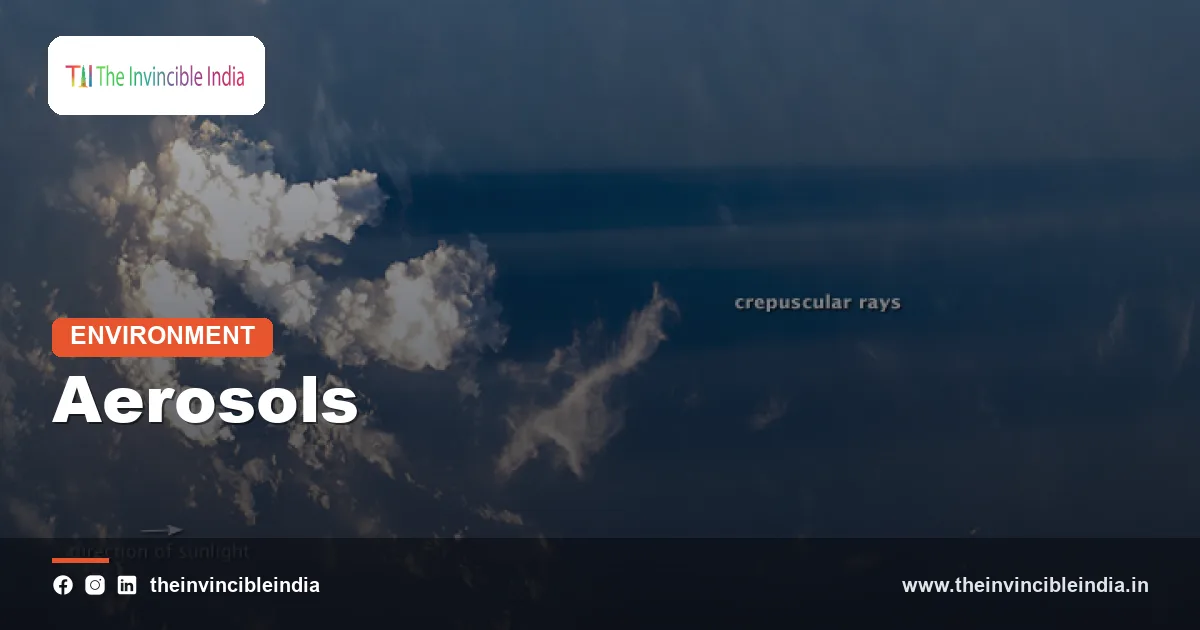
Aerosols are tiny solid or liquid particles suspended in the air, from desert dust and sea salt to sulphate droplets and soot, and over India they scatter and absorb sunlight, seed clouds and may be quietly nudging the behaviour of the monsoon. You cannot see a single aerosol, but together they make the milky haze that blurs the horizon over the Gangetic plain in winter, the yellow-brown pall that rolls in from the Thar before the rains, and the grey veil that hangs over coastal cities.
This explainer, last reviewed 4 November 2026, walks through what aerosols are made of, where they come from, how they interact with sunlight and clouds, what scientists have learnt about their influence on the Indian monsoon, and why the science is still argued over. The short version: aerosols are one of the largest uncertainties in understanding how India’s rainfall is changing.
Quick Facts
| What they are | Microscopic particles and droplets suspended in air, ranging from a few nanometres to tens of micrometres |
|---|---|
| Natural types | Mineral dust, sea salt, pollen, volcanic ash, smoke from wildfires |
| Man-made types | Sulphates, nitrates, black carbon (soot), organic particles from burning fuel, crop residue and dung |
| Main effect on sunlight | Scatter or absorb it, so less reaches the ground (“dimming”) |
| Main effect on clouds | Act as seeds (cloud condensation nuclei), changing droplet size and cloud life |
| How long they last | Days to a couple of weeks before rain or gravity removes them |
| Landmark Indian study | INDOEX, the Indian Ocean Experiment of 1998-1999, which found a thick haze layer over the north Indian Ocean |
| Monsoon link | Likely to weaken the monsoon circulation over decades; dust may boost early-season rain, a point still debated |
Key Takeaways
- Aerosols are airborne particles, and over India they come from both nature (desert dust, sea salt) and human activity (coal smoke, vehicle exhaust, crop-residue and biomass burning).
- Most aerosols cool the ground by blocking sunlight, but dark ones such as soot also heat the air they sit in, so the effect on weather depends on the particle type and height.
- Particles act as seeds for cloud droplets, which can make clouds brighter and longer-lived and sometimes delay rain from shallow clouds.
- Many studies link rising pollution over South Asia to a gradual weakening of the summer monsoon circulation since the mid-twentieth century, though other causes also played a part.
- The “elevated heat pump” idea says dust and soot piled against the Himalaya could strengthen early monsoon rain, but this is a hypothesis that remains contested.
- The monsoon itself cleans the air, because rain washes particles out, so India’s air is typically clearest in the wet months.
What are aerosols and what are they made of?
Aerosols are a suspension of fine particles or droplets in the air, and their composition varies enormously with place and season. Scientists usually sort them by origin. Mineral dust is lifted by strong winds from dry ground and is the biggest natural source over northwest India, carried in from the Thar Desert and from as far away as the Arabian Peninsula and the Horn of Africa. Sea salt is thrown up as spray along the long coastline. Pollen, spores and tiny fragments of plants add a biological fraction, and volcanic eruptions occasionally inject ash and sulphur far above the weather.
The human share is dominated by combustion. Burning coal and oil releases sulphur dioxide, which turns in the air into sulphate particles. Vehicles, power stations and industry emit nitrogen oxides that become nitrates, and fertiliser and livestock release ammonia that combines with them. Cooking fires, brick kilns, waste burning and the seasonal burning of crop stubble put out smoky organic particles and black carbon. Size matters as well as chemistry: the finest particles, known as PM2.5 because they are under 2.5 micrometres across, stay aloft longest and can lodge deep in human lungs, while coarse dust settles faster.
Because the particles are so varied, researchers describe them with a single measure, aerosol optical depth, which expresses how much light the column of air above a point blocks. Values over the Indo-Gangetic Plain are among the highest in the world, a sign of how loaded the region’s atmosphere is.
Where do India’s aerosols come from?
India’s aerosols come from a patchwork of natural and human sources whose mix changes by region and by month. In the northwest, dust dominates from March to June, when hot, dry winds sweep across the Thar and the Iranian and Arabian plateaus. Along both coasts, sea salt is a constant background, especially during the strong southwest monsoon winds.
The Indo-Gangetic Plain is the great hotspot because it combines a dense population, widespread biomass cooking, coal power, brick kilns, traffic and intensive farming, with geography that traps pollution. The plain is bounded on the north by the Himalaya, so in winter, with weak winds and a low mixing height, particles pile up under a stagnant lid of cold air. Post-harvest stubble burning in Punjab and Haryana adds a sharp seasonal pulse in October and November. Peninsular India has a smaller but growing load from cities, industrial clusters and power plants, while the northeast and Himalaya receive transported particles from the plains below.
Some aerosols are made in the air itself rather than emitted directly. Gases such as sulphur dioxide, ammonia and volatile organic compounds react to form new particles, which is why a clean-looking plume can still become hazy downwind. Studies using satellites and ground networks consistently show the Indian subcontinent as one of the world’s main aerosol sources, with the haze extending hundreds of kilometres over the Bay of Bengal and Arabian Sea.
How do aerosols change sunlight and the surface?
Aerosols change sunlight by scattering part of it back to space and absorbing another part, so that less energy reaches the ground. This surface dimming is measurable: sun-photometer and pyranometer records over India have shown that the amount of sunlight arriving at the surface fell for several decades from the 1950s, a trend often called “global dimming” and tied in large part to rising air pollution. In some later years, as measures improved in other parts of the world, dimming eased, but over heavily polluted South Asia it has persisted longer.
Not all particles behave the same way. Sulphates and most organic particles are white or pale and mainly scatter light, cooling the surface. Black carbon is a strong absorber: it removes sunlight before it reaches the ground and warms the layer of air where it floats. The result is a surface that is cooler while the lower atmosphere is warmer, which makes the air more stable and discourages the rising motion that builds big clouds.
This split matters for the monsoon, which is driven by contrast. The monsoon winds exist because land heats faster than the ocean, and a dimmer, cooler land surface weakens that contrast. The effect is strongest in the pre-monsoon and winter months, when the sun is high or the air is calm and polluted. Aerosols also reduce visibility, affect solar power yields, and, when they settle on Himalayan snow and glaciers, darken the surface and speed melt.
How do aerosols affect clouds and rainfall?
Aerosols affect clouds by supplying the tiny nuclei on which water vapour condenses, and that changes how clouds look, last and rain. Cloud droplets cannot easily form from pure vapour; they need a speck to condense on. In a clean atmosphere there are few such seeds, so the water forms fewer, larger droplets that quickly grow heavy enough to fall. In a polluted atmosphere the same water is split across many more, smaller droplets.
The consequences run in several directions. Clouds with many small droplets reflect more sunlight, so they are brighter and cool the surface more. Because small droplets collide and merge less readily, rain from shallow clouds can be delayed or suppressed, and the clouds may live longer. In deep convective clouds, some studies propose the opposite: that the delay in rain lets droplets be carried higher, freeze, and release extra heat that invigorates the storm. Observations over India show both behaviours, depending on cloud depth and moisture.
Scientists also talk of the “semi-direct” effect, where absorbing aerosols heat the air and cause nearby cloud droplets to evaporate. Together these processes make aerosol-cloud interactions the single biggest uncertainty in global climate models. Over India, where clouds range from stratocumulus off the coast to towering monsoon thunderheads, teasing apart the signal from natural variability is a hard, ongoing task.
What did the INDOEX experiment discover?
The Indian Ocean Experiment, or INDOEX, discovered a vast, thick haze of pollution over the north Indian Ocean during the dry winter monsoon. The field campaign ran in 1998-1999, with its intensive phase in early 1999, and brought together scientists from India, the United States, Europe and the Maldives, using ships, aircraft, satellites and ground stations such as the observatory at Kaashidhoo in the Maldives. Indian institutions and research vessels played a central role.
Before INDOEX, many assumed the open ocean far from cities would be pristine. Instead, the team found that during January to March, when northeasterly winds blow off the subcontinent, a brownish haze up to about three kilometres thick covered large parts of the Arabian Sea, Bay of Bengal and equatorial Indian Ocean. The particles included sulphate, organics, fly ash and a notable fraction of black carbon. The measurements suggested the haze cut sunlight reaching the ocean surface substantially while warming the lower atmosphere.
INDOEX is widely credited with showing that South Asian pollution is a regional, even hemispheric, climate factor, and it led to the later concept of the Atmospheric Brown Cloud. It also seeded long-running Indian monitoring efforts, including networks that track aerosol properties across the country and measure how the particles alter sunlight.
Do aerosols weaken the Indian monsoon?
Many studies suggest that aerosols have contributed to weakening the Indian summer monsoon circulation over recent decades, although the claim is a tendency rather than a settled fact. Observations show that all-India monsoon rainfall declined modestly from about the 1950s to the early 2000s, with a notable drying trend across the Indo-Gangetic Plain and parts of central India and the Western Ghats. At the same time the land-sea temperature contrast that drives the monsoon winds grew weaker.
Climate model experiments, including widely cited work published around 2011, found that when they included the rising man-made aerosol load over Asia, they reproduced much of the drying and the weakening of the monsoon flow, whereas models with greenhouse gases alone did not. The logic follows from the dimming described earlier: aerosols cool the land and the northern Indian Ocean unevenly, reducing the pressure gradient that drags moist air onto the continent, and over the northern Indian Ocean they reduce evaporation, so less moisture is available.
Caution is needed. Other influences act at the same time, including natural swings in the Pacific and Indian Oceans, land-use change, irrigation and greenhouse warming, which tends to add moisture to the air. Since about the 2000s, rainfall in some regions has partly recovered and extreme events have increased. Scientists generally expect that the direction of the aerosol effect is to suppress rainfall, but they disagree on how large it is relative to the others.
What is the “elevated heat pump” and is it proven?
The elevated heat pump is a hypothesis that dust and soot trapped against the Himalayan foothills in spring heat the air and strengthen the early monsoon, and it is not proven. It was proposed in the mid-2000s by researchers using NASA data and models. The idea is that from April to June, aerosols pile up over the Gangetic plain and along the southern slope of the Tibetan Plateau, where the mountains block their escape.
Absorbing particles such as dust and black carbon warm the air high up on the mountain slope. Warm air rises, which pulls in moist air from the south and creates an earlier, stronger rainfall surge over northern India and the Himalaya in May and June. In this view, aerosols do not weaken but rather advance and intensify the pre-monsoon and early monsoon rain, even if they later reduce total rainfall.
The theory attracted attention because it gave a mechanism that could reverse the usual story. But other groups found that the response in their models was weak, that it depended on how much dust was present and on the exact heights, or that other drivers of early rains were stronger. At present the heat pump is best viewed as a plausible process that might operate in some years, not an established explanation of the monsoon’s behaviour.
How does the monsoon itself clean the air?
The monsoon cleans the air because rainfall scavenges particles out of the atmosphere, a process called wet deposition. Raindrops capture aerosols as they fall, and clouds convert some into dissolved material, so that after a few days of steady rain the air over much of India becomes noticeably clearer. Strong monsoon winds off the sea also bring in clean marine air, which dilutes the continental haze.
This is why India’s air quality follows a clear annual rhythm. Pollution is typically worst in the cold, calm months from October to January, improves in spring as winds pick up although dust rises, and reaches its best during the monsoon from June to September. Cities in the north such as Delhi and Lucknow show this pattern most sharply. It also means that a weak or delayed monsoon can leave the haze to linger longer, and break periods in the rains can see particle levels climb again.
The cleaning is not complete. Fine particles from sources such as sea salt and sulphate persist, and dust and smoke are replenished quickly once the rain stops. Still, the washout is an important reminder that aerosols and the monsoon influence each other in both directions: the monsoon sets the atmospheric load, and the load may in turn alter the monsoon.
Natural versus man-made aerosols: how do they compare?
Natural and man-made aerosols differ in source, colour and climate effect, and the table below sets out the main contrasts relevant to India.
| Aerosol type | Main source in India | Effect on sunlight | Likely monsoon role |
|---|---|---|---|
| Mineral dust | Thar Desert, Arabia, Africa | Scatters and partly absorbs | May heat air and boost early rain (debated) |
| Sea salt | Coastal spray, monsoon winds | Scatters; strong cloud seeds | Helps form marine clouds |
| Sulphate | Coal power, industry, vehicles | Scatters, cools surface | Dims land, may weaken monsoon flow |
| Nitrate and ammonium | Vehicles, fertiliser, livestock | Scatters | Adds to winter haze |
| Black carbon | Biomass, diesel, kilns, stubble | Strongly absorbs, warms air | Stabilises the air; darkens snow |
| Organic particles | Cooking fires, crop burning | Mostly scatters, some brown absorption | Seeds cloud, reduces visibility |
What can be done about harmful aerosols?
Harmful aerosols can be reduced mainly by cutting the combustion that produces them, and India has begun several programmes with that aim. Cleaner cooking fuel has been one of the biggest levers, because smoky household fires are a leading source of fine particles and of indoor exposure; large-scale LPG distribution schemes aim to replace chulhas. Power plants are being asked to fit desulphurisation equipment to cut sulphur dioxide, vehicles have moved through tightening emission norms, and brick kilns are shifting to cleaner technologies.
The National Clean Air Programme, launched in 2019, set targets to cut particulate pollution in a list of polluted cities, and agencies are expanding monitoring. Managing crop residue, by promoting machinery that incorporates stubble into soil or uses it as feedstock, targets the autumn pulse in the northwest.
There is a scientific wrinkle. Because sulphate aerosols mask part of greenhouse warming, cleaning them up will reveal some of the warming now hidden, so air-quality policy and climate policy have to move together. The soot component is different: cutting black carbon helps both health and the climate, which is why it is considered a “win-win” target. Better measurement, from ground networks to satellites, will be needed to know whether cleaner air eventually helps restore the monsoon’s strength.
Bottom Line
Aerosols are the invisible workforce of the Indian sky: they dim sunlight, seed clouds, carry health risks and probably play a role in the monsoon’s slow shifts. Their effects are real but tangled, with some cooling and some heating, some suppressing rain and some perhaps boosting it. What is clear is that cleaner combustion would benefit health immediately, and understanding aerosols better is essential to forecasting India’s rains.
Frequently Asked Questions
What are aerosols in simple words?
Aerosols are tiny particles or droplets floating in the air, such as dust, sea salt, smoke and sulphate. Together they create haze and affect how sunlight and clouds behave.
Are all aerosols man-made?
No. Desert dust, sea salt, pollen and volcanic ash are natural. Sulphate, nitrate and soot from burning coal, fuel, crop residue and biomass are mostly caused by human activity.
Do aerosols reduce rainfall in India?
Many studies suggest that rising pollution has helped weaken the monsoon circulation and reduce rainfall in parts of India since the mid-twentieth century. The size of the effect is uncertain because other factors also change rainfall.
What was the INDOEX experiment?
INDOEX was an international field study in 1998-1999 that discovered a thick pollution haze over the northern Indian Ocean. It showed that South Asian aerosols dim the sea surface and warm the air above.
What is the elevated heat pump theory?
It is a hypothesis that dust and soot trapped against the Himalayan foothills warm the air and pull in moisture, strengthening early monsoon rain. It remains debated and is not proven.
Does rain clean aerosols from the air?
Yes. Raindrops wash particles out of the atmosphere, so air over much of India is cleanest during the monsoon and most polluted in the dry, calm winter months.
{“@context”:”https://schema.org”,”@graph”:[{“@type”:”FAQPage”,”mainEntity”:[{“@type”:”Question”,”name”:”What are aerosols in simple words?”,”acceptedAnswer”:{“@type”:”Answer”,”text”:”Aerosols are tiny particles or droplets floating in the air, such as dust, sea salt, smoke and sulphate. Together they create haze and affect how sunlight and clouds behave.”}},{“@type”:”Question”,”name”:”Are all aerosols man-made?”,”acceptedAnswer”:{“@type”:”Answer”,”text”:”No. Desert dust, sea salt, pollen and volcanic ash are natural. Sulphate, nitrate and soot from burning coal, fuel, crop residue and biomass are mostly caused by human activity.”}},{“@type”:”Question”,”name”:”Do aerosols reduce rainfall in India?”,”acceptedAnswer”:{“@type”:”Answer”,”text”:”Many studies suggest that rising pollution has helped weaken the monsoon circulation and reduce rainfall in parts of India since the mid-twentieth century. The size of the effect is uncertain because other factors also change rainfall.”}},{“@type”:”Question”,”name”:”What was the INDOEX experiment?”,”acceptedAnswer”:{“@type”:”Answer”,”text”:”INDOEX was an international field study in 1998-1999 that discovered a thick pollution haze over the northern Indian Ocean. It showed that South Asian aerosols dim the sea surface and warm the air above.”}},{“@type”:”Question”,”name”:”What is the elevated heat pump theory?”,”acceptedAnswer”:{“@type”:”Answer”,”text”:”It is a hypothesis that dust and soot trapped against the Himalayan foothills warm the air and pull in moisture, strengthening early monsoon rain. It remains debated and is not proven.”}},{“@type”:”Question”,”name”:”Does rain clean aerosols from the air?”,”acceptedAnswer”:{“@type”:”Answer”,”text”:”Yes. Raindrops wash particles out of the atmosphere, so air over much of India is cleanest during the monsoon and most polluted in the dry, calm winter months.”}}]}]}


