

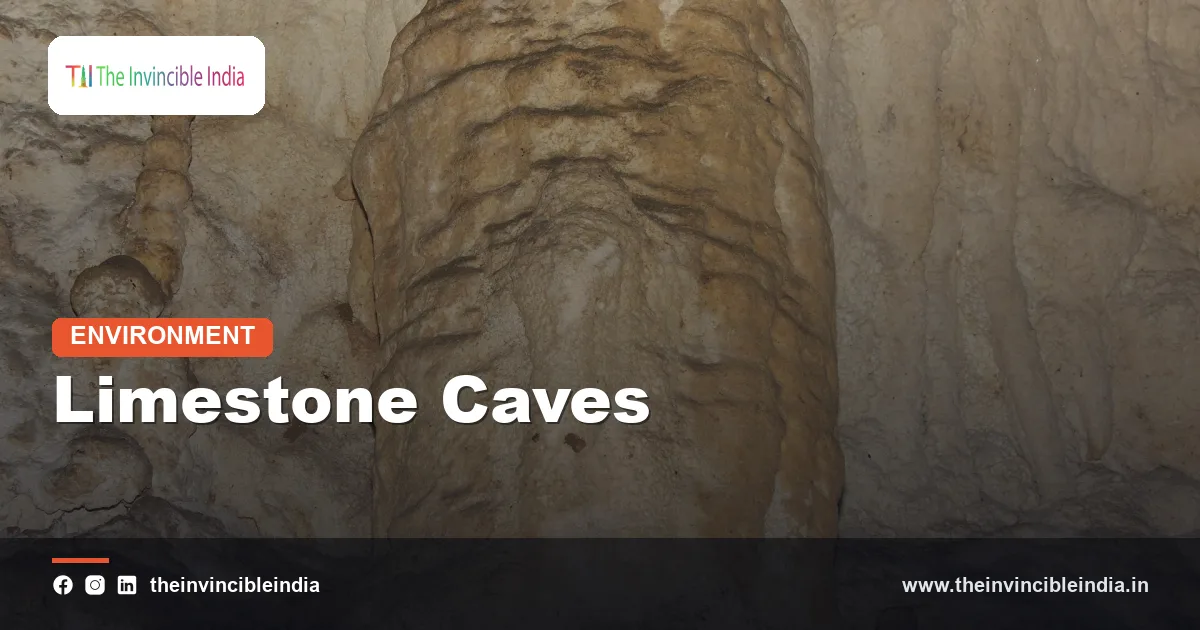
Limestone caves are underground chambers and passages dissolved out of limestone rock by slightly acidic water over thousands to millions of years, and in India they are found mainly in a handful of karst regions, from the rain-soaked Khasi and Jaintia Hills of Meghalaya to the Eastern Ghats of Andhra Pradesh. They are among the most delicate natural landscapes in the country, decorated with dripstone formations such as stalactites and stalagmites, home to specialised bats, insects and fish, and quietly storing records of ancient monsoons in their mineral deposits.
India’s best-known caves in popular imagination, such as Ajanta, Ellora and Bhimbetka, are not limestone solution caves at all, which is a common source of confusion. This article, last reviewed on 4 November 2026, explains how limestone caves form, where the main ones lie, what makes Meghalaya the country’s caving capital, what the famous Borra and Belum caves are like, and how to tell a true limestone cave from a rock shelter or a rock-cut temple.
Limestone Caves of India: Quick Facts
| What they are | Natural caves dissolved out of limestone by acidic water, a feature of karst landscapes |
|---|---|
| Main process | Dissolution of calcium carbonate by rainwater and groundwater carrying dissolved carbon dioxide |
| Typical decorations | Stalactites, stalagmites, columns, flowstone and cave pearls, collectively called speleothems |
| Main Indian regions | Meghalaya, Andhra Pradesh, Chhattisgarh, Uttarakhand, Odisha, Karnataka and the Andaman Islands |
| Longest limestone cave in India | Krem Liat Prah in the Jaintia Hills, Meghalaya, with more than 30 km of mapped passage |
| Famous show caves | Mawsmai (Meghalaya), Borra (Andhra Pradesh) and Belum (Andhra Pradesh) |
| Longest cave on the plains of the subcontinent | Belum Caves, a little over 3 km long, in Kurnool district |
| Often confused with | Bhimbetka rock shelters (sandstone) and Ajanta and Ellora (man-made rock-cut caves in basalt) |
| Main threats | Quarrying, mining, careless tourism, pollution and disturbance of bats |
Key Takeaways
- Limestone caves in India are natural solution caves carved by slightly acidic water dissolving limestone, and they are concentrated in a few karst regions such as Meghalaya, the Eastern Ghats and Chhattisgarh.
- Meghalaya holds the country’s longest and most numerous caves, with Krem Liat Prah in the Jaintia Hills being the longest limestone cave in India, and it is widely regarded as one of the best caving regions in Asia.
- Borra Caves in Andhra Pradesh and Belum Caves in Kurnool are the best-known show caves of peninsular India, and Belum is the longest cave on the plains of the Indian subcontinent.
- Bhimbetka’s rock shelters are carved in sandstone, and Ajanta and Ellora are man-made rock-cut temples in basalt, so none of them are limestone caves.
- Stalagmites from Indian limestone caves preserve chemical records of past monsoons, and one from a Meghalaya cave helped define the start of the Meghalayan Age in geological time.
- Limestone caves are fragile habitats for bats and cave-adapted animals, and they are threatened by quarrying, cement industry demand for limestone and unregulated tourism.
What are limestone caves and how do they form?
Limestone caves are natural cavities formed when slightly acidic water slowly dissolves limestone along cracks and bedding planes, widening them into passages and chambers over a very long time. Rain absorbs carbon dioxide from the air and, even more, from the soil, forming weak carbonic acid. As this water seeps into limestone, which is made mostly of calcium carbonate, it dissolves the rock and carries it away in solution.
The process begins along tiny joints and fractures. Over thousands of years the cracks widen, water finds easier paths, and underground streams form. Caves tend to develop most actively at or just below the water table, where flowing water is abundant. If the water table later falls, or if the surrounding river valley cuts deeper, the passages are left dry and air-filled.
Landscapes shaped by this dissolution are called karst, after a limestone region in Slovenia. Karst has its own typical features: sinkholes, disappearing streams, springs, sharp ridges of rock called karren or lapies, and of course caves. Limestone caves are only one part of the karst system, which is also a major underground water store.
How do stalactites and stalagmites form?
Stalactites and stalagmites form when water dripping into an air-filled cave loses carbon dioxide and leaves behind tiny crystals of calcium carbonate, which build up slowly into hanging and rising columns of stone. A drop of water that has travelled through limestone is rich in dissolved calcium carbonate. When it reaches the cave air, some of the dissolved carbon dioxide escapes, and a thin ring of calcite is deposited at the ceiling. Drop after drop, this grows downward as a stalactite.
When the drop falls to the floor it still carries some dissolved mineral, and it deposits calcite there, building up a stalagmite from below. When a stalactite and a stalagmite meet, they form a column. Other forms include flowstone, which looks like a frozen waterfall draped over cave walls, delicate soda straws, helictites that twist in odd directions, and rimstone pools. Together these features are called speleothems.
Growth is extremely slow, often around a fraction of a millimetre to a few millimetres a year depending on conditions. That means a formation that snaps off in seconds because a visitor touches or breaks it may have taken thousands of years to grow. This is the reason that touching speleothems is strongly discouraged in show caves.
Where are the limestone caves of India found?
Limestone caves occur wherever thick limestone formations meet enough rainfall or groundwater to dissolve them, and in India the key regions are Meghalaya, the Eastern Ghats of Andhra Pradesh, the Bastar area of Chhattisgarh, the Himalayan foothills of Uttarakhand, Odisha, parts of Karnataka and Maharashtra, and the Andaman Islands. Each region has its own geology and character.
Meghalaya lies in the north-east, where Eocene limestones of the Tertiary period on the Shillong plateau receive some of the heaviest rainfall on Earth, which has produced a huge network of caves. In Andhra Pradesh, the Borra Caves lie in the Ananthagiri hills of the Eastern Ghats near Araku Valley in the Visakhapatnam region, while the Belum Caves lie in the dry Kurnool district of the Deccan. In Chhattisgarh, the Kutumsar and Kailash caves of the Kanger Valley National Park are well-known limestone caverns. In Uttarakhand, Patal Bhuvaneshwar near Pithoragarh and the river cave known as Robber’s Cave or Gucchupani near Dehradun are famous examples. Odisha has Gupteshwar in the Koraput region, and the Andaman Islands have limestone caves on Baratang Island, which are reached by boat through mangrove creeks.
Not all limestone is equally cave-prone. India’s great limestone belts include the Vindhyan limestones of central India, the Cuddapah group in Andhra Pradesh, the Krol limestones in the lesser Himalaya and the Eocene limestones of Meghalaya, and each has different conditions for cave growth.
Why is Meghalaya the caving capital of India?
Meghalaya is the caving capital of India because its thick limestone belt, extreme rainfall and steep relief have produced more than a thousand known caves, including the longest and some of the deepest in the subcontinent. Cherrapunji and Mawsynram, in the Khasi Hills, are among the wettest places on Earth, and the rain feeds powerful underground streams that dissolve and enlarge the rock. Since the 1990s, expeditions by the Meghalaya Adventurers’ Association and international cavers have surveyed and mapped hundreds of caves, with the number of known caves rising steadily as exploration continues.
Local people call a cave a krem in the Khasi and Pnar languages, which is why so many cave names begin with that word. The best known include Krem Liat Prah in the Jaintia Hills, which is the longest limestone cave in India with more than 30 kilometres of surveyed passages, Krem Mawmluh near Cherrapunji, Krem Mawkhyrdop, and the Siju cave in the Garo Hills, which is large, home to many bats, and carved by the Simsang river. Another long Meghalaya cave, Krem Puri, is carved in sandstone and quartzite rather than limestone and is often cited as one of the longest sandstone caves in the world. This illustrates the point that cave type depends on rock type.
Many Meghalaya caves are river caves, in which streams still flow through the passages, and some are decorated with active speleothems. Their exploration is challenging because floods can fill them quickly during the monsoon, so cavers work mainly in the drier months.
What is special about Mawsmai Cave?
Mawsmai Cave is a limestone show cave near Cherrapunji in the East Khasi Hills, one of the few Meghalaya caves open to ordinary visitors, with a lit passage of a couple of hundred metres. It is accessible and well decorated with stalactites, stalagmites and columns, and visitors squeeze through narrow gaps and wade through shallow pools as they follow a marked path. The cave is a popular stop for visitors to Cherrapunji, and its ease of access makes it a gentle introduction to the karst world of the plateau.
Nearby, Krem Mawmluh has gained scientific fame. A stalagmite from this cave was used to define the base of the Meghalayan Age, the most recent stage of the geological time scale, formally recognised by the International Commission on Stratigraphy in 2018. The chemical signature in the stalagmite records a major drought-related climate event about 4,200 years ago, which is thought to have affected several early civilisations, though the details of its impacts remain debated. This is a powerful example of how a cave in the north-east can speak about the world’s climate history.
What are the Borra Caves?
The Borra Caves are a large limestone cave system in the Ananthagiri hills of the Eastern Ghats in Andhra Pradesh, known for their spectacular dripstone formations and for the Gosthani river which flows through the area. They lie at an altitude of roughly seven hundred metres above sea level near the Araku Valley, in the Visakhapatnam district. The caves are famous for their lit chambers, where stalactites and stalagmites resemble animals, deities and other shapes that local guides point out, and the cave is associated with religious stories in local tradition.
The caves are generally said to have been brought to wider notice in 1807 by a geologist from the Geological Survey of India, William King George, though local tribal people knew of the caves long before then. The caves are a major tourist destination, and thousands of visitors come each year, especially on the scenic railway and road route from Visakhapatnam to Araku.
Like other show caves, Borra faces pressure from crowds, artificial lighting, which encourages algae growth on rock surfaces, and breath and body heat that change the cave’s microclimate. Managing visitor numbers and lighting is important to protect the formations that make the cave attractive.
What are the Belum Caves?
The Belum Caves in Kurnool district of Andhra Pradesh form the longest cave on the plains of the Indian subcontinent, with a total length of a little over three kilometres, of which part is open to visitors. They are carved in limestone, probably by the ancient flow of the Chitravathi river, and are decorated with a variety of speleothems, including stalactites, stalagmites, columns and a feature named Pataalaganga, where a stream flows underground.
The caves have a long human history, with archaeological evidence of occupation by Jain and Buddhist monks centuries ago, and finds of pottery suggesting even earlier use. They were largely unknown to the wider world until a German speleologist, Herbert Daniel Gebauer, explored and surveyed them in the 1980s. Since then, the Andhra Pradesh government has developed a section for tourism, with steps, lighting and ventilation, and Belum is now among the best-known caves in South India.
The caves also host bats and several cave-adapted invertebrates. Because the interior is very quiet and the formations are old, they are an important subject for researchers who study karst processes in the drier peninsular climate.
Which Indian caves are not limestone caves?
Several of India’s most celebrated caves are not limestone solution caves, including the Bhimbetka rock shelters in sandstone, and Ajanta, Ellora and Elephanta, which are man-made rock-cut caves cut into basalt. The following table sets out the main distinctions.
| Site | Rock | How it formed | Type |
|---|---|---|---|
| Krem Liat Prah, Mawsmai, Borra, Belum | Limestone | Natural dissolution by water | True karst solution caves |
| Bhimbetka, Madhya Pradesh | Sandstone | Natural erosion forming overhangs and shelters | Rock shelters with prehistoric rock art |
| Ajanta and Ellora, Maharashtra | Basalt (Deccan Traps) | Carved by human hands over centuries | Rock-cut monasteries and temples |
| Barabar Caves, Bihar | Granite | Carved and polished by human hands | Rock-cut caves from the Mauryan period |
| Krem Puri, Meghalaya | Sandstone and quartzite | Natural erosion and solution of cementing material | Natural sandstone cave |
Bhimbetka, a UNESCO World Heritage Site near Bhopal, is famous for its many thousand-year-old paintings, some of them thought to be many thousands of years old, but it is a set of sandstone shelters rather than a limestone cave system. Ajanta and Ellora are built by people, not by water, and are best understood as architecture rather than geology.
What lives in India’s limestone caves?
India’s limestone caves shelter bats, cave-adapted insects, spiders, crickets, shrimps and a few specialised fish, many of which are found nowhere else. Bats are the most visible residents, with colonies of fruit bats and insect-eating bats roosting on the ceilings of many caves, including Siju. Their droppings, called guano, feed an entire food web of beetles, mites and fungi on the cave floor.
Meghalaya’s caves have yielded several blind or reduced-eye fish, loaches and barbs adapted to life in dark streams, as well as new species of cave-dwelling invertebrates described by scientists in recent years. Animals that live permanently in caves often lose their eyes and skin colour and develop very long antennae or other senses to navigate in darkness. Because their ranges are tiny and their habitats fragile, they are highly vulnerable to local disturbance.
Caves also store a hidden climate archive. Stalagmites record changes in rainfall through the chemistry of their layers, and studies of stalagmites from caves in Meghalaya and Uttarakhand have reconstructed monsoon strength over thousands of years, giving scientists a long view of how the Indian monsoon has varied.
How are India’s limestone caves threatened and protected?
India’s limestone caves are threatened mainly by limestone quarrying for cement, coal mining in karst regions, careless tourism, pollution of groundwater, and disturbance to bats and cave life. In Meghalaya, large-scale limestone mining and cement plants have damaged some caves and polluted streams, while in other regions road building and urbanisation have damaged sinkholes and recharge areas.
Tourism can be harmful if poorly managed. Visitors touching formations, littering, bright artificial lighting and trampling all degrade caves, and high carbon dioxide levels from crowds can change the chemistry that builds speleothems. Cavers are asked to follow the principle of taking nothing but photographs and leaving nothing but footprints.
Protection comes from several laws, including the Wildlife Protection Act, which covers many cave-dwelling animals such as bats, and from local community customs in Meghalaya, where some caves are regarded as sacred. Many conservationists argue that India needs a dedicated inventory and legal protection for important caves and karst areas, along with scientific monitoring, visitor limits, and meaningful involvement of local communities who often know the caves best.
Bottom Line
Limestone caves of India are the natural dripstone caverns carved by water in the country’s karst belts, with Meghalaya as the richest region and Borra and Belum as the best known show caves in the south. They record monsoon history, shelter rare cave life and sustain groundwater, yet they are easily damaged. Telling them apart from sandstone rock shelters like Bhimbetka and man-made rock-cut temples like Ajanta is the first step in appreciating what a true limestone cave is, and why it needs protection.
Frequently Asked Questions
Which is the longest limestone cave in India?
Krem Liat Prah in the Jaintia Hills of Meghalaya, with more than 30 kilometres of surveyed passage, is generally regarded as the longest limestone cave in India. Meghalaya also holds Krem Puri, a long cave in sandstone.
Is Bhimbetka a limestone cave?
No. The Bhimbetka rock shelters in Madhya Pradesh are formed in sandstone, and they are famous for prehistoric rock paintings. They are rock shelters rather than limestone solution caves.
How long are the Belum Caves?
The Belum Caves in Kurnool district of Andhra Pradesh are a little over three kilometres long, making them the longest cave on the plains of the Indian subcontinent. Only a part of the system is open to visitors.
Where are the Borra Caves located?
The Borra Caves are in the Ananthagiri hills of the Eastern Ghats, near the Araku Valley in the Visakhapatnam district of Andhra Pradesh. They are known for their stalactites, stalagmites and the Gosthani river flowing nearby.
How do limestone caves form?
Rainwater absorbs carbon dioxide and becomes weakly acidic, then seeps into limestone and slowly dissolves it along cracks. Over thousands to millions of years the cracks widen into passages and chambers.
Are Ajanta and Ellora limestone caves?
No. Ajanta and Ellora are man-made rock-cut monasteries and temples carved into basalt of the Deccan Traps. They are works of architecture, not natural caves formed by dissolving limestone.
{“@context”:”https://schema.org”,”@graph”:[{“@type”:”FAQPage”,”mainEntity”:[{“@type”:”Question”,”name”:”Which is the longest limestone cave in India?”,”acceptedAnswer”:{“@type”:”Answer”,”text”:”Krem Liat Prah in the Jaintia Hills of Meghalaya, with more than 30 kilometres of surveyed passage, is generally regarded as the longest limestone cave in India. Meghalaya also holds Krem Puri, a long cave in sandstone.”}},{“@type”:”Question”,”name”:”Is Bhimbetka a limestone cave?”,”acceptedAnswer”:{“@type”:”Answer”,”text”:”No. The Bhimbetka rock shelters in Madhya Pradesh are formed in sandstone, and they are famous for prehistoric rock paintings. They are rock shelters rather than limestone solution caves.”}},{“@type”:”Question”,”name”:”How long are the Belum Caves?”,”acceptedAnswer”:{“@type”:”Answer”,”text”:”The Belum Caves in Kurnool district of Andhra Pradesh are a little over three kilometres long, making them the longest cave on the plains of the Indian subcontinent. Only a part of the system is open to visitors.”}},{“@type”:”Question”,”name”:”Where are the Borra Caves located?”,”acceptedAnswer”:{“@type”:”Answer”,”text”:”The Borra Caves are in the Ananthagiri hills of the Eastern Ghats, near the Araku Valley in the Visakhapatnam district of Andhra Pradesh. They are known for their stalactites, stalagmites and the Gosthani river flowing nearby.”}},{“@type”:”Question”,”name”:”How do limestone caves form?”,”acceptedAnswer”:{“@type”:”Answer”,”text”:”Rainwater absorbs carbon dioxide and becomes weakly acidic, then seeps into limestone and slowly dissolves it along cracks. Over thousands to millions of years the cracks widen into passages and chambers.”}},{“@type”:”Question”,”name”:”Are Ajanta and Ellora limestone caves?”,”acceptedAnswer”:{“@type”:”Answer”,”text”:”No. Ajanta and Ellora are man-made rock-cut monasteries and temples carved into basalt of the Deccan Traps. They are works of architecture, not natural caves formed by dissolving limestone.”}}]}]}


