


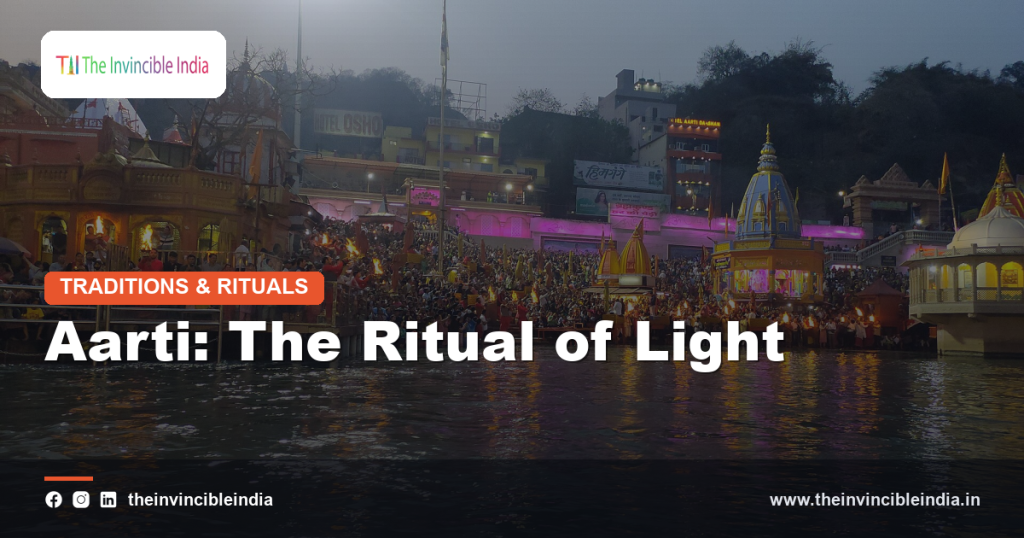
Aarti is a Hindu devotional ritual in which a lit lamp, typically fed with ghee or camphor, is gently waved in a circular motion before an image of a deity, accompanied by devotional songs and the ringing of bells. Performed daily in temples and homes across India, as well as at large public gatherings such as the Ganga aarti on the banks of the river, it stands as one of the most visible and widely recognised forms of Hindu worship. Much like the devotion and song that mark Durga Puja, aarti brings worship into a shared, sensory experience of sound, light and song. This guide explores its meaning, forms and continuing place in devotional life.
Quick Facts
| Detail | Information |
|---|---|
| Meaning | Ritual offering of light to a deity |
| Typical Object Used | Lit lamp (diya) fed with ghee or camphor |
| Accompaniments | Devotional songs (bhajans), bells, conch |
| When Performed | Daily, especially at dawn and dusk, and on festivals |
| Performed At | Temples, homes, riverbanks and public gatherings |
| Notable Example | Ganga Aarti performed at river ghats |
Meaning and Significance of Aarti
Aarti is a devotional ritual central to Hindu worship, in which a lit lamp is offered before an image or symbol of a deity by moving it gently in a circular motion, typically performed by a priest or devotee at the conclusion of a longer sequence of prayer. The ritual is understood as an act of reverence, in which light is offered back to the divine as a gesture of devotion and gratitude.
Performed daily in countless temples and homes, aarti is one of the most visually and aurally distinctive elements of Hindu worship, combining the sight of moving flame with the sound of bells and devotional song in a single, unified act of prayer.
The Symbolism of Light in Hindu Worship
Light holds deep symbolic importance across Hindu religious practice, generally associated with knowledge, purity and the dispelling of ignorance and darkness. Offering a lit lamp during aarti draws on this broader symbolism, presenting light back to the deity as an expression of devotion while also invoking these associated qualities for the worshipper.
This symbolic use of light connects aarti to other light-centred observances in Hindu tradition, such as the lamps lit during Diwali, reflecting a consistent thread throughout Hindu ritual life in which flame is treated as a particularly meaningful medium of worship and offering.
The Ritual Objects Used in Aarti
The central object in aarti is a lamp, often a multi-wicked brass vessel or a simple diya, filled with ghee or oil and lit before the ritual begins. In many traditions, camphor is used instead of or alongside oil, valued for its clean-burning flame and pleasant fragrance during worship.
Additional items commonly accompanying the ritual include a small bell rung throughout the ceremony, incense sticks, flowers and sometimes a conch shell, each contributing to the sensory richness of the ritual and reflecting the broader Hindu practice of engaging multiple senses in acts of worship.
The Structure and Movement of the Ritual
During aarti, the lit lamp is moved in a clockwise circular motion before the image of the deity, often following a specific sequence that includes circling the feet, the midsection and finally the whole form of the deity. This structured movement is generally repeated a set number of times, according to the customs of the particular temple or household.
Following the offering to the deity, the lamp is frequently passed among the assembled devotees, who briefly pass their hands over the flame and then touch their hands to their forehead or eyes, a gesture through which they symbolically receive a portion of the divine light.
Aarti Songs and Devotional Music
Aarti is almost always accompanied by devotional songs composed specifically for the ritual, often addressed directly to the deity being worshipped and describing their attributes, deeds or blessings. These aarti songs are widely known within their respective devotional traditions, sung communally by those present rather than performed solely by the officiating priest.
The combination of familiar melody and repeated communal singing gives aarti a participatory quality distinct from more silent or individual forms of worship, allowing even those unfamiliar with formal ritual procedure to take part meaningfully through song.
Aarti in Temple Worship
In temples, aarti is typically performed multiple times a day, most prominently at dawn and dusk, forming a regular rhythm around which the temple’s broader schedule of worship is organised. Larger temples often mark these moments with particular ceremony, involving multiple priests, elaborate lamps and larger devotional gatherings.
The timing of temple aarti is generally well known to regular devotees, many of whom plan their visits specifically to be present for this portion of the day’s worship, reflecting the ritual’s role as a focal point of communal temple life.
Aarti in the Home
Within many Hindu households, a simplified form of aarti is performed daily at a home shrine, typically by a family member rather than a priest, often in the morning and evening. This home-based practice mirrors temple ritual on a smaller, more personal scale, using a modest lamp and a brief devotional song suited to daily routine.
The consistency of home aarti, performed as part of ordinary daily life rather than reserved for special occasions, illustrates how the ritual functions as both an extraordinary and an entirely routine element of Hindu devotional practice.
Ganga Aarti and River Worship
Among the most well-known public expressions of the ritual is the Ganga aarti, performed each evening at ghats along the river Ganga in cities such as Varanasi and Haridwar, where priests perform a large, coordinated aarti using elaborate multi-tiered lamps before an audience of devotees and visitors gathered along the riverbank.
This large-scale public ritual, accompanied by chanting, music and the sight of flames reflected on the water, has become one of the most recognisable devotional spectacles in India, drawing both pilgrims and general visitors to witness the ceremony at close range.
Aarti During Festivals
Aarti features prominently during major Hindu festivals, often performed with particular elaborateness as part of the day’s or night’s central worship. During Durga Puja, Diwali and Navratri, temples and community gatherings frequently conduct aarti as a key ritual moment, drawing especially large gatherings compared with routine daily observance.
This festival-time emphasis on aarti reflects its role as a natural focal point for communal celebration, offering a moment in which an entire gathered assembly can participate together in a single, unified act of worship rather than observing individually.
The Role of Bells, Conch and Sound
Sound plays an integral role in aarti, with the ringing of a small bell throughout the ritual believed to help focus attention and, in traditional understanding, to invite auspiciousness while dispelling negative influences. In some traditions, a conch shell is also blown at key points during the ceremony, adding a resonant, carrying tone to the ritual.
This combination of bell, conch and communal singing creates a distinctive soundscape strongly associated with Hindu worship more broadly, one that many devotees describe as instantly recognisable and closely tied to their earliest memories of temple or home worship.
Prasad and the Conclusion of Aarti
Aarti frequently concludes with the distribution of prasad, food or sweets first offered to the deity and then shared among those present, extending the ritual’s sense of divine blessing into a tangible, shared gesture. This distribution often takes place immediately after devotees have passed their hands over the aarti flame.
The sequence of light, sound and shared food gives aarti a complete ritual arc, moving from formal offering to communal participation, and reflects the broader pattern in Hindu worship in which prayer is typically followed by some form of tangible blessing extended to the worshippers.
Regional Variations in Aarti Practice
While the core elements of aarti, a lit lamp, devotional song and circular offering, are consistent nationwide, specific customs vary by region and tradition, including the particular songs sung, the number of times the lamp is circled, and the style of the lamp itself. Certain temples are also known for especially elaborate or historically distinctive versions of the ritual.
These regional variations reflect the broader diversity found throughout Hindu ritual practice, where a shared underlying structure accommodates a wide range of local expression shaped by community tradition and specific temple lineage.
Aarti in Other Devotional Traditions
While most closely associated with Hindu worship, ritual forms involving lamps and light offerings appear in related devotional contexts as well, including certain Sikh and Jain practices that share elements of ceremonial lamp offering, each shaped by its own theological framework. These parallels reflect a broader regional tradition of using light as a devotional medium.
Such shared elements across traditions illustrate how certain ritual forms, particularly those built around widely resonant symbols like light, can appear in related but distinct religious practices across the Indian subcontinent, each retaining its own specific meaning and context.
Aarti as Communal and Public Worship
Beyond its role in individual or family devotion, aarti frequently functions as a communal act, particularly in its larger temple and public forms, where devotees gather specifically to participate together in a shared moment of worship. The communal singing that accompanies aarti reinforces this shared character, allowing large groups to worship in unison.
This public dimension has also made aarti a recognisable feature of Indian religious life to outside observers, often serving as an accessible entry point for visitors seeking to witness Hindu worship in a vivid, participatory setting.
The Everyday Rhythm of Aarti
For many practicing Hindus, aarti forms a quiet but consistent rhythm within daily life, marking the beginning and end of the day through a brief moment of devotion at a home shrine or nearby temple. This regularity gives the ritual a grounding quality, distinct from more elaborate occasional ceremonies.
The brevity and simplicity of daily aarti, requiring only a lamp and a few minutes of attention, allows it to remain a sustainable part of even busy modern routines, helping explain its continued widespread practice across generations.
Aarti Today
In contemporary India, aarti continues to be performed with much the same form it has held for generations, from quiet home rituals to grand public ceremonies such as the Ganga aarti, which now draws visitors from around the world alongside local devotees. Live broadcasts of major temple and riverside aartis have also extended their reach to audiences unable to attend in person.
Despite these modern additions, the ritual’s essential character, a simple offering of light accompanied by devotion and song, remains unchanged, continuing to serve as one of the most immediate and widely recognised expressions of Hindu worship.
Sources & Further Reading
- Ministry of Culture, Government of India (indiaculture.gov.in).
- Sangeet Natak Akademi (sangeetnatak.gov.in).
Frequently Asked Questions
What is aarti?
Aarti is a Hindu devotional ritual in which a lit lamp is offered to a deity through a circular waving motion, accompanied by devotional songs and bells.
What is used to light the aarti lamp?
The lamp is typically fed with ghee or oil, and camphor is also commonly used, valued for its clean flame and fragrance during worship.
Why do devotees pass their hands over the aarti flame?
This gesture is understood as a way of symbolically receiving the divine light offered during the ritual, after which devotees touch their hands to their forehead.
What is Ganga aarti?
Ganga aarti is a large, public evening ritual performed at riverbank ghats in cities such as Varanasi and Haridwar, using elaborate lamps before gathered devotees.
How often is aarti performed?
Aarti is typically performed daily in temples and many homes, especially at dawn and dusk, and with added elaborateness during festivals.