


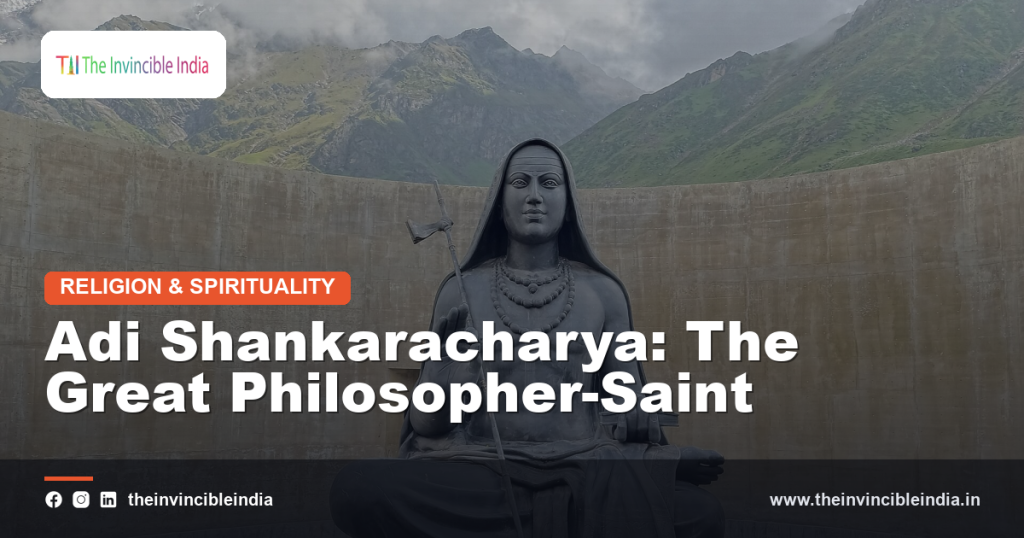
Adi Shankaracharya is remembered as one of the greatest philosopher-saints in the history of Indian thought, a towering figure whose profound teachings gave enduring shape to Hindu philosophy. Renouncing worldly life at a young age, he travelled across the length of the subcontinent, engaging in philosophical debate, composing influential commentaries on India’s most sacred texts, and establishing monastic institutions that continue to function to this day. His philosophy of Advaita Vedanta, the teaching of non-dualism and the essential unity of the individual soul with ultimate reality, remains one of the most influential schools of thought within Hindu philosophy. This guide explores the life, teachings, writings and enduring legacy of Adi Shankaracharya.
Quick Facts
| Detail | Information |
|---|---|
| Known as | A great philosopher-saint of Hindu tradition |
| Philosophy | Advaita Vedanta, the teaching of non-dualism |
| Era | Traditionally placed in ancient to early classical India |
| Legacy | Founded major monastic centres (mathas) across India |
| Associated sites | Sringeri, Kedarnath and other sacred places |
| Writings | Commentaries on the Upanishads, Gita and Brahma Sutras |
A Towering Figure in Indian Philosophy
Adi Shankaracharya stands as one of the most towering figures in the history of Indian philosophy, a thinker and teacher whose influence on Hindu thought has endured across many centuries. Revered as a philosopher-saint, he combined profound intellectual brilliance with deep personal renunciation and spiritual attainment, a rare combination that gave his teaching exceptional authority and lasting impact. His work gave systematic philosophical form to some of the deepest teachings found in India’s most ancient scriptures, shaping the subsequent development of Hindu philosophy in fundamental ways. As a figure whose thought continues to be studied and revered today, Adi Shankaracharya occupies a central place in the story of Indian spiritual and philosophical achievement.
Early Life and Renunciation
According to tradition, Shankaracharya showed extraordinary intellectual and spiritual gifts from a very young age, displaying a deep inclination towards learning and contemplation that set him apart from other children. He is remembered as having chosen the path of renunciation while still very young, leaving behind the prospect of ordinary worldly life to devote himself entirely to the pursuit of spiritual knowledge and truth. This early and decisive turn towards renunciation is regarded as a defining feature of his life story, reflecting the intensity of his spiritual calling from childhood. This remarkable early renunciation set the stage for the extraordinary philosophical and spiritual achievements that would follow across his short but immensely productive life.
The Path of a Wandering Monk
After his renunciation, Shankaracharya adopted the life of a wandering monk, travelling extensively across the Indian subcontinent in search of learning, spiritual attainment and opportunities to teach. His travels are remembered as taking him to many of the most sacred sites and centres of learning across India, from the far south to the Himalayan north, engaging with scholars, ascetics and spiritual seekers along the way. This life of constant travel and teaching allowed him to spread his philosophical teachings widely and to establish a network of institutions and disciples across the country. The image of Shankaracharya as a tireless wandering teacher, covering vast distances in the pursuit of truth, remains central to his enduring legacy.
Advaita Vedanta Explained
Shankaracharya is most closely associated with the philosophy of Advaita Vedanta, a school of thought whose name means non-dualism, the teaching that ultimate reality is one and undivided. According to this philosophy, the apparent multiplicity and diversity of the world is, at the deepest level of understanding, an expression of a single underlying reality rather than a collection of truly separate and independent things. Shankaracharya gave this ancient teaching, rooted in India’s oldest philosophical texts, a systematic and rigorous philosophical form that has shaped Hindu thought ever since. Advaita Vedanta remains one of the most influential and widely studied schools of Indian philosophy, admired for its intellectual depth and its profound spiritual vision.
Brahman and Maya
Central to Shankaracharya’s philosophy is the concept of Brahman, the single, ultimate and unchanging reality that underlies all existence, and the related concept of maya, often understood as the veiling power that gives rise to the world’s apparent diversity and change. According to this teaching, the everyday world of separate objects and beings, while experienced as real in ordinary life, does not represent the deepest and final truth of existence, which is the single, undivided reality of Brahman. This distinction between the ultimate reality of Brahman and the provisional, changing nature of the experienced world is a cornerstone of Advaita philosophy. Shankaracharya’s careful articulation of this relationship remains one of his most significant and influential philosophical contributions.
The Unity of Atman and Brahman
A central and profound teaching within Shankaracharya’s philosophy is the identity of atman, the innermost self, with Brahman, the ultimate reality, a unity that is held to be the deepest truth about human existence. According to this teaching, spiritual liberation comes not from acquiring something new but from directly realising this already-existing unity between the individual self and the ultimate reality, dispelling the ignorance that obscures this truth. This teaching gives Advaita Vedanta its distinctive spiritual orientation, centred on knowledge and direct realisation rather than ritual alone. The teaching of the unity of atman and Brahman remains one of the most celebrated and influential ideas in the whole of Indian philosophy.
Commentaries on the Upanishads
Among Shankaracharya’s most significant intellectual achievements are his detailed commentaries on the principal Upanishads, the profound philosophical texts that form the concluding portion of the Vedic scriptures. In these commentaries, he offered careful and systematic interpretations that drew out the philosophy of non-dualism from these ancient and often dense texts, making their teachings more accessible and giving them a coherent philosophical structure. These commentaries remain foundational texts for the study of Advaita Vedanta and continue to be studied by scholars and students of Indian philosophy to this day. Shankaracharya’s work on the Upanishads is regarded as one of the great achievements of classical Indian philosophical scholarship.
Commentary on the Bhagavad Gita
Shankaracharya also composed an influential commentary on the Bhagavad Gita, one of the most beloved and widely read texts of Hindu scripture, offering a philosophical interpretation of its teachings in light of Advaita Vedanta. His commentary helped shape how generations of readers and scholars have understood the Gita’s teachings on duty, devotion and knowledge, situating them within a broader philosophy of ultimate unity. This work exemplifies Shankaracharya’s broader project of interpreting India’s central scriptural texts through the lens of non-dualist philosophy, giving them a unified and coherent philosophical foundation. His commentary on the Gita remains among the most respected and widely studied interpretations of this cherished text.
The Brahma Sutra Bhasya
Among Shankaracharya’s most important works is his commentary on the Brahma Sutras, a foundational text of Vedanta philosophy that systematically addresses questions about the nature of ultimate reality. His commentary on this challenging text, known as the Brahma Sutra Bhasya, is regarded as one of the great masterworks of Indian philosophical literature, offering a rigorous and comprehensive exposition of Advaita Vedanta. Through this work, Shankaracharya provided a systematic philosophical foundation for non-dualist thought that has shaped the subsequent development of Vedanta philosophy for centuries. This commentary remains a central text for the study of Vedanta philosophy in traditional and academic settings alike.
Philosophical Debates
Shankaracharya was renowned for his skill in philosophical debate, and tradition holds that he engaged in significant intellectual exchanges with scholars and proponents of rival philosophical schools during his travels across India. These debates, remembered as demonstrations of his exceptional learning and reasoning ability, are said to have played an important role in establishing the standing of his philosophy among the learned communities of his time. Through these engagements, Shankaracharya is remembered as having helped to reinvigorate philosophical discourse and to give Advaita Vedanta a place of prominence among the schools of Indian thought. This tradition of vigorous and reasoned philosophical debate remains an important part of his enduring legacy as a thinker.
The Cardinal Mathas
One of Shankaracharya’s most enduring institutional legacies is the establishment of major monastic centres, known as mathas, located in different regions of India, each intended to preserve and transmit his philosophical teachings across the generations. These mathas were established with structures of leadership intended to ensure the continuity of teaching and monastic discipline long after his own lifetime. Through this network of institutions, Shankaracharya ensured that his philosophy would not remain a purely intellectual achievement but would be sustained by living communities of teachers and students. The continued functioning of these mathas today stands as a remarkable testament to the foresight and lasting impact of his institutional vision.
Sringeri and the Monastic Tradition
Among the mathas associated with Shankaracharya, the monastic centre at Sringeri holds a place of particular prominence and reverence within the tradition, regarded as one of the most important seats of the Advaita monastic lineage. Sringeri has continued for many centuries as a centre of learning, spiritual guidance and monastic leadership, maintaining the philosophical and spiritual traditions associated with Shankaracharya. The heads of such mathas are regarded as important spiritual authorities within the tradition, continuing to guide followers and to preserve teachings across the generations. The continued vitality of Sringeri and similar institutions illustrates the lasting success of Shankaracharya’s effort to institutionalise and perpetuate his philosophical legacy.
Journeys Across India
Shankaracharya’s life is remembered as one of extraordinary travel across the length and breadth of the Indian subcontinent, journeys undertaken on foot in an age without modern transport, reflecting remarkable dedication and physical endurance in service of his spiritual mission. His travels are associated with numerous sacred sites across India, including sites in the far Himalayan north such as Kedarnath, where tradition holds he spent time in his final years. These extensive journeys allowed him to engage with diverse regional traditions, establish institutions and spread his teachings to a truly national audience. The sheer geographic scope of his travels remains a remarkable feature of his life, reflecting the scale of his ambition to renew Hindu philosophy across the whole country.
Devotional Hymns and Poetry
Beyond his rigorous philosophical writings, Shankaracharya is also remembered as the composer of beautiful devotional hymns and poetry dedicated to various forms of the divine, reflecting a warmer, more personal and devotional side to his spiritual life. These hymns, admired for their poetic beauty and depth of feeling, continue to be recited and sung by devotees in temples and homes across India. This combination of profound philosophical achievement with heartfelt devotional expression reflects the breadth and richness of Shankaracharya’s spiritual personality, encompassing both rigorous intellectual inquiry and warm personal devotion. This devotional legacy remains a cherished and living part of his contribution to Hindu religious life.
Revival of Hindu Philosophy
Shankaracharya is widely credited with playing a central role in revitalising Hindu philosophy during a period when it faced significant intellectual challenges from rival schools of thought. Through his systematic philosophical writings, his skill in debate and his establishment of lasting institutions, he is remembered as having helped restore confidence and coherence to Vedanta philosophy and to the broader tradition of Hindu thought. This revival is regarded by scholars and tradition alike as one of the most significant achievements in the intellectual history of Hinduism. The scale and lasting impact of this philosophical revival is a central reason for the immense reverence in which Shankaracharya continues to be held.
Legacy and Influence
The legacy of Adi Shankaracharya extends across the whole subsequent history of Hindu philosophy, influencing countless later thinkers, teachers and spiritual movements who engaged with, built upon or responded to his teachings. His philosophy of Advaita Vedanta remains one of the most widely studied and respected schools of Indian thought, both within traditional religious contexts and in modern academic study of philosophy. The mathas he founded continue to function as living centres of teaching and spiritual guidance, carrying his legacy forward into the present day. This combination of enduring philosophical influence and living institutional continuity makes Shankaracharya’s legacy among the most substantial and lasting of any figure in the history of Indian thought.
Adi Shankaracharya Today
Today Adi Shankaracharya is revered across India as one of the greatest philosopher-saints in the nation’s history, his teachings studied by scholars, students and spiritual seekers alike. The mathas he established continue to function as active centres of learning and spiritual guidance, and his commentaries remain foundational texts for the study of Vedanta philosophy. His statues and memorials at sacred sites across the country stand as reminders of his extraordinary life and legacy. As a thinker who combined profound intellectual achievement with deep spiritual attainment and tireless dedication to teaching, Adi Shankaracharya remains one of the most influential and revered figures in the entire history of Indian philosophy and spirituality.
Sources & Further Reading
- Ministry of Culture, Government of India, on the philosophical and spiritual heritage of India (indiaculture.gov.in).
- Sahitya Akademi, on classical Indian philosophical literature.
Frequently Asked Questions
Who was Adi Shankaracharya?
Adi Shankaracharya was a great philosopher-saint of India, renowned for his teaching of Advaita Vedanta, his commentaries on India’s central scriptures, and his establishment of monastic centres that continue to function today.
What is Advaita Vedanta?
Advaita Vedanta is a school of Hindu philosophy meaning non-dualism, which teaches that ultimate reality, Brahman, is one and undivided, and that the individual self is, at the deepest level, identical with this ultimate reality.
What did Shankaracharya write?
Shankaracharya wrote influential commentaries on the principal Upanishads, the Bhagavad Gita and the Brahma Sutras, along with devotional hymns and poetry, giving systematic philosophical form to the teaching of non-dualism.
What are the mathas Shankaracharya established?
Shankaracharya established major monastic centres, known as mathas, in different regions of India, including the well-known centre at Sringeri, intended to preserve and transmit his philosophical teachings across the generations.
Why is he called a philosopher-saint?
He is called a philosopher-saint because he combined rigorous, systematic philosophical thought with deep personal renunciation and spiritual attainment, a rare combination that gave his teachings exceptional authority within the Hindu tradition.