


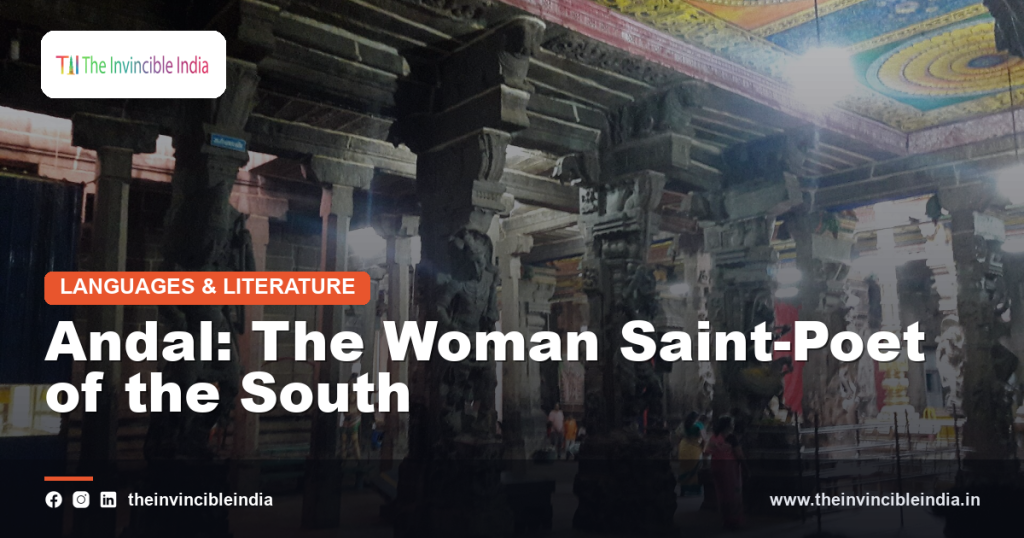
Andal occupies a singular place in South Indian devotional history as the only woman traditionally counted among the twelve Alvars, the Vaishnava saint-poets whose Tamil compositions shaped the Bhakti movement across the subcontinent. Writing in classical Tamil, she expressed an intense, personal devotion to Vishnu through verse that blends everyday imagery with profound spiritual longing, giving her poetry an intimacy rarely matched among her contemporaries. Centered on the temple town of Srivilliputhur, her life and legend remain deeply woven into Tamil Vaishnava worship, and her two surviving works continue to be recited, sung, and studied across Tamil Nadu. Andal’s legacy endures as one of the most cherished chapters in India’s devotional literary heritage.
Quick Facts
| Detail | Information |
|---|---|
| Tradition | Sri Vaishnavism, one of the twelve Alvars |
| Region | Srivilliputhur, Tamil Nadu |
| Language | Tamil |
| Major Works | Tiruppavai and Nachiar Tirumozhi |
| Distinction | Traditionally the only woman among the Alvars |
| Deity of Devotion | Vishnu, worshipped as Ranganatha |
Who Was Andal
Andal is remembered as one of the most cherished figures in South Indian devotional history, a Tamil saint-poet whose verses express an unusually personal and intimate form of devotion to Vishnu. Her life, as recounted in tradition, is inseparable from the temple town of Srivilliputhur, with which she remains closely associated to this day.
Unlike many devotional poets who wrote primarily in a contemplative or philosophical register, Andal’s compositions convey longing, tenderness, and yearning in a voice that feels remarkably direct even across the centuries. This distinctive emotional quality has helped her poetry retain a devoted readership and listenership long after it was first composed.
Place Among the Alvars
Andal is traditionally counted among the twelve Alvars, a group of Vaishnava saint-poets whose Tamil devotional compositions form a foundational body of literature within the Sri Vaishnava tradition. She is generally regarded as the only woman among this revered group of poet-saints.
The Alvars are remembered collectively for songs that express deep personal devotion to Vishnu, composed in accessible Tamil verse rather than formal Sanskrit, which helped their compositions reach a wide and devoted audience. Andal’s inclusion among them reflects the esteem in which her poetry has long been held within this tradition.
Legendary Life and Devotion
According to tradition, Andal was raised in a household devoted to the worship of Vishnu, and from an early age she is said to have expressed an unusually intense and personal attachment to the deity. This devotion came to shape the entire course of her life as it is remembered today.
Rather than treating devotion as a distant or formal act of worship, Andal’s story presents her relationship with Vishnu in terms of deep personal longing, often compared in tone to the love expressed between devoted companions. This distinctive framing of divine devotion became a defining feature of her poetic voice.
Srivilliputhur and Her Temple
Srivilliputhur, a temple town in Tamil Nadu, is closely identified with Andal’s life and continues to serve as a major center of her worship and remembrance. A temple dedicated to her stands as an important pilgrimage site within the wider network of Vaishnava shrines in the region.
The town’s association with Andal has helped sustain an unbroken tradition of ritual, festival, and recitation connected to her life and poetry, ensuring that her memory remains actively honored rather than confined to historical or literary study alone. This living devotional practice continues to draw pilgrims and devotees today.
The Tiruppavai
The Tiruppavai stands as Andal’s most celebrated composition, a sequence of Tamil verses in which the poet takes on the voice of a young devotee observing a vow of devotion during the winter month sacred to Vaishnava worship. The work is structured around this ritual framework of collective devotion.
Within this structure, the Tiruppavai weaves together imagery of daily rural life with expressions of intense spiritual aspiration, addressing companions, invoking Vishnu, and expressing hope for divine grace. Its accessible language and devotional depth have made it one of the most widely recited works in Tamil Vaishnava practice.
Themes of the Tiruppavai
The Tiruppavai explores themes of collective devotion, community, and spiritual discipline, presenting worship not as a solitary act but as a shared undertaking among companions united by devotion to Vishnu. This communal framing gives the work a distinctive social as well as spiritual dimension.
At the same time, the poem conveys deeply personal yearning, as its speaker expresses hope, humility, and longing for divine closeness through simple, evocative language drawn from everyday rural imagery. This combination of communal ritual and intimate emotion has helped the Tiruppavai remain widely loved across generations of readers and devotees.
The Nachiar Tirumozhi
Andal’s second major work, the Nachiar Tirumozhi, presents an even more intensely personal expression of devotion, structured as a sequence of verses in which the speaker expresses longing for union with Vishnu in strikingly emotional imagery. The work pushes devotional poetry into deeply intimate territory.
Where the Tiruppavai emphasizes communal ritual, the Nachiar Tirumozhi turns inward, dwelling on the private emotional experience of a devotee consumed by love for the divine. Together, the two works display the range of Andal’s poetic voice, from collective celebration to solitary yearning.
Bridal Mysticism in Andal's Poetry
A distinctive feature of Andal’s poetry is its use of bridal mysticism, a devotional mode in which the relationship between the devotee and the divine is expressed through the imagery and emotional register of a bride awaiting her beloved. This approach gives her verse an unusually vivid emotional intensity.
By framing devotion in these terms, Andal’s poetry conveys spiritual longing in a way that felt immediate and relatable to listeners familiar with the customs and emotions surrounding courtship and marriage in her time. This mode of bridal mysticism has since become closely associated with her literary legacy.
The Legend of the Garland
Among the best-known stories associated with Andal is the legend of the garland, in which she is said to have worn a garland intended as an offering to the deity before it was presented at the temple, out of her own devoted admiration for how it might look on Vishnu.
Though the garland was later offered as intended, the story is remembered as an expression of Andal’s uninhibited, deeply personal devotion, one that prioritized heartfelt connection with the divine over strict ritual formality. This tale remains a cherished part of the oral tradition surrounding her life.
Union with Ranganatha
Tradition holds that Andal’s life culminated in a union with Vishnu, worshipped in this context as Ranganatha, understood by devotees as the fulfillment of her lifelong devotion rather than an ordinary earthly event. This conclusion to her story reinforces the deeply devotional character of her entire life narrative.
This element of her legend is central to how she is remembered and venerated, reinforcing the idea that her poetry was not merely literary composition but a lived expression of spiritual longing that tradition regards as ultimately fulfilled. Her story continues to be retold in this spirit across generations.
Andal in the Bhakti Movement
Andal’s poetry forms an important part of the broader Bhakti movement, a widespread devotional current across India that emphasized direct, personal devotion to a chosen deity over formal ritual or scholarly religious learning. Her Tamil verses exemplify this emphasis on heartfelt, accessible devotion.
As one of the Alvars, Andal contributed to a body of devotional literature that helped popularize Vaishnava worship among ordinary people, using vernacular language and vivid emotional imagery rather than the more formal register of classical religious texts. This accessibility helped her work reach and move a wide devotional audience.
Tamil Literary Significance
Beyond her religious significance, Andal holds an important place within the history of Tamil literature, recognized for the lyrical quality, emotional depth, and structural craftsmanship of her verse. Her compositions are studied both as devotional texts and as important literary achievements in their own right.
Her work exemplifies how Tamil devotional poetry could combine accessible language with sophisticated literary technique, achieving emotional resonance without sacrificing artistic refinement. This dual significance, spiritual and literary, has helped secure Andal’s lasting place within the broader canon of classical Tamil literature.
Influence on Sri Vaishnavism
Andal’s compositions occupy a respected place within Sri Vaishnavism, a major devotional tradition centered on the worship of Vishnu, where her verses are recited as part of regular temple liturgy and ritual practice. Her poetry is treated with the same reverence accorded to other Alvar compositions.
The continued liturgical use of her work reflects the deep integration of her poetry into everyday devotional life within this tradition, rather than treating it as a purely historical or literary artifact. This ongoing ritual use has helped preserve both the language and spirit of her verse across many generations.
Festivals and Ongoing Worship
Andal is honored through annual festivals and observances connected to the sacred Tamil month associated with her most famous composition, during which her verses are recited widely in temples and homes across Tamil Nadu. These occasions renew public engagement with her poetry each year.
Temple processions, recitations, and communal gatherings held in her honor continue to draw devotees, reflecting the living, active nature of her veneration rather than a purely commemorative or historical observance. This yearly cycle of celebration keeps her story and poetry present in contemporary devotional life.
Andal in Art and Iconography
Andal is a familiar figure in South Indian religious art and iconography, typically depicted as a young woman adorned with garlands and jewelry, an image closely tied to the legends surrounding her devotion and her association with floral offerings. This iconography is widely recognized across Vaishnava temples.
Sculptures, paintings, and temple imagery depicting Andal reinforce her identity as a beloved devotional figure, distinct in both appearance and narrative from the male saint-poets among the Alvars. This visual tradition has helped keep her story accessible to devotees beyond the reach of her written verse alone.
Andal's Poetic Technique
Andal’s verse is notable for its careful use of poetic meter, refrain, and structured sequence, techniques that gave her compositions a musical quality well suited to communal recitation and singing. This technical skill supported the emotional power of her devotional themes.
Her ability to combine formal poetic discipline with genuine emotional expression reflects a high level of literary craftsmanship, distinguishing her work as both a devotional and an artistic achievement recognized within the wider tradition of classical Tamil verse.
Andal Today
Andal’s legacy today remains vibrant, sustained by continued recitation of her poetry, active temple worship, and scholarly interest in her literary and devotional contributions. Her verses continue to be taught, translated, and studied by those interested in Tamil literature and Vaishnava devotional tradition.
As one of the most enduring voices among the Alvars, Andal continues to represent a distinctive strand of Bhakti devotion defined by intimacy, emotional honesty, and literary artistry. Her continued relevance underscores the lasting power of her poetry across the centuries since it was first composed.
Sources & Further Reading
- Sahitya Akademi.
- Ministry of Culture, Government of India (indiaculture.gov.in).
Frequently Asked Questions
Who was Andal?
Andal was a Tamil saint-poet traditionally regarded as the only woman among the twelve Alvars, celebrated for devotional poetry expressing intense personal love for Vishnu.
What is the Tiruppavai?
The Tiruppavai is Andal’s best-known work, a sequence of Tamil verses in which a devotee observes a vow of devotion, blending everyday imagery with spiritual longing for Vishnu.
What is the Nachiar Tirumozhi?
The Nachiar Tirumozhi is Andal’s second major composition, expressing deeply personal and emotionally intense longing for union with the divine.
Where is Andal especially venerated?
Andal is especially venerated in Srivilliputhur, a Tamil Nadu temple town closely associated with her life, where a temple dedicated to her remains an active pilgrimage site.
What is bridal mysticism in Andal's poetry?
Bridal mysticism is a devotional mode in which the relationship between devotee and deity is expressed through the emotional imagery of a bride awaiting her beloved, a technique central to Andal’s verse.