


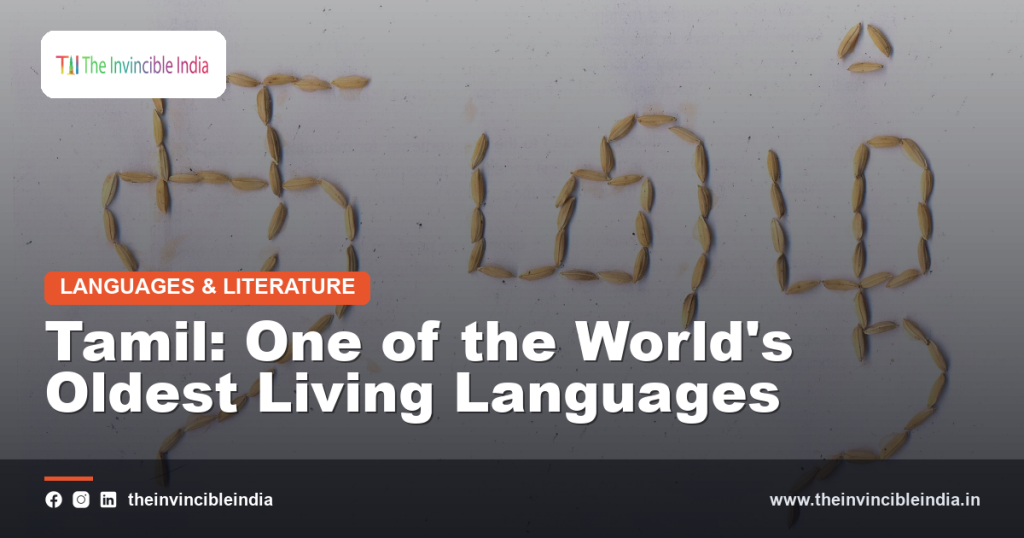
Tamil is one of the oldest living languages in the world, a classical language of extraordinary antiquity spoken by millions and boasting a continuous literary tradition stretching back more than two thousand years. The principal language of Tamil Nadu and of Tamil communities across the world, it belongs to the Dravidian family and is celebrated for its ancient roots, its rich and unbroken literature, and its deep cultural pride. From the exquisite poetry of the Sangam age to the timeless wisdom of the Thirukkural, Tamil has given the world a literary heritage of great beauty and depth. It was the first language to be recognised as a classical language of India. This guide explores its history, its literature, its classical status, its script and its living tradition among the great languages of India.
Quick Facts
| Detail | Information |
|---|---|
| Type | Classical Dravidian language |
| Antiquity | One of the oldest living languages in the world |
| Region | Tamil Nadu and Tamil communities worldwide |
| Early literature | The Sangam literature, over two thousand years old |
| Famous work | The Thirukkural, a classic of ethics and wisdom |
| Status | The first language recognised as a classical language of India |
An Ancient Living Language
Tamil is remarkable among the world’s languages for combining extreme antiquity with living vitality. Unlike many ancient languages that have died out or transformed beyond recognition, Tamil has been spoken continuously for thousands of years and remains a vibrant, living language today, spoken by tens of millions of people. This unbroken continuity, linking the modern speaker to the poets of two thousand years ago, is a source of immense pride and a subject of wonder. Few languages can claim so long and continuous a history as a living tongue with a continuous literature. This combination of great age and enduring life makes Tamil one of the most extraordinary languages in the world.
A Dravidian Language
Tamil belongs to the Dravidian family of languages, which is distinct from the Indo-European family to which languages such as Sanskrit and Hindi belong. The Dravidian languages are spoken mainly in southern India, and Tamil is among the most ancient and important of them. As a Dravidian language, Tamil has its own distinctive structure, sounds and grammar, developed independently over its long history, though it has also interacted with and influenced other languages over the centuries. Its place in the Dravidian family, with its own ancient and independent roots, is fundamental to understanding Tamil and its distinct identity among the languages of India and the world.
The Sangam Age
The earliest and one of the most glorious periods of Tamil literature is the Sangam age, named after legendary academies of poets, which produced a remarkable body of poetry more than two thousand years ago. The Sangam literature consists of exquisite poems on themes of love, war, nature, ethics and the life of the people, composed by many poets and celebrated for their beauty, realism and emotional depth. This ancient poetry offers a vivid window into the society, values and landscape of the ancient Tamil country. The Sangam literature is one of the great treasures of world literature and a foundation of the Tamil literary tradition, testifying to the extraordinary antiquity of Tamil letters.
The Poetry of the Sangam
The poetry of the Sangam age is admired for its sophistication, its vivid imagery and its deep humanity. It is traditionally divided into poems of the inner world, dealing with love and the emotions, and poems of the outer world, dealing with war, kings, ethics and public life, each with its own conventions and themes. The love poetry, in particular, is celebrated for its subtle association of human emotions with different landscapes and moods, a sophisticated poetic system of great beauty. This ancient poetry, at once refined and deeply human, reveals a mature and highly developed literary culture flourishing in the Tamil country two thousand years ago and remains a cherished part of the heritage.
The Thirukkural
Among the most revered of all Tamil works is the Thirukkural, a classic text of ethics, wisdom and practical living attributed to the ancient poet-sage Thiruvalluvar. Composed of short, pithy couplets of remarkable economy and depth, the Thirukkural offers profound teaching on virtue, wealth, love and the conduct of life, in verses admired for their wisdom, universality and literary beauty. So esteemed is the work that it is honoured far beyond the Tamil world and has been translated into many languages. The Thirukkural is a jewel of Tamil literature and of world wisdom literature, and it holds a place of deep reverence in Tamil culture as a timeless guide to right living.
A Continuous Literary Tradition
One of the glories of Tamil is its continuous and unbroken literary tradition, stretching from the ancient Sangam age through the centuries to the present day. Over these two thousand years and more, Tamil has produced a vast and varied literature, including epics, devotional poetry, ethical works, grammar, commentary and, in modern times, novels, short stories and poetry. This continuous tradition, with each age building on those before, is extraordinarily rich and is a source of great pride. Few languages can claim so long an unbroken literary history. This continuity links the modern Tamil reader directly to the ancient poets and gives the tradition a remarkable depth and unity.
The Tamil Epics
Tamil literature includes great epics that are counted among its finest achievements. The most celebrated is the ancient epic that tells a moving story of love, injustice and the tragic fate of its heroine, a work admired for its poetic beauty, its vivid picture of ancient Tamil society and its powerful emotional force. Alongside it are other classical epics of great literary value. These works, composed in the centuries after the Sangam age, represent the height of classical Tamil narrative poetry and are treasured as masterpieces of the tradition. The Tamil epics, rich in story, character and poetic art, are among the great contributions of Tamil to the literature of India and the world.
Devotional Literature
Tamil has a rich and beautiful tradition of devotional literature, especially the passionate hymns of the saint-poets who sang of their love for the divine. In the great age of devotion, saint-poets composed outpourings of devotional poetry in Tamil, addressed to the gods and expressing intense personal love, longing and surrender. These hymns, sung in temples to this day, are treasured both as literature and as living devotion, and they played a great part in the religious and cultural life of the Tamil country. This devotional poetry is one of the glories of Tamil literature, combining deep spiritual feeling with great poetic beauty and remaining a living part of Tamil religious tradition.
The Tolkappiyam
Among the most ancient and important Tamil works is the Tolkappiyam, the oldest surviving Tamil grammar, a work of remarkable antiquity and sophistication. Far more than a mere grammar, it deals not only with the sounds and structure of the language but with poetics, literary conventions and even aspects of the culture and life of the ancient Tamils. Its existence testifies to the highly developed state of the Tamil language and its literary culture in ancient times. The Tolkappiyam is a foundational text of the Tamil tradition, studied and revered for its analysis of the language and its window into the ancient Tamil world, and it stands as a monument of early Tamil learning.
Classical Language Status
In recognition of its extraordinary antiquity, its rich and independent literary tradition and its cultural importance, Tamil was the first language to be officially recognised as a classical language of India. This landmark recognition affirmed what Tamil speakers had long known: that their language is among the most ancient and important in the world, with a continuous literature of great value stretching back over two millennia. The classical status brought recognition, support for research and preservation, and pride to the Tamil people. It affirmed the place of Tamil among the great classical languages of humanity and underlined the importance of preserving and promoting its ancient and living heritage.
The Tamil Script
Tamil is written in its own distinctive script, which has developed over many centuries from ancient origins. The Tamil script is well suited to the sounds of the language and is used to write the vast literature of Tamil, from ancient inscriptions and manuscripts to modern books and digital media. Over its long history the script evolved in form, and it has been adapted for print and for the digital age. The distinctive Tamil script is an important part of the identity of the language and its culture, and its long development mirrors the long history of the Tamil language itself, carrying its literature across the centuries to the present day.
A Language of Pride and Identity
Tamil is more than a means of communication; it is a profound source of pride and identity for the Tamil people. The antiquity of the language, the richness of its literature and its unbroken continuity are cherished as symbols of a proud and ancient culture, and love of the Tamil language runs deep in Tamil society. This devotion to the language has inspired movements for its preservation and promotion and is expressed in a strong cultural attachment to Tamil letters and learning. The deep bond between the Tamil people and their language, and the pride they take in its ancient and living heritage, is one of the most striking features of Tamil culture.
Tamil Across the World
Tamil is spoken not only in Tamil Nadu but by large communities across the world, for the Tamil people have long migrated and settled in many countries. Substantial Tamil-speaking populations live in various parts of Asia and around the globe, and Tamil holds official status in more than one country beyond India. This global spread has carried the language, literature and culture of Tamil far and wide, and Tamil communities abroad maintain a strong attachment to their language and heritage. The presence of Tamil as a living language across many countries is a testament to its vitality and to the enduring cultural identity of the Tamil people wherever they live.
Modern Tamil Literature
The ancient literary tradition of Tamil continues vigorously into the modern age, with a rich body of modern literature in the language. Modern Tamil writers have produced novels, short stories, poetry, essays and drama, addressing contemporary themes and society while drawing on the deep heritage of the language. Modern Tamil literature is vibrant and diverse, and it continues the unbroken tradition of Tamil letters into the present, adapting to new forms and concerns. Tamil also flourishes in cinema, journalism, music and digital media. This living, evolving modern literature shows that Tamil remains not a museum piece but a vital, creative language, carrying its ancient tradition forward into the modern world.
Tamil Today
Today Tamil flourishes as one of the great living languages of the world, ancient beyond most others yet vibrantly alive, spoken by tens of millions and cherished with deep pride. Its classical status honours its extraordinary antiquity and its rich, continuous literature, while its modern literature, cinema and media show its living vitality. Spoken in Tamil Nadu and by communities across the globe, and treasured as a symbol of a proud and ancient culture, Tamil carries its two-thousand-year heritage forward into the present. In its unbroken continuity, its magnificent literature and its living vitality, Tamil remains one of the most remarkable languages in the history of humanity.
Sources & Further Reading
- Ministry of Culture, Government of India, on the classical languages of India (indiaculture.gov.in).
- Sahitya Akademi, national academy of letters, on Tamil literature (sahitya-akademi.gov.in).
- Central Institute of Classical Tamil and other institutions devoted to Tamil study.
Frequently Asked Questions
What is the Tamil language?
Tamil is a classical Dravidian language and one of the oldest living languages in the world, with a continuous literary tradition stretching back more than two thousand years. It is the principal language of Tamil Nadu and of Tamil communities around the world.
What is Sangam literature?
Sangam literature is the earliest body of Tamil literature, composed more than two thousand years ago and named after legendary academies of poets. It consists of exquisite poems on love, war, nature and ethics, celebrated for their beauty and their vivid picture of ancient Tamil society.
What is the Thirukkural?
The Thirukkural is a revered classic of Tamil literature, attributed to the poet-sage Thiruvalluvar, made up of short couplets offering profound teaching on virtue, wealth, love and the conduct of life. It is admired for its wisdom and has been translated into many languages.
Is Tamil a classical language?
Yes. Tamil was the first language to be officially recognised as a classical language of India, in recognition of its extraordinary antiquity, its rich and independent literary tradition and its cultural importance.
How old is the Tamil language?
Tamil is one of the oldest living languages in the world, with a continuous literary tradition of more than two thousand years, its earliest works being the ancient Sangam poetry. It has been spoken continuously since antiquity and remains a vibrant living language today.