


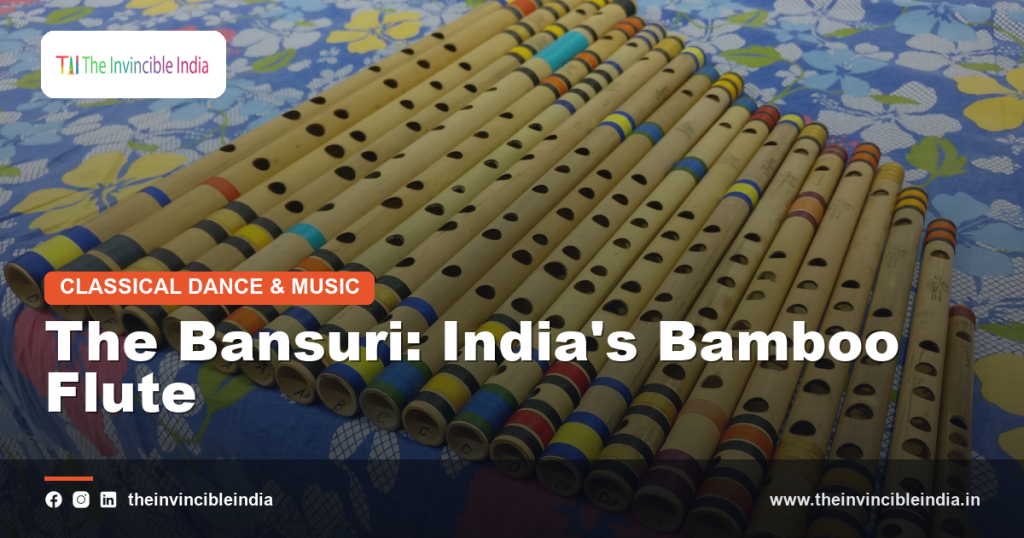
The bansuri is the bamboo flute of India, one of the oldest and most beloved of all Indian instruments, cherished for its sweet, soulful and haunting sound. A simple tube of bamboo with finger holes and no keys, it is capable in skilled hands of extraordinary expressiveness, able to glide and bend between notes in the manner essential to Indian music. The bansuri holds a special place in Indian culture through its ancient association with Lord Krishna, ever depicted playing his flute, and it is a leading melodic instrument of Hindustani classical music. This guide explores the bansuri’s history, its link to Krishna, its construction, how it is played, its role in classical music and its great masters.
Quick Facts
| Detail | Information |
|---|---|
| Type | A bamboo transverse (side-blown) flute |
| Age | One of the most ancient of Indian instruments |
| Cultural icon | The flute of Lord Krishna |
| Construction | A single tube of bamboo with finger holes and no keys |
| Sound | Sweet, mellow and soulful, capable of expressive slides |
| Tradition | A leading melodic instrument of Hindustani music |
An Ancient and Simple Instrument
The bansuri is among the most ancient of India’s instruments, a simple flute made from a single length of bamboo, yet capable of profound musical beauty. Its very simplicity is part of its appeal: with no keys or mechanism, just a tube pierced with holes, it seems almost an extension of the breath and the human voice. Flutes of this kind have been played in India since antiquity, appearing in ancient art and literature, and the instrument has remained essentially unchanged in its basic form for millennia. This deep antiquity and elemental simplicity give the bansuri a special, timeless quality among Indian instruments.
The Flute of Krishna
No instrument is more deeply woven into Indian culture and mythology than the bansuri, through its association with Lord Krishna, who is almost always depicted holding his flute. In the stories and devotional tradition, the enchanting sound of Krishna’s flute draws the cowherds and their maidens, the gopis, to him, symbolising the irresistible call of the divine to the human soul. The image of Krishna playing his flute is one of the most beloved in Indian art and religion, and it has given the bansuri a sacred and romantic aura found in no other instrument. This link to Krishna lends the flute a spiritual and emotional resonance cherished across India.
The Structure of the Bansuri
The bansuri is beautifully simple in construction: a hollow tube of bamboo, closed at one end, with a hole near the closed end for blowing and a row of finger holes along its length. It has no keys or pads; the player covers and uncovers the holes directly with the fingers. Bansuris are made in various sizes, longer flutes producing lower, deeper tones and shorter ones higher pitches, and a player may use several to suit different music. The choice and preparation of the bamboo, and the precise placing and sizing of the holes, are crucial to the instrument’s tuning and tone, and making a fine bansuri is a skilled craft.
How the Bansuri Is Played
The bansuri is a transverse, or side-blown, flute, held horizontally and played by blowing across the blowing hole while the fingers cover and uncover the finger holes to produce the notes. The sound is created and controlled entirely by the breath and the fingers, without any mechanism, which demands great control but allows enormous expressiveness. By varying the strength and angle of the breath, the player can change the volume, tone and octave, and by half-covering the holes and sliding the fingers, can bend and glide between notes. This direct, intimate relationship between breath, fingers and sound is the essence of bansuri playing.
The Art of the Slide
Central to Indian music is the ability to glide smoothly between notes, and the bansuri achieves this through the subtle technique of the fingers. Rather than simply lifting a finger to move from one note to the next, the player gradually slides the finger off or onto a hole, or partially covers it, producing a seamless, continuous change of pitch, the meend so essential to the expressive character of Indian music. This capacity for smooth, vocal-like slides and delicate ornaments, achieved with nothing but breath and finger, is one of the glories of the bansuri and a mark of the skill of a fine player, giving the instrument its singing, soulful quality.
The Bansuri in Classical Music
The bansuri is a leading melodic instrument of Hindustani classical music, used to perform ragas with a depth and beauty that rival the human voice. In classical performance, the player unfolds a raga in the traditional way, beginning with a slow, free exploration, the alap, then moving through faster, rhythmic sections accompanied by the tabla, and building to an exciting climax. The bansuri’s sweet, expressive tone and its capacity for subtle ornament make it beautifully suited to this exploration of the ragas. Though long used in folk and devotional music, the bansuri was raised to the front rank of classical instruments in the modern era, where it now holds an honoured place.
From Folk to Classical
For much of its history, the bansuri was chiefly a folk and devotional instrument, played by shepherds and villagers and associated with pastoral life and devotion, especially to Krishna. Its rise to prominence as a serious classical instrument is largely a development of the twentieth century, when pioneering musicians demonstrated that the humble bamboo flute could express the full depth and subtlety of the ragas. They developed longer flutes capable of the lower registers suited to classical music and refined the technique, establishing the bansuri as a concert instrument. This transformation, from folk pipe to classical voice, is one of the notable stories in the recent history of Indian music.
The Great Masters
The elevation of the bansuri to a leading classical instrument was the achievement of a series of great masters who devoted themselves to the flute. These pioneering musicians developed the instrument and its technique, showed its capacity for classical music, and gave performances of extraordinary beauty that won the bansuri a devoted following. Through their concerts, recordings and teaching, they trained new generations of flautists and carried the instrument to national and international acclaim. Their artistry revealed the full expressive range of the bansuri and secured its place among the great melodic instruments of India. The flourishing tradition of the bansuri today rests on the foundations these masters laid.
The Bansuri and the Voice
Of all instruments, the bansuri is often said to come closest to the human voice, and this vocal quality is central to its appeal. Its capacity for smooth slides, delicate ornaments and expressive shaping of each note allows it to sing a raga in a way that echoes the techniques and emotion of Indian vocal music. Many bansuri players consciously model their playing on the voice, seeking to reproduce its subtlety and feeling. This closeness to song gives the bansuri a special place among Indian instruments and a directness of emotional expression, so that its music can seem to speak or sing straight to the heart of the listener.
Breath and Discipline
Playing the bansuri well demands great control of the breath, for the breath alone produces and shapes the sound. The player must learn to control the strength, steadiness and direction of the airflow to produce a pure tone, to move between octaves, and to sustain long, unbroken musical lines, all while the fingers work the holes. This requires not only technique but stamina and a kind of physical discipline akin to the breath control of yoga. The intimate dependence of the music on the breath makes bansuri playing a deeply personal and demanding art, and mastery of breath is fundamental to the beauty and power of a fine player’s music.
The Bansuri in Devotion and Film
Beyond the classical concert, the bansuri has a rich life in devotional and popular music. Its association with Krishna makes it a natural voice for devotional songs, and its sweet, soulful tone has long been beloved in the folk music of many regions. In the twentieth century, the bansuri also became a favourite in the film music of the subcontinent, its evocative sound used to convey tenderness, longing, serenity and the pastoral, and heard in countless memorable melodies. This wide presence, in temple, village, concert hall and cinema, has kept the bansuri close to the hearts of people across India and has spread its gentle beauty far and wide.
Learning the Bansuri
Learning the bansuri is a long and rewarding pursuit, traditionally undertaken under the guidance of a guru. The student must first master the production of a clear, pure tone and the control of the breath, before progressing to the notes, the octaves, and the subtle slides and ornaments that give the music its expressiveness, and then to the ragas and the structure of classical performance. Much is learned through listening and imitation and through the close relationship with the teacher. The apparent simplicity of the instrument belies the depth of skill required, and it is through dedicated practice over many years that a player learns to make the bamboo flute truly sing.
Regional Names and Varieties
The bamboo flute is played across India under many names and in many forms. In the North it is most often called the bansuri, while in the South the transverse bamboo flute is known as the venu or pullanguzhal and is an important instrument of Carnatic music, and the flute of Krishna is often called the murali. Flutes vary in size, number of holes and playing style across regions and between the classical and folk traditions. This rich diversity reflects the deep and widespread presence of the bamboo flute in Indian musical life, from the concert stage to the village field, each region and tradition shaping the instrument to its own music and needs.
The Bansuri Today
Today the bansuri flourishes as a leading instrument of Hindustani classical music and as a beloved voice in devotional, folk and popular music across India and beyond. It is performed in concerts, taught through traditional lineages and music schools, and admired around the world for its sweet, soulful sound. New generations of flautists continue the tradition established by the great masters, and the instrument features in many musical settings far beyond the classical stage. Ancient yet ever fresh, humble in form yet capable of profound beauty, and forever linked to the flute of Krishna, the bansuri remains one of the most cherished and evocative of all the instruments of India.
Sources & Further Reading
- Sangeet Natak Akademi, national academy for music, dance and drama, on Indian classical instruments (sangeetnatak.gov.in).
- Ministry of Culture, Government of India, on the classical music traditions of India (indiaculture.gov.in).
Frequently Asked Questions
What is a bansuri?
The bansuri is India’s bamboo flute, an ancient side-blown wind instrument made from a single tube of bamboo with finger holes and no keys. Known for its sweet, soulful sound, it is a leading melodic instrument of Hindustani classical music.
Why is the bansuri associated with Krishna?
The bansuri is deeply associated with Lord Krishna, who is almost always depicted playing his flute. In tradition, the enchanting sound of Krishna’s flute draws the gopis to him, symbolising the call of the divine to the human soul.
How is the bansuri played?
The bansuri is held horizontally and played by blowing across a hole near one end while the fingers cover and uncover the finger holes. The sound is shaped entirely by the breath and fingers, allowing expressive slides between notes.
How does the bansuri produce sliding notes?
The player produces smooth slides between notes, called meend, by gradually sliding the fingers off or onto the holes or partially covering them, creating a seamless change of pitch essential to the expressive character of Indian music.
Was the bansuri always a classical instrument?
No. For much of its history the bansuri was chiefly a folk and devotional instrument. It was raised to the front rank of classical instruments in the twentieth century by pioneering masters who developed longer flutes and refined the technique.