


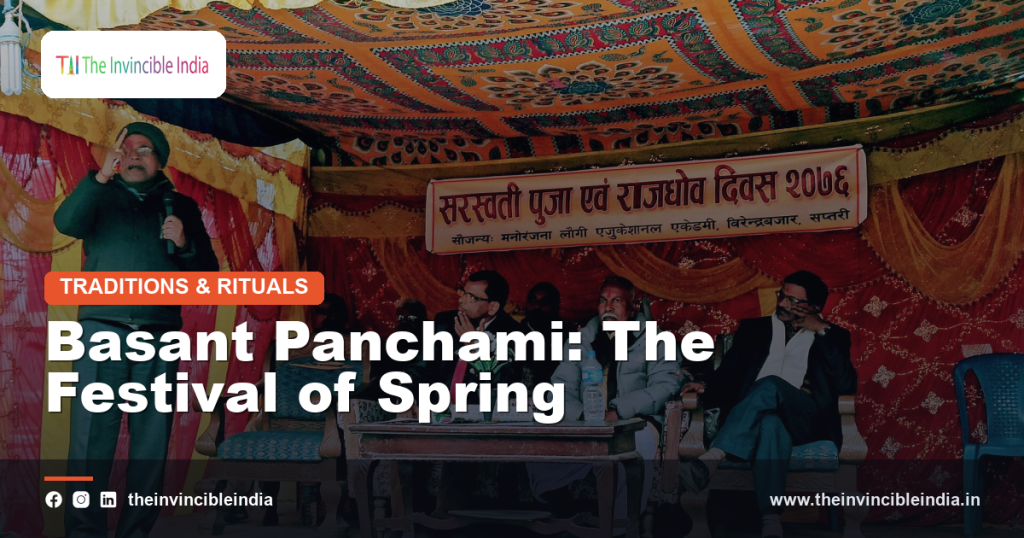
Basant Panchami marks the arrival of spring in the Hindu calendar and is celebrated chiefly as a day of worship for Saraswati, the goddess of knowledge, music and the arts. The festival is associated with the colour yellow, worn in clothing and used to decorate homes and shrines, echoing the mustard fields that bloom around this time of year. It falls roughly forty days before Holi, effectively opening the spring festival season in much of northern India. This guide surveys the meaning, rituals and regional character of Basant Panchami.
Quick Facts
| Detail | Information |
|---|---|
| Also Known As | Vasant Panchami, Saraswati Puja |
| Dedicated To | Goddess Saraswati, deity of knowledge and the arts |
| Type of Observance | Hindu religious and seasonal festival |
| General Timing | Shukla Paksha Panchami of Magha (January-February) |
| Key Practices | Saraswati worship, wearing yellow, kite flying |
| Region of Prominence | Observed across India, especially North India and Bengal |
Meaning and Significance
Basant Panchami is celebrated as the formal beginning of spring within the Hindu calendar, a season traditionally associated with renewal, learning and creative energy. The festival centres on the worship of Saraswati, regarded as the goddess of knowledge, music, art and speech, making it a particularly meaningful occasion for students, artists and musicians.
The festival’s dual identity, as both a seasonal marker and a religious observance dedicated to learning and the arts, gives it a distinctive place among Indian festivals. This combination of natural celebration and intellectual reverence has helped Basant Panchami remain significant across a wide range of communities and professions.
Saraswati as Goddess of Knowledge
Saraswati holds a distinctive place in the Hindu pantheon as the goddess associated with knowledge, learning, music and the arts, often depicted seated on a lotus with a veena, a stringed musical instrument, in her hands. She is traditionally invoked by students before examinations and by artists and musicians seeking inspiration and skill.
Basant Panchami is considered especially auspicious for beginning a child’s formal education, with young children sometimes guided to write their first letters on this day as part of a ceremony seeking the goddess’s blessing. This association with learning gives the festival particular resonance in schools and educational institutions across the country.
Position in the Lunar Calendar
Basant Panchami falls on the fifth day of the bright fortnight of the Hindu lunar month of Magha, generally corresponding to late January or early February in the Gregorian calendar. As with other lunar festivals, the exact Gregorian date shifts from year to year, and regional almanacs are consulted to confirm the day of observance.
The festival’s position early in the year, ahead of the fuller arrival of spring, situates it as an anticipatory celebration, welcoming the season’s approach rather than marking its peak. This timing gives Basant Panchami a role as the opening festival in a sequence of spring observances that continues through to Holi.
Rituals of Saraswati Puja
Saraswati Puja, the central ritual of Basant Panchami, involves the worship of an image or idol of the goddess, often freshly installed for the occasion in homes, schools and community pandals. Devotees offer yellow flowers, sweets and books or musical instruments at the altar, seeking blessings for knowledge and creative skill.
Educational institutions frequently organise special prayers on this day, with students placing their books and writing instruments before the goddess as part of the ritual. In many homes, the day also involves the recitation of hymns dedicated to Saraswati, continuing a devotional practice associated with the pursuit of learning.
The Colour Yellow and Its Symbolism
Yellow is the defining colour of Basant Panchami, worn in clothing and used to decorate homes, food and offerings throughout the day. The colour is associated with the mustard flowers that bloom across northern Indian fields at this time of year, as well as with the vibrancy and energy traditionally linked to the arrival of spring.
Sweets and dishes prepared for the occasion are often coloured yellow using ingredients such as saffron or turmeric, extending the festival’s visual theme to its food traditions as well. This consistent use of a single colour across clothing, decoration and cuisine gives Basant Panchami a distinctive and easily recognisable festive character.
Mustard Fields and the Arrival of Spring
The timing of Basant Panchami coincides with the flowering of mustard crops across large parts of northern India, when fields turn a striking yellow that has become closely associated with the festival’s visual identity. This agricultural backdrop links the festival to the region’s farming calendar, much as other seasonal festivals draw on the timing of local crops.
The sight of blooming mustard fields has also made Basant Panchami a popular occasion for outdoor gatherings and cultural events in rural and semi-rural areas, where the natural scenery becomes part of the celebration itself. This connection between landscape and festival is a recurring theme in the way Basant Panchami is experienced across the countryside.
Kite Flying Traditions
Kite flying is one of the most visible customs associated with Basant Panchami, particularly in parts of northern India where the festival is marked by skies filled with colourful kites from morning until evening. Competitions between kite flyers, in which strings are used to try to cut down rival kites, are a common feature of the day in many towns and cities.
This tradition transforms rooftops and open grounds into gathering points for families and communities, adding a lively, outdoor dimension to what is otherwise a devotional occasion. The custom’s popularity has made kite flying almost as strongly associated with Basant Panchami in some regions as the Saraswati worship itself.
Basant Panchami in Educational Institutions
Schools, colleges and other educational institutions across India mark Basant Panchami with particular enthusiasm, given the festival’s close association with Saraswati as the patron of learning. Special assemblies, prayers and cultural programmes are commonly organised, often including music and dance performances offered in the goddess’s honour.
Some institutions use the occasion to conduct initiation ceremonies for young children beginning their education, continuing the long-standing custom of seeking blessings for learning at the start of a child’s academic journey. This institutional observance reinforces the festival’s identity as a celebration closely tied to knowledge and its pursuit.
Basant and the Sufi Tradition
Basant Panchami also holds a place within certain Sufi traditions in India, most notably at the dargah of the saint Nizamuddin Auliya in Delhi, where the festival’s association with the poet-musician Amir Khusrau is commemorated with yellow flowers and music. This observance reflects a distinct cultural strand in which the seasonal celebration of Basant has been embraced within a devotional Sufi setting.
Such celebrations typically feature qawwali performances and processions bearing mustard flowers, blending seasonal festivity with devotional music in a manner that has continued at these shrines for a long period. This tradition illustrates how Basant Panchami’s spring symbolism has been adapted across different religious and cultural contexts within India.
Regional Variations Across India
While Saraswati worship and the colour yellow are common threads, Basant Panchami is observed differently across India’s regions. In Punjab, the festival is closely tied to kite flying and outdoor community celebration, while in Bengal it takes the form of elaborate Saraswati Puja observances comparable in scale to other major community pujas.
In Bihar and other parts of eastern India, the festival is similarly centred on Saraswati worship in homes and schools, often with community pandals set up for public celebration. These regional differences demonstrate how a shared festival can develop distinct local emphases while retaining its core devotional and seasonal meaning.
Basant Panchami in Punjab
In Punjab, Basant Panchami is celebrated with strong emphasis on its seasonal and cultural dimensions, particularly kite flying, alongside its religious observance. Fields of blooming mustard and community gatherings for kite competitions give the festival a distinctly outdoor, celebratory character in this region.
Punjabi celebrations of Basant Panchami often incorporate folk music and dance, contributing to a festive atmosphere that extends well beyond the immediate rituals of Saraswati worship. This regional emphasis on outdoor festivity reflects Punjab’s broader tradition of marking seasonal transitions with community celebration.
Basant Panchami in Bengal
In West Bengal, Basant Panchami is observed with particularly elaborate Saraswati Puja celebrations, especially in schools and colleges, where students play a leading role in organising the worship. Idols of the goddess are installed, decorated and worshipped over the course of the day, often followed by community feasting.
The festival in Bengal is also associated with a distinctive dress code, with young people frequently wearing yellow and saffron-coloured traditional attire for the occasion. This strong institutional and youth-centred character gives Basant Panchami in Bengal a somewhat different flavour from its more outdoor, kite-focused celebration in parts of the north.
Music, Poetry and the Arts
Given its association with Saraswati as goddess of the arts, Basant Panchami is closely linked to music, poetry and classical performance traditions across India. Concerts and recitals dedicated to the goddess are organised by cultural institutions, and musicians often consider the day auspicious for beginning new training or compositions.
Devotional songs and classical compositions praising Saraswati are performed in many settings during the festival, reflecting a long tradition of linking artistic practice to religious observance. This intersection of music, poetry and devotion reinforces Basant Panchami’s identity as a festival concerned as much with creative expression as with formal worship.
Food and Sweets Associated with Basant
Food traditions associated with Basant Panchami often reflect the festival’s yellow theme, with dishes such as saffron-infused rice, kesari halwa and other yellow sweets prepared in many households. These foods are typically offered to Saraswati before being shared among family members as prasad.
In some regions, seasonal produce associated with the arrival of spring also finds its way into festival meals, linking the day’s cuisine to the broader agricultural calendar. This combination of symbolic colour and seasonal ingredient reflects a pattern common to many Indian festivals, where food serves as a tangible expression of the occasion’s themes.
Start of the Spring Festival Season
Basant Panchami is widely regarded as the opening of the spring festival season in the Hindu calendar, setting in motion a period that continues through to Holi roughly forty days later. This positioning gives the festival a transitional character, marking the shift away from winter observances toward the more exuberant celebrations associated with spring.
The sequence linking Basant Panchami to Holi is often noted in cultural and religious commentary, framing the two festivals as bookends of the same seasonal period. This connection reinforces the broader rhythm of the Hindu festival calendar, in which successive occasions trace the changing character of the year.
Basant Panchami Today
In contemporary India, Basant Panchami continues to be marked by Saraswati worship, the wearing of yellow and, in many regions, kite flying, even as urban celebrations have adapted some practices to modern settings. Schools and cultural organisations remain central to the festival’s observance, keeping its association with learning and the arts firmly intact.
Social and digital platforms have also become spaces for sharing festival greetings and images of celebrations, extending the occasion’s reach beyond physical gatherings. Despite such changes, the festival’s essential character, a joyful welcome to spring paired with reverence for knowledge and creativity, remains consistent with its long-standing tradition.
Sources & Further Reading
- Ministry of Culture, Government of India (indiaculture.gov.in).
- Sahitya Akademi.
Frequently Asked Questions
What is Basant Panchami?
Basant Panchami is a Hindu festival marking the arrival of spring, celebrated chiefly through the worship of Saraswati, the goddess of knowledge and the arts.
Why is yellow associated with Basant Panchami?
Yellow represents the mustard fields that bloom at this time of year and the vibrancy of spring, and it is worn and used in decorations and food throughout the day.
Why is kite flying linked to Basant Panchami?
Kite flying is a popular outdoor custom associated with the festival in parts of northern India, particularly Punjab, adding a festive, community dimension to the day.
Is Basant Panchami connected to Holi?
Yes, it falls roughly forty days before Holi and is often regarded as the opening of the spring festival season in the Hindu calendar.
Why do students observe Basant Panchami?
Saraswati is considered the patron of learning, so students often worship her on this day and some institutions hold ceremonies for children beginning their education.