


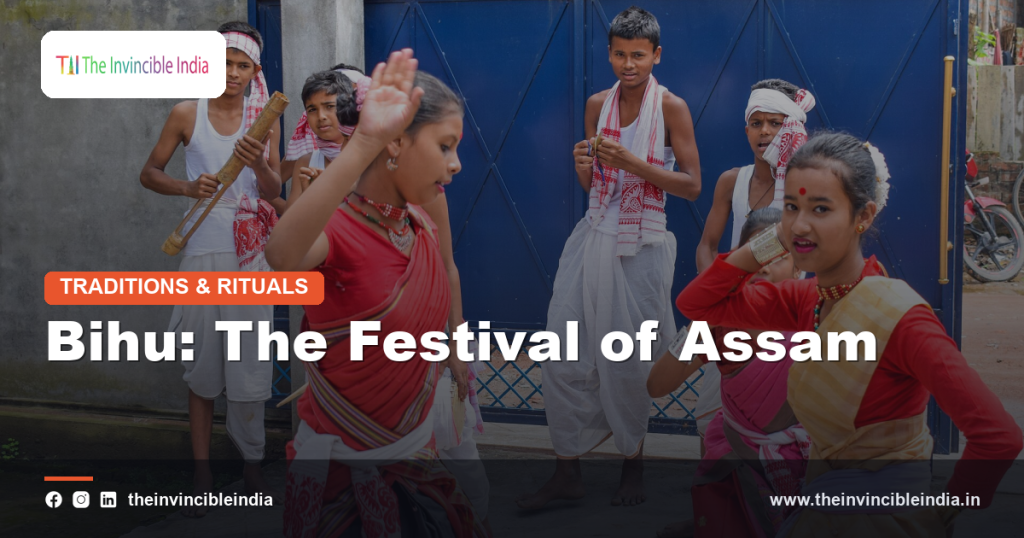
Bihu is the most important festival of Assam, observed three times a year to mark distinct stages of the agricultural calendar rather than as a single annual event. Central to Assamese cultural identity, it is celebrated through traditional dance, music, community feasting and rituals connected to farming life. Much like Makar Sankranti elsewhere in India, Bihu is deeply tied to the rhythms of harvest and season. This guide introduces the three Bihus, their distinct character, and the customs that continue to define this cornerstone of Assamese tradition.
Quick Facts
| Detail | Information |
|---|---|
| Also Known As | Assamese New Year (Rongali Bihu) |
| Type of Observance | Seasonal and harvest festival of Assam |
| Number of Bihus | Three annually: Bohag, Kati and Magh Bihu |
| General Timing | April (Bohag), October (Kati), January (Magh) |
| Key Practices | Bihu dance, feasting, cattle worship, bonfires |
| Region of Prominence | Assam and Assamese communities worldwide |
Meaning and Significance
Bihu refers to a set of three festivals observed across the year in Assam, each tied to a particular stage in the agricultural cycle of rice cultivation, the region’s traditional economic mainstay. Unlike many Indian festivals built around a single mythological event, Bihu is fundamentally a seasonal and agricultural observance, reflecting the rhythms of sowing, tending and harvesting.
Because of its deep connection to Assamese identity and everyday life, Bihu functions as more than a religious occasion; it is widely regarded as a marker of Assamese cultural belonging, celebrated by people across different communities and faiths within the state.
The Three Bihus
The year in Assam is punctuated by three Bihu festivals: Bohag Bihu, also called Rongali Bihu, celebrated in mid-April to mark the start of the agricultural year and the Assamese New Year; Kati Bihu, observed in October during a lean period in the farming cycle when granaries typically run low; and Magh Bihu, also known as Bhogali Bihu, celebrated in January to mark the harvest season with feasting.
Each of these three observances has a distinct mood and set of customs suited to its place in the farming calendar, ranging from the joyous, celebratory character of Bohag Bihu to the more restrained, prayerful tone of Kati Bihu.
Bohag Bihu: The Assamese New Year
Bohag Bihu, falling in mid-April, is the most widely celebrated of the three and marks the beginning of the Assamese New Year as well as the start of the agricultural season. It is observed with several days of festivity, including music, dance, feasting and visits between family and friends, making it comparable in spirit to new year celebrations observed elsewhere in India around the same period.
The festival traditionally unfolds over multiple days, each with its own customs, including a day dedicated to the care and worship of cattle, reflecting the importance of livestock to the agricultural economy that underpins the broader Bihu tradition.
Garu Bihu: Honouring Cattle
The day preceding the main day of Bohag Bihu is traditionally observed as Garu Bihu, dedicated to the care and honouring of cattle, which hold central importance in Assam’s agrarian economy. Cattle are bathed, often in nearby rivers or ponds, and adorned with turmeric paste and other traditional items as a mark of respect and gratitude.
This practice reflects a broader theme found in many harvest-related festivals across India, in which working animals central to agricultural life are given special recognition. The ritual underscores the close relationship between rural Assamese life and the animals that sustain it.
Manuh Bihu: Renewal and Family
The main day of Bohag Bihu, known as Manuh Bihu, or “human Bihu”, is centred on personal renewal and family bonds. People bathe, wear new traditional clothing, and visit elders to seek blessings, often presenting gamosa, the traditional Assamese woven cloth, as a token of respect and goodwill.
Family gatherings, festive meals and visits between relatives and neighbours are central to this day, reflecting the festival’s role in reinforcing community and familial ties at the start of a new agricultural and calendar year. The exchange of gamosa in particular has become one of the most recognisable customs associated with the festival.
Bihu Dance and Music
The Bihu dance is among the most recognisable expressions of Assamese culture, performed by groups of young men and women in colourful traditional attire to the accompaniment of instruments such as the dhol, pepa and gogona. Characterised by brisk, energetic movements, the dance is closely tied to the joyous spirit of Bohag Bihu.
Traditional Bihu songs, with lyrics often touching on themes of love, nature and community life, accompany the dance and are considered an integral part of Assamese folk music heritage. Community Bihu performances, held in open fields and public spaces, remain a defining feature of the festival’s public celebration.
Kati Bihu: A Quieter Observance
Kati Bihu, observed in October, falls during a comparatively lean period in the agricultural cycle, after transplantation of the rice crop but before harvest, when household granaries have often been depleted. Reflecting this leaner period, the festival is marked by a quieter, more restrained set of customs compared to the exuberance of Bohag Bihu.
Rituals during Kati Bihu often centre on lighting earthen lamps near paddy fields, granaries and household courtyards, accompanied by prayers for a good forthcoming harvest and protection of the growing crop. This practice reflects the festival’s essentially agricultural and prayerful character.
Magh Bihu: The Harvest Celebration
Magh Bihu, observed in January and also known as Bhogali Bihu, celebrates the completion of the harvest and is associated with abundance and feasting. Communities traditionally build temporary structures called bhelaghar and meji, which are ceremonially burnt on the eve of the festival, accompanied by community feasting around the bonfire.
The following day involves further feasting, traditional games and community gatherings, marking a period of relative ease following the labour of the harvest season. Magh Bihu’s emphasis on shared meals and communal celebration echoes the harvest-festival traditions found in various forms across many regions of India.
Traditional Attire and the Gamosa
Traditional Assamese attire plays a prominent role in Bihu celebrations, with women typically wearing the mekhela chador, a distinctive two-piece garment, and men often wearing the dhoti and gamosa. The gamosa, a handwoven cotton cloth with decorative borders, holds particular cultural significance, used both as an item of clothing and as a gesture of respect when presented to elders or guests.
The weaving of these textiles is itself a valued traditional craft in Assam, and Bihu season often sees increased demand for handwoven garments, supporting local weaving communities and reinforcing the connection between the festival and the region’s textile heritage.
Bihu Cuisine
Festive food plays an important role across all three Bihus, with dishes varying according to the season. Bohag Bihu features an assortment of traditional sweets made from rice and coconut, alongside seasonal vegetables. Magh Bihu, coming after the harvest, is particularly associated with rich feasting, including various preparations of rice, fish and meat typical of Assamese cuisine.
Community feasts held during Magh Bihu in particular bring together large groups to share food cooked over open fires, reinforcing the festival’s emphasis on abundance and communal celebration following a successful harvest season.
Bihu Beyond Assam
As Assamese communities have settled in other parts of India and abroad, Bihu celebrations have travelled with them, with cultural associations in major Indian cities and in countries with significant Assamese diaspora populations organising community Bihu events. These celebrations typically feature Bihu dance performances, traditional food and cultural programmes.
Such diaspora celebrations serve an important role in maintaining cultural continuity for Assamese communities living away from the state, allowing younger generations in particular to remain connected to traditions rooted in their regional heritage even at a geographic distance.
Bihu and Assamese Identity
Bihu occupies a distinctive place in Assamese cultural identity, celebrated across communities of different religious backgrounds within the state as a shared marker of regional belonging rather than a festival tied to a single faith. This inclusive character sets it apart from many religiously specific festivals observed elsewhere in India.
The festival’s association with agriculture, community and the Assamese language and arts has made it a central reference point in discussions of the state’s cultural heritage, and its symbols, from the Bihu dance to the gamosa, are widely recognised as emblematic of Assam more broadly.
Contemporary Bihu Performances and Competitions
In recent decades, Bihu celebrations in urban Assam have expanded to include large stage performances and organised competitions, sometimes referred to as Bihu Utsav, held in public venues and broadcast on regional television. These events feature professional and amateur troupes performing choreographed versions of traditional Bihu dance.
While these organised performances differ in scale and setting from the informal village celebrations from which the tradition emerged, they have played a significant role in popularising and preserving Bihu dance and music for wider and younger audiences across the state and beyond.
Craft and Trade During Bihu Season
The period surrounding Bihu, particularly Bohag Bihu, sees increased local economic activity centred on traditional crafts, including weaving, pottery and bamboo work, as households prepare gifts, garments and decorative items for the festival. Local markets and fairs often see a rise in the sale of these traditional goods in the weeks leading up to the celebration.
This seasonal boost supports many small-scale artisans and weavers across Assam, linking the festival’s cultural significance to a tangible economic role within local communities, a pattern also observed around major festivals in other parts of India.
Historical Roots of Bihu
Bihu is generally understood to have grown out of ancient agrarian and community practices native to the Brahmaputra valley, predating the arrival of many later religious and cultural influences in the region. Over time, the festival absorbed elements from the diverse communities that have long inhabited Assam, including various indigenous and tribal groups, giving it a composite character distinct from festivals with a single religious origin.
This layered history is part of why Bihu is widely regarded as a shared cultural festival rather than one belonging to a specific faith, with its customs reflecting a long process of regional development rooted in the agricultural life of the Brahmaputra valley rather than a single founding narrative.
Bihu Today
Bihu remains one of the most vibrant and widely observed festivals in India, continuing to be marked by traditional dance, music, feasting and rituals connected to the agricultural cycle even as Assam’s economy has diversified beyond farming. Community celebrations, both in rural villages and organised urban events, ensure the tradition remains a living and evolving practice.
Its recognition beyond Assam has also grown, with Bihu dance performances increasingly featured in national cultural events and celebrations of Indian folk heritage. This continued vitality reflects Bihu’s deep roots in Assamese identity alongside its capacity to adapt to a changing social and economic landscape.
Sources & Further Reading
- Ministry of Culture, Government of India (indiaculture.gov.in).
- Sangeet Natak Akademi (sangeetnatak.gov.in).
Frequently Asked Questions
What is Bihu?
Bihu is a set of three seasonal festivals celebrated in Assam, each marking a different stage of the agricultural cycle, with Bohag Bihu being the most widely celebrated.
What are the three types of Bihu?
The three Bihus are Bohag Bihu (April, New Year), Kati Bihu (October, a lean farming period) and Magh Bihu (January, the harvest celebration).
What is the Bihu dance?
The Bihu dance is a traditional Assamese folk dance performed during Bohag Bihu, characterised by energetic movements accompanied by instruments such as the dhol and pepa.
What is a gamosa?
A gamosa is a traditional handwoven Assamese cloth with decorative borders, used as clothing and as a symbolic gesture of respect, especially during Bihu.
Is Bihu only a Hindu festival?
No, Bihu is celebrated across communities of different faiths within Assam, as it is rooted in the region’s shared agricultural cycle and cultural identity rather than a single religious tradition.