


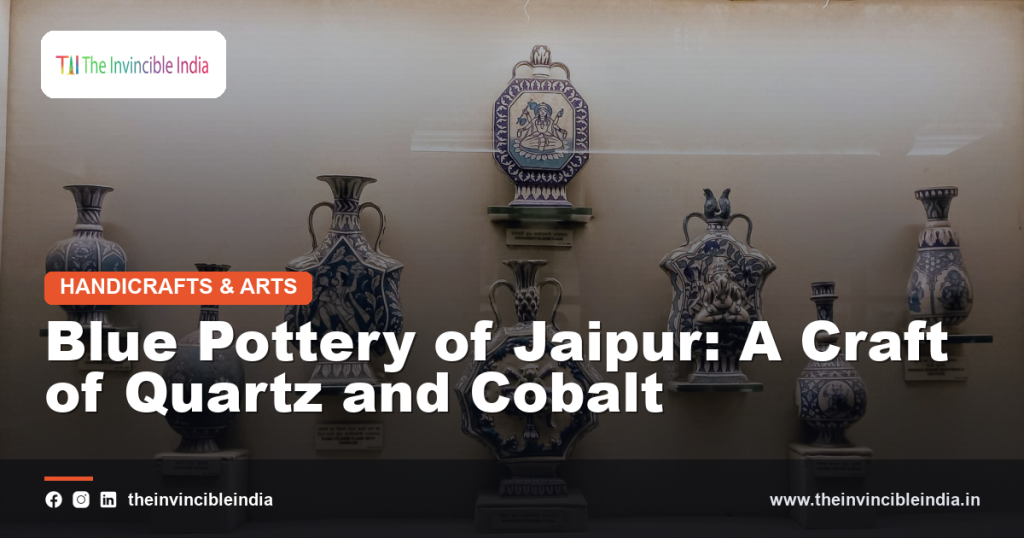
The blue pottery of Jaipur is one of the most distinctive and beautiful crafts of Rajasthan, instantly recognised by its vivid cobalt-blue and turquoise glazes and its delicate floral designs. What makes it truly unusual is that, unlike almost all other pottery, it is made without clay: the body is fashioned from a mixture based on ground quartz. Turko-Persian in origin and long associated with the city of Jaipur, this glazed ceramic craft produces vases, plates, tiles, bowls and countless decorative objects glowing with blue and white. It is one of the treasured handicrafts of Rajasthan. This guide explores its origins, its unusual material, its colours and motifs, its making, its artisans and its living tradition.
Quick Facts
| Detail | Information |
|---|---|
| Type | Glazed decorative ceramic craft |
| Region | Jaipur, Rajasthan |
| Unusual feature | Made without clay, from a quartz-based body |
| Colours | Vivid cobalt blue, turquoise and white glazes |
| Origin | Turko-Persian, brought to Rajasthan centuries ago |
| Recognition | Protected by a Geographical Indication (GI) tag |
A Craft Like No Other
The blue pottery of Jaipur stands apart from other Indian pottery traditions, both for its striking beauty and for the unusual way it is made. Glowing in shades of cobalt blue, turquoise and white, and decorated with delicate floral and geometric patterns, blue pottery objects are prized as decorative pieces across India and beyond. Yet the craft is remarkable above all because it uses no clay at all, a fact that sets it apart from virtually every other ceramic tradition. This combination of vivid colour, elegant design and unique material makes the blue pottery of Jaipur one of the most distinctive and admired handicrafts of Rajasthan and of India.
Turko-Persian Origins
The blue pottery tradition is not indigenous to Rajasthan but came from the wider Turko-Persian world, where the art of glazed blue-and-white ceramics had long flourished. The technique travelled across Central Asia and reached India, where it was practised in various centres before finding a lasting home in Jaipur. Its very name reflects the characteristic blue glazes that came with this Persian-influenced tradition. The craft thus represents a beautiful example of the exchange of artistic ideas across cultures, an art of foreign origin that took root in Rajasthan and became, over the centuries, a cherished part of the region’s own craft heritage and identity.
The Craft in Jaipur
Blue pottery became especially associated with Jaipur, the capital of Rajasthan, where it was nurtured under royal patronage and grew into one of the city’s signature crafts. The rulers of Jaipur, great patrons of the arts, supported the craft and helped it flourish, and over time the city became the principal centre of blue pottery in India. The craft is now closely tied to Jaipur’s identity as a city of art and colour, and its distinctive blue wares are among the most popular of the crafts for which the city is famous. This bond with Jaipur is central to the identity and reputation of the tradition.
A Body Without Clay
The most extraordinary feature of Jaipur blue pottery is that it contains no clay. Instead of the clay used in ordinary pottery, the body is made from a special mixture based on finely ground quartz, or stone powder, combined with other ingredients such as powdered glass and a binder to hold it together. This unusual dough-like material is then shaped into the desired forms. Because it contains no clay, the pottery is fired at a relatively low temperature and has a distinctive character quite different from ordinary earthenware. This clay-free, quartz-based body is the defining technical feature of the craft and the source of its unique nature among ceramics.
Preparing the Material
Making the special quartz-based dough is a careful first stage in the craft. The finely ground quartz is mixed in precise proportions with the other ingredients, including powdered glass and a binding agent, along with water, to form a smooth, workable paste. Getting this mixture right is essential, for it determines whether the objects can be shaped and fired successfully, and the recipe and preparation are part of the traditional knowledge of the craft. Because the material contains no clay, it behaves quite differently from ordinary potter’s clay and cannot be thrown on a wheel in the usual way, which shapes the whole method of making blue pottery.
Shaping the Objects
Because the quartz-based material lacks the plasticity of clay, blue pottery objects are usually not thrown on a potter’s wheel but shaped using moulds. The prepared dough is pressed or formed into moulds to create the basic shapes of plates, bowls, vases, tiles and other objects, which are then removed, smoothed and prepared for decoration. This method of shaping suits the unusual material and allows the making of the flat and rounded forms characteristic of the craft. The shaped objects are dried before the next stages of the process. This moulding technique, adapted to the clay-free body, is an essential part of how the distinctive wares of blue pottery are made.
The Cobalt-Blue Glaze
The glory of blue pottery is its colour, above all the vivid cobalt blue that gives the craft its name, along with a beautiful turquoise and a clean white. These colours are created using mineral-based pigments, the deep blue traditionally derived from cobalt, applied over the white ground of the object before it is coated with a clear glaze and fired. The glaze fuses in firing to give the surface its characteristic glossy, glassy finish and its glowing colour. The rich blues and turquoise against the white, sealed under the shining glaze, create the luminous beauty for which blue pottery is famous and which makes each piece so appealing.
Floral and Geometric Motifs
Blue pottery is decorated with delicate and elegant designs, most characteristically floral and geometric motifs painted by hand. Flowers, leaves, creepers and arabesques, along with birds and geometric patterns, are painted onto the white ground in blue and turquoise, reflecting the Persian heritage of the craft as well as local taste. The designs are applied with a fine brush and require a steady hand and artistic skill. These graceful, flowing patterns, glowing in blue against the white and sealed beneath the glaze, give blue pottery its refined and decorative character. The vocabulary of motifs, refined over generations, is central to the beauty and identity of the craft.
Hand-Painting the Designs
The decoration of blue pottery is done entirely by hand, and the painting of the designs is a skilled and delicate art. Working on the shaped and prepared white surface, the artisan paints the floral and geometric patterns with a fine brush, using the mineral pigments that will become the glowing blues and turquoise after firing. This hand-painting demands a steady hand, an eye for design and considerable practice, and it is what gives each piece its individual character and beauty. The skill of the painter is central to the quality of the finished object, and this hand-decoration is one of the most important and artistic stages in the making of blue pottery.
Glazing and Firing
Once painted, the object is coated with a clear glaze and fired in a kiln, the stage that transforms the painted, quartz-based piece into the finished, glossy blue pottery. Because the body contains no clay, the firing is done at a relatively low temperature compared with ordinary pottery. In the heat of the kiln, the glaze melts and fuses to the surface, sealing in the colours and giving the object its characteristic shining, glassy finish. The firing must be carefully controlled, for the unusual body can be fragile, and pieces may crack if the process is not managed well. Successful glazing and firing complete the making of a piece of blue pottery.
A Fragile Beauty
The unusual, clay-free composition of blue pottery gives it a distinctive character but also makes it relatively delicate. Because it is fired at a low temperature and made from a quartz-based body rather than clay, blue pottery is more fragile than ordinary stoneware and must be handled with care. This delicacy is part of the nature of the craft and a challenge for the artisans, who must manage the material and firing carefully to avoid cracks and breakages. It also means that blue pottery is prized chiefly for decorative and light use rather than heavy everyday service. This fragile beauty is an inherent feature of the unique material from which the craft is made.
The Range of Products
Blue pottery is made in a wide and appealing range of objects, from purely decorative pieces to practical wares. Vases, bowls, plates, jars, coasters, boxes, ashtrays, doorknobs and decorative tiles are among the many forms produced, all glowing with the characteristic blue and turquoise designs. Tiles and panels of blue pottery are used to decorate walls and buildings, and the smaller items are popular as gifts and decorative accents. This variety allows the craft to appeal to many tastes and uses, and the adaptation of the tradition to a broad range of products has helped it thrive in the modern market while keeping its distinctive style.
The Artisans
Blue pottery is the work of skilled artisans in and around Jaipur, who master the making of the special material, the shaping of the objects, the delicate hand-painting and the glazing and firing. The craft has been sustained by communities of potters and painters, often within families, who carry the traditional knowledge across generations. Creating fine blue pottery requires a combination of technical skill in handling the difficult material and artistic skill in the painting, and this expertise is the foundation of the craft. The dedication of these artisans, and the passing on of their specialised knowledge, is essential to the survival and quality of the blue pottery tradition.
Revival and Recognition
Like many traditional crafts, blue pottery passed through periods of decline, but it has been revived and promoted in modern times through the efforts of patrons, designers and institutions who recognised its beauty and worked to support the artisans and expand the market. New designs and products have been developed alongside the traditional forms, helping the craft appeal to contemporary tastes. Jaipur blue pottery has also been granted a Geographical Indication (GI) tag, which recognises it as a product distinctive to its region and helps protect its authenticity. These efforts at revival, innovation and protection have helped secure the future of this unique and beautiful craft.
Blue Pottery Today
Today the blue pottery of Jaipur flourishes as one of the most popular and admired crafts of Rajasthan, its glowing blue wares sought after by visitors and buyers across India and around the world. Artisans continue to make the pottery by traditional methods, while designers develop new products and applications, from tableware to tiles and decor, keeping the craft vibrant and relevant. The distinctive blue-and-white beauty of the pottery, and its unique clay-free making, continue to fascinate and delight. In its vivid colour, its elegant designs and its remarkable technique, the blue pottery of Jaipur remains one of the most distinctive and cherished handicrafts of India.
Sources & Further Reading
- Ministry of Culture, Government of India, on the craft traditions of Rajasthan (indiaculture.gov.in).
- Geographical Indications Registry, Government of India, on the GI status of Jaipur blue pottery (ipindia.gov.in).
- Development Commissioner (Handicrafts), Ministry of Textiles, on traditional Indian handicrafts.
Frequently Asked Questions
What is the blue pottery of Jaipur?
The blue pottery of Jaipur is a distinctive Rajasthani craft of glazed decorative ceramics, glowing in cobalt blue, turquoise and white with floral and geometric designs. It is unusual because it is made without clay, from a body based on ground quartz.
Why is Jaipur blue pottery made without clay?
Jaipur blue pottery uses a body made from ground quartz mixed with powdered glass and a binder instead of clay. This Turko-Persian tradition of glazed ceramics uses this special quartz-based material, which is fired at a low temperature and gives the pottery its unique character.
Where did blue pottery come from?
Blue pottery originated in the Turko-Persian world, where glazed blue-and-white ceramics had long flourished. The technique travelled across Central Asia to India and found a lasting home in Jaipur, where it was nurtured under royal patronage.
What colours and designs does blue pottery use?
Blue pottery is famous for its vivid cobalt blue, turquoise and white, decorated with delicate hand-painted floral and geometric motifs such as flowers, creepers, birds and arabesques, reflecting its Persian heritage.
Is Jaipur blue pottery protected by a GI tag?
Yes. Jaipur blue pottery has been granted a Geographical Indication (GI) tag, which recognises it as a product distinctive to its region and helps protect its authenticity and the interests of its artisans.