


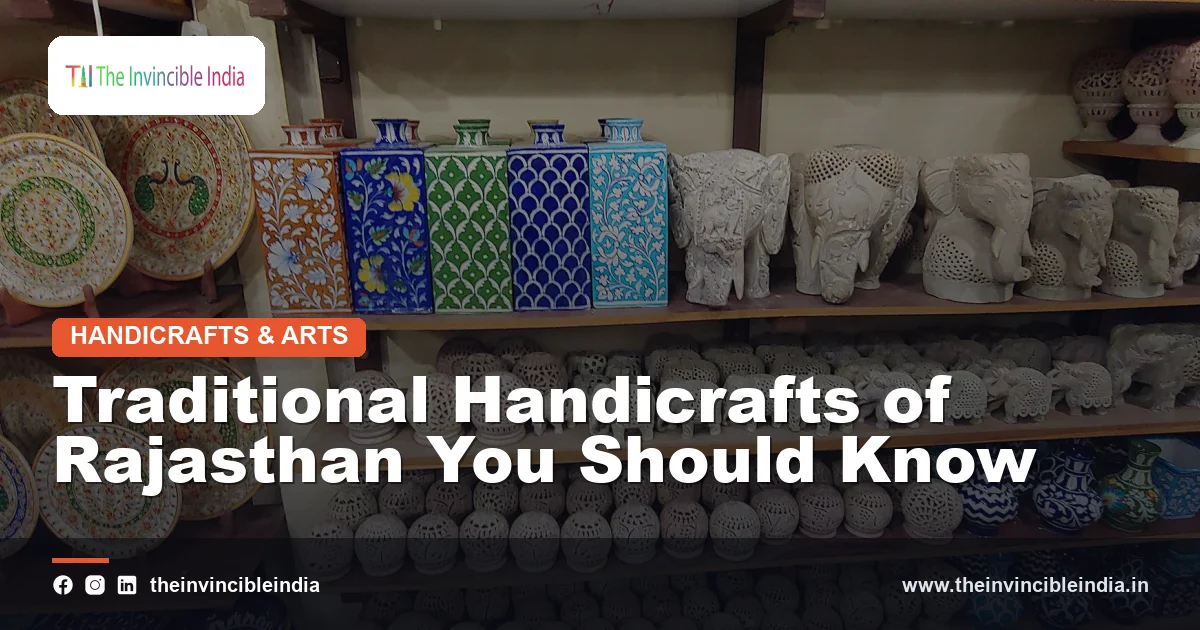
Rajasthan’s vibrant culture comes alive through its traditional handicrafts. Shaped by centuries of royal patronage, a harsh desert environment and deep-rooted community skills passed down through generations, the crafts of Rajasthan are among the richest and most colourful in India. From textiles and pottery to jewellery and painting, they turn everyday objects into works of art. This detailed guide explores the traditional handicrafts of Rajasthan you should know, and how to buy them responsibly.
Quick Facts
| Famous textiles | Bandhani, leheriya, block prints |
| Famous pottery | Jaipur blue pottery |
| Famous jewellery | Meenakari, kundan, thewa |
| Craft hubs | Jaipur, Jodhpur, Udaipur, Sanganer, Bagru |
Blue Pottery
Jaipur‘s iconic blue pottery, with its striking cobalt-blue and white floral patterns, is a Turko-Persian art form unlike any other in India. Remarkably, it uses no clay at all; instead, it is made from a paste of quartz powder, powdered glass, borax and other materials. This gives it a distinctive glazed finish, and it is used for tiles, vases, coasters, plates and decorative items. The craft nearly died out before being revived in the 20th century, and it remains one of Jaipur’s most sought-after souvenirs.
Bandhani and Leheriya
Rajasthan is famous for its resist-dyeing textile traditions. Bandhani is an intricate tie-and-dye technique in which thousands of tiny points are tied by hand before dyeing, creating beautiful dotted patterns on sarees, turbans and odhnis; the finer and more numerous the dots, the more prized the piece. Leheriya, meaning “waves,” produces distinctive diagonal or wavy stripes and is especially associated with festive turbans and sarees. Both crafts are labour-intensive and require great skill, and their bright colours are instantly recognisable.
Block Printing
The towns of Sanganer and Bagru near Jaipur are world-renowned centres of hand block-printing. Artisans carve intricate designs onto wooden blocks, then stamp them by hand onto cotton fabric using natural or mineral dyes. Bagru is known for its earthy colours and mud-resist (dabu) printing, while Sanganer specialises in fine floral patterns on light backgrounds. The resulting textiles are used for clothing, bedspreads and furnishings and are exported around the world.
Kathputli Puppets
Rajasthan’s traditional string puppets, known as kathputli, are central to the state’s folk storytelling. Carved from wood and dressed in colourful Rajasthani costumes, the puppets are brought to life by skilled puppeteers who narrate tales of kings, heroes and legends, accompanied by music and a distinctive whistling voice. Kathputli performances remain a beloved part of village life and cultural festivals, and the puppets themselves are popular decorative souvenirs.
Meenakari, Kundan and Thewa Jewellery
Rajasthan, especially Jaipur, is one of India’s great jewellery centres. Meenakari is the art of enamelling metal with vivid colours, often on the reverse of kundan pieces so that a necklace is beautiful on both sides. Kundan involves setting gemstones in refined gold, a technique that flourished under royal patronage. Thewa, from the town of Pratapgarh, is a unique craft in which intricately worked gold sheet is fused onto coloured glass. These traditions produce some of the most exquisite jewellery in the country.
Miniature and Phad Painting
Rajasthan has a rich painting heritage. The various schools of Rajasthani miniature painting — from Mewar to Kishangarh, famous for its delicately elongated faces — depict court scenes, religious themes and romance in brilliant colour and fine detail. Phad painting is a traditional scroll-painting form used to narrate the epics of folk deities such as Pabuji, traditionally unrolled and sung by travelling bard-priests. These art forms are living traditions still practised by hereditary artist families.
Stone Carving and Marble Work
The palaces, temples and havelis of Rajasthan showcase the state’s superb tradition of stone and marble carving. Artisans create intricate lattice screens (jalis), statues, temple panels and decorative objects from sandstone and marble, particularly around Jaipur, Jodhpur and the marble town of Makrana, whose stone was used in the Taj Mahal. This craft continues to supply temples, homes and collectors across India and abroad.
Leather, Lac and Other Crafts
Rajasthan’s craft repertoire is vast. The state is famous for embroidered mojari and jutti footwear, made from camel and other leather in bright colours. Lac bangles and jewellery, colourful and inexpensive, are a favourite at fairs and markets. Handwoven dhurries (flat rugs) and knotted carpets, ironwork, wood carving and camel-bone artefacts add to the extraordinary diversity of the state’s handmade treasures.
Where to Buy and Supporting Artisans
Many Rajasthani crafts carry Geographical Indication (GI) tags, protecting their authenticity and origin. To buy genuine pieces at fair prices, seek out government emporiums (such as Rajasthali), artisan cooperatives, and workshops where you can watch the craft being made. Buying directly from artisans, rather than from mass-market middlemen, ensures that more of your money reaches the makers and helps sustain these skills. Craft fairs such as those at Shilpgram in Udaipur and the many village haats are wonderful places to meet artisans and learn about their work.
Terracotta and Molela Clay Work
Beyond its famous blue pottery, Rajasthan has a rich tradition of terracotta and clay craft. The village of Molela near Udaipur is renowned for its distinctive votive clay plaques depicting deities and folk heroes, made by hereditary artisan families and carried away by pilgrims to shrines across the region. Everyday terracotta — pots, lamps, figurines and toys — is produced across the state, a humble but beautiful craft that connects modern Rajasthan to its ancient roots.
Usta Art and Gold Work of Bikaner
Bikaner is celebrated for the exquisite Usta art, a form of gold-embossing and intricate painting (manoti) traditionally applied to camel hide, walls, ceilings and objects. Delicate floral and geometric patterns raised in gold give the work a luminous, three-dimensional quality. Once used to decorate palaces and havelis, this rare and demanding craft is kept alive by a small number of skilled families and is a distinctive souvenir of the region.
Wood, Lac and Ivory-Style Inlay
Rajasthan’s artisans are masters of woodwork. Carved wooden furniture, doors, jharokhas and decorative panels showcase generations of skill, while the town of Kishangarh and others produce fine painted and inlaid pieces. Lac, a natural resin, is worked into brilliantly coloured bangles and decorative objects, often studded with mirrors and stones, and is a signature craft seen at every Rajasthani fair and market.
Namda, Durries and Textile Crafts
Rajasthan’s textile heritage extends well beyond block prints and tie-dye. Namda is a traditional felted-wool craft used to make warm, colourful rugs and mats, often embroidered with bright patterns. Handwoven cotton dhurries (flat rugs) and knotted woollen carpets, particularly from Bikaner and Jaipur, are prized for their geometric designs. Fine embroidery, gota-patti appliqué work and mirror embroidery further enrich the state’s clothing and furnishings.
The Economics and Future of Rajasthan’s Crafts
Handicrafts are not only a cultural treasure but also a vital livelihood for millions of artisans across Rajasthan, many of them women and members of traditional craft communities. The sector supports rural economies, sustains tourism, and earns valuable export income. However, artisans face challenges from machine-made imitations, fluctuating markets and the migration of younger generations to other work. Fair-trade initiatives, cooperatives, e-commerce platforms and Geographical Indication protections are helping to secure fairer prices and wider markets, ensuring these ancient skills have a future.
Craft Tourism, Workshops and Caring for Your Purchases
One of the most rewarding ways to appreciate Rajasthan’s crafts is to meet the makers. Many workshops in Jaipur, Jodhpur, Udaipur, Bagru and Sanganer welcome visitors to watch block-printing, pottery, jewellery-making and puppet-carving, and craft villages such as Shilpgram near Udaipur bring artisans together under one roof. When you buy, ask about the craft and the maker, look for genuine handmade quality, and follow care instructions — hand-washing block-printed textiles in cold water, keeping blue pottery away from hard knocks, and storing silver jewellery carefully — so that your piece of Rajasthan lasts for years to come.
The Making of a Kathputli Puppet
Behind every Rajasthani puppet lies painstaking craft. The heads are carved from mango wood, painted with large expressive eyes and features, and topped with vivid turbans or veils. The bodies are stuffed and dressed in flowing, mirror-worked Rajasthani costumes, and strings are attached so a skilled puppeteer can make them dance, fight and bow. Entire families sustain this tradition, with the men carving and performing and the women stitching the elaborate garments, passing the skills from parent to child in an unbroken line.
Camel Leather and Other Desert Crafts
The camel, so central to desert life, also shapes Rajasthan’s crafts. Bikaner is famous for its camel-leather craft, producing beautifully decorated water flasks (kuppis), lampshades, bags and footwear, often painted with gold Usta work. Camel bone is carved into delicate jewellery and ornaments as an ethical alternative to ivory. These crafts turn the resources of a harsh land into objects of great beauty and utility.
Souvenirs to Buy by City
Each Rajasthani city has its craft specialities, making shopping a journey in itself. In Jaipur, look for blue pottery, gemstones, meenakari and kundan jewellery, and block-printed textiles. Jodhpur is known for antiques, textiles and lacquerware. Udaipur excels in miniature paintings, silver and pichwai art. Bikaner offers Usta gold work and leather craft, Jaisalmer is famous for embroidered textiles and mirror work, and Pratapgarh for thewa jewellery. Buying a craft where it is made ensures authenticity and supports the artisan communities directly.
A Craft for Every Occasion
Handicrafts are woven into every aspect of life in Rajasthan. Weddings call for lehariya and bandhani textiles, gota-patti finery and kundan jewellery; festivals bring out puppet shows, clay diyas and decorative torans; and homes are adorned with block-printed furnishings, blue pottery and carved wooden furniture. Even the humblest village market overflows with lac bangles, embroidered juttis and brightly painted toys. This deep integration of craft into daily and ceremonial life is what keeps the traditions vibrant and ensures that skills are constantly practised and passed on.
Taking a Piece of Rajasthan Home
For visitors, buying a handcrafted souvenir is a way to carry home a piece of Rajasthan’s soul and to support the artisans who keep these traditions alive. Whether it is a hand-block-printed scarf, a piece of blue pottery, a miniature painting or a pair of embroidered mojaris, each object tells the story of the hands that made it and the centuries of tradition behind it. Choosing genuine, handmade pieces over mass-produced imitations helps sustain a living heritage that is among the richest in the world.
Frequently Asked Questions
What is Rajasthan famous for in handicrafts?
Rajasthan is famous for blue pottery, bandhani and leheriya tie-dye, block printing, kathputli puppets, and meenakari and kundan jewellery.
What is blue pottery made of?
Blue pottery is unusual in that it contains no clay; it is made from quartz powder, powdered glass and other materials, giving it a distinctive glaze.
What is bandhani?
Bandhani is an intricate tie-and-dye technique that creates dotted patterns on fabrics such as sarees, turbans and dupattas.
Where can I buy authentic Rajasthani handicrafts?
Buy from government emporiums, artisan cooperatives, craft fairs and workshops in cities like Jaipur, Jodhpur and Udaipur for authenticity and fair prices.
Which town is famous for block printing?
Sanganer and Bagru near Jaipur are the most famous centres for hand block-printed textiles.