


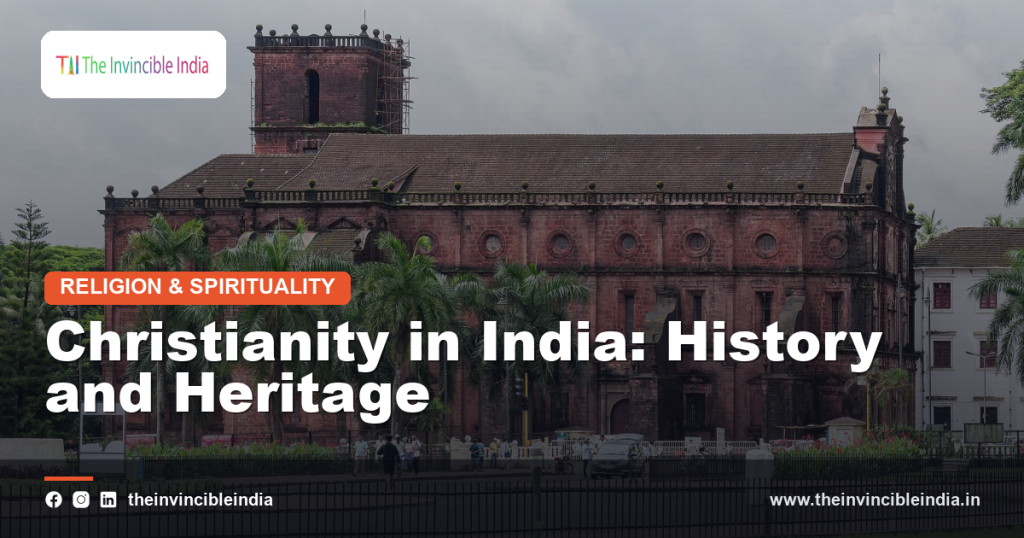
Christianity is one of India’s oldest religious communities, its presence on the subcontinent reaching back, according to long-cherished tradition, to the earliest centuries of the faith itself. Carried first to the Malabar coast and later reinforced by the arrival of European missionaries and traders, Christianity has grown into a richly diverse community found across the length and breadth of the country, from the ancient churches of Kerala to the historic monuments of Goa and the vibrant congregations of the Northeast. Its heritage includes some of India’s most treasured architectural monuments, a distinctive artistic and musical tradition, and centuries of contribution to education and healthcare, all woven into the wider story of India’s pilgrimage and religious life. This guide traces the history, communities, heritage and living presence of Christianity in India.
Quick Facts
| Detail | Information |
|---|---|
| Type | One of India’s oldest religious minority communities |
| Traditional origin | Brought to the Malabar coast in the earliest Christian centuries, by tradition |
| Major traditions | Catholic, Orthodox, Protestant and independent churches |
| Historic centres | Kerala, Goa, Mumbai, Tamil Nadu and the Northeast |
| Notable monument | The Basilica of Bom Jesus, Goa |
| Character | A diverse, historic and living faith community |
An Ancient Presence in India
Christianity holds a place of remarkable antiquity in India, ranking among the oldest continuous Christian communities anywhere in the world. According to long tradition, the faith reached the shores of the subcontinent within the earliest centuries of Christianity itself, carried to the Malabar coast in the far south-west of India. Over the two thousand years that followed, the faith took root within Indian society, developing distinct regional communities, languages of worship and forms of practice shaped by the wider culture around them. Today Christianity is practised across India, from ancient communities in Kerala to the many congregations of the Northeast and the historic heritage of Goa. This deep antiquity and diversity make Christianity in India a subject of great historical interest, a faith at once ancient and continuing to flourish.
The Tradition of St Thomas
A cherished tradition holds that Christianity first came to India through the apostle Thomas, who is believed to have travelled to the Malabar coast and preached there, establishing communities of believers among the local population. While the precise historical details of this ancient tradition are a matter of faith and scholarly discussion, it is held with deep reverence by the Christians of Kerala, who trace their spiritual ancestry to this apostolic mission. Churches and shrines associated with the memory of St Thomas remain places of devotion and pilgrimage to this day. This tradition gives Indian Christianity a sense of apostolic antiquity shared by few Christian communities outside the Holy Land, and it remains a defining part of the community’s identity and pride.
The Syrian Christians of Kerala
Among the most distinctive Christian communities in India are the Syrian Christians of Kerala, an ancient community whose worship and liturgical heritage draw on Syriac Christian traditions from West Asia. Deeply integrated into the social and cultural fabric of Kerala over many centuries, this community developed its own customs, architecture and forms of worship while maintaining its distinct Christian identity. Over time the community came to include several branches, reflecting later contact with different strands of the wider Christian world, yet all share a common sense of ancient heritage. The Syrian Christians of Kerala represent one of the most historically significant Christian communities in Asia, a living witness to the antiquity of the faith on Indian soil.
The Arrival of European Missionaries
The arrival of European traders and explorers by sea brought a new wave of Christian missionary activity to India, introducing Roman Catholic and, later, Protestant traditions to new regions of the subcontinent. Missionaries from various religious orders travelled to India’s coastal cities and beyond, establishing churches, schools and charitable institutions alongside their spiritual work. This period broadened the geography of Indian Christianity well beyond its ancient heartland in Kerala, planting communities along the western and eastern coasts and eventually across much of the country. The missionary era left a profound and lasting mark on Indian Christianity, shaping many of its institutions, its architecture and its continuing engagement with education and social service.
Portuguese Goa and Christianity
Goa became one of the most important centres of Christianity in Asia during the era of Portuguese presence on the Indian coast, developing into a major hub of Catholic faith, learning and architecture. Missionaries and religious orders based in Goa built churches, seminaries and convents, and the territory became known for its devout Catholic population and its distinctive blend of Indian and European religious culture. This heritage remains vividly visible today in Goa’s old town, where historic churches and convents stand as some of the finest examples of religious architecture from this era anywhere in Asia. Goa’s Christian heritage, at once deeply Indian and shaped by centuries of Portuguese presence, remains a defining part of the region’s identity.
The Basilica of Bom Jesus
Among the most celebrated monuments of Christianity in India is the Basilica of Bom Jesus in Goa, one of the finest examples of religious architecture from the period of Portuguese presence and a recognised World Heritage site. The basilica is renowned for its dignified baroque architecture and for holding the revered remains of the missionary St Francis Xavier, making it an important place of pilgrimage and devotion for Catholics from across India and beyond. Its enduring beauty and spiritual significance have made it one of the most visited religious monuments in the country. The Basilica of Bom Jesus stands as a lasting symbol of the depth and richness of Christian heritage in India.
St Francis Xavier
St Francis Xavier is remembered as one of the most significant missionary figures associated with the spread of Christianity in India and across Asia during the era of European missionary activity. Based for a time in Goa, he travelled widely along the Indian coast and beyond, engaging in missionary and charitable work among diverse communities. He is revered by Catholics in India as a founding figure of the modern missionary era on the subcontinent, and his memory remains closely tied to the religious heritage of Goa in particular. The veneration of St Francis Xavier, whose remains rest in the Basilica of Bom Jesus, continues to draw devotion and pilgrimage to this day, reflecting his lasting place in Indian Christian memory.
Catholic Communities Across India
Beyond Goa and Kerala, Catholic communities are found in many parts of India, each shaped by its own regional history and culture while sharing the common faith and structures of the wider Catholic Church. Cities along the western and southern coasts, as well as many inland regions, developed Catholic parishes, schools and institutions over the centuries, often tracing their origins to the missionary era. These communities have contributed richly to local culture, from music and art to education and social service, while maintaining their distinct religious identity. The presence of Catholic communities across such a wide geography reflects the long and varied history of Christianity’s growth in India, adapted to many different regional and cultural settings.
Protestant Missions and Education
Protestant Christianity arrived in India somewhat later than Catholicism, brought chiefly by missionaries associated with various European and later other traditions, who established churches, schools and printing presses across the country. These missions placed a strong emphasis on education and on translating scripture and literature into Indian languages, contributions that had a lasting impact well beyond the Christian community itself. Protestant missionary educational institutions became known for their academic standards and helped shape the modern education system in many parts of India. This legacy of educational and literary contribution remains one of the most significant and widely felt aspects of the Protestant missionary presence in the country, extending its influence far beyond church membership alone.
Christianity in the Northeast
The states of India’s Northeast are home to some of the country’s largest and most vibrant Christian populations, the result of missionary work among the region’s tribal communities from the colonial period onward. In states such as Nagaland, Mizoram and Meghalaya, Christianity became deeply woven into local identity, culture and community life, with church congregations playing a central role in social and cultural affairs. The faith in this region has developed its own distinctive character, blending Christian worship with local languages, music and customs. This strong and enduring Christian presence in the Northeast represents one of the most significant chapters in the modern growth of Christianity in India, distinct in its history and character from the ancient communities of the south.
Churches as Architectural Heritage
India is home to a remarkable heritage of church architecture, reflecting centuries of building across very different regional and historical contexts. From the ancient and distinctively styled churches of Kerala to the grand baroque monuments of Goa and the colonial-era cathedrals of cities such as Mumbai and Chennai, Indian churches display an extraordinary range of architectural styles and influences. Many of these buildings blend European architectural traditions with local materials, craftsmanship and decorative motifs, producing a distinctive Indian Christian architectural heritage. These churches, whether ancient, colonial or modern, are treasured not only as places of worship but as significant monuments of India’s broader architectural and cultural history, admired by visitors of all backgrounds.
Contributions to Education and Healthcare
Christian missionary and community institutions have made a substantial and lasting contribution to education and healthcare in India, establishing schools, colleges and hospitals that continue to serve people of all faiths. Many of the country’s respected educational institutions trace their founding to Christian missionary efforts, and Christian-run hospitals and healthcare centres have long been valued for their service, particularly in remote and underserved regions. This tradition of institution-building reflects a strong Christian emphasis on service to the wider community, extending well beyond the boundaries of the faith itself. The enduring presence of these institutions across India stands as one of the most widely recognised and appreciated legacies of the Christian community in the country.
Festivals: Christmas and Easter in India
Christmas and Easter are celebrated by Christian communities across India with devotion and festivity, often taking on distinctive regional and local character. In Goa, Kerala and parts of the Northeast, Christmas is marked with elaborate church services, festive lights, music and family gatherings, while in many Indian cities the season is celebrated more broadly, drawing participation from people of many faiths who enjoy its festive spirit. Easter, marking the culmination of the Christian liturgical calendar, is observed with solemn church services and joyful celebration among the faithful. These festivals, blending universal Christian tradition with distinctly Indian regional flavour, are a vivid expression of how the faith has been woven into the wider cultural fabric of the country.
Christian Art and Music in India
Christianity in India has inspired a rich tradition of religious art, architecture and music, blending universal Christian themes with distinctly Indian artistic sensibilities. Church interiors across the country often feature paintings, carvings and decorative art created by local craftsmen, reflecting regional artistic traditions alongside conventional Christian imagery. Choral singing, carol traditions and devotional music have flourished within Indian Christian communities, often incorporating local languages, melodies and instruments. This creative blending of Christian devotion with Indian artistic heritage has produced a distinctive body of religious art and music, one that reflects the deep inculturation of Christianity within Indian society over many centuries of shared history and expression.
Diversity within Indian Christianity
Christianity in India today encompasses remarkable internal diversity, including Catholic, Orthodox, Protestant, evangelical and independent church traditions, each with its own history, liturgy and community life. The ancient Syrian Christian traditions of Kerala exist alongside communities established through later Catholic and Protestant missionary work, as well as newer independent and evangelical churches that have grown significantly in recent generations. This diversity mirrors, in miniature, the broader diversity of the global Christian world, while remaining distinctly rooted in Indian regional and cultural contexts. The coexistence of so many Christian traditions within a single country reflects both the long history of the faith in India and its continuing capacity for renewal and growth.
Interfaith Life and Harmony
Christians in India live as part of a broader society of many faiths, and Christian communities have generally participated fully in India’s shared civic, cultural and national life alongside their neighbours of other religions. Christian institutions such as schools and hospitals serve people of all backgrounds without distinction, reflecting a spirit of service that transcends religious boundaries. Festivals such as Christmas are often enjoyed and celebrated more broadly across communities, contributing to the festive calendar shared by the wider society. This tradition of coexistence and shared participation in national life reflects the long-standing place of Christianity as one thread within India’s rich and diverse religious tapestry, contributing to the country’s pluralistic character.
Christianity in India Today
Today Christianity remains a significant and living presence in India, practised by a diverse community found in nearly every part of the country, from the ancient churches of Kerala to the vibrant congregations of the Northeast and the historic monuments of Goa. Its heritage of architecture, art, music, education and healthcare continues to be treasured and to serve the wider society, while its communities continue to observe their faith with devotion across many traditions. As one of the oldest and most diverse religious communities on the subcontinent, Christianity in India stands as a testament to the country’s long history of religious plurality. Ancient in origin yet continually renewed, Christianity in India endures as an integral part of the nation’s rich spiritual heritage.
Sources & Further Reading
- Ministry of Culture, Government of India, on the religious communities and heritage of India (indiaculture.gov.in).
- Archaeological Survey of India, on the historic churches and monuments of Goa and Kerala (asi.nic.in).
Frequently Asked Questions
When did Christianity arrive in India?
According to long tradition, Christianity arrived in India in the earliest centuries of the faith, brought to the Malabar coast and associated with the apostle Thomas. Later waves of missionary activity, particularly from the period of European maritime presence onward, further expanded the faith across the subcontinent.
Who are the Syrian Christians of Kerala?
The Syrian Christians of Kerala are an ancient Christian community whose worship and heritage draw on Syriac Christian traditions from West Asia. Deeply woven into Kerala’s culture over many centuries, they represent one of the oldest continuous Christian communities in Asia.
What is the Basilica of Bom Jesus?
The Basilica of Bom Jesus is a celebrated church in Goa, recognised as a World Heritage site and renowned for its baroque architecture. It holds the revered remains of the missionary St Francis Xavier and is an important place of Catholic pilgrimage in India.
Where are Christian communities found in India today?
Christian communities are found across India, with especially strong historic presence in Kerala, Goa, Tamil Nadu and Mumbai, and a large and vibrant presence in the Northeastern states such as Nagaland, Mizoram and Meghalaya.
What contributions has Christianity made to Indian society?
Christian missionary and community institutions have made lasting contributions to education and healthcare in India, founding schools, colleges and hospitals that continue to serve people of all faiths, alongside a rich heritage of church architecture, art and music.