


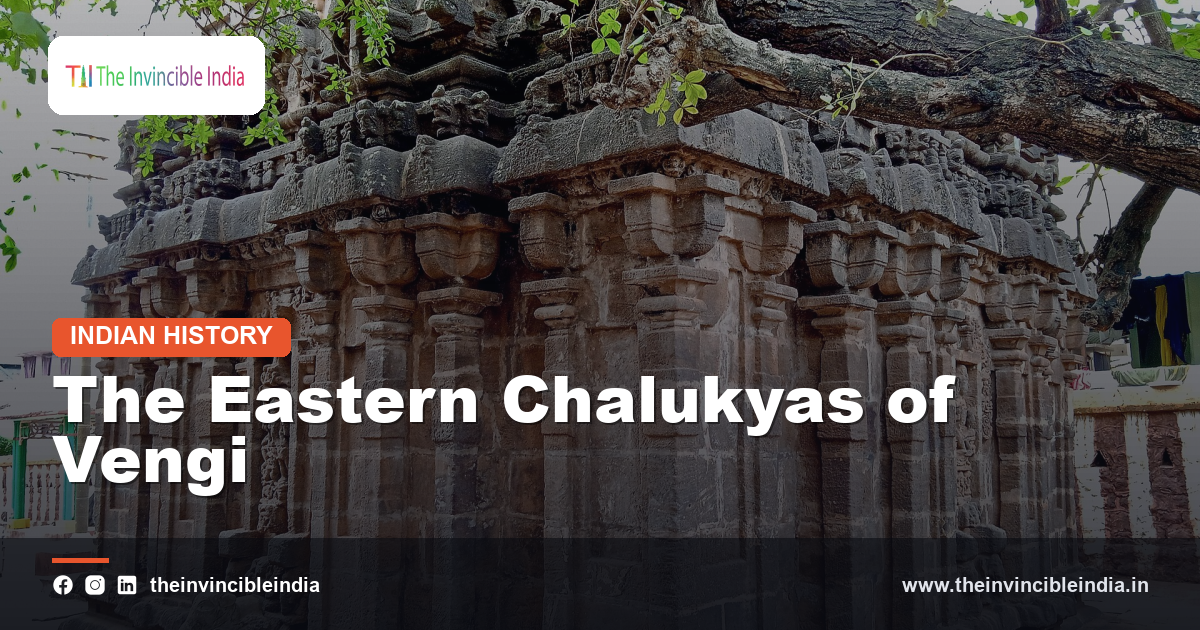
The Eastern Chalukyas ruled the fertile land between the Godavari and Krishna rivers for several centuries, governing first from Vengi and later from Rajahmundry in the heart of the Andhra country. They began as a branch of the great Chalukya house of Badami, whose story is told in our guide to the Chalukya dynasty, but they soon developed into an independent power with a distinct regional identity. Positioned between the Deccan plateau and the Tamil south, they were drawn into long rivalries with the Rashtrakutas and the Cholas, yet they also became partners in a famous marriage alliance. Their patronage of temples and of the Telugu language leaves a lasting cultural mark on Andhra.
Quick Facts
| Detail | Information |
|---|---|
| Dynasty | Eastern Chalukyas (Chalukyas of Vengi) |
| Origin | Branch of the Chalukyas of Badami |
| Founder | Kubja Vishnuvardhana, brother of Pulakeshin II |
| Capitals | Vengi, later Rajahmundry |
| Core Region | Godavari-Krishna delta, coastal Andhra |
| Famed For | Telugu literary beginnings and Chola marriage ties |
Origins of the Vengi Branch
The Eastern Chalukyas trace their beginning to the expansion of the Chalukya kingdom of Badami during the seventh century. Pulakeshin II, the most celebrated ruler of that house, extended his influence into the eastern Deccan and entrusted the newly acquired Andhra territory to his brother Kubja Vishnuvardhana. This arrangement placed a trusted family member in charge of a distant region and created the conditions for a lasting dynasty. In time, the governor became a king in his own right, and his descendants ruled the land as an independent house. The origin of the Eastern Chalukyas shows how a frontier appointment could grow into a separate royal line, one that would outlast many of the powers around it.
Kubja Vishnuvardhana the Founder
Kubja Vishnuvardhana is remembered as the founder of the line and the first ruler to establish a settled administration in the eastern territories. Governing from Vengi, he consolidated authority over the region between the two great rivers and laid the foundations on which later rulers would build. His reign is documented in inscriptions that record grants to temples and Brahmins, a practice that became a hallmark of the dynasty. By securing the loyalty of local chiefs and organizing the land revenue, he gave the new kingdom stability. The founder thus stands at the head of a long succession of kings who would shape the political and cultural history of coastal Andhra for the centuries that followed.
Vengi and the Andhra Heartland
The dynasty took its name from Vengi, the ancient region and city located in the delta country near present-day Eluru. This land, watered by the Godavari and the Krishna, was among the most productive agricultural areas of the subcontinent. Rice cultivation, supported by river irrigation, gave the kingdom a strong economic base, while the long coastline connected it to maritime trade. Vengi had an older history under earlier dynasties, and its name carried prestige that the Eastern Chalukyas were eager to claim. Later the royal seat moved to Rajahmundry, but the title of lord of Vengi remained associated with the family. The geography of the Andhra heartland therefore played a central part in the prosperity and the political ambitions of the dynasty.
Early Rulers and Consolidation
Following the founder, a succession of kings worked to defend and extend the kingdom against pressures from several sides. The early Eastern Chalukyas faced the threat of neighboring powers in the Deccan, including the Pallavas to the south and the Chalukyas of Badami themselves, whose fortunes rose and fell. During this formative period, the dynasty adapted by building local alliances and by granting land to temples and learned families, who in turn supported royal authority. Succession was not always peaceful, and disputes within the family sometimes invited outside intervention. Yet the kingdom endured, and its rulers gradually developed a distinct court culture. This phase of consolidation transformed a branch of a larger house into a durable regional state with its own traditions.
Conflict with the Rashtrakutas
The rise of the Rashtrakutas in the Deccan brought a prolonged period of conflict for the Eastern Chalukyas. The Rashtrakutas, whose story appears in our guide to the Rashtrakuta dynasty, repeatedly sought to control the rich Vengi country and at times forced its rulers into subordination. Wars alternated with truces, and the Eastern Chalukyas sometimes served as reluctant allies of their stronger neighbors. Despite these pressures, the dynasty recovered each time and reasserted its independence when circumstances allowed. Rulers such as Vijayaditya III are remembered in tradition for strengthening the kingdom during this contest. The long struggle with the Rashtrakutas shaped the military and political outlook of the dynasty and tested its resilience.
Administration and Land Grants
Eastern Chalukya administration relied on a hierarchy of officials and local chiefs who collected revenue and maintained order in the districts of the kingdom. Copper plate inscriptions, issued in large numbers, record the royal gift of villages to temples, scholars and religious institutions, often with precise descriptions of boundaries and obligations. These grants reveal a society in which land was the main source of wealth and in which royal patronage secured the loyalty of influential groups. The documents also preserve the names of officials and the language of royal authority. Through these records, historians can reconstruct how the kingdom functioned in daily practice. The careful system of grants helped keep the realm stable across many generations.
Society and Economy
The society of the Eastern Chalukya realm combined agricultural communities, skilled artisans, merchants and religious specialists. The delta lands supported dense settlement, and villages formed the basic unit of social and economic life. Merchants carried goods along the coast and inland, linking Andhra with other parts of the peninsula and with overseas markets. Temples were not only places of worship but also centers of economic activity, employing priests, craftsmen and musicians and managing endowed lands. Guilds and local assemblies played their part in civic life. The picture that emerges from inscriptions is of a prosperous and well organized region, in which the rhythms of farming, trade and ritual were closely intertwined.
Religion and Temple Building
The Eastern Chalukyas supported a variety of religious traditions, with Shaiva and Vaishnava worship receiving special royal favor. Temples such as the Bhimeswara temple at Draksharama, associated with the later Chalukya period, remain among the most important sacred sites of the region and show the architectural ambitions of the dynasty. Earlier Buddhist and Jain communities, which had flourished in Andhra for centuries, continued to exist alongside the newer temple cults, and the kings made gifts to several faiths. The style of temple building in the delta developed its own character, blending influences from the Deccan and the Tamil country. The religious patronage of the dynasty thus contributed to the lasting sacred landscape of coastal Andhra.
Marriage Ties with the Cholas
One of the most remarkable chapters in the history of the dynasty is its alliance with the Chola royal family. Even as the Cholas expanded northward, the two houses chose to cement their relationship through marriage, with Chola princesses wedding Eastern Chalukya princes. The union of Kundavai, a daughter of the great Chola ruler Rajaraja, with Vimaladitya of Vengi is among the best known. The alliance brought Chola influence into the Andhra country and gave the Eastern Chalukya princes a powerful ally. It also blurred the line between the two dynasties, since their children belonged to both lineages. Our guide to the Chola dynasty provides further context on this extraordinary diplomatic strategy.
Rajaraja Narendra and the Golden Age
Rajaraja Narendra, a son of Vimaladitya and Kundavai, ruled from Rajahmundry and is remembered as one of the most cultured kings of the dynasty. His reign is regarded as a high point for the kingdom, marked by stability, the encouragement of learning and the founding of a literary tradition that still defines Telugu culture. The king married a Chola princess, continuing the tradition of alliance between the two houses. Rajahmundry, on the banks of the Godavari, flourished as a center of court life and scholarship during his time. Posterity has seen his rule as a golden age because of the lasting cultural achievements it fostered. His reign illustrates how political security could nourish creativity.
Nannaya and the Telugu Mahabharata
The poet Nannaya Bhatta, honored as the Adi Kavi or first poet of Telugu literature, composed the opening portion of a Telugu rendering of the Mahabharata under the patronage of Rajaraja Narendra. This work is celebrated as the beginning of a long tradition in which the epic was retold in the Telugu language, blending Sanskrit learning with the idiom of the people. Nannaya is remembered for a refined literary style that set standards for later poets. The project was continued by later writers, who completed the translation over subsequent generations. The association of the Eastern Chalukya court with this achievement gives the dynasty a special place in the cultural history of Andhra and of Indian literature as a whole.
The Growth of the Telugu Language
The Eastern Chalukya period saw Telugu emerge more fully as a language of inscriptions, court poetry and literature. Earlier records in the region were often written in Sanskrit or Prakrit, but under the Eastern Chalukyas the use of Telugu in official and literary contexts expanded steadily. Verses composed in Telugu appear in inscriptions, showing that the language had acquired prestige and poetic form. Royal patronage played an important role in this development, since kings encouraged writers who could craft works in the regional tongue. The gradual rise of Telugu laid the foundation for the classical literature of later centuries. This linguistic flowering counts among the most enduring contributions of the dynasty to Indian culture.
Art, Sculpture and Inscriptions
The artistic legacy of the Eastern Chalukyas includes temple sculpture, carved pillars and a large body of inscriptions that document royal activity. The monuments of the delta region show a fusion of influences, drawing on the traditions of the Deccan and the southern Tamil country. Sculptors worked in stone to decorate shrines with images of deities and ornamental motifs, while donors recorded their gifts in carefully engraved texts. Inscriptions also reveal the development of scripts that would later evolve into the Telugu and Kannada alphabets. The surviving works, though affected by the passage of time, testify to a lively artistic culture supported by royal and local patronage, and they continue to attract the attention of art historians and epigraphists.
Succession Disputes and Decline
Over time, the Eastern Chalukya kingdom suffered from recurring disputes over the throne, which weakened its internal unity and invited interference from outside powers. The Cholas, with whom the family had intermarried, increasingly played a decisive role in the affairs of Vengi, sometimes supporting one claimant against another. Pressure also came from other Deccan kingdoms, and the dynasty’s independence gradually eroded. These difficulties did not erase the dynasty’s cultural accomplishments, but they reduced its political freedom. The decline reveals how the very alliances that once protected the kingdom could, in later circumstances, tie its fate to that of a stronger partner and lead to the loss of autonomy.
Kulothunga Chola and the Merging of Lines
The dynastic ties between the Cholas and the Eastern Chalukyas culminated in the accession of Kulothunga Chola I, a prince born of the two families, who took the Chola throne. His rise united the two lineages in one royal person and brought Vengi into close association with the Chola empire. Historians often see this moment as marking the end of the independent Eastern Chalukya line, although the family continued to hold influence in the region. Governors of the Vengi country were later drawn from the same circle of relatives. The episode shows how marriage alliances could reshape the political map without a conventional conquest, and it remains one of the most striking examples of dynastic fusion in Indian history.
After the Eastern Chalukyas
After the period of Chola ascendancy, the Andhra country passed through the hands of several regional powers, including the Velanati Cholas and, in later centuries, the Kakatiyas, who built a powerful Telugu kingdom with its capital at Warangal. These later dynasties inherited the cultural environment that the Eastern Chalukyas had helped create, including the growing prestige of the Telugu language and the tradition of royal temple patronage. Literary figures who followed Nannaya continued his work, completing the Telugu Mahabharata and composing new poetry. The continuity between the Eastern Chalukya era and the later history of Andhra shows how deeply the dynasty influenced the identity of the region and prepared the ground for its later flowering.
The Eastern Chalukya Legacy Today
Today the Eastern Chalukyas are remembered chiefly for their role in nurturing Telugu literature, their temples in the Godavari delta and their unusual alliance with the Chola royal house. The city of Rajahmundry, now known as Rajamahendravaram, preserves the memory of Rajaraja Narendra and Nannaya through its cultural institutions and traditions. Scholars continue to study the copper plate grants and inscriptions that document the dynasty, and the temples of the region remain active places of worship. The Eastern Chalukyas remind readers that regional kingdoms can shape the language, faith and identity of an entire people. Their legacy lives on wherever the Telugu language is spoken and celebrated, and in the historic landscape of coastal Andhra.
Sources & Further Reading
- Archaeological Survey of India (asi.nic.in).
- Ministry of Culture, Government of India (indiaculture.gov.in).
Frequently Asked Questions
Who founded the Eastern Chalukya dynasty?
The dynasty was founded by Kubja Vishnuvardhana, a brother of the Chalukya ruler Pulakeshin II of Badami. He was appointed to govern the eastern Deccan and established a lasting line at Vengi. His descendants ruled the Andhra country for centuries.
Where was Vengi located?
Vengi was a region and city in the delta country between the Godavari and Krishna rivers, near present-day Eluru in Andhra Pradesh. The dynasty later also ruled from Rajahmundry. The fertile delta gave the kingdom great agricultural wealth.
Why are the Eastern Chalukyas important to Telugu literature?
Under the patronage of Rajaraja Narendra, the poet Nannaya Bhatta began a Telugu version of the Mahabharata. This work is regarded as the start of classical Telugu literature. It was later completed by other poets.
How were the Eastern Chalukyas connected to the Cholas?
The two dynasties were joined through several marriage alliances, including the union of the Chola princess Kundavai with Vimaladitya of Vengi. Their descendants belonged to both families. Kulothunga Chola I, born of this union, eventually took the Chola throne.
What remains of the Eastern Chalukya legacy?
The legacy includes temples in the Godavari delta, many inscriptions and copper plate grants, and the early flowering of Telugu literature. These traditions continue to shape the cultural identity of Andhra. Scholars still study the dynasty through its surviving records.