


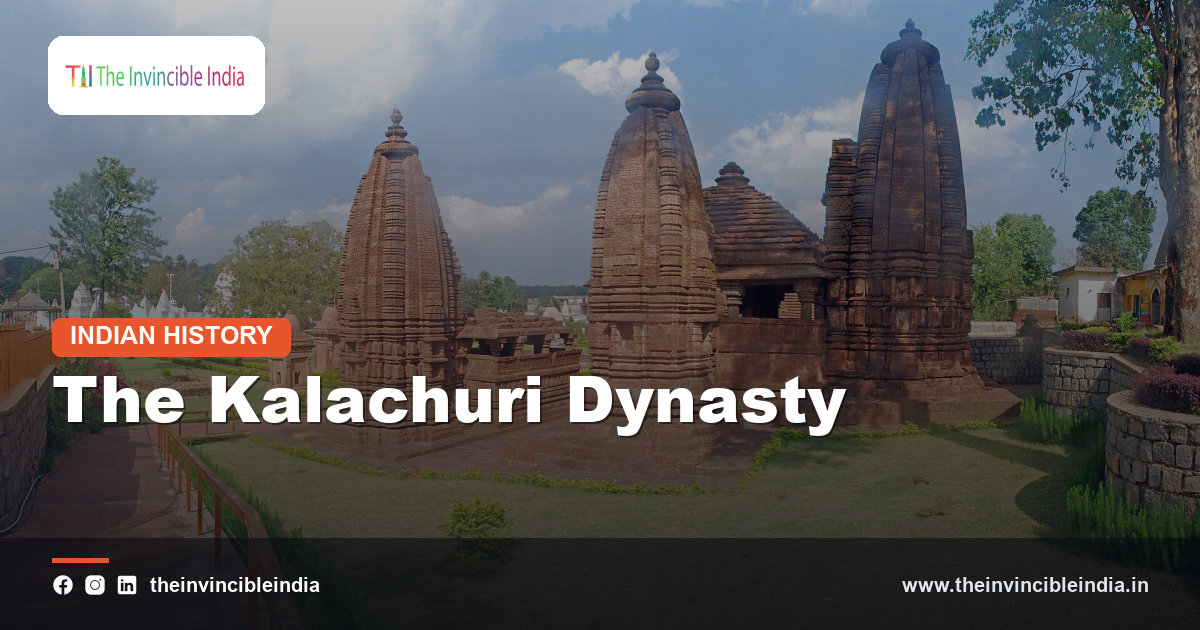
The name Kalachuri is attached not to a single kingdom but to several related ruling houses that held power in different parts of central and southern India across the medieval centuries. The best known of them governed from Tripuri in the Chedi country, while later branches rose in the forested uplands of present-day Chhattisgarh and, for a time, in the Deccan. Their story overlaps with that of neighboring powers such as the Chalukyas, whose rivalries and alliances shaped the politics of the age. Remembered for temple building, distinctive coinage, and patronage of learning, the Kalachuris illustrate how regional dynasties sustained a rich cultural life between the great imperial eras.
Quick Facts
| Detail | Information |
|---|---|
| Dynasty | Kalachuri (Haihaya lineage tradition) |
| Main Branches | Tripuri, Ratnapura and Kalyani |
| Core Region | Central India, the Chedi country and parts of the Deccan |
| Period | Early to late medieval centuries |
| Known For | Temples, coinage, inscriptions and literary patronage |
| Notable Site | Chausath Yogini temple at Bheraghat near Jabalpur |
Who Were the Kalachuris
The Kalachuris were a family of ruling houses that claimed descent from the ancient Haihaya lineage and used the name Kalachuri, sometimes spelled Kalacuri or Kalchuri, in their inscriptions. Rather than forming one continuous empire, they appeared as separate branches in different regions and different centuries, each with its own capital and its own political fortunes. Historians therefore speak of the Kalachuris of Tripuri, the Kalachuris of Ratnapura and the Kalachuris of Kalyani as distinct but related dynasties. What binds them together is a shared dynastic identity, a common tradition of ancestry, and a reputation for patronizing temples and learning. Understanding the dynasty begins with recognizing this plural character, because it explains why the Kalachuri legacy is spread across so wide a geography.
The Early Kalachuri Presence
Evidence for an early Kalachuri presence in central India comes mainly from inscriptions and copper plates that mention rulers using the family name in the centuries before the better documented medieval houses emerged. These early rulers governed parts of the Narmada valley and neighboring uplands, a region that stood at the crossroads between northern India and the Deccan. Their authority was often shaped by the larger powers around them, and at times they appear as feudatories or rivals of more prominent dynasties. Although the sources for this early phase are limited and sometimes difficult to interpret, they establish that the Kalachuri name was already associated with political power in the heartland of India. This early foundation prepared the ground for the more fully recorded rise of the Tripuri branch.
Tripuri and the Chedi Country
The most prominent Kalachuri house ruled from Tripuri, a site near modern Jabalpur, over a territory commonly called Chedi or Dahala. This region lay along the Narmada and included fertile river plains as well as forested hill country, giving the rulers both agricultural wealth and strategic depth. Because Chedi sat between the Gangetic plain to the north, Malwa to the west and the Deccan to the south, its rulers were constantly drawn into the politics of their neighbors. Tripuri served as the political and ceremonial center from which the dynasty projected its authority. The importance of the Chedi country in medieval Indian history owes much to the Kalachuris, who turned a frontier region into a recognized regional kingdom with its own court culture and administrative traditions.
Rise of the Tripuri Kingdom
The Kalachuri house at Tripuri gained strength through a series of ambitious rulers who expanded their influence by diplomacy, marriage alliances and military campaigns. Early figures such as Kokalla are remembered in the inscriptions for forging connections with neighboring dynasties and for asserting the family claim to regional leadership. Over successive generations, the kingdom grew from a modest principality into a power capable of competing with its better known neighbors. This growth was never smooth, since the Kalachuris faced strong rivals on several sides and depended on shifting alliances. Even so, the rise of Tripuri shows how a determined regional dynasty could secure a place among the significant kingdoms of its time, leaving behind a record that historians continue to study through epigraphy and surviving monuments.
Gangeyadeva and the Height of Power
The Tripuri kingdom is generally regarded as reaching its greatest prominence under rulers such as Gangeyadeva and his son Karna, also known as Lakshmikarna. Gangeyadeva is remembered for strengthening the kingdom and for issuing handsome coinage that circulated widely in northern and central India. Karna continued this expansion and is recorded as having campaigned against several neighboring powers, claiming imperial titles in the process. These assertions reflect the confidence of a dynasty at the height of its influence, even if the real extent of its control varied over time. The period associated with these two rulers stands as the high point of the Tripuri line, when the Kalachuris could credibly present themselves as one of the leading dynasties of central India.
Rivalries and Alliances
Like most medieval kingdoms, the Kalachuris of Tripuri lived in an environment of constant negotiation with their neighbors. To the west lay the Paramaras of Malwa, to the north the Chandellas and other houses of the Gangetic region, and to the south the powerful dynasties of the Deccan. Relations with these states alternated between warfare and cooperation, with marriage ties often used to seal agreements. Such rivalries drained resources but also encouraged exchanges of artistic and religious ideas across political borders. The Kalachuri experience shows that medieval politics in India was rarely a matter of simple conquest, but rather a continuing balance between competing courts. This pattern of rivalry and alliance helps explain both the dynasty’s moments of strength and its eventual weakening.
Administration and Society
Kalachuri governance followed the pattern familiar from other medieval Indian kingdoms, in which a king ruled through a hierarchy of ministers, local officers and subordinate chiefs. Land grants recorded on copper plates reveal how rulers rewarded temples, scholars and religious institutions with income from villages, thereby binding local elites to the throne. Such grants also show the importance of agriculture, since the revenue of the kingdom rested largely on the produce of the land. Society was organized around established social groups, with Brahmins, warriors, traders and cultivators each holding recognized roles. The Kalachuri court drew on the shared administrative vocabulary of its age, and its inscriptions preserve a picture of an orderly polity concerned with law, ritual and the support of religious life.
Religion and Patronage
The Kalachuri rulers were closely associated with the worship of Shiva, and many of their records open with invocations to that deity. Their patronage of Shaiva ascetics and temples fits a wider pattern in central India, where Shaivism flourished under royal support during the medieval centuries. At the same time, the region remained home to a variety of traditions, including Vaishnava devotion and the older Buddhist and Jain communities. Kalachuri kings made gifts to religious teachers and endowed monasteries, which in turn contributed to the intellectual life of the region. This pluralism of belief, supported by generous royal patronage, gave the kingdom a vibrant religious landscape. The religious outlook of the dynasty therefore reflects both personal devotion and the deliberate use of patronage as an instrument of governance.
Temples and the Chausath Yogini
Among the most celebrated monuments associated with the Kalachuri period is the Chausath Yogini temple at Bheraghat, near Jabalpur, set on a hill overlooking the Narmada. Its circular plan, with an open courtyard surrounded by shrines housing sculpted female deities, is among the more distinctive forms of medieval Indian temple architecture. The site is linked in tradition with the Tripuri Kalachuris and reflects the importance of Shaiva and Shakta practice in the region. Nearby, the marble rocks of the Narmada gorge draw visitors who admire the natural setting that surrounds these monuments. The temple stands as a lasting reminder of the architectural ambition of the dynasty and of the region’s wider contribution to the story of Indian sacred architecture.
Coinage and Economy
The Kalachuris of Tripuri are noted by numismatists for their coinage, which includes gold issues bearing a seated goddess on one face. This type of coin was widely recognized and imitated by neighboring dynasties, a sign of the economic reach of the kingdom. Coins served not only as a means of exchange but also as statements of royal authority, carrying symbols that proclaimed legitimacy and religious devotion. The kingdom’s economy rested on agriculture in the river valleys, on forest produce from the uplands, and on trade routes that crossed the region between north and south. Merchants and artisans formed an important part of urban life at centers such as Tripuri. The coinage of the dynasty thus offers a valuable window into the commercial and political life of medieval central India.
Language, Literature and Learning
Kalachuri courts supported Sanskrit learning, and their inscriptions are composed in polished verse that reveals a sophisticated literary culture. The poet and critic Rajashekhara is associated in tradition with the Kalachuri court of the Chedi region, and his writings on poetics and drama are among the notable literary products linked to the area. Royal patronage of scholars encouraged the copying of texts, the composition of eulogies and the study of grammar, rhetoric and philosophy. Local languages also developed alongside Sanskrit, preparing the way for later regional literatures. The presence of such learned figures at the court suggests that the dynasty valued culture as much as conquest. Literary patronage therefore forms an essential part of the Kalachuri legacy, complementing their achievements in architecture and coinage.
The Kalachuris of Ratnapura
A separate Kalachuri branch established itself at Ratnapura, in the region of present-day Chhattisgarh, and is often described as a cadet line of the Tripuri house. Ruling over the uplands and plains of the Mahanadi basin, these rulers developed a distinct regional identity and left inscriptions and monuments that mark their presence. The Janjgir Vishnu temple is among the structures traditionally connected with this branch, illustrating their patronage of Vaishnava as well as Shaiva worship. Their rule demonstrates how the Kalachuri name spread beyond Chedi into new territories, carrying with it the habits of royal patronage and temple building. The Ratnapura line also contributed to the cultural history of Chhattisgarh, where its legacy remains an important part of local heritage.
The Kalachuris of Kalyani
A third branch of Kalachuris rose to prominence in the Deccan when a minister of the Western Chalukya kingdom, Bijjala, gained control of the capital at Kalyani. This episode shows how officials of prominent families could rise to royal power during periods of political strain. Bijjala’s rule is remembered chiefly because it coincided with the activity of the philosopher and reformer Basavanna, who served at the court and inspired the Lingayat or Virashaiva movement. Although the Kalyani Kalachuris held power only for a relatively brief period, their era had lasting cultural consequences, especially for the Kannada-speaking world. The branch demonstrates that the Kalachuri story reached well beyond central India and touched one of the great religious and literary movements of the medieval Deccan.
Basavanna and the Lingayat Tradition
The association between the Kalyani Kalachuris and Basavanna gives this branch a place of special importance in Indian religious history. Basavanna and his contemporaries, including many poet-saints, composed short devotional and reformist verses in Kannada known as vachanas. These works emphasized personal devotion to Shiva, questioned rigid hierarchies of birth, and spoke in plain language to ordinary people. The movement that grew from these teachings became the Lingayat tradition, which remains influential in Karnataka and neighboring regions. Although the relationship between the king and the reformers was complicated, the intellectual ferment of Kalyani during this era produced a body of literature of lasting power. The Kalachuri period at Kalyani is thus remembered less for its politics than for its remarkable spiritual and literary creativity.
Decline of the Kalachuri Houses
The various Kalachuri houses declined for different reasons and at different times. The Tripuri kingdom was weakened by continuing conflicts with neighboring powers, by internal difficulties of succession, and by the gradual rise of rivals such as the Paramaras and Chandellas. Over time its territory shrank and its capital lost the prominence it once enjoyed, even as the family name continued to appear in later records. The Kalyani branch faded after a short period of authority, when the Chalukya line reasserted itself and the region passed to other powers. The Ratnapura line persisted longer as a regional dynasty before giving way to new political forces. These varied declines show that the Kalachuri legacy was never tied to a single capital, which helps explain why the dynasty is remembered in so many places.
Reading the Kalachuri Record
Modern knowledge of the Kalachuris depends heavily on inscriptions engraved on stone and copper, supported by coins and surviving monuments. Many of these records use a dating system known as the Kalachuri or Chedi era, which helps scholars place events in sequence and compare them with other dynasties. Because inscriptions often celebrate royal achievements in elaborate language, historians read them carefully, balancing praise against other sources. Archaeological work at Tripuri, Bheraghat and other sites continues to add detail to the picture. The relative scarcity of narrative chronicles means that the story has to be pieced together from fragments. This patient process of interpretation reveals a dynasty whose importance is greater than its popular fame would suggest.
The Kalachuri Legacy Today
Today the Kalachuri legacy survives in temples, sculpture, coins and inscriptions scattered across Madhya Pradesh, Chhattisgarh and Karnataka. The Chausath Yogini temple and the surrounding Narmada landscape draw pilgrims and visitors, while museums preserve coins and carvings that speak of a once vigorous court culture. In Karnataka, the memory of Kalyani and Basavanna keeps alive the intellectual achievements of a brief but fertile period. Local communities continue to honor the sites associated with the dynasty, and scholars continue to refine the history of its branches. The Kalachuris remind readers that India’s past is not confined to its largest empires, since regional dynasties also shaped art, belief and literature. Their enduring monuments invite continued study and respectful preservation.
Sources & Further Reading
- Archaeological Survey of India (asi.nic.in).
- Ministry of Culture, Government of India (indiaculture.gov.in).
Frequently Asked Questions
Who were the Kalachuris?
The Kalachuris were a group of related ruling dynasties that governed parts of central India and the Deccan during the medieval period. The best known branches ruled from Tripuri, Ratnapura and Kalyani. They are remembered for temples, coinage and the patronage of learning.
Where was the Kalachuri capital?
There was no single capital, because the dynasty existed as several branches. The Tripuri branch ruled near modern Jabalpur, the Ratnapura branch in present-day Chhattisgarh, and the Kalyani branch in the Deccan. Each branch had its own center of power.
What is the Chausath Yogini temple at Bheraghat?
It is a circular temple complex near Jabalpur, associated in tradition with the Kalachuris of Tripuri. Its open courtyard is ringed by shrines containing sculpted female deities. It remains one of the most distinctive medieval temples in central India.
How are the Kalachuris linked to Basavanna?
Basavanna served as a minister at Kalyani during the period when a Kalachuri ruler held the throne. His teachings inspired the Lingayat movement and a rich tradition of Kannada vachana literature. This connection gives the Kalyani branch special cultural importance.
How do historians know about the Kalachuris?
Knowledge of the dynasty comes largely from inscriptions on stone and copper plates, from coins, and from surviving monuments. Many records use the Kalachuri or Chedi era for dating. Archaeological work continues to add to this evidence.