


Griha Pravesh, literally the ceremonial entry into a home, is one of the most widely observed housewarming traditions in Indian culture, performed when a family moves into a newly built or newly purchased house. Rooted in Hindu ritual practice and closely tied to the principles of Vastu Shastra, the traditional system of architectural and spatial guidance, the ceremony is intended to invite blessings, harmony, and prosperity into a new dwelling. Much like other domestic and life-cycle rites observed across the country, including the emphasis on auspicious timing seen around Makar Sankranti, Griha Pravesh reflects a broader cultural tendency to begin important transitions with appropriate ritual observance. This guide outlines its meaning, key rituals, and continuing relevance for households across India.
Quick Facts
| Detail | Information |
|---|---|
| Ceremony Type | Hindu housewarming rite |
| Purpose | To bless a new home before occupancy |
| Key Elements | Puja, havan, kalash, rangoli |
| Typical Officiant | A priest (purohit) |
| Associated Concept | Vastu Shastra |
| Common Timing | Chosen per an auspicious muhurat |
What Is Griha Pravesh?
Griha Pravesh refers to the traditional Hindu ceremony performed when a family enters a new home for the first time as residents, marking the formal beginning of their occupancy with religious rites intended to invite prosperity and wellbeing. The term itself combines words meaning house and entry, capturing the essential act at the centre of the observance. Rather than simply moving belongings into a new dwelling, families following this tradition treat the first entry as a significant occasion requiring blessing and ritual preparation. The ceremony typically involves prayers, offerings, and symbolic acts performed either by a priest or by family members familiar with the customary sequence. Its underlying purpose is to sanctify the new living space, seeking harmony between the household and its physical environment before daily life in the home begins in earnest.
Vastu Shastra and the Choice of Home
Griha Pravesh is closely connected to Vastu Shastra, a traditional Indian system of architectural and spatial principles concerned with the orientation, layout, and design of buildings in relation to natural forces and directional considerations. Many families consult Vastu principles well before construction or purchase, seeking a home whose layout is considered favourable according to these guidelines. The housewarming ceremony itself is often seen as complementary to this earlier planning, addressing through ritual means any considerations that could not be fully resolved through design alone. While Vastu Shastra and Griha Pravesh are related, they are distinct: one concerns the physical planning of a structure, and the other concerns the ritual marking of its occupation. Together, they reflect a broader cultural approach in which both practical design and religious observance are seen as contributing to a harmonious and auspicious home.
Selecting an Auspicious Time
Choosing the right date and time for Griha Pravesh is considered an important part of the preparation, with many families consulting a priest or referring to a traditional almanac to identify a muhurat, or auspicious period, considered favourable for the occasion. Certain months, lunar phases, and days of the week are traditionally regarded as more suitable than others for such ceremonies, and families often plan their move accordingly, even if this means a short delay after a home becomes physically ready. This emphasis on timing reflects a broader pattern in Hindu ritual practice, in which the choice of an auspicious moment is treated as meaningfully connected to the success and harmony of the undertaking that follows. For many households, ensuring the ceremony falls within a recommended period is considered as important as the rituals performed on the day itself.
Pre-Ceremony Preparations
In the days leading up to Griha Pravesh, families typically undertake a thorough cleaning of the new home, arrange for the necessary ritual items, and coordinate with a priest if one is to conduct the ceremony. Common preparations include gathering items such as a coconut, mango leaves, a decorated pot for the kalash, and materials required for the havan or fire ritual. Some families also arrange for the main door and threshold of the home to be decorated, often with rangoli patterns or garlands, in anticipation of the ceremony. Invitations may be extended to close relatives and friends who wish to join the occasion, and in many households a shared meal is planned to follow the rituals. This period of preparation is treated as an integral part of the observance, setting the tone for the ceremony that marks the family’s formal entry into their new home.
The Role of the Priest
A priest, or purohit, is commonly engaged to conduct the rituals associated with Griha Pravesh, guiding the family through the sequence of prayers, offerings, and symbolic actions considered appropriate for the occasion. The priest typically recites Sanskrit verses invoking blessings for the household, directs the family in performing specific rites such as the havan, and advises on the correct order in which different elements of the ceremony should proceed. Because the precise sequence and content of the rituals can vary by regional and community tradition, the priest’s familiarity with the family’s particular customs is often valued. In households where a priest is not engaged, family elders may take on a similar guiding role, drawing on customary knowledge passed down through the family. Either way, the presence of an experienced guide is generally considered helpful in ensuring the ceremony proceeds in a manner consistent with tradition.
Invocation of Lord Ganesha
As with many Hindu ceremonies, Griha Pravesh typically begins with an invocation of Lord Ganesha, revered as the remover of obstacles and traditionally honoured at the start of new undertakings. A small idol or image of Ganesha may be installed in the new home as part of the ceremony, sometimes remaining in a household shrine well beyond the occasion itself. This opening invocation is intended to seek a smooth and auspicious beginning to the family’s life in the new dwelling, setting a tone of reverence before the remaining rituals proceed. The practice of beginning with Ganesha worship reflects a broader convention across Hindu ceremonial life, in which the deity’s blessing is sought before weddings, business openings, and other significant new beginnings. Its inclusion in Griha Pravesh situates the housewarming firmly within this wider pattern of ritual practice.
The Kalash and Its Symbolism
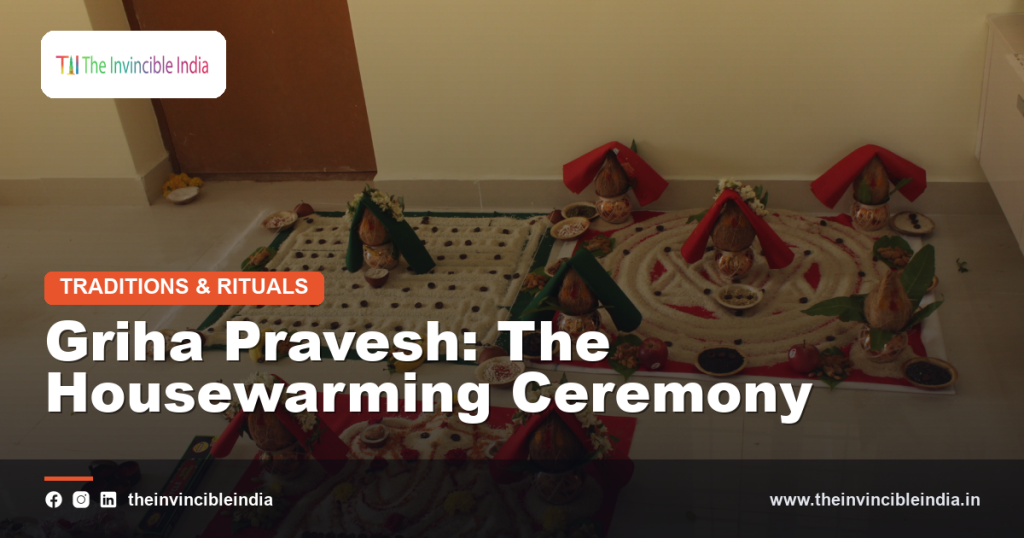
A decorated pot known as a kalash, typically filled with water and topped with mango leaves and a coconut, holds an important place in the Griha Pravesh ceremony and in many other Hindu rituals. It is generally understood to symbolise abundance, life, and the auspicious presence being invited into the home. During the ceremony, the kalash may be placed near the entrance or at a significant point within the house, sometimes accompanied by additional decorative elements such as rangoli patterns drawn on the floor nearby. Its presence is considered to reinforce the ceremony’s underlying intent of inviting prosperity and positive energy into the new dwelling. The kalash is a recurring symbol across Indian ritual life, appearing in weddings, religious festivals, and other significant occasions, and its inclusion in Griha Pravesh reflects this broader shared vocabulary of auspicious symbolism.
The Havan or Fire Ritual
A havan, or sacred fire ritual, forms a central part of most Griha Pravesh ceremonies, performed by lighting a fire in a specially prepared receptacle and offering items such as ghee, grains, and other materials while reciting Sanskrit verses. The fire is traditionally regarded as a sacred witness and a medium through which offerings and prayers are conveyed, and its presence is considered to purify the surrounding space. Family members typically gather around the havan during this portion of the ceremony, often taking turns to make offerings under the priest’s guidance. The smoke and fragrance produced by the ritual are also believed by tradition to have a purifying effect on the physical environment of the new home. As one of the more elaborate elements of the ceremony, the havan is often regarded as its ritual centrepiece, around which the remaining customs are structured.
Boiling Milk and the First Meal
A widely observed custom during Griha Pravesh involves boiling milk on the stove of the new kitchen, often allowing it to boil over slightly as a symbolic gesture associated with abundance and prosperity for the household. This is frequently among the first activities performed once the family formally enters the home, and it is sometimes followed by preparing a simple sweet dish using the boiled milk, shared among those present. The first meal cooked and eaten in the new home is also treated as significant in many families, marking the practical beginning of daily life in the space. These small domestic rituals, though modest compared to the more elaborate puja and havan, are valued for grounding the ceremony in the everyday activities the family will now carry out in their new surroundings, linking ritual symbolism directly to ordinary household life.
Rangoli and Home Decoration
Decoration plays an important role in Griha Pravesh, with many families adorning the entrance of the new home with rangoli, a traditional art form using coloured powders, flowers, or rice to create patterns on the floor, often near the threshold. Mango leaves, marigold garlands, and other auspicious decorative elements are also commonly used to frame doorways and windows for the occasion. These decorations are understood not merely as aesthetic touches but as expressions of welcome, intended to mark the home as a place now blessed and ready for habitation. The specific patterns and materials used in rangoli can vary considerably by region, reflecting broader Indian traditions of decorative floor art associated with festivals and auspicious occasions more generally. Together with the ritual elements of the ceremony, this decorative dimension contributes to the festive and celebratory atmosphere typically associated with Griha Pravesh.
Types of Griha Pravesh Ceremonies
Hindu tradition recognises several broad categories of Griha Pravesh, generally distinguished by the circumstances under which a family enters a home, such as moving into a newly constructed house for the first time, re-entering a home after a period of absence, or entering a previously occupied house after acquiring it. Each of these situations is traditionally understood to call for a somewhat different emphasis in the rituals performed, reflecting the different circumstances of the move. Families are often guided by a priest in determining which form of the ceremony is most appropriate to their situation. While the core elements, such as the invocation of Ganesha, the kalash, and the havan, remain broadly consistent across these variations, the overall tone and specific sequence can differ depending on the type of entry being marked, illustrating the flexibility built into the wider tradition.
Family and Guest Participation
Griha Pravesh is typically observed as a family occasion, with close relatives often invited to join the rituals and the celebratory meal that follows. Depending on the family’s preference and resources, the guest list can range from an intimate gathering of immediate family to a larger event including extended relatives, friends, and neighbours. Guests may participate directly in aspects of the ceremony, such as offering items during the havan, or may simply be present to witness the rituals and share in the subsequent celebration. This communal dimension reflects a broader pattern in Indian domestic ceremonies, where significant personal milestones are marked collectively rather than in isolation. For many families, the gathering itself becomes an important part of the memory associated with moving into a new home, alongside the ritual content of the ceremony.
Regional Customs Across India
While the core structure of Griha Pravesh, involving prayers, a havan, and symbolic domestic rituals, is broadly recognised across Hindu communities in India, specific customs and the emphasis given to particular elements can vary considerably from one region to another. Some communities place greater emphasis on particular deities being invoked, while others follow distinct sequences for the various rituals or incorporate additional local customs not universally observed elsewhere. Language, regional festival calendars, and local priestly traditions all contribute to these variations. Despite such differences, the underlying purpose of the ceremony, to bless a new home and mark the family’s formal entry with appropriate ritual, remains a consistent thread across the country’s diverse expressions of the tradition, illustrating both the shared foundations and the regional richness of Hindu domestic ritual practice.
Symbolic Meaning of the New Home
Within Hindu tradition, a home is often regarded as more than a physical structure, understood instead as a space closely tied to the wellbeing, harmony, and prosperity of the family that occupies it. Griha Pravesh gives ritual expression to this understanding, treating the act of entering a new home as an occasion requiring careful, respectful observance rather than a purely practical event. The rituals performed, from the invocation of Ganesha to the lighting of the havan, are all oriented toward establishing a sense of sanctity and positive intention within the new space from the very outset of occupancy. This symbolic framing reflects a broader cultural view in which the environments people inhabit are considered to have a meaningful bearing on their lives, reinforcing the importance placed on beginning residence in a new home with appropriate ceremony.
Modern Adaptations of the Ceremony
As housing patterns in India have shifted, with more families moving into apartments and urban developments rather than standalone houses, Griha Pravesh has adapted in various ways while retaining its essential ritual core. Space constraints in modern apartments, for instance, may lead families to hold simplified versions of the havan or adjust the scale of the accompanying celebration. Some families now coordinate with priests who specialise in shorter ceremonies suited to busy urban schedules, while others continue to observe more elaborate traditional sequences regardless of setting. Online resources and priest-booking services have also made it easier for urban families to arrange the ceremony without extensive prior familiarity with its details. These adaptations reflect a broader pattern seen across many Indian traditions, in which core rituals persist even as their specific format evolves to suit contemporary living arrangements.
Griha Pravesh Today
Griha Pravesh remains a widely observed tradition among Hindu families across India, valued as a meaningful way to mark the significant transition of moving into a new home. Whether performed with an elaborate havan and full priestly guidance or in a more modest, adapted form suited to urban living, the ceremony continues to express longstanding beliefs about the importance of beginning residence in a new space with blessing and positive intention. Its persistence, even amid changing housing patterns and busier contemporary lifestyles, speaks to the continued value many families place on ritual observance at key life transitions. As a practice that blends religious devotion, domestic symbolism, and family celebration, Griha Pravesh continues to occupy an important place in the broader landscape of Indian household tradition, marking new beginnings with a ceremony that has endured across generations.
Sources & Further Reading
- Ministry of Housing and Urban Affairs, Government of India (mohua.gov.in).
- Ministry of Culture, Government of India (indiaculture.gov.in).
Frequently Asked Questions
What is Griha Pravesh?
Griha Pravesh is a Hindu housewarming ceremony performed when a family formally enters a new home, involving rituals intended to bless the household and invite prosperity.
How is the date for Griha Pravesh chosen?
Families typically consult a priest or traditional almanac to identify an auspicious muhurat, or time period, considered favourable for the ceremony.
What rituals are commonly part of Griha Pravesh?
Common elements include the invocation of Lord Ganesha, the placement of a kalash, a havan or fire ritual, and the boiling of milk in the new kitchen.
Is Griha Pravesh only for newly built homes?
No, variations of the ceremony also apply to families entering a previously occupied home or returning after an absence, with the specific rituals adjusted accordingly.
Has Griha Pravesh changed for modern apartment living?
Yes, many urban families now observe simplified or shorter versions of the ceremony to suit smaller spaces and busier schedules, while retaining its essential rituals.