


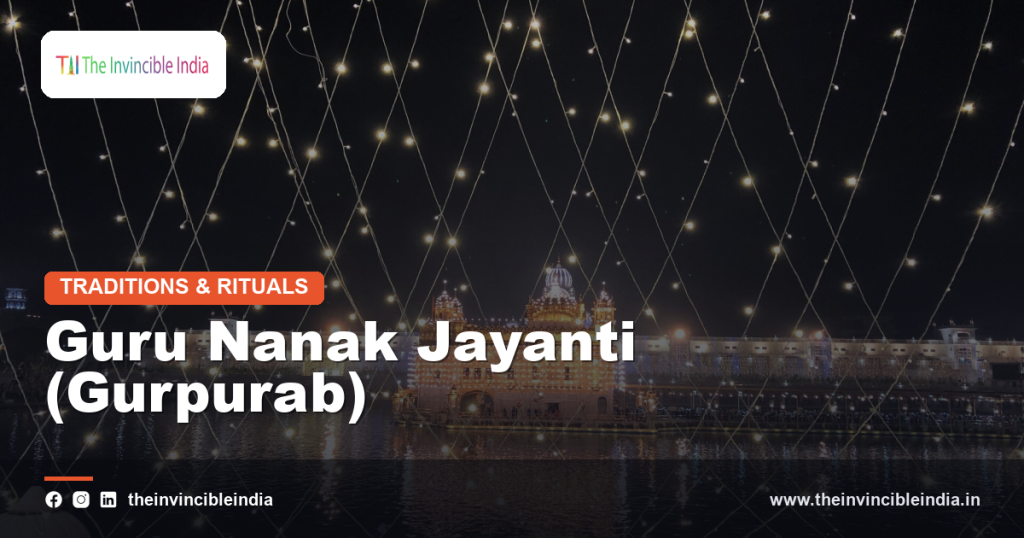
Guru Nanak Jayanti, widely known as Gurpurab, commemorates the birth of Guru Nanak, the founder of Sikhism and the first of the faith’s ten Gurus. The occasion is marked by continuous scriptural recitation, devotional singing, community processions and the communal meal known as langar, reflecting core Sikh values of devotion, equality and service. Much like Durga Puja, the festival draws large public processions and community participation that extend well beyond the walls of individual gurdwaras. This guide explains the meaning, rituals and continuing importance of Guru Nanak Jayanti.
Quick Facts
| Detail | Information |
|---|---|
| Also Known As | Gurpurab, Prakash Purab |
| Commemorates | The birth of Guru Nanak, founder of Sikhism |
| Type of Observance | Sikh religious festival |
| General Timing | Kartik Purnima, generally in November |
| Key Practices | Akhand Path, Nagar Kirtan, langar |
| Region of Prominence | Observed by Sikh communities across India and worldwide |
Meaning and Significance
Guru Nanak Jayanti is celebrated as one of the most important occasions in the Sikh calendar, marking the birth of Guru Nanak, whose teachings laid the foundation for Sikhism as a distinct faith. The festival is observed with deep reverence, combining scriptural recitation, devotional music and community service in a manner that reflects the values Guru Nanak himself is remembered for espousing.
For Sikhs, the occasion is both a religious commemoration and an opportunity to reaffirm commitment to core principles such as equality, honest living and service to others. This dual character, devotional and ethical, gives Gurpurab a significance that extends well beyond ritual observance alone.
Guru Nanak's Life and Teachings
Guru Nanak is remembered in Sikh tradition for teachings that emphasised the oneness of God, the equality of all people regardless of caste or creed, and the importance of honest work and selfless service. His travels across the Indian subcontinent and beyond are recounted in Sikh tradition as journeys undertaken to share these teachings widely with diverse communities.
His compositions, later included within the Guru Granth Sahib, the central scripture of Sikhism, are regarded as foundational expressions of these ideas. Guru Nanak’s life and teachings continue to be studied and recited widely, forming the basis for much of the devotional literature associated with Gurpurab celebrations.
Founding of Sikhism and Core Beliefs
Guru Nanak’s teachings mark the beginning of Sikhism as a distinct spiritual tradition, built around belief in one formless God, the pursuit of truthful living, and rejection of ritualism and social distinctions such as caste. These core principles were carried forward and elaborated by the nine Gurus who succeeded him.
The tradition places strong emphasis on three interconnected practices often summarised as remembering the divine, honest labour, and sharing with others, principles that continue to shape Sikh religious and community life today. Gurpurab celebrations are, in many respects, a communal reaffirmation of these founding beliefs.
Position in the Sikh Calendar
Guru Nanak Jayanti is traditionally observed on Kartik Purnima, the full moon day of the lunar month of Kartik, which generally falls in November on the Gregorian calendar. As with other festivals tied to the lunar calendar, the precise date can shift slightly from year to year.
The Nanakshahi calendar, a solar calendar adopted by some Sikh institutions, has in certain contexts assigned a fixed Gregorian date to the occasion, though the traditional lunar dating according to Kartik Purnima remains widely followed and observed across most Sikh communities.
Akhand Path: The Continuous Reading
A central feature of Gurpurab observance is the Akhand Path, a continuous and unbroken reading of the entire Guru Granth Sahib, conducted over roughly two days by a rotating team of readers. This uninterrupted recitation typically concludes on the morning of the festival itself, timed so that the reading’s completion coincides with the day of celebration.
The Akhand Path is regarded as an act of deep devotion, requiring careful organisation to maintain the continuous reading without pause. Gurdwaras across the world undertake this practice in the days leading up to Gurpurab, drawing devotees to participate in listening to portions of the recitation.
Nagar Kirtan Processions
Nagar Kirtan, a devotional procession through city streets, is among the most visible public expressions of Gurpurab celebration. Led by five ceremonially dressed representatives known as Panj Pyare, the procession carries the Guru Granth Sahib on a decorated float, accompanied by hymn singing, martial arts displays and community participation.
These processions draw large crowds and often pass through major thoroughfares, turning public space into a site of shared devotion for the day. The scale and route of Nagar Kirtan vary by city, but the procession’s core elements, scripture, music and communal walking, remain consistent across different locations.
Gurdwara Decorations and Special Prayers
Gurdwaras are elaborately decorated for Gurpurab, with lights, flowers and special arrangements marking the occasion well in advance of the festival day itself. Special prayers, hymn singing and readings from the Guru Granth Sahib continue throughout the day, drawing large numbers of devotees to participate in worship.
Many gurdwaras also organise educational programmes and lectures on Guru Nanak’s life and teachings around the festival, aiming to deepen understanding of his message among younger generations. This combination of ritual observance and educational outreach reflects the broader emphasis Sikhism places on both devotion and learning.
The Golden Temple During Gurpurab
The Golden Temple in Amritsar, the most revered site in Sikhism, sees particularly elaborate celebrations during Gurpurab, with the complex illuminated and decorated for the occasion. Continuous kirtan, special prayers and large-scale langar service mark the celebrations at this central shrine.
Pilgrims travel to Amritsar from across India and abroad specifically for the festival, seeking to be present at the Golden Temple during this significant occasion. The scale of celebration at this site, drawing enormous crowds and extensive community service, reflects its central place in Sikh religious life.
Langar: Community Kitchen Tradition
Langar, the community kitchen tradition central to Sikh practice, becomes especially prominent during Gurpurab, with gurdwaras preparing and serving free meals to all visitors regardless of religion, caste or background. Volunteers, known as sevadars, contribute their time and labour to cooking, serving and cleaning as an act of service.
The scale of langar during Gurpurab can be considerable, particularly at major gurdwaras, reflecting the festival’s emphasis on hospitality and equality. This tradition of shared, freely offered food is regarded as one of the clearest practical expressions of Guru Nanak’s teachings on equality and selfless service.
Guru Granth Sahib and Its Significance
The Guru Granth Sahib, regarded as the living Guru and eternal spiritual authority in Sikhism, occupies a central place in Gurpurab observance, with its continuous reading and ceremonial procession forming the backbone of the festival’s rituals. The scripture contains hymns composed by Guru Nanak and successive Gurus, along with writings from other saints.
Its treatment as a living spiritual guide, rather than merely a historical text, shapes the reverence with which it is handled and read during Gurpurab and throughout the year. This centrality of scripture reflects Sikhism’s broader emphasis on the written word as a direct channel to spiritual guidance.
Kartarpur Corridor and Pilgrimage
Kartarpur, associated with the final years of Guru Nanak’s life, has become an increasingly significant pilgrimage site for Sikhs, particularly following the opening of a dedicated corridor allowing pilgrims easier access to the shrine. Gurpurab season often sees heightened interest in visiting sites connected to Guru Nanak’s life and travels.
Pilgrimage to locations associated with the Guru’s journeys forms an important part of devotional practice for many Sikhs, connecting contemporary worship to the historical narrative of his life. Such pilgrimages, whether undertaken during Gurpurab or at other times, reinforce the personal and communal significance of these historic sites.
Regional and Global Sikh Celebrations
Guru Nanak Jayanti is celebrated wherever Sikh communities are established, from Punjab and other parts of India to countries with significant Sikh diaspora populations such as the United Kingdom, Canada and the United States. Gurdwaras in these locations organise their own processions, recitations and langar services.
While the core rituals remain consistent, local celebrations often reflect the particular character of each community, whether through the scale of public processions or the specific cultural context in which they take place. This global observance underscores the widespread reach of Guru Nanak’s teachings well beyond their original geographic setting.
Music and Kirtan Traditions
Kirtan, the singing of devotional hymns, forms a continuous thread through Gurpurab celebrations, performed by trained ragis, or hymn singers, in gurdwaras throughout the festival period. These musical renditions of scripture are considered a central form of worship in Sikh tradition, engaging devotees directly with the teachings through melody and rhythm.
Special kirtan programmes, often extending over several hours, are organised specifically for Gurpurab, drawing skilled performers and large congregations. This musical tradition, rooted in the hymns of the Guru Granth Sahib, remains one of the most immediately recognisable aspects of Sikh religious practice during the festival.
Charitable Activities and Seva
Seva, or selfless service, is a core value emphasised during Gurpurab, expressed through activities such as community meal service, blood donation camps and charitable outreach organised by gurdwaras and Sikh organisations. These activities are considered a direct extension of the festival’s devotional themes into practical action.
Volunteering during Gurpurab, whether in the kitchen, at cleaning duties, or in organising processions, is regarded not as a chore but as an act of worship in itself. This emphasis on service reflects the practical, community-oriented dimension of Sikh teaching that Guru Nanak Jayanti is understood to honour.
Guru Nanak's Legacy in Indian Culture
Beyond its religious significance, Guru Nanak’s teachings on equality, honest living and service have had a lasting influence on Indian cultural and social life more broadly, often cited in discussions of social reform and communal harmony. His message is frequently referenced as an early and influential call for social equality within the subcontinent’s history.
This broader cultural resonance means Guru Nanak Jayanti is observed with interest and respect by many beyond the Sikh community itself, reflecting the wide reach of his teachings across religious and regional lines. Civic events and interfaith gatherings are sometimes organised around the occasion in recognition of this shared legacy.
Guru Nanak Jayanti Today
In present-day observance, Guru Nanak Jayanti continues to be marked by the traditional combination of Akhand Path, Nagar Kirtan and langar, even as celebrations have grown in scale and reach through modern organisation and communication. Live broadcasts from major gurdwaras allow devotees worldwide to participate remotely in the festival’s central rituals.
Sikh institutions and community organisations continue to use the occasion to promote Guru Nanak’s teachings through educational programmes and public outreach. Despite changes in scale and format, the festival’s essential focus, honouring the founder of Sikhism and the values he taught, remains firmly consistent with its long tradition.
Sources & Further Reading
- Ministry of Culture, Government of India (indiaculture.gov.in).
- Sangeet Natak Akademi (sangeetnatak.gov.in).
Frequently Asked Questions
What is Guru Nanak Jayanti?
Guru Nanak Jayanti, or Gurpurab, is a Sikh festival celebrating the birth of Guru Nanak, the founder of Sikhism, marked by scripture recitation, processions and community service.
What is Akhand Path?
Akhand Path is a continuous, unbroken reading of the entire Guru Granth Sahib conducted over roughly two days, timed to conclude on the day of Gurpurab.
What happens during Nagar Kirtan?
Nagar Kirtan is a devotional procession in which the Guru Granth Sahib is carried through city streets accompanied by hymn singing and community participation.
Why is langar important during Gurpurab?
Langar, the free community meal, reflects Sikh values of equality and service, with gurdwaras serving all visitors regardless of background during the festival.
When is Guru Nanak Jayanti celebrated?
It is traditionally observed on Kartik Purnima, the full moon day of the lunar month of Kartik, generally falling in November.