


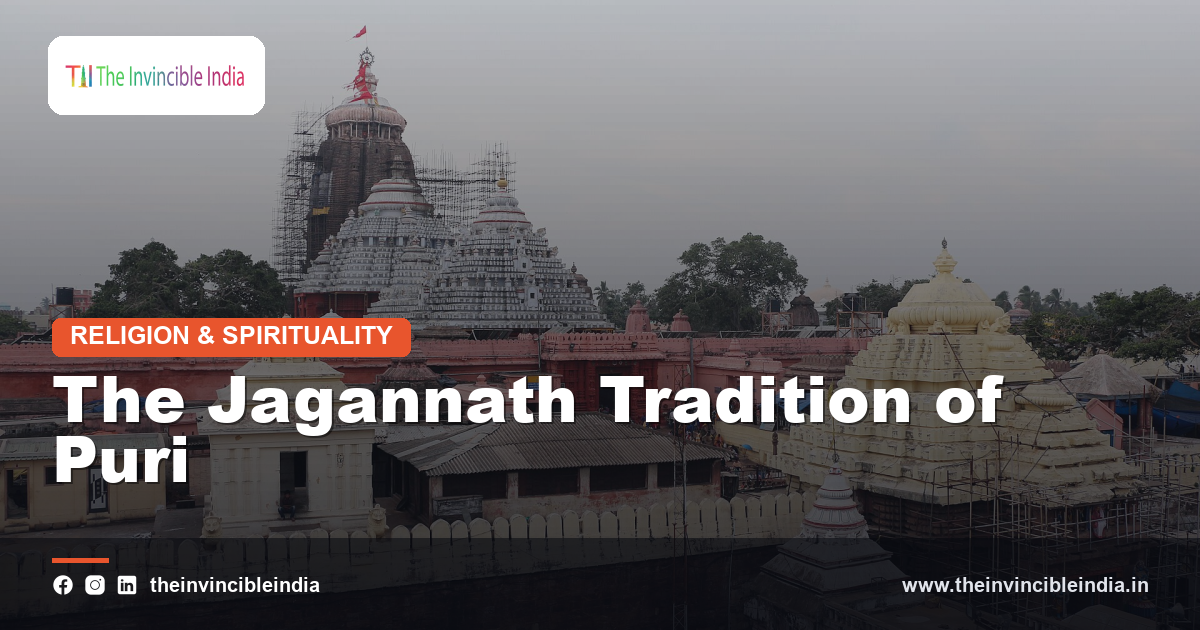
The Jagannath tradition of Puri, on the eastern coast of Odisha, is one of the most distinctive devotional cultures in the Hindu world. Its presiding deity, Lord Jagannath, whose name means the lord of the universe, is worshipped together with his elder brother Balabhadra and sister Subhadra in a form unlike the stone or metal images found in most temples. Puri is counted among the four sacred abodes of the Char Dham, and its annual Rath Yatra is among the best-known religious festivals in India. This guide explores the deities and their symbolism, the temple and its servitors, the great chariot festival, the famed sacred food, and the arts that have grown around the tradition over the centuries.
Quick Facts
| Detail | Information |
|---|---|
| Presiding Deity | Lord Jagannath with Balabhadra and Subhadra |
| Location | Puri, Odisha |
| Sacred Circuit | One of the Char Dham |
| Great Festival | Rath Yatra |
| Sacred Food | Mahaprasad |
| Renewal Ritual | Nabakalebara |
Who Is Lord Jagannath
Lord Jagannath is a form of the divine worshipped chiefly in Odisha, where he is regarded as the supreme presence watching over the whole world. The name combines the Sanskrit words for the universe and its lord, and devotees speak of him with great familiarity, treating him as a beloved member of the household as well as a cosmic ruler. Many Vaishnava devotees identify him with Vishnu or Krishna, while the tradition itself has a character of its own and draws on several streams of Indian religious thought. His large, round eyes and his broad, simple features make the image instantly recognizable. Worship of Jagannath is open-hearted, festive, and closely tied to everyday life in Puri. The deity is thus both a theological ideal and an intimate companion in the experience of countless devotees.
Balabhadra and Subhadra
Jagannath is never worshipped alone. At Puri he is installed with his elder brother Balabhadra and his younger sister Subhadra, and the three together form the central trio of the tradition. Balabhadra, often associated with strength and the plough, is shown with a lighter complexion, while Subhadra stands between her brothers as a symbol of affection and family unity. A fourth emblem, the Sudarshana, is worshipped beside them and is associated with the discus. The presence of a sister alongside two brothers is unusual among major Hindu deities, and it gives the tradition a strongly familial character. Devotees speak of the three as siblings who share meals, journeys, and festivals. This family picture helps explain the warm, personal tone of Jagannath devotion and its appeal across all sections of society.
The Wooden Form of the Deities
One of the most remarkable features of the tradition is that the principal images are made of wood rather than stone or metal. The deities are carved from sacred timber, usually neem, and their appearance is stylized, with large eyes, rounded heads, and no fully formed limbs. This distinctive form has drawn the attention of scholars, artists, and visitors for generations, and many interpretations have been offered of its meaning. Some see in it an abstract image that points beyond ordinary form, while others emphasize its links with older tribal and forest traditions of tree worship. The tradition itself does not insist on a single explanation. What matters to devotees is the living presence they experience in the images, which are dressed, fed, bathed, and cared for as honored beings. The wooden form has become one of the defining signs of the whole Jagannath culture.
Legends of Origin
Several traditional stories describe how the deity came to be worshipped at Puri. Many versions speak of a king who was guided by a dream to find a sacred image, and of a forest dweller who had long worshipped the deity in secret. Others describe a divine carpenter who agreed to carve the images on the condition that he would be left undisturbed, and the account of the unfinished figures is often told to explain their distinctive form. These narratives vary from one telling to another, and devotees generally appreciate them as expressions of faith rather than as exact history. They are nonetheless meaningful, because they connect the royal court, tribal communities, and ordinary worshippers within a single story. Together the legends show that the Jagannath tradition grew from many roots, joining different groups in shared reverence for one deity.
A Meeting of Many Traditions
Scholars often describe the Jagannath tradition as syncretic, meaning that it has absorbed and harmonized elements from several religious streams. Vaishnava devotion is prominent, yet Shaiva and Shakta influences are also visible in the ritual life of the temple, and the worship of a wooden image is often linked with older tribal practices of the region. Some writers also note affinities with other Indian religious currents, though such connections are discussed with varying degrees of certainty. For devotees, the question is rarely a matter of dispute, because Jagannath is understood as embracing all paths. This inclusive character helps explain why the tradition has attracted followers from a wide range of backgrounds and why its festivals have long been moments of broad participation. The blending of influences is itself one of the tradition’s most important cultural achievements.
The Temple at Puri
The great temple of Puri, often called the Sri Mandir, is a large complex built in the Kalinga style of architecture characteristic of Odisha. Its tall main tower rises above the town and is a landmark visible from a distance, and the surrounding compound contains many smaller shrines, halls, and kitchens. Entry is through a series of gateways, and the main approach is guarded by a gate associated with lions, with a flight of steps leading up to the interior. The temple stands near the sea, and the coastal setting gives it a distinct atmosphere. A wheel-like emblem at the summit and a flag that is traditionally changed with great ceremony form part of its daily ritual landscape. Over many centuries the building has been maintained, repaired, and expanded, and it remains the beating heart of the town’s religious and social life.
Puri as One of the Char Dham
Puri holds a place among the four sacred abodes that together make up the Char Dham, the great pilgrimage circuit of India. Traditionally the four are associated with the four directions of the country, and Puri represents the east. A pilgrim who completes the circuit is understood to have honored the whole sacred geography of the land. Puri has long been regarded as a place where seekers may find peace and spiritual benefit, and it is often called Jagannath Puri. Visitors from all over India arrive throughout the year, with larger numbers at festival seasons. The association with the Char Dham has helped make Jagannath one of the most widely known deities of the subcontinent. It also ties the regional culture of Odisha into the wider pattern of Indian pilgrimage.
The Servitors and Daily Worship
The daily life of the temple is carried out by large communities of hereditary servitors, each responsible for a specific duty. Some care for the dressing and adornment of the deities, others prepare offerings, play music, or manage the vast kitchens, and still others look after the flags, garlands, and lamps. These roles are passed down within families over generations and form a detailed system of service that has been described as one of the most elaborate in the Hindu world. The deities are woken, bathed, clothed, offered meals, and put to rest on a fixed schedule through the day, in the manner of a royal household. Devotees see this routine as a loving form of care for the beloved lord. The system of servitors preserves a continuous tradition of knowledge, skill, and devotion in the temple.
Mahaprasad and the Temple Kitchen
The temple kitchen of Puri is renowned for preparing food on a very large scale as an offering to the deities. This food, once offered, is known as Mahaprasad, meaning the great sacred gift, and it is shared with devotees in the temple precincts. A well-known feature of the tradition is the sense of equality at the meal, since the sacred food is regarded as pure in itself and is often shared among people of different backgrounds. Cooking is done by traditional cooks in earthen vessels, using vegetarian ingredients prepared according to long-standing practice. The offerings are made in a set order, and the food is then sold or given in a nearby market area where visitors gather to eat. For many pilgrims, receiving Mahaprasad is one of the most cherished parts of a visit to Puri, a moment of direct, edible blessing.
Snana Yatra and the Period of Retreat
Before the great chariot festival, the deities take part in a ceremonial bathing known as the Snana Yatra, observed in the warm weeks of early summer. The images are brought out and bathed with water drawn from a sacred source, to the delight of the gathered crowd. According to the traditional account, the deities are then said to fall ill, and they withdraw from public view for a period of rest and recuperation. During these days the usual darshan is not available, and devotees await their return with a sense of longing. This custom beautifully expresses the human, familial character of the tradition, in which even the lord is treated as one who may be tired or unwell. The retreat also builds anticipation for the great festival to follow, and it deepens the emotional bond between the deities and those who worship them.
The Rath Yatra: The Festival of Chariots
The Rath Yatra, or festival of chariots, is the most famous event in the Jagannath calendar, held each year in the monsoon season. The three deities are brought out of the temple in procession and placed on three enormous wooden chariots, each with its own name, color, and decoration. Thousands of devotees take hold of the thick ropes and draw the chariots along the broad avenue toward a temple associated with the deities’ aunt, where they stay for several days before returning. The festival turns the sacred image into a visible, moving presence in the streets, allowing every person, whatever their station, to see the lord at close range. Devotees consider pulling the chariot an act of great merit. The English word juggernaut is believed to derive from this tradition. The festival remains a joyful, spectacular expression of shared devotion.
The Three Chariots
Each year new chariots are constructed for the festival, using traditional methods and specific kinds of wood, in workshops located near the temple. The chariot of Jagannath is the largest of the three and is richly adorned with colorful fabric and carved wooden figures, while the chariots of Balabhadra and Subhadra are somewhat smaller and distinguished by their own colors and names. Each chariot has a defined structure of wheels, a platform, and a canopy, and each is attended by carved horses and guardian figures. The craftsmen who build them belong to families that have practiced the work for generations. The ceremonial sweeping of the chariot platform by the traditional ruler of the region, in a gesture of humility before the deity, is a famous part of the rite. The chariots are thus works of art, engineering, and devotion combined.
Return Journey and Related Festivals
After the stay at the destination temple, the deities return in a second procession often called the Bahuda Yatra, which mirrors the outward journey. On the way back they are traditionally offered a special sweet at a halting point, and on arrival they are dressed in elaborate golden ornaments in a ceremony known as Suna Besha, which draws large crowds. Other festivals through the year, including seasonal celebrations tied to the agricultural calendar, keep the temple’s ritual life constantly active. The yearly cycle gives devotees a rhythm of anticipation, participation, and renewal, with the Rath Yatra as the high point. Together the festivals demonstrate how thoroughly the tradition is woven into the life of the town and region. The festival calendar is therefore not merely a set of events but a continuing story told every year.
Nabakalebara: The Renewal of the Deities
One of the most solemn rites of the tradition is Nabakalebara, in which the wooden images are replaced with new ones at intervals determined by the traditional calendar. The ritual begins with a search for the proper sacred trees, guided by long-established signs and prayers, and it involves the careful carving of the new images by specially assigned craftsmen. The sacred essence is understood to be transferred from the old forms to the new in a deeply private ceremony. The old images are then given ceremonial burial in the temple grounds. The event is attended by great public emotion and draws huge numbers of devotees. Nabakalebara expresses the tradition’s profound reflections on change, continuity, and the cycle of life and renewal, showing that the deity endures even as its visible form is replaced.
Music, Poetry, and the Gita Govinda
Poetry and song have been central to Jagannath devotion for centuries. The Gita Govinda, a lyrical Sanskrit poem about the love of Radha and Krishna composed by the poet Jayadeva, is closely associated with the temple, and verses from it have long been sung during the evening rituals. Devotional poets writing in Odia, including those of later centuries, also composed songs expressing longing and love for the lord. Among them are voices from varied backgrounds, including a devotee named Salabega, whose verses are remembered with affection in Odisha. The tradition of ritual dance, once performed by temple dancers, contributed to the development of the classical dance form known as Odissi. These musical and poetic traditions deepen the sense that worship at Puri is an art as well as a discipline. They continue to inspire performers and listeners across India.
Art, Craft, and Pattachitra
The tradition has inspired a rich body of visual art, much of it still produced by hereditary craftsmen in and around Puri. Pattachitra, a form of painting done on prepared cloth with natural pigments, often depicts Jagannath, his siblings, and episodes from the stories of Vishnu and Krishna in bold lines and vivid colors. Wood carving, stone sculpture, palm-leaf engraving, and appliqué work are also practiced, and many of these crafts serve the festivals directly by providing ornaments, canopies, and decorations. Pilgrims often take home small paintings or wooden images as keepsakes of their visit. The craft communities form an essential part of the cultural ecosystem of Puri. Through their work the iconography of the deity has spread widely, and the distinctive faces of the three siblings have become among the most recognizable images in Indian devotional art.
Jagannath Beyond Odisha
Although rooted in Puri, devotion to Jagannath has spread widely across India and the world. Temples dedicated to the deity and his siblings have been built in many Indian states, and Rath Yatra processions are now held in numerous cities, both in India and abroad, often organized by local communities and devotional movements. The great Bengali saint Chaitanya is traditionally remembered as having spent his later years in Puri and as having brought great fervor to the worship of Jagannath, strengthening links between Odisha and the Vaishnava traditions of eastern India. Followers of various Vaishnava movements regard the festival as especially sacred. This global spread shows the adaptability of the tradition and its universal emotional appeal. The image of the chariot being pulled by a joyful crowd has become a worldwide symbol of devotion and shared celebration.
The Jagannath Tradition Today
Today the Jagannath tradition remains a vibrant living faith, anchored by the daily rituals of the Puri temple and the grand celebration of the Rath Yatra each year. Millions of devotees travel to Puri as pilgrims, while others follow the festival through broadcasts and local celebrations in their own cities. The temple administration, the hereditary servitors, and the many craftspeople and cooks continue to preserve a body of knowledge handed down through generations, even as modern facilities and organization help manage the crowds. Scholars and visitors alike admire the tradition’s inclusive spirit, its remarkable art, and its warm picture of a divine family who share in human life. Whatever the interpretation, the central experience endures: a lord who comes out to meet his people. The Jagannath tradition remains one of the most beloved and distinctive treasures of Indian religious culture.
Sources & Further Reading
- Ministry of Culture, Government of India (indiaculture.gov.in).
- Odisha Tourism, Government of Odisha (odishatourism.gov.in).
Frequently Asked Questions
Who is Lord Jagannath?
Lord Jagannath, whose name means lord of the universe, is the presiding deity of the great temple at Puri in Odisha. He is worshipped together with his brother Balabhadra and sister Subhadra, and many devotees identify him with Vishnu or Krishna.
Why are the Jagannath images made of wood?
The deities are carved from sacred timber, typically neem, in a stylized form with large eyes and no fully formed limbs. Interpretations of this form vary, and the tradition emphasizes the living presence devotees experience in the images rather than any single explanation.
What is the Rath Yatra?
The Rath Yatra is the annual festival of chariots in which the three deities are taken from the temple on enormous wooden chariots drawn by devotees to a temple a short distance away. They stay there for several days before returning in a second procession.
What is Mahaprasad?
Mahaprasad is the sacred food prepared in the temple kitchen and offered to the deities before being shared with devotees. It is vegetarian, cooked in earthen vessels, and widely regarded as a symbol of equality at the shared meal.
What is Nabakalebara?
Nabakalebara is a solemn ritual in which the wooden images of the deities are replaced with new ones at intervals set by the traditional calendar. It expresses ideas of renewal and continuity, showing that the deity endures while the visible form changes.