


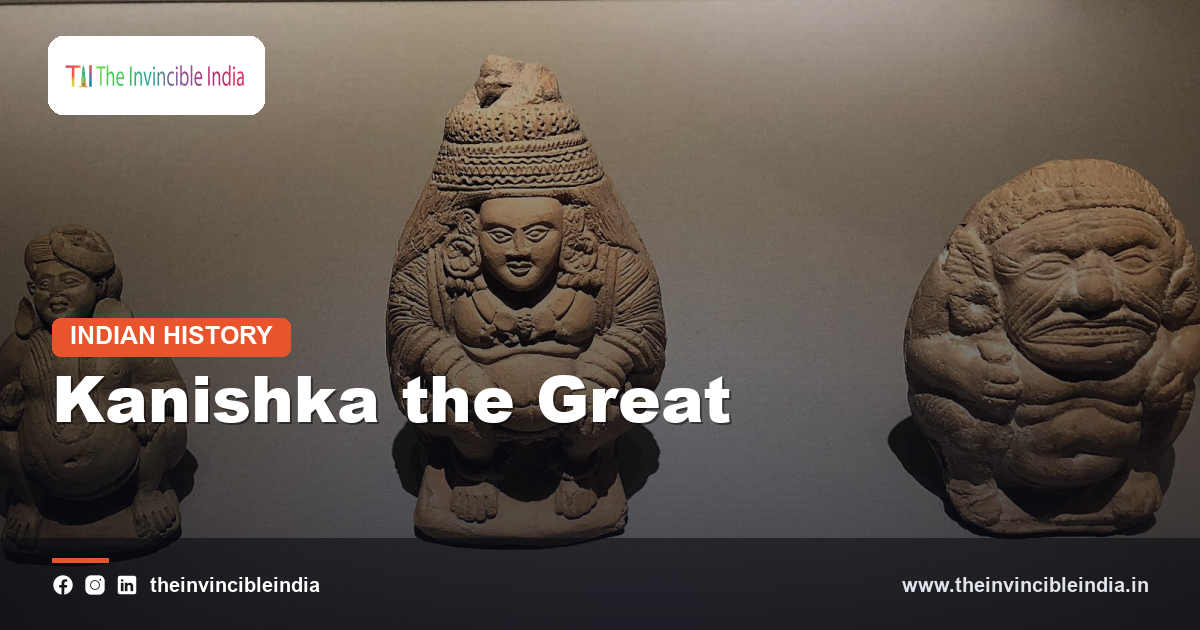
Kanishka the Great is the most famous emperor of the Kushan dynasty, a ruler whose domain stretched across a vast belt of Central Asia and northern India. Reigning in the early centuries of the Common Era, he presided over an empire that linked the great civilisations of the Mediterranean, Persia, India and China, and he became celebrated as a patron of Buddhism, of learning and of art. Under his rule the schools of Gandhara and Mathura produced some of the most admired sculpture of the ancient world. His memory endured long after his dynasty had passed. To understand his place in history it helps to begin with the wider story of the Kushan Empire, the great power he ruled. This guide explores the empire, the achievements and the legacy of Kanishka the Great.
Quick Facts
| Detail | Information |
|---|---|
| Dynasty | The Kushans |
| Capitals | Purushapura (Peshawar) and Mathura |
| Known for | Patronage of Buddhism and art |
| Art traditions | Gandhara and Mathura schools |
| Trade link | The Silk Road |
| Coinage | Gold coins bearing many deities |
The Kushans and Their Origins
The Kushans were a people who came out of Central Asia and established a great empire that stretched across Bactria and northern India. Their ancestors are linked in traditional accounts with groups moving through the steppe lands beyond the northwestern frontier, and over time they settled in the region of Bactria, where they absorbed the cultural influences of the Greeks and the Iranians who had lived there before them. From this mixed heritage a powerful state emerged, ruled by a line of kings who expanded steadily towards the Indian subcontinent. By the time of Kanishka the Kushans had become the masters of a vast and varied empire. The story of the dynasty is one of movement, adaptation and the blending of cultures. The Kushans gave Kanishka the foundation on which he built his renown as one of the great emperors of the ancient world.
The Rise of Kanishka
Kanishka came to the throne of the Kushan Empire as one of its most capable rulers, inheriting a kingdom already established by his predecessors and carrying it to new heights. Exact details of his accession and the precise years of his reign are matters on which scholars hold differing views, and the date of his rule remains a subject of scholarly discussion. What is clear is that his reign marked the peak of Kushan power and prosperity. He was a strong and energetic ruler who strengthened the empire, secured its frontiers and encouraged the flourishing of religion, trade and art. His reputation in later tradition was that of a great king who combined strength with generosity. The rise of Kanishka turned the Kushan state into one of the leading powers of its age and made his name one of the most celebrated in early Indian history.
The Extent of the Empire
The empire of Kanishka was among the largest of its time, stretching from regions of Central Asia across Afghanistan and the northwest into the plains of northern India. It included the great cities of the northwest and the fertile lands of the Gangetic region, and its reach connected several of the most important centres of the ancient world. Ruling so wide and diverse a territory required skilful administration and the cooperation of local rulers and officials. The empire brought together peoples of many languages, faiths and traditions under a single authority. Its size and wealth made it a major power alongside Rome, Parthia and Han China. The vast extent of the Kushan realm under Kanishka explains why he is remembered as a world ruler of his age, and why his empire occupies such an important place in the history of Asia as a whole.
Purushapura and Mathura, the Twin Capitals
Kanishka governed his empire from two principal centres. The first was Purushapura, the city known today as Peshawar, which lay in the northwest near the passes leading to Central Asia, and the second was Mathura on the Yamuna, which served as a great southern centre of the empire. The arrangement allowed the Kushans to control both the mountain gateways of the northwest and the rich heartland of northern India. Both cities flourished as centres of trade, religion and art. Purushapura was connected to the world of Gandhara and the western routes, while Mathura became a famous centre of sculpture and devotion. The choice of two capitals reflected the dual character of the empire, which looked both towards Central Asia and towards India. The twin capitals of Kanishka were the beating hearts of a state that straddled two great worlds.
Kanishka and the Buddhist Tradition
Kanishka is remembered above all as a great patron of Buddhism, and in Buddhist tradition he is ranked beside the emperor Ashoka as one of the faith’s greatest royal supporters. He is credited with encouraging monasteries, stupas and learned communities, and with giving the faith protection and prestige across his wide empire. His patronage helped Buddhism to spread along the trade routes of Central Asia and eventually to China and beyond. The emperor was not narrow in his outlook, for the Kushan world included many faiths, but his support for the Buddhist community was a defining feature of his reign. Because of his generosity, the monks and scholars of the age remembered him with gratitude. The patronage of Kanishka made him a central figure in the history of Buddhism and one of the faith’s most honoured royal friends.
The Buddhist Council Associated with His Reign
Buddhist tradition associates the reign of Kanishka with a great council of monks, often called the Fourth Buddhist Council, which is said to have been held in the region of Kashmir. According to the tradition, learned monks gathered to discuss and organise the teachings of the faith and to settle questions that had arisen among the different schools. The details of this council and its exact place in history are discussed by scholars, and accounts differ between traditions. Yet the memory of the assembly under royal patronage shows how closely the emperor was linked with the intellectual life of the Buddhist community. Such gatherings helped to preserve and clarify the teachings for later generations. The tradition of a council in the age of Kanishka stands as a symbol of his role as protector of the faith and supporter of the learning of its monks.
The Rise of Mahayana Buddhism
The age of the Kushans saw the growing prominence of the Mahayana tradition of Buddhism, a movement that placed special emphasis on compassion and on the ideal of the bodhisattva who seeks the welfare of all beings. The conditions of the Kushan empire, with its wide contacts, its prosperity and its patronage, helped this form of the faith to grow and spread. Images of the Buddha and of bodhisattvas became increasingly common, and the devotional side of the faith flourished alongside its philosophical traditions. Great thinkers and teachers are associated in tradition with this period. The movement carried Buddhism across Central Asia and into East Asia, changing the religious landscape of a huge part of the continent. The Kushan age, and the patronage of Kanishka in particular, formed an important chapter in the development and spread of Mahayana Buddhism.
The Silk Road and Kushan Trade
The Kushan empire lay at the centre of the great trade routes that linked China, India, Persia and the Mediterranean world, collectively known as the Silk Road. Caravans carried silk, spices, precious stones, metals and many other goods across its territory, and the Kushans grew wealthy by protecting this commerce and taxing the merchants who passed through. Trade also carried ideas, religions and artistic styles, so that the empire became a meeting point of cultures. Ports on the western coast linked the overland routes with the maritime trade across the sea. The prosperity brought by commerce paid for monasteries, monuments and the splendid court of the emperor. The position of the empire at the heart of the Silk Road was the key to its wealth and influence, and Kanishka stands as the ruler who presided over the golden age of this trade.
The Coinage of Kanishka
The coins of Kanishka are among the most fascinating legacies of his reign. The Kushans issued fine gold and copper coins, which show the emperor on one side and a deity on the other. The inscriptions were written in a Greek-based script adapted for the local language, and the deities depicted came from several traditions, including Iranian, Greek and Indian figures. Remarkably, some coins show an image of the Buddha, which is among the earliest appearances of the Buddha on coinage. The variety of images reflects the diversity of the empire and the tolerant outlook of its rulers. Coins also circulated widely along the trade routes and served as a symbol of Kushan prestige. Because they preserve images, names and symbols, the coins of Kanishka are an invaluable window into the religious and political world of his time.
The Gandhara School of Art
The Gandhara region of the northwest became famous in the Kushan age for a distinctive school of sculpture. Combining Indian Buddhist themes with artistic techniques influenced by the Greco-Roman world, Gandhara artists produced realistic images of the Buddha and scenes from his life, carved in grey schist and stucco. The Buddha appears with wavy hair, flowing drapery and a calm, dignified expression, a style that became hugely influential. These works adorned monasteries and stupas and were admired by pilgrims and travellers. The school shows how cultures met and mingled under Kushan rule, producing something new and lasting. Gandhara art influenced Buddhist sculpture across Central and East Asia. Under the patronage of the Kushan emperors, including Kanishka, the Gandhara school became one of the great artistic achievements of the ancient world.
The Mathura School and the Image of Kanishka
While Gandhara flourished in the northwest, Mathura developed a school of sculpture of its own, rooted firmly in the Indian tradition. Artists working in the red sandstone of the region created powerful images of the Buddha, of Jain teachers and of Hindu deities, with a vigour and sensuous grace that came to be greatly admired. Mathura also gave us one of the best-known portraits of Kanishka himself, a standing royal statue, now without its head, that shows the king in the clothing of the northern steppe, with heavy boots and a long coat. The statue is valued as a rare image of an ancient ruler. Mathura became a major artistic centre serving many faiths. The sculpture of Mathura, together with the royal portrait of Kanishka, stands among the proudest achievements of Kushan art.
The Kanishka Stupa at Purushapura
Tradition credits Kanishka with building a great stupa at his capital Purushapura, a monument said to have been of extraordinary height and to have been admired by pilgrims from far and wide. Travellers from China described it with awe, and it was regarded as one of the wonders of the Buddhist world. A relic casket associated with the site, bearing images of the Buddha and the emperor, was recovered in modern times and is treasured as an important artefact. Although the monument itself has not survived in its original form, its fame testifies to the scale of the emperor’s ambitions as a builder and pious donor. Such stupas were centres of worship and pilgrimage, binding the empire to its faith. The great stupa of Kanishka remains a symbol of the devotion and architectural vision of the Kushan emperor.
Scholars and Thinkers at the Kushan Court
The court of Kanishka is remembered in tradition as a gathering place for scholars, poets and physicians. Buddhist philosophers and poets are associated with the royal circle, and later accounts also link the court with distinguished figures in the fields of medicine and learning. While the exact details of who lived at court and when are sometimes uncertain, the general picture is of an empire that valued knowledge and encouraged the exchange of ideas. The wide contacts of the Kushan world meant that scientific and philosophical ideas travelled along with goods and religions. Translators, teachers and monks carried texts across the borders of the empire. The tradition of a learned court adds to the portrait of Kanishka as a ruler who prized wisdom. His patronage of scholars forms an important part of his reputation as a great and enlightened emperor.
Administration and Religious Tolerance
Governing a vast empire of many peoples required a flexible system. The Kushans used provincial governors and relied on local rulers who recognised the supremacy of the emperor, while the central court coordinated the affairs of the realm. Kingship was exalted by grand titles that drew on several cultural traditions, and the rulers presented themselves as sovereigns of a multicultural world. The religious outlook of the empire was notably tolerant, with Buddhism, the Hindu traditions, Zoroastrian elements and local cults all finding space and recognition. Such tolerance encouraged peace and cooperation among a diverse population. It also fostered the creative mixing of styles that marks the art of the age. The inclusive administration of Kanishka, and the respect shown to many beliefs, were central to the stability and cultural richness of the Kushan empire.
The Kanishka Era and Questions of Chronology
Kanishka is associated with the beginning of a dating era that was used for a considerable time in the inscriptions of the Kushan period. Many scholars connect this era with his accession, though the exact starting point and its relation to later calendar systems have long been debated. The question of when Kanishka ruled is one of the classic problems of ancient Indian chronology, and different historians have proposed different answers based on the evidence of inscriptions, coins and later records. Without settling that debate, it is enough to say that the era is a sign of the importance of his reign in the memory of his age. The use of a dating era shows how significant a turning point his accession was considered. The chronology of Kanishka remains a subject of scholarly interest and a reminder of how much history still invites study.
The Kushan Legacy After Kanishka
After Kanishka the Kushan empire continued under later rulers, who maintained much of its extent and traditions for a time before the empire gradually weakened and divided. Pressure from new powers on its borders and internal changes led to the decline of the great state. Yet the cultural legacy of the Kushans did not disappear. The artistic styles of Gandhara and Mathura went on influencing sculpture for centuries, and the Buddhist traditions encouraged by the dynasty carried on across Asia. The trade routes and cultural contacts that the Kushans protected remained vital. Later Indian dynasties built on the political and cultural experience of the Kushan age. The empire that Kanishka ruled passed into history, but the influence of his age lived on in the art, religion and exchanges that he had nurtured.
Kanishka the Great Today
Today Kanishka is remembered as one of the great emperors of the ancient world, a ruler whose reign symbolises the meeting of cultures. His memory lives on in the museums that hold Kushan sculpture and coins, in the study of Gandhara and Mathura art, and in the Buddhist traditions that honour him as a patron of the faith. For scholars, his empire is a valuable example of how trade and tolerance can create a vibrant civilisation. For the people of the Indian subcontinent and Central Asia, he is part of a shared heritage that crosses modern borders. Exhibitions and research continue to reveal new aspects of the Kushan world. The legacy of Kanishka the Great endures as a testament to an age of wide horizons, artistic brilliance and cultural exchange.
Sources & Further Reading
- Archaeological Survey of India (asi.nic.in).
- Ministry of Culture, Government of India (indiaculture.gov.in).
Frequently Asked Questions
Who was Kanishka the Great?
Kanishka was the most famous emperor of the Kushan dynasty, who ruled a vast empire across Central Asia and northern India. He is remembered as a patron of Buddhism, art and learning.
Where were the capitals of Kanishka?
His empire was governed from two main centres, Purushapura, which is today Peshawar, and Mathura on the Yamuna. They linked the northwestern gateways with the heart of northern India.
Why is Kanishka important to Buddhism?
He is remembered in Buddhist tradition as a great royal patron, ranked alongside Ashoka. His support helped Buddhism and Mahayana traditions spread along the Silk Road into Central and East Asia.
What were the Gandhara and Mathura schools of art?
They were two great sculptural traditions that flourished under the Kushans. Gandhara blended Indian themes with Greco-Roman influences, while Mathura developed a vigorous Indian style in red sandstone.
What do the coins of Kanishka show?
They show the emperor on one side and a deity on the other, including figures from Iranian, Greek and Indian traditions. Some coins even bear an image of the Buddha, reflecting the diversity of the empire.