


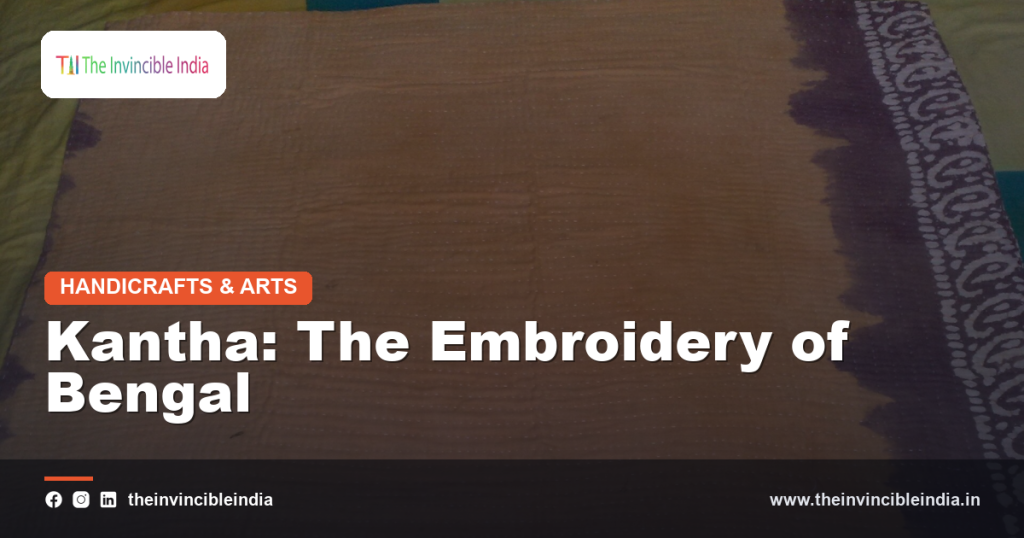
Kantha is a running-stitch embroidery tradition from Bengal in which layers of old cloth are quilted together with simple, closely spaced stitches to create durable, richly patterned textiles. Traditionally made by rural women repurposing worn saris and dhotis, Kantha transforms domestic recycling into an art form built entirely from repeated hand stitching rather than woven or printed pattern. The craft shares its folk, community-based origins with other regional embroidery traditions such as Phulkari embroidery of Punjab, though Kantha’s characteristic rippled surface and recycled base cloth give it a distinct, tactile identity of its own. Kantha work today ranges from simple quilts to finely embroidered sarees and stoles.
Quick Facts
| Detail | Information |
|---|---|
| Also Known As | Kantha stitch, Nakshi Kantha (figurative form) |
| Primary Regions | West Bengal, Bangladesh (undivided Bengal) |
| Core Technique | Running stitch quilting on layered cloth |
| Traditional Base Material | Old cotton saris and dhotis |
| Signature Motifs | Lotus, tree of life, folk figures, borders |
| Common Products | Quilts, sarees, stoles, wall hangings |
Origins in Rural Bengal
Kantha embroidery developed as a domestic craft among rural households in Bengal, where women stitched together layers of worn cotton cloth to create warm, durable quilts and wraps for everyday family use. Rather than beginning as a courtly or commercial art form, Kantha emerged from practical necessity, offering a way to extend the life of old saris and dhotis that would otherwise have been discarded.
Over generations, this practical stitching evolved into a recognised decorative craft, with women adding increasingly elaborate patterns and figurative designs to the plain quilting stitches. The tradition is closely tied to the undivided Bengal region, spanning present-day West Bengal and Bangladesh, where closely related forms of the craft continued to develop after political partition.
Meaning and Terminology
The word Kantha is generally understood to refer to the patched or quilted cloth itself, with the embroidery technique taking its name from the finished textile it produces. Within the tradition, particularly elaborate and figurative examples are often distinguished with the term Nakshi Kantha, combining Kantha with a word relating to design, to indicate pieces that go beyond simple quilting into pictorial storytelling.
This distinction reflects a broader range within the craft, from plain functional quilts intended purely for warmth to highly decorated pieces created for special occasions or as heirlooms. Regional variations in terminology exist across Bengal, but the core association between the word Kantha and layered, hand-stitched cloth remains consistent.
Recycling as a Foundation
A defining feature of traditional Kantha is its foundation in recycled cloth, with worn cotton saris and dhotis layered together, often five or more sheets thick, to create a sturdy base for stitching. This practice of reuse reflected both the economic realities of rural households and a broader cultural value placed on careful, resourceful use of textiles.
The layered old cloth, softened through years of use, produces a quilt with a distinctive light, slightly rippled texture once stitched. Threads for the embroidery itself were traditionally drawn from the coloured borders of old saris, unpicked and reused rather than purchased new, extending the recycling ethic into every part of the process.
The Running Stitch Technique
The primary stitch used in Kantha is a simple running stitch, in which the needle passes in and out of the layered cloth at short, even intervals to secure the fabric layers together while also creating a decorative surface texture. Despite its simplicity, this stitch is worked with remarkable consistency across large areas of cloth.
Skilled Kantha embroiderers vary the density and direction of running stitches to create both plain quilted backgrounds and more defined pattern areas within the same piece. This simplicity also historically made the craft accessible to women without formal training, learned instead through observation and practice within the household.
Layering and Quilting
Before any embroidery begins, several layers of old cloth are stacked and loosely tacked together to hold them in place, forming the base that will later be stitched throughout with running stitch. The number of layers used depends on the intended purpose of the finished piece, with quilts meant for warmth typically using more layers than lighter decorative pieces.
As the running stitches are added across the entire surface, the layered cloth naturally develops a slightly puckered or rippled texture. This characteristic texture is considered an authentic hallmark of hand-worked Kantha, distinguishing genuine pieces from smoother, machine-quilted imitations.
Nakshi Kantha: Figurative Embroidery
Nakshi Kantha refers to the more elaborate, pictorial branch of the tradition, in which running stitch and other simple embroidery stitches are used to depict figures, animals, plants, and scenes from daily life or folklore across the surface of the cloth. These figurative pieces often took considerable time to complete, sometimes stitched over months or years.
Common subjects include trees of life, boats, birds, and scenes of rural life, arranged in registers or borders around a central motif. Nakshi Kantha pieces were sometimes created to mark important life events, such as marriages or births, and passed down as treasured family possessions.
Motifs and Symbolism
Kantha motifs draw heavily on the natural and domestic world familiar to the rural women who created them, including lotus flowers, trees, birds, fish, and geometric borders that frame the central design. The lotus in particular recurs frequently, often placed at the centre of a piece.
Scenes of daily life also appear in more elaborate Nakshi Kantha pieces, offering a window into the everyday experiences of the communities that produced them. Borders are typically built from repeating geometric or floral patterns that give the composition a sense of order despite the free, hand-drawn quality of individual stitches.
Colour and Thread
Traditional Kantha embroidery relied on thread unpicked from the coloured borders of old saris, resulting in a naturally limited but harmonious palette dominated by the reds, blues, and blacks commonly used in sari border weaving. This constraint contributed to Kantha’s distinctive restrained colour sense.
Contemporary Kantha production frequently uses new embroidery thread in a wider range of colours to meet commercial demand, though many artisans continue to favour traditional colour combinations. The base cloth itself, usually white or off-white cotton, provides a neutral ground against which the coloured stitching stands out clearly.
Kantha Quilts
The Kantha quilt remains the most traditional and widely recognised product of the craft, valued for its light weight, breathability, and the soft, worn-in texture inherited from its recycled cloth base. These quilts were historically made for practical household use, providing bedding suited to Bengal’s climate.
The all-over running stitch not only decorates the quilt but also strengthens it, allowing a Kantha quilt made from multiple thin layers to remain durable through repeated washing and use over many years. Contemporary Kantha quilts range from simple, lightly stitched pieces to elaborately embroidered heirloom items.
Kantha Sarees and Garments
Beyond quilts, Kantha stitching has been adapted to decorate sarees, dupattas, stoles, and various garments, applying the same running stitch technique to new or lightly used fabric rather than heavily recycled cloth. Kantha sarees typically feature embroidered borders, pallus, and scattered motifs across the body of the fabric.
This adaptation has allowed Kantha to enter the fashion and garment market more directly. Silk and other fine fabrics are increasingly used as a base for garment-oriented Kantha work, offering a smoother, more refined finish suited to formal wear.
Regional Variations
Kantha embroidery, having developed across the wider Bengal region spanning West Bengal and Bangladesh, shows some regional variation in motif preference, stitch density, and typical product types, shaped by local customs and available materials. Certain districts became particularly well known for figurative Nakshi Kantha work, while others focused more on plain quilting.
Following the political partition of Bengal, the craft continued to develop somewhat independently on either side of the border, though shared historical roots mean the fundamental technique and visual vocabulary remain closely related.
Women and Community Practice
Kantha has historically been practised almost exclusively by women, often worked communally during periods when agricultural or household duties allowed time for needlework, turning embroidery into both a practical activity and a social occasion. Skills were passed informally from mothers and grandmothers to younger women.
This communal, intergenerational transmission helped Kantha survive as a living tradition even without extensive external patronage. In many rural communities, Kantha-making also served as an important outlet for personal and artistic expression among women.
Revival Through Cooperatives
Kantha experienced renewed attention beginning in the twentieth century, aided significantly by cultural institutions and craft cooperatives that recognised the artistic value of Nakshi Kantha and worked to document, promote, and commercialise the tradition. These organisations helped connect rural Kantha artisans to wider markets.
Training programmes and design collaborations introduced new product formats and quality standards while aiming to preserve the essential hand-stitching technique. This cooperative model has been credited with significantly improving income and recognition for women Kantha artisans across Bengal.
Kantha in Contemporary Design
Contemporary fashion and home decor designers have increasingly incorporated Kantha embroidery into their collections, valuing both its distinctive hand-stitched texture and its association with sustainable, low-impact textile production. Kantha-stitched fabric now appears in items ranging from cushion covers and throws to jackets, bags, and accessories.
Some designers deliberately preserve the recycled-cloth character of traditional Kantha, marketing pieces on their sustainable credentials, while others use the stitching technique purely as a decorative surface treatment on new fabric.
Challenges and Authenticity
As demand for Kantha products has grown, questions of authenticity and fair compensation have become increasingly important within the craft’s commercial ecosystem. Machine-embroidered imitations that mimic the visual texture of hand-stitched Kantha have entered the market, often at significantly lower prices than genuine handwork.
Ensuring that women artisans receive fair payment for their labour, particularly for highly detailed Nakshi Kantha pieces, remains an ongoing concern for cooperatives working in the sector. Sourcing genuinely recycled cloth has also become more difficult as production has scaled up to meet commercial demand.
Regional Names and Recognition
Kantha embroidery is known by a variety of local names and regional variants across Bengal, reflecting the craft’s deep integration into everyday household life rather than a single standardised commercial identity. Certain forms of Kantha produced in specific districts have gained formal recognition for their distinctive characteristics, helping to document and protect particular regional styles within the wider tradition. This recognition has supported museums, craft archives, and academic researchers in cataloguing surviving examples of historic Nakshi Kantha, many of which are now held in cultural institutions as important records of rural Bengali artistic expression.
Such documentation has also proved useful for contemporary artisans and designers, who can study traditional motifs and compositions when developing new Kantha products. This ongoing attention to regional identity and historical preservation helps ensure that the craft’s full diversity, rather than a single simplified version of it, continues to be understood and valued by both scholars and buyers.
Kantha Today
Kantha today stands as one of India’s most distinctive folk embroidery traditions, valued both for its humble origins in household recycling and for the artistic heights it reaches in elaborate Nakshi Kantha work. From simple quilted bedding to finely embroidered sarees, the craft continues to demonstrate remarkable versatility.
Cooperatives and craft organisations across Bengal have played an important role in bringing fair income and wider recognition to the women artisans who sustain the tradition. As long as women in Bengal continue to pass down their needle skills, Kantha is likely to remain a living, evolving tradition.
Sources & Further Reading
- Ministry of Textiles, Government of India (texmin.nic.in).
- Ministry of Culture, Government of India (indiaculture.gov.in).
Frequently Asked Questions
What does the word Kantha refer to?
Kantha refers to the layered, hand-stitched cloth produced through the craft, with the embroidery technique named after the finished quilted textile itself rather than a specific stitch or pattern.
What is Nakshi Kantha?
Nakshi Kantha refers to the more elaborate, figurative branch of the tradition, in which running stitch is used to depict scenes, animals, and motifs rather than simple quilting patterns, often marking family occasions.
What fabric is traditionally used for Kantha?
Traditional Kantha uses layers of old, worn cotton saris and dhotis stitched together, reflecting the craft’s origins as a household recycling practice, though new fabric is increasingly used in commercial production.
Who traditionally makes Kantha embroidery?
Kantha has historically been made by women in rural Bengal, who learned the craft informally from older female relatives and often worked communally during shared household or seasonal downtime.
Is Kantha only used for quilts?
No, while quilts remain the most traditional Kantha product, the technique is now widely applied to sarees, stoles, garments, cushion covers, and various home furnishings for domestic and export markets.