


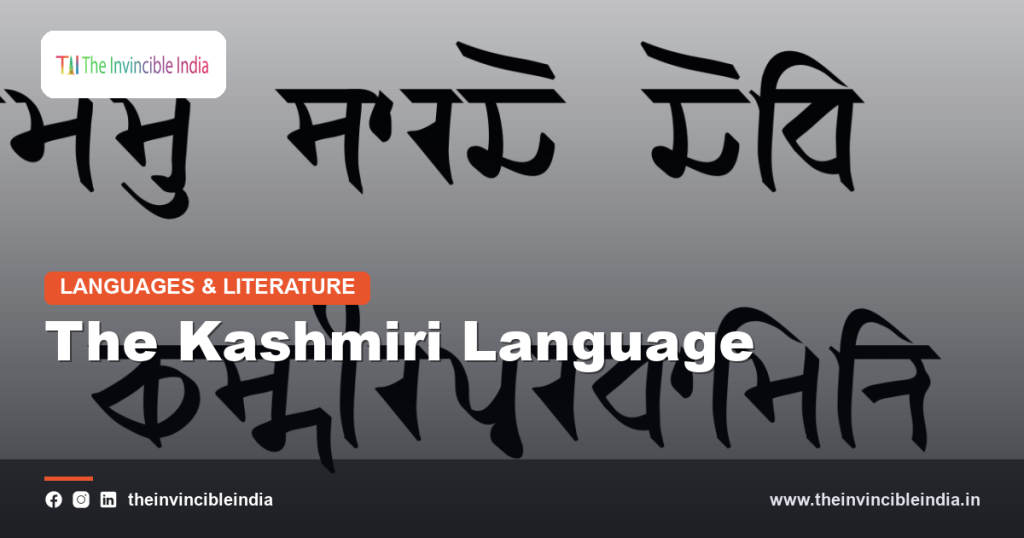
Kashmiri is the mother tongue of the Kashmir Valley, a Dardic language within the Indo-Aryan family whose sounds, grammar and literary heritage set it apart from most other languages of the Indian subcontinent. Carried through centuries of scholarship, devotion and everyday life, it has been written at different times in the ancient Sharada script, in an adapted Perso-Arabic script, and in Devanagari, a layered history explored further in this guide to the scripts of India. From the mystic verses of Lal Ded to the songs of the Rishi order and the modern short story, Kashmiri has long served as a vessel for both spiritual reflection and everyday expression, remaining a vital marker of regional identity today.
Quick Facts
| Detail | Information |
|---|---|
| Language Family | Dardic branch of the Indo-Aryan family |
| Primary Region | Kashmir Valley, Jammu & Kashmir |
| Scripts Used | Perso-Arabic (common today), Devanagari, historically Sharada |
| Official Status | Scheduled language of India |
| Notable Early Poets | Lal Ded (Lalleshwari), Nund Rishi |
| Literary Forms | Vakh poetry, Sufi verse, folk song, modern fiction |
Origins and Linguistic Classification
Kashmiri belongs to the Dardic group of languages, a branch generally classified within the broader Indo-Aryan family that itself descends from Indo-European roots. It is set apart from most other Indo-Aryan languages of the plains by features that scholars trace to its long development in the mountainous terrain of the western Himalayas. Over many centuries, Kashmiri absorbed influences from neighbouring linguistic traditions while retaining a distinct grammatical core, giving it a character that is at once recognisably Indo-Aryan and strikingly individual.
Linguists have long been drawn to Kashmiri for the light it sheds on how languages evolve in relative geographic isolation, cut off by high mountain passes from the major trade and pilgrimage routes that shaped languages elsewhere on the subcontinent. Its closest relatives are found among other Dardic languages spoken in the wider Hindu Kush and western Himalayan region, though Kashmiri today stands out for possessing the richest and most continuous literary tradition among them.
Geographic Reach and Communities
Kashmiri is spoken predominantly in the Kashmir Valley, where it functions as the mother tongue of the majority of the local population and as a marker of shared regional identity. Beyond the valley itself, communities of Kashmiri speakers are found across the wider union territory of Jammu and Kashmir, in neighbouring hill areas, and among diaspora communities settled in other parts of India and abroad. Migration over the generations has carried the language well beyond its valley heartland, and Kashmiri associations in various cities work to keep it alive among younger generations growing up away from home.
Within the valley, the language shows some regional variation in accent and vocabulary between areas, though these differences remain mutually intelligible. It also coexists with Urdu, which has long served as an official and literary language of the region, and with Dogri, Ladakhi and other neighbouring tongues, making the wider region a notably multilingual landscape.
The Sharada Script and Its Legacy
For much of its early history, Kashmiri was written in the Sharada script, an ancient writing system that developed in the region and was once used widely across the northwestern subcontinent for both Sanskrit and vernacular texts. Sharada is closely associated with Kashmir’s long tradition of scholarship, and manuscripts in the script preserve important works of philosophy, grammar and literature produced by Kashmiri scholars over the centuries. The script takes its name from the goddess Sharada, long venerated in the region as a patroness of learning.
Although Sharada gradually gave way to other scripts for everyday and literary use, it never entirely disappeared, and it continues to hold ceremonial and symbolic importance, particularly in religious and academic contexts. Scholars and cultural organisations in recent years have worked to document surviving Sharada manuscripts, viewing the script as an important link to the region’s intellectual heritage.
The Perso-Arabic Script in Modern Kashmiri
Since the medieval period, Kashmiri has increasingly been written in a Perso-Arabic script adapted to represent its distinctive sounds, a shift that paralleled the growing influence of Persian as a language of administration and courtly culture in the region. This script, modified with additional marks to capture vowel sounds not present in standard Persian or Urdu, remains the most common script for printing Kashmiri today, including in newspapers, books and official publications.
Its adoption reflects centuries of cultural exchange between Kashmir and the wider Persianate world, an exchange that also shaped Kashmiri vocabulary, poetry and artistic sensibility. Learning to read Kashmiri in this script requires familiarity with conventions that differ somewhat from standard Urdu, since certain vowel distinctions crucial to Kashmiri are not automatically obvious from the base Arabic letters.
Devanagari and Other Writing Conventions
Alongside the Perso-Arabic script, Kashmiri is also written in the Devanagari script, particularly by segments of the community and in certain educational and religious contexts where Devanagari is the preferred medium. This dual-script situation means that Kashmiri literature and learning materials can appear in more than one written form, a pattern not unusual among Indian languages with long and layered histories.
Romanised transliteration schemes are also used informally, especially in digital communication and among younger speakers more comfortable typing in the Roman alphabet than in either traditional script. Each writing system captures the sounds of Kashmiri with varying precision, and for everyday speakers the choice of script is often simply a matter of the context in which they were educated.
Sounds and Pronunciation
Kashmiri is known among linguists for a set of phonological features that distinguish it sharply from many neighbouring Indo-Aryan languages, most notably a series of vowel distinctions that can be subtle to the untrained ear but are essential to correct meaning. The language also makes use of consonant clusters and stress patterns that give spoken Kashmiri its particular rhythm and cadence.
These features contribute to the perception, often noted by linguists, that Kashmiri sits somewhat apart from the languages of the Indian plains in terms of sound structure, even while remaining firmly within the Indo-Aryan family in grammar and vocabulary. Native speakers absorb these distinctions naturally from childhood, and the resulting soundscape of spoken Kashmiri is often described as musical and well suited to the region’s rich tradition of sung and recited poetry.
Grammar and Sentence Formation
Kashmiri grammar retains a number of archaic Indo-Aryan features alongside innovations of its own, giving it a structure that grammarians find especially instructive for understanding the historical development of the wider language family. Verb forms can encode a range of information about tense, aspect and the relationship between subject and object within a single word, producing a compact and highly inflected sentence structure.
Word order in Kashmiri also shows patterns that differ from the more familiar order found in many other Indo-Aryan languages, lending it a distinctive syntactic profile. For everyday speakers, this grammatical richness is simply the natural medium of expression, embedded in idiom and proverb, and it underlies the flexibility that Kashmiri poets have long drawn upon in their work.
Vocabulary and Layers of Influence
The vocabulary of Kashmiri reflects the many cultural currents that have flowed through the valley over the centuries. A substantial layer of words derives from Sanskrit, reflecting Kashmir’s long history as a centre of Sanskritic learning, philosophy and religious scholarship. Persian and Arabic contributed extensively to Kashmiri vocabulary from the medieval period onward, entering through administration, Sufi teaching and everyday trade, and these borrowings remain deeply embedded in the language today.
More recent history has added English loanwords, particularly in education, technology and modern administration. This layered vocabulary allows Kashmiri speakers and writers considerable stylistic range, letting them draw on Sanskritic, Persian or more colloquial registers depending on the tone of a given piece of writing.
Lal Ded and the Vakh Tradition
Among the earliest and most revered figures in Kashmiri literary history is Lal Ded, also known as Lalleshwari, a mystic poet whose verses, called vakhs, are still recited and cherished across the Kashmir Valley regardless of religious background. Her poetry, composed in a direct and accessible register of Kashmiri, addresses themes of spiritual longing, the nature of the self, and union with the divine, expressed through vivid, everyday imagery rather than abstract philosophical language.
Lal Ded is honoured by both Hindu and Muslim communities in Kashmir, and her verses are often cited as an early example of the shared devotional culture that has long characterised the valley. The vakh form she popularised remains a recognised genre within Kashmiri literature, studied and admired for its simplicity and emotional depth.
Nund Rishi and the Rishi Order
Alongside Lal Ded, the poet-saint popularly known as Nund Rishi, also referred to by the honorific Sheikh-ul-Alam, holds a central place in the devotional and literary history of Kashmir. He is regarded as the founder of the Rishi order, a distinctly Kashmiri tradition of ascetic spirituality that blended elements of Islamic mysticism with practices and sensibilities rooted in the valley’s older devotional culture.
His verses, composed in Kashmiri, are valued both for their spiritual content and for their contribution to the development of Kashmiri as a language capable of expressing complex religious and ethical ideas. Shrines associated with the Rishi tradition remain places of reverence in Kashmir today, and his poetic sayings continue to be quoted in everyday speech.
Sufi and Devotional Poetry
Beyond these two towering early figures, Kashmiri literature developed a broader and enduring tradition of Sufi and devotional poetry that continued to flourish across succeeding centuries. Poets working within this tradition used Kashmiri to explore themes of divine love, spiritual searching and the relationship between the individual soul and the universe, often employing metaphors drawn from nature and the valley’s distinctive landscape.
This body of poetry was frequently composed to be sung, and many devotional verses became part of the region’s musical heritage, performed at shrines and gatherings. The interweaving of Sufi thought with older devotional currents gave Kashmiri poetry a syncretic character that many scholars consider central to the region’s cultural identity.
Kashmiri Oral Literature and Folk Song
Kashmiri also possesses a rich oral literary tradition that runs alongside its written poetry, encompassing folk tales, proverbs, riddles and song forms passed down through generations largely outside formal manuscript culture. Ladishah, a form of satirical folk song performed with simple percussion, offers commentary on social and everyday matters in a witty and accessible style, while other folk song traditions accompany weddings, harvests and seasonal festivities throughout the valley.
Proverbs and idiomatic expressions drawn from this oral tradition remain in everyday use, carrying concise, often metaphorical wisdom. Folklorists have worked to document these oral traditions, recognising them as an essential complement to the written literary record and a vital repository of the valley’s collective memory.
Modern Kashmiri Prose and the Novel
The modern era brought new literary forms to Kashmiri, including short fiction, the novel, and modern free verse, as writers began to adapt the language to genres that had earlier developed elsewhere in South Asian and world literature. Twentieth-century Kashmiri writers explored themes of social change, displacement, personal identity and everyday life in the valley, often blending traditional imagery with contemporary concerns.
Literary journals and associations dedicated to Kashmiri played an important role in nurturing this modern literature. Translation work, both from Kashmiri into other languages and vice versa, has also helped introduce modern Kashmiri writing to wider audiences, extending its reach well beyond the valley.
Kashmiri in Education, Media and Public Life
Kashmiri holds recognition as one of the scheduled languages of India, a status that supports its inclusion in certain educational and administrative contexts, even though Urdu has historically dominated formal education and administration within the region. In recent years, there have been growing efforts to introduce Kashmiri as a subject of instruction in schools and to develop textbooks in the language.
Kashmiri also appears in radio broadcasting, television programming and, increasingly, digital and social media, offering new avenues for the language to reach younger audiences. Cultural and literary organisations continue to publish books and journals, sustaining a public sphere in which the language remains a living medium for creative writing and everyday discourse.
Kashmiri Language Today
Today, Kashmiri continues to be spoken as a first language across the Kashmir Valley and by diaspora communities elsewhere, even as it exists alongside Urdu, Hindi and English in a multilingual environment shaped by education, media and migration. Concerns about intergenerational transmission have prompted renewed interest in documentation, teaching materials and digital resources aimed at supporting the language among children and young adults.
The enduring popularity of poets such as Lal Ded and Nund Rishi demonstrates the deep cultural roots that continue to sustain Kashmiri as a living tradition. Writers, scholars and cultural organisations continue to produce new work while preserving its older literary and oral heritage, reflecting a broader recognition of Kashmiri as an essential part of India’s linguistic diversity.
Sources & Further Reading
- Ministry of Culture, Government of India (indiaculture.gov.in).
- Sahitya Akademi (sahitya-akademi.gov.in).
Frequently Asked Questions
What language family does Kashmiri belong to?
Kashmiri belongs to the Dardic branch of the Indo-Aryan language family, a group historically spoken across parts of the western Himalayas and the wider Hindu Kush region.
Which scripts are used to write Kashmiri?
Kashmiri has historically been written in the Sharada script and is most commonly printed today in an adapted Perso-Arabic script, with Devanagari and Roman transliteration also in use.
Who was Lal Ded?
Lal Ded, also known as Lalleshwari, was a revered mystic poet of medieval Kashmir whose verses, called vakhs, remain widely recited and honoured across religious communities in the valley.
What is the Rishi order associated with Kashmiri literature?
The Rishi order is a Kashmiri spiritual tradition founded by the poet-saint popularly known as Nund Rishi, blending Islamic mysticism with older devotional sensibilities expressed largely through Kashmiri verse.
Is Kashmiri an official language of India?
Kashmiri is recognised as one of the scheduled languages of India, a status that supports its use in select educational, cultural and administrative contexts alongside Urdu and other regional languages.