


India is home to one of the richest and most fascinating families of writing systems in the world, a diverse array of scripts used to write its many languages. Most of these scripts share a common ancestor in the ancient Brahmi script, from which, over more than two thousand years, developed the great variety of writing systems seen across the country today, including Devanagari and the distinctive regional scripts of the different linguistic regions. These scripts, with their elegant forms and their ingenious structure, are not only practical tools but objects of beauty and important parts of India’s cultural heritage. This guide explores the scripts of India, from the ancient Brahmi to Devanagari and the regional scripts, how they work, and their rich heritage.
Quick Facts
| Detail | Information |
|---|---|
| Type | The writing systems of the Indian languages |
| Common ancestor | The ancient Brahmi script |
| Major script | Devanagari, used for Hindi, Sanskrit and others |
| Regional scripts | Tamil, Bengali, Telugu, Kannada, Malayalam and more |
| Structure | Mostly of the abugida type, combining consonants and vowels |
| Heritage | Over two thousand years of development |
A Land of Many Scripts
India is remarkable for the great diversity of its writing systems, a rich array of scripts used across the country to write its many languages. Different linguistic regions have their own distinctive scripts, so that the traveller across India encounters a fascinating variety of writing, each with its own elegant and characteristic forms. This diversity of scripts is one of the striking features of India’s linguistic landscape and a rich part of its cultural heritage. Yet beneath this diversity lies a deep unity, for most of the scripts of India are related, descended from a common ancient ancestor. The scripts of India are thus both wonderfully varied and deeply connected, a family of writing systems unique in the world.
The Ancient Brahmi Script
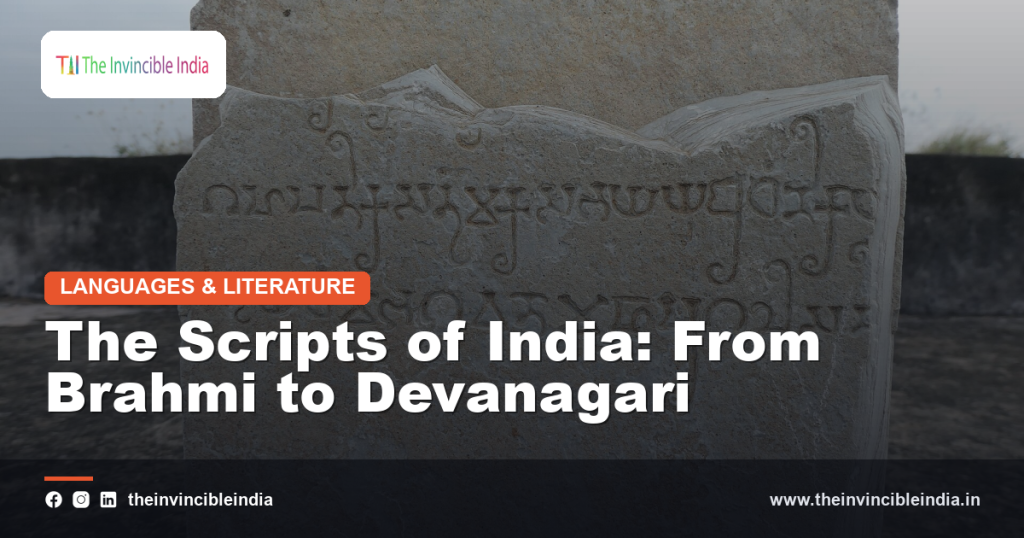
At the root of most of the scripts of India lies the ancient Brahmi script, one of the most important writing systems in the history of the world. Brahmi is the ancestor from which the great majority of Indian scripts, and many scripts beyond India, ultimately descend. It was used in ancient India to write inscriptions and texts, and from it, over the centuries, the many later scripts evolved. The deciphering of Brahmi in modern times unlocked the ability to read the most ancient written records of India. As the fountainhead of the Indian family of scripts, Brahmi holds a place of the greatest importance in the history of writing in India and Asia.
The Edicts of Ashoka
Some of the most famous and important early uses of the Brahmi script are the edicts of the ancient emperor Ashoka, inscribed on pillars and rocks across his vast empire more than two thousand years ago. In these inscriptions, the emperor proclaimed his ideals of righteousness, compassion and good governance to his people, and they are among the earliest substantial written records of India. Composed largely in Brahmi, the edicts of Ashoka are of immense importance both as historical documents and as monuments of early Indian writing. They testify to the use of the Brahmi script for public communication across a huge realm in ancient times and are a treasured part of India’s written heritage.
A Family of Scripts
From the ancient Brahmi script, over more than two thousand years, developed the great family of Indian scripts used today, branching and evolving in different regions to produce the diverse writing systems now seen across the country. As the script spread and was used to write different languages in different areas, regional variations arose and gradually developed into distinct scripts, each adapting to local needs and tastes while retaining the underlying structure inherited from Brahmi. This process of branching evolution over the centuries produced the rich family of related scripts that characterises India today. Understanding the scripts of India as a family descended from a common ancestor is key to appreciating both their diversity and their deep unity.
How Indian Scripts Work
Most Indian scripts share a common and ingenious structure, belonging to a type of writing system in which the basic units represent consonants with an inherent vowel, and vowels are indicated by marks added to the consonants. This type of system, sometimes called an abugida, is different from an alphabet, in which consonants and vowels are separate letters, and from systems that represent whole syllables or words. The Indian scripts are highly systematic and well suited to the sounds of the Indian languages, whose sounds were carefully analysed by ancient scholars. This shared, logical structure, inherited from their common ancestor, is a fundamental and elegant feature of the Indian family of scripts.
Devanagari
The most widely used of the Indian scripts is Devanagari, employed to write Hindi, one of the most spoken languages in the world, as well as Sanskrit, Marathi and several other languages. Recognisable by the horizontal line that runs along the top of its letters, from which the characters seem to hang, Devanagari is an elegant and systematic script with a long history. Its wide use and its role in writing Sanskrit and Hindi give it a special prominence among the scripts of India. Devanagari is often the script that comes to mind when people think of Indian writing, and it is one of the most important and widely encountered writing systems in the country.
The Scripts of the South
The southern regions of India, home to the Dravidian languages, have their own distinctive and beautiful scripts, including those used to write Tamil, Telugu, Kannada and Malayalam. These southern scripts, though also descended ultimately from the ancient Brahmi, developed their own characteristic rounded and flowing forms, quite different in appearance from the northern scripts, partly shaped by the materials once used for writing in the region. Each is elegant and distinctive, and each is closely bound to the language and culture it serves. The scripts of the south are among the most graceful of Indian writing systems and reflect the rich and ancient literary cultures of the southern languages they record.
The Scripts of the East and Others
The eastern and other regions of India likewise have their own distinctive scripts, each with its own character and beauty. The script used for Bengali, also used for related languages of the east, has its own elegant forms; the scripts for Odia, Gujarati, Punjabi and other languages each have their distinctive appearance and history. Across the whole country, the different linguistic regions have developed or adopted scripts suited to their languages, contributing to the rich diversity of Indian writing. Each of these scripts, descended from the common ancestor yet distinct in form, is closely tied to the identity and heritage of the language and people it serves, adding to the remarkable variety of India’s writing systems.
Scripts and Language
The scripts of India are closely bound to the languages and cultures they serve, and often to the identity of the regions and peoples who use them. A script is not merely a neutral tool but is frequently a cherished symbol of a language and its culture, tied to its literature, its heritage and its sense of identity. At the same time, the relationship between script and language is not always one-to-one, for some languages have been written in more than one script, and some scripts serve more than one language. This close and sometimes complex relationship between the scripts and the languages of India is an important aspect of the country’s rich linguistic and cultural landscape.
The Beauty of the Scripts
Beyond their practical function, the scripts of India are objects of great beauty, admired for the elegance of their forms and cultivated as arts in their own right. The graceful curves and lines of the various scripts, and the skill of fine handwriting and calligraphy, have long been valued, and beautiful writing has adorned manuscripts, inscriptions and works of art. Each script has its own aesthetic character, from the flowing forms of the southern scripts to the distinctive appearance of Devanagari and the others. This beauty of the scripts, and the art of writing them well, is a cherished part of India’s cultural heritage and adds an aesthetic dimension to the country’s rich tradition of writing.
Scripts in the Digital Age
In the modern era, the scripts of India have made the transition to print and, more recently, to the digital age, adapting to new technologies while preserving their distinctive forms. The many Indian scripts are now used in computing, on the internet and on mobile devices, allowing the languages of India to flourish in digital communication. This adaptation has required considerable effort to represent the complex and varied Indian scripts accurately in digital form, and the ability to use them on modern devices is important for the vitality of the languages in the contemporary world. The successful movement of India’s ancient and diverse scripts into the digital age helps ensure that they continue to thrive in modern life.
A Shared Heritage
The scripts of India, in all their diversity, form a shared heritage, a family of related writing systems descended from a common ancestor and expressing the linguistic richness of the country. Together they tell a story of more than two thousand years of writing, from the ancient Brahmi to the many scripts of today, and of the unity underlying the diversity of India’s languages. This heritage of writing is a precious part of Indian civilisation, preserving its vast literature and connecting the present to the ancient past. Appreciating the scripts of India as a shared and connected heritage, diverse yet united, deepens our understanding of the remarkable linguistic and cultural landscape of the country.
Preserving the Scripts
The preservation and continued vitality of India’s many scripts is an important concern, for they are essential to the languages, literatures and cultures they serve. Efforts to teach the scripts, to support their use in education, publishing and the digital world, and to preserve the vast written heritage recorded in them, all help to keep them alive and flourishing. The study of ancient scripts and inscriptions also continues to unlock the history recorded in them. Ensuring that the scripts of India remain living, used and valued, and that their heritage is preserved, is important for the future of the country’s languages and for the safeguarding of its rich written inheritance for coming generations.
The Scripts of India Today
Today the scripts of India remain in vibrant use, writing the many languages of the country in print, on screens and by hand, and preserving one of the world’s richest traditions of writing. Devanagari and the diverse regional scripts are used daily by hundreds of millions, they flourish in the digital age, and their ancient heritage, reaching back to Brahmi and the edicts of Ashoka, is studied and cherished. Diverse yet united, ancient yet living, beautiful yet practical, the scripts of India are a remarkable expression of the country’s linguistic richness and cultural heritage, and they continue to carry its languages and literature into the future.
Sources & Further Reading
- Ministry of Culture, Government of India, on the scripts and languages of India (indiaculture.gov.in).
- Archaeological Survey of India, on ancient inscriptions and the Brahmi script (asi.nic.in).
- Sahitya Akademi, national academy of letters, on Indian languages and writing.
Frequently Asked Questions
What is the origin of the scripts of India?
Most of the scripts of India descend from a common ancestor, the ancient Brahmi script, one of the most important writing systems in history. From Brahmi, over more than two thousand years, developed the great variety of Indian scripts used today.
What is the Brahmi script?
Brahmi is the ancient script from which most Indian scripts, and many scripts beyond India, ultimately descend. It was used in ancient India, including in the famous edicts of the emperor Ashoka, and is the fountainhead of the Indian family of writing systems.
What is Devanagari?
Devanagari is the most widely used Indian script, employed to write Hindi, Sanskrit, Marathi and other languages. It is recognisable by the horizontal line running along the top of its letters and is an elegant, systematic writing system with a long history.
How do Indian scripts work?
Most Indian scripts belong to a type of writing system, sometimes called an abugida, in which the basic units represent consonants with an inherent vowel, and other vowels are indicated by marks added to the consonants. They are highly systematic and suited to the sounds of Indian languages.
Why does India have so many scripts?
India has many scripts because, as the ancient Brahmi script spread and was used to write different languages in different regions over the centuries, regional variations arose and developed into distinct scripts, each adapted to its language while sharing a common underlying structure.