


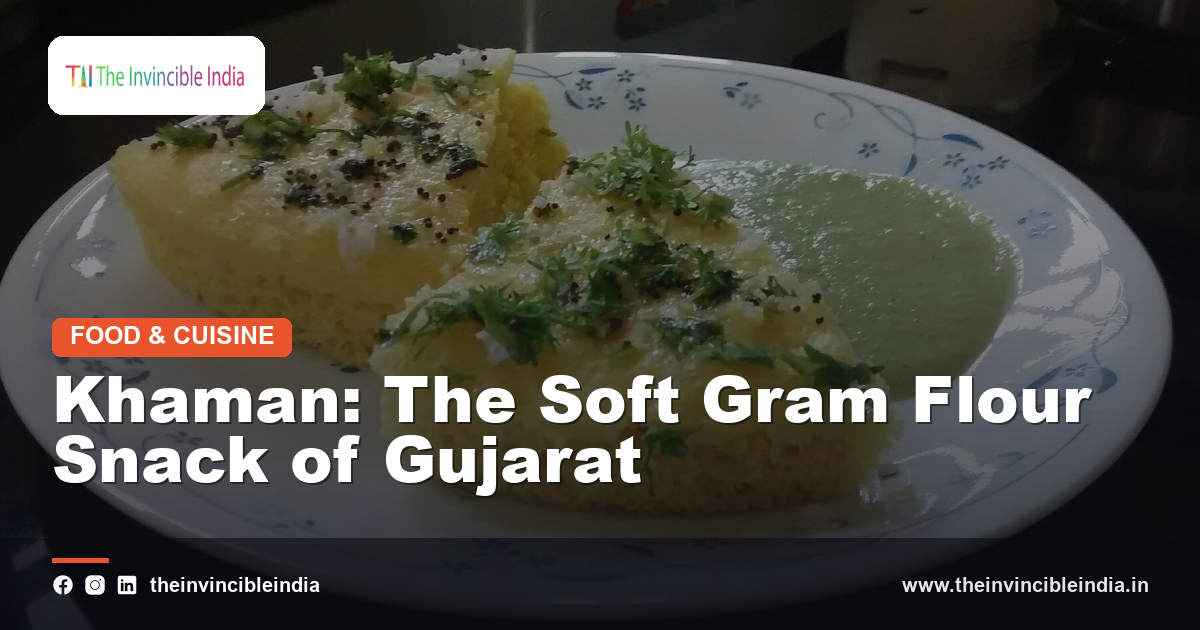
Khaman is one of the best loved snacks of Gujarat, a soft, airy, pale yellow cake made from gram flour and cooked by steaming. Served in neat squares and glistening with a tempering of mustard seeds, green chillies and a light sugar syrup, it is eaten at breakfast, at tea time and as part of festive spreads. Khaman belongs to the wider tradition explored in our guide to Gujarati cuisine, where sweet, sour and savoury notes are balanced with great care. This guide explains what khaman is, how it is made, how it differs from the related dhokla and why it has travelled far beyond its home state.
Quick Facts
| Detail | Information |
|---|---|
| Dish type | Steamed savoury snack |
| Main ingredient | Gram flour (besan) |
| Origin | Gujarat, western India |
| Texture | Soft, spongy and moist |
| Finishing touch | Mustard seed tempering with sugar syrup |
| Typical pairing | Green chutney, fried chillies and tea |
What Is Khaman?
Khaman is a steamed savoury cake made from a batter of gram flour, known in India as besan. The batter is lightened with a raising agent and cooked in a steamer until it forms a soft, sponge-like slab that is then cut into squares or diamonds. A fragrant tempering of mustard seeds, green chillies and curry leaves is poured over it, often together with a light, sweet and sour liquid that keeps it moist.
The appeal of khaman lies in its contrast of flavours and textures. It is delicately sweet, gently tangy and mildly spicy all at once, and it is so light that a whole plate can be eaten without heaviness. It is commonly served with green chutney and fried green chillies. Khaman is, in essence, a cheerful and elegant snack that captures the balanced palate of Gujarat.
Gujarat and Its Snack Tradition
Gujarat is known across India for a rich culture of savoury snacks, often collectively called farsan. These include fried, steamed and roasted items made from gram flour, millets, wheat and lentils, and they are an essential part of the region’s daily food habits. Farsan is eaten with tea, served to guests and packed for journeys, and it forms a proud part of Gujarati hospitality.
Khaman sits at the centre of this tradition as one of its most recognisable members. Its steamed preparation makes it a lighter option than many fried snacks, and its lemon-yellow colour and airy texture make it instantly identifiable. Because Gujarati households often prefer foods that keep well and are easy to share, khaman fits naturally into everyday life. It reflects a food culture in which snacking is a social and celebratory habit.
The Ingredients
The list of ingredients for khaman is short and simple. Fine gram flour forms the body of the batter, and water is used to bring it to a smooth, pourable consistency. A little sugar, salt, lemon juice or citric acid, ginger and green chilli paste add flavour, while a pinch of turmeric contributes colour. A raising agent, commonly fruit salt or baking soda, is added just before steaming to create the characteristic lightness.
The finishing tempering uses oil, mustard seeds, sesame seeds, green chillies and curry leaves, and the whole dish is usually garnished with fresh coriander and grated coconut. Each ingredient has a clear role, and none is expensive or hard to find. The quality of the gram flour matters most, since a fine, fresh flour produces a smoother and more tender crumb. Simple ingredients, handled well, create a snack of remarkable softness.
Preparing the Batter
The batter is the heart of khaman, and its preparation rewards care. The gram flour is sieved to remove lumps and then whisked with water, ginger and chilli paste, sugar, salt and lemon juice until completely smooth. The consistency should resemble a thick but flowing cake batter, neither too runny nor too stiff, so that it rises evenly when steamed.
Some cooks let the batter rest for a short time to allow the flour to hydrate fully. Others add the ingredients in a particular order to keep the mixture lump free. The raising agent is folded in gently at the very end and the batter is poured into the steaming tray immediately, because the bubbles begin to form at once and must not be lost. A smooth, well-rested batter is the first guarantee of a soft and spongy finished khaman.
Steaming for Softness
Once the raising agent has been added, the batter goes straight into a greased tray and is placed in a steamer with water already at a rolling boil. The lid is closed and the khaman cooks in the steam until a skewer inserted in the centre comes out clean. The steam gives the cake its moist, tender crumb without any browning.
Timing is important. If the khaman is steamed for too short a time it remains sticky and raw in the centre, while overcooking can make it dense and dry. Cooks learn to recognise the moment by the puffed, set surface and the faint aroma rising from the steamer. After steaming, the cake is allowed to rest briefly before being cut. Gentle steam, rather than direct heat, is what delivers the signature softness of this celebrated snack.
The Tempering and Syrup
The finishing touch transforms steamed gram flour into a fully flavoured dish. Oil is heated until hot, and mustard seeds are added and left to crackle, followed by sesame seeds, slit green chillies and curry leaves. A small quantity of water mixed with sugar and a little lemon juice is then added to the pan and brought briefly to a boil.
This fragrant liquid is poured evenly over the cut khaman, which absorbs it and becomes even more tender and juicy. The mild sweetness balances the chillies, while the sour note from the lemon keeps the flavour bright. Fresh coriander and grated coconut are scattered on top for freshness. The tempering is not merely a garnish but the element that unites sweet, sour, salty and spicy notes, showing how a few minutes at the stove can complete a dish.
Khaman and Dhokla
Khaman is frequently called khaman dhokla, and the two names are often used interchangeably outside Gujarat, which causes some confusion. In traditional usage, however, the dishes are distinguished. Khaman is made directly from gram flour batter that is steamed immediately, which gives it a yellow colour and a very soft, spongy texture.
Dhokla, in the stricter sense, is typically made from a fermented batter of rice and split chickpea lentils, resulting in a slightly denser, paler and tangier cake. Both are steamed, both are tempered and both are much loved, yet they differ in base ingredients, colour and method. Understanding the difference helps appreciate the variety within Gujarati steamed snacks. Khaman and dhokla are close relatives rather than identical twins, each with its own character and following.
Regional and Household Variations
Within Gujarat, khaman varies by city, household and occasion. Surat, in particular, has a strong reputation for its soft khaman, and many cooks associate the dish with that part of the state. Some families prefer a sweeter finish while others favour a sharper, spicier tempering, and the thickness of the cut pieces differs from kitchen to kitchen.
Variations also include nylon khaman, named for its exceptionally fine and light texture, and masala khaman, which has a spiced filling or topping. Some versions are made with a little semolina or finely grated vegetables for added body. These differences reflect the personal touch each cook brings while staying within the framework of the dish. The flexibility of the recipe explains why khaman tastes slightly different in almost every home that makes it.
Serving Khaman
Khaman is best enjoyed fresh and slightly warm, served on a plate with its tempered syrup still glistening on the surface. The usual companions are green coriander and mint chutney, a tamarind chutney for sweetness and fried green chillies, which add a sharp and salty accent. A sprinkle of fine sev, the thin gram flour noodles, is also popular for crunch.
The snack appears at breakfast tables, on tea-time trays and in festive spreads, and it is a common offering at family gatherings and celebrations. In Gujarati households it is often packed into lunch boxes or served to visiting guests as a mark of hospitality. The pleasing balance of sweet, tangy and spicy flavours makes khaman easy to serve and easy to enjoy at almost any hour.
Khaman in the Gujarati Meal
Khaman is usually classified as a snack or a light breakfast, but it also appears within larger meals. It may be served alongside a thali as a savoury starter, or as part of a festive farsan platter together with fried items, pickles and sweets. The Gujarati meal is designed to offer a balance of tastes, and khaman contributes the soft and gently sweet note.
Its lightness means it does not overwhelm the main courses that follow, and its mild spiciness prepares the palate for richer dishes. Families also make it on Sundays and at festivals when time allows for a more leisurely preparation. Khaman thus plays a dual role, serving both as a quick everyday treat and as a dish that adds quiet distinction to a special occasion.
Nutrition and Digestibility
Khaman is often considered a relatively light snack because it is steamed rather than fried. Gram flour is made from ground chickpeas and is a good source of plant protein and dietary fibre, and the small amount of oil used in the tempering keeps the dish moderate in fat. These qualities have helped khaman win a reputation as a wholesome choice among snacks.
Its soft texture also makes it easy to eat for people of all ages, and many families regard it as a gentle option for breakfast. As with any food, the overall nutrition depends on the quantity of sugar, oil and accompaniments used. When prepared with restraint, khaman offers a pleasing mix of protein, carbohydrate and flavour. Its steamed preparation remains the main reason it is thought of as a lighter alternative to many fried snacks.
Tips for Perfect Khaman
Cooks who make khaman often share a handful of practical tips. Sifting the gram flour prevents lumps, and whisking the batter thoroughly builds a smooth base. The batter should be poured into the steamer as soon as the raising agent has been mixed in, because the gas that makes it rise begins to escape almost at once.
The steaming water should already be boiling before the tray goes in, and the lid should stay closed until the cake is nearly done. Pricking the cooked cake lightly before pouring on the syrup helps it absorb the flavour evenly. Finally, cutting is easier once the slab has rested for a few minutes. These small habits, passed on within families, ensure the cake stays tender, airy and well flavoured every time it is made.
From Home Kitchens to Shops
Khaman is made in homes every day, but it is also a staple of sweet and snack shops across Gujarat. Early morning queues at farsan counters are a common sight, with customers buying fresh khaman by the plate or by the kilogram to take home. Shops typically serve it with chutney, fried chillies and sometimes a scoop of sev on top.
Because the dish is easy to transport and stays soft for a good while, it is also sold at railway stations and sweet stalls and is a favourite gift for travellers returning from Gujarat. Ready-to-cook mixes make it possible to prepare a version at home quickly. The presence of khaman in both household and commercial settings shows how central it is to local eating habits and to the economy of small food businesses.
Khaman Across India and Abroad
As Gujarati families settled in cities across India and overseas, khaman travelled with them. It is now widely available in snack shops in Mumbai, Delhi, Bengaluru and other cities, and is often found on the menus of Indian restaurants abroad. In many places it has become a recognised symbol of Gujarati food, sometimes presented on vegetarian snack platters.
Local adaptations occasionally appear, such as the addition of extra green chilli, garlic or spices to suit regional tastes. Even so, the defining features of soft texture, yellow colour and sweet, sour and spicy tempering generally remain intact. The journey of khaman from a regional favourite to a widely enjoyed national and international snack demonstrates how a simple steamed dish can carry the identity of a culture far beyond its homeland.
Khaman Today
Today khaman remains a cherished part of Gujarat’s culinary identity. Home cooks still prepare it from scratch, shops continue to sell it fresh each morning and modern cooks experiment with additions such as vegetables, millets or new chutneys. Instant mixes and microwave methods have made it accessible even to those short of time.
Through all these changes, the essential appeal of khaman endures: a soft, light, gently sweet and tangy snack that is easy to make and delightful to eat. Its steady popularity demonstrates that a dish built on a humble ingredient like gram flour can rise, quite literally, to become a symbol of a regional cuisine. Khaman continues to represent the hospitality, balance and ingenuity of Gujarati cooking.
Sources & Further Reading
- Ministry of Culture, Government of India (indiaculture.gov.in).
- Gujarat Tourism, Government of Gujarat (gujarattourism.com).
Frequently Asked Questions
What is khaman made of?
Khaman is made from gram flour, known as besan, mixed with water, sugar, salt, lemon juice, ginger and green chilli and raised with fruit salt or baking soda. It is steamed and then finished with a tempering of mustard seeds, curry leaves and green chillies.
What is the difference between khaman and dhokla?
Khaman is made from a gram flour batter that is steamed straight away, giving a yellow, spongy cake. Traditional dhokla uses a fermented batter of rice and split chickpea lentils and is usually paler and slightly tangier, though the two names are often used interchangeably.
Is khaman healthy?
Khaman is steamed rather than fried and is made from gram flour, which provides protein and fibre, so it is generally seen as a lighter snack. The sugar and oil in the tempering affect its overall nutritional value.
How is khaman served?
Khaman is served fresh with green chutney, tamarind chutney, fried green chillies and sometimes a scattering of sev. It is eaten at breakfast, at tea time and at festive gatherings.
Why is khaman soft and spongy?
The softness comes from a smooth batter, a raising agent that creates tiny air bubbles and gentle steaming that cooks the cake evenly. The sugar and lemon syrup poured over it afterwards keeps the texture moist.