


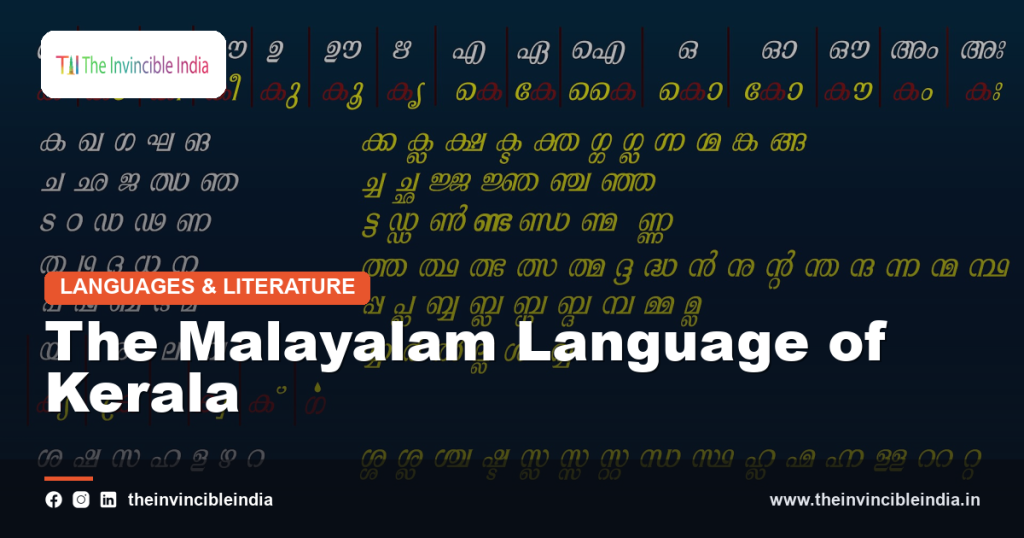
Malayalam is a Dravidian language spoken predominantly in the southern Indian state of Kerala, where it serves as the principal language of daily life, administration and literature. Though closely related to Tamil, with which it shares a common linguistic ancestor, Malayalam developed as a distinct literary language over the course of many centuries, absorbing considerable vocabulary from Sanskrit along the way, in a manner comparable to the blending seen in Sanskrit’s long interaction with regional Indian languages. Malayalam possesses its own script and a substantial body of poetry, prose and drama, and has been recognised as a Classical Language of India. This guide explores its origins, script, literary heritage and continuing role in Kerala and beyond.
Quick Facts
| Detail | Information |
|---|---|
| Language Family | Dravidian |
| Primary Region | Kerala, southern India |
| Script | Malayalam script, a rounded Brahmi-derived writing system |
| Classical Status | Recognised by the Government of India as a Classical Language |
| Historical Note | Developed from a source shared with early Tamil before diverging |
| Notable Literary Forms | Manipravalam poetry, devotional literature, modern novel and short story |
Origins and Language Family
Malayalam belongs to the Dravidian language family and is most closely related to Tamil, with the two languages sharing a common ancestral source from which they gradually diverged over many centuries. Linguists generally regard Malayalam as having developed a distinct identity separate from Tamil sometime during the medieval period, evolving its own grammar, vocabulary and literary conventions in the process.
This divergence was shaped significantly by Kerala’s particular geography and history, including sustained contact with Sanskrit through religious and scholarly traditions, as well as trade contacts along the Malabar coast that brought the region into exchange with distant parts of the world. These combined influences gave Malayalam a distinctive character within the wider Dravidian family.
Relationship to Tamil and Divergence
The close relationship between Malayalam and Tamil is evident in shared vocabulary, grammatical structures and literary conventions inherited from their common source. Early Malayalam literature, in fact, is sometimes difficult to distinguish from contemporary Tamil works, reflecting a period before the two languages had fully diverged into separate literary traditions.
Over time, however, Malayalam absorbed a much greater proportion of Sanskrit vocabulary than Tamil generally did, particularly in registers associated with religion, scholarship and formal writing, contributing to its emergence as a recognisably distinct language. This blending of Dravidian grammar with substantial Sanskrit vocabulary remains one of the defining features that sets Malayalam apart from its closest linguistic relative.
The Malayalam Script
Malayalam is written in its own script, a rounded, syllabic writing system descended, like other South Indian scripts, from the ancient Brahmi script. The script evolved through several intermediate forms before settling into its current shape, which is well adapted to representing the language’s rich consonant clusters, a feature that distinguishes Malayalam from many other Dravidian languages.
The rounded curves characteristic of the script are often linked, as with related scripts of the region, to the historical practice of writing on palm leaves, where straight lines could cause the leaf to tear. Today the script is used in print, education and digital media throughout Kerala and among Malayalam-speaking communities elsewhere.
Palm Leaf Manuscripts and Early Writing
Before the advent of paper and printing, Malayalam texts were preserved on palm leaf manuscripts, inscribed with a stylus and bound together to form durable, portable volumes. This method of writing and preservation was widespread across southern India and allowed for the transmission of literary, religious and administrative texts across generations, despite the region’s humid climate posing constant challenges to preservation.
Libraries and manuscript collections in Kerala continue to hold significant numbers of these palm leaf documents, which remain an important source for scholars studying the early history of the Malayalam language and its literature. Conservation efforts today focus on digitising and preserving these fragile manuscripts for future study.
Early and Classical Malayalam Literature
Among the earliest distinctive works associated with Malayalam literature are texts blending Sanskrit and Malayalam elements, a style known as Manipravalam, which flourished particularly in courtly and devotional contexts during the medieval period. This hybrid literary form allowed poets to draw on the prestige and vocabulary of Sanskrit while writing fundamentally in the Malayalam idiom.
Alongside Manipravalam works, a separate tradition of folk songs and ballads, generally freer of heavy Sanskrit influence, developed among the wider population, preserving indigenous Dravidian storytelling traditions. Together, these two strands, one closely tied to Sanskritic learning and the other rooted in popular oral tradition, shaped the foundations of later Malayalam literature.
Geographic Spread and Speaker Communities
Malayalam is the principal language of Kerala, where it is spoken by the vast majority of the population and used across daily life, government, education and media. It is also spoken in the union territory of Lakshadweep and by communities in neighbouring parts of Karnataka and Tamil Nadu.
Beyond India, Malayalam-speaking communities are found in significant numbers across the Gulf countries, reflecting decades of labour migration from Kerala, as well as in other parts of the world including North America and Europe. These overseas communities maintain active cultural and linguistic ties to Kerala through associations, publications and media in Malayalam.
Phonology and Sound System
Malayalam has a notably rich phonological inventory, including an unusually large number of distinct consonant sounds compared to many other Indian languages, among them multiple types of nasal and liquid consonants. This complexity is often cited by linguists as one of the language’s most distinctive features within the Dravidian family.
The language also preserves a range of consonant clusters and gemination, the doubling of consonant sounds, which affects meaning and pronunciation in ways not always found in related languages. This intricate sound system, shaped by the language’s layered history of Dravidian roots and Sanskrit influence, gives spoken Malayalam a particularly dense and textured quality.
Grammar and Sentence Structure
Like other Dravidian languages, Malayalam follows a subject-object-verb word order and is agglutinative, building grammatical meaning by attaching suffixes to root words rather than relying on separate function words. Nouns are inflected for case, and verbs carry markers indicating tense and, in many contexts, other grammatical distinctions.
One notable feature of Malayalam grammar, compared to some related languages, is a relatively reduced reliance on verb agreement with the subject’s person and number in certain constructions, a characteristic that has drawn particular interest from linguists studying Dravidian grammar. This gives Malayalam sentence structure a distinct rhythm even within its broader Dravidian grammatical framework.
Dialects and Regional Variation
Malayalam exhibits notable dialectal variation across Kerala, shaped by geography, caste, religion and historical trade contacts along the coast. Broadly, linguists distinguish between northern, central and southern dialect regions, each carrying distinctive vocabulary and pronunciation, alongside a standardised literary form used in education, media and formal writing.
Religious community has also historically influenced dialect, with certain vocabulary and speech patterns associated with Kerala’s Muslim, Christian and Hindu communities respectively, reflecting the state’s long history of religious and cultural diversity. Despite this variation, the standardised form of Malayalam ensures broad mutual intelligibility across the state’s different regions and communities.
Devotional and Manipravalam Literature
Devotional literature occupies an important place in the Malayalam literary tradition, with poets composing hymns and narrative poetry dedicated to various deities, often drawing on themes from the Ramayana, Mahabharata and Puranic literature. Such devotional works were composed both in the ornate Manipravalam style and in simpler, more accessible Malayalam intended for wider audiences.
Adaptations of the Ramayana into Malayalam verse, in particular, hold an especially revered place in Kerala’s literary and religious culture, recited in households and temples as part of ongoing devotional practice. This devotional strand of literature runs alongside the more courtly and secular traditions, together forming a rich and varied literary inheritance.
Modern Malayalam Prose and the Novel
The emergence of modern Malayalam prose, including the novel and short story, marked a significant expansion of the language’s literary scope from the nineteenth century onward, engaging with themes of social reform, caste, gender and the changing conditions of Kerala society. Malayalam writers working in these modern forms have been recognised nationally for their contributions to Indian literature.
Malayalam literary criticism and essay writing also developed substantially during this period, reflecting a broader engagement with modern ideas and social questions. This vigorous modern prose tradition, built upon a much older poetic and devotional literary base, has helped establish Malayalam as one of the most critically well-regarded literary languages of India.
Malayalam Cinema and Performing Arts
Malayalam cinema has earned a distinguished reputation within Indian film for its focus on realistic storytelling and social themes, often regarded by critics as a particularly strong regional cinema tradition. It continues to produce a steady output of acclaimed films that engage seriously with everyday life and social questions in Kerala.
Kerala is also home to distinctive performing arts traditions such as Kathakali and Koodiyattam, classical dance-drama forms that draw on stories from Sanskrit and Malayalam literature, performed with elaborate costume, makeup and gesture. These performing arts traditions, alongside cinema, keep Malayalam narrative and literary themes alive in vivid visual and theatrical form.
Classical Language Status and Recognition
Malayalam has been accorded the status of a Classical Language of India by the Government of India, a recognition reserved for languages with an ancient and independently developed body of literature. This status acknowledges Malayalam’s long literary history, including its early Manipravalam works and its subsequent development into a fully independent literary language.
The classical designation has supported further academic study, including research centres and initiatives dedicated to the preservation and study of ancient Malayalam texts and manuscripts. Such recognition situates Malayalam among a select group of Indian languages honoured for the depth and antiquity of their literary heritage.
Malayalam in Education and Administration
Malayalam is the medium of instruction in a large proportion of schools across Kerala and is taught as a compulsory subject in many others, reflecting its central role in the state’s educational system. It also serves as the official language of the Kerala state government, used widely in administration, legislation and public communication.
Universities and research institutions in Kerala offer advanced programmes in Malayalam language and literature, supporting continued scholarship and literary production. This strong institutional presence across schools, government and higher education has helped Malayalam maintain a robust and secure position in the formal life of the state.
Malayalam Diaspora and Global Presence
Kerala has a long history of migration, and Malayalam has travelled with its speakers to destinations across the globe, particularly the Gulf countries, where large communities of Malayalam speakers have lived and worked for decades. Malayalam-language newspapers, television channels and cultural associations serve these communities, helping sustain the language far from Kerala itself.
Malayalam cinema and literature also enjoy audiences well beyond Kerala’s borders, supported by streaming platforms and translation into other languages. This global reach, unusual in scale for a regional Indian language, reflects both the size of the Malayalam diaspora and the enduring cultural pride associated with the language among its speakers abroad.
Malayalam Today
Malayalam today remains a dynamic and widely used language, central to literature, cinema, journalism, education and everyday communication across Kerala and among its large diaspora community. Its literary tradition, spanning ancient Manipravalam poetry, devotional verse and an acclaimed modern prose tradition, continues to be studied, read and celebrated.
As Kerala continues to change socially and economically, Malayalam adapts alongside it, absorbing new vocabulary from technology, science and global culture while retaining its distinctive grammar and rich literary heritage. This balance of continuity and adaptation ensures Malayalam remains a vibrant and secure part of India’s linguistic landscape.
Sources & Further Reading
- Sahitya Akademi.
- Ministry of Culture, Government of India (indiaculture.gov.in).
Frequently Asked Questions
What language family does Malayalam belong to?
Malayalam belongs to the Dravidian language family and is most closely related to Tamil, with which it shares a common ancestral source before diverging into a separate language.
What script is used for Malayalam?
Malayalam is written in its own rounded, syllabic script descended from the ancient Brahmi script, adapted over centuries to represent the language’s rich consonant sounds.
What is Manipravalam?
Manipravalam is an early literary style that blended Sanskrit and Malayalam, widely used in courtly and devotional poetry during the medieval period of Malayalam literature.
Is Malayalam a classical language?
Yes, Malayalam has been recognised by the Government of India as a Classical Language in acknowledgement of its ancient and independently developed literary tradition.
Where is Malayalam mainly spoken?
Malayalam is the principal language of the southern Indian state of Kerala, with large speaker communities also present in the Gulf countries and other parts of the world.