


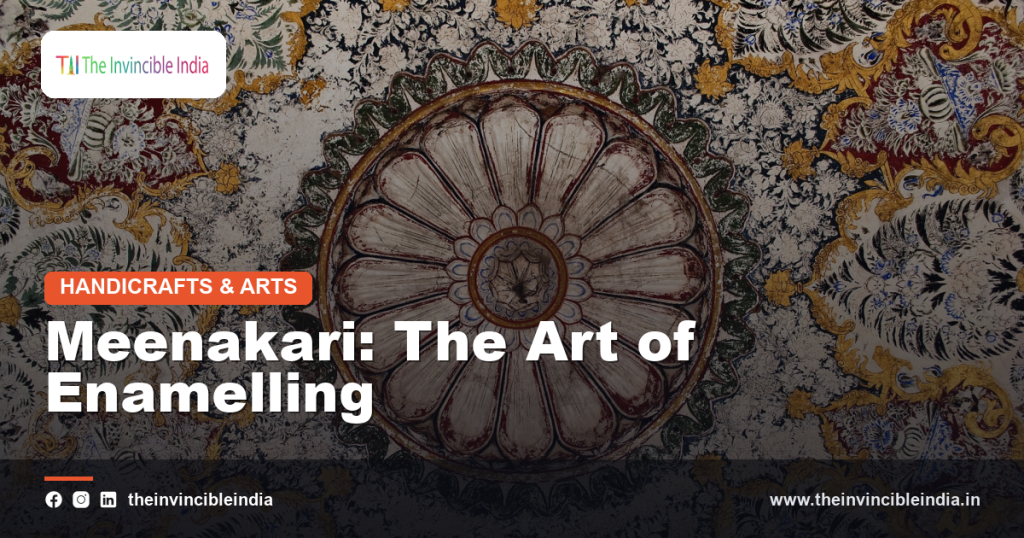
Meenakari is the traditional Indian art of fusing coloured enamel onto engraved gold and silver surfaces, best known through Jaipur’s vividly coloured jewellery. Skilled artisans engrave a design, fill it with mineral-based enamel, and fire the piece until the colour fuses permanently to the metal. Much like Thewa art, Meenakari reflects Rajasthan’s long tradition of combining fine metalwork with brilliant colour. This guide covers its history, materials, process, regional centres and continuing role in Indian jewellery-making.
Quick Facts
| Detail | Information |
|---|---|
| Craft Type | Metal enamelling |
| Base Metal | Gold, silver |
| Key Material | Vitreous enamel |
| Signature Colour | Red (Jaipur style) |
| Main Centre | Jaipur, Rajasthan |
| Common Use | Jewellery, decorative objects |
Origins and Historical Roots
Meenakari, the art of applying vitreous enamel to metal surfaces, is believed to have developed through a long history of exchange between Indian metalworking traditions and enamelling techniques practised in Persia and Central Asia. The craft is widely associated with the patronage of royal courts, where skilled artisans were commissioned to decorate jewellery, vessels and ceremonial objects with vivid enamel colour.
Over centuries, Meenakari became closely identified with the city of Jaipur in Rajasthan, though related enamelling traditions also developed in other parts of northern India. The technique’s ability to add rich, jewel-like colour to gold and silver surfaces made it especially prized for royal and aristocratic commissions. As Meenakari spread beyond court patronage, it became integrated into broader jewellery-making traditions, eventually reaching a wider clientele while retaining its association with fine craftsmanship and luxury.
Meenakari and the Mughal Legacy
The flourishing of Meenakari in India is often linked to the artistic patronage associated with the Mughal era, when craftsmen skilled in enamelling and related decorative arts were welcomed into royal workshops. This period is generally understood to have encouraged the exchange of techniques between Persian-influenced enamelling traditions and existing Indian metalworking skills, contributing to the refined, colourful style Meenakari is known for today.
Jaipur’s association with Meenakari is often traced to royal patronage extended to artisan families who settled in the city and continued to develop the craft under courtly support. While specific historical details of this transmission are not always precisely documented, the broader connection between royal patronage and the flourishing of fine decorative crafts is well established. This legacy continues to shape Jaipur’s identity as a centre of Meenakari production.
What Is Meenakari
Meenakari refers to the art of fusing coloured enamel onto the surface of gold, silver or other metals through a process of engraving, colour application and controlled heating. The technique allows artisans to create vivid, glass-like colour fields set within finely engraved metal outlines, producing a distinctive combination of metallic shine and rich enamel colour.
Meenakari is most closely associated with jewellery, where it is often used on the reverse side of gem-set pieces, though it is also applied to decorative objects such as boxes, plates and figurines. The finished appearance depends heavily on the quality of the underlying engraving, the purity of the enamel colours used, and the precision of the firing process, all of which require years of specialised training to master.
Materials: Metals Used
Gold and silver are the traditional metals used as a base for Meenakari work, chosen both for their ability to hold enamel securely and for their association with fine jewellery and luxury objects. Gold is generally considered to produce the richest and most vivid enamel colours, since its surface interacts favourably with the mineral pigments used in the enamelling process.
Silver is also widely used, particularly for more accessible pieces or decorative items where the higher cost of gold is not required. In some cases, copper or other base metals are used as a substrate, especially for larger decorative objects, though these are generally considered less prestigious than gold or silver Meenakari. The choice of metal affects both the cost and the durability of the finished piece.
Enamel Colours and Pigments
The enamel used in Meenakari is made from finely ground glass combined with metallic oxide pigments, which produce a range of vivid colours once fused to the metal surface through heat. Red, commonly associated with Jaipur’s Meenakari tradition, is considered particularly difficult to achieve well and is often regarded as a marker of skilled craftsmanship.
Other colours, including green, blue, white and yellow, are also used extensively, with artisans often combining several colours within a single design to create contrast and visual interest. Achieving consistent, vibrant colour requires careful control of enamel composition and firing temperature, as even small variations can affect the final hue and finish.
The Meenakari Process
The Meenakari process begins with an artisan engraving a design into the metal surface, creating recessed areas that will later hold the enamel. Finely ground enamel powder is then carefully applied into these engraved sections, colour by colour, often starting with the colour that requires the highest firing temperature.
The piece is heated in a small furnace or over a controlled flame, fusing the enamel to the metal, and this process is typically repeated multiple times as additional colours are added and fired at progressively lower temperatures. Once all colours have been applied and fused, the surface is cooled, cleaned and polished to reveal the finished, glass-smooth enamel work.
Tools and Workshop Setup
Meenakari artisans work with a specialised set of tools, including fine engraving instruments for preparing the metal surface, small tools for applying enamel powder with precision, and a controlled heat source for firing the piece. Traditional workshops often use small furnaces or blowpipes directed at a flame to achieve the localised, controlled heat needed for enamel fusion.
Precision at every stage is essential, as the engraving must be deep and clean enough to hold enamel securely, while the firing must reach the correct temperature without overheating the piece. Many Meenakari workshops operate as small, family-run setups, with different artisans sometimes specialising in engraving, colour application or firing.
Common Motifs and Designs
Meenakari designs frequently draw on floral and foliate patterns, birds, and traditional decorative motifs that complement the jewellery or objects they adorn. Many designs are influenced by Mughal-era decorative arts, featuring symmetrical arrangements of flowers, leaves and vines rendered in vivid enamel colour.
Figurative motifs, including birds and occasionally human or animal forms, also appear in certain regional styles of Meenakari, particularly in decorative objects rather than jewellery. The choice of motif is often closely tied to the intended use of the piece, with jewellery typically favouring more delicate, refined patterns suited to smaller surfaces, while larger decorative items allow for more elaborate compositions.
Regional Centres
Jaipur in Rajasthan is the centre most closely associated with Meenakari, particularly known for its distinctive use of red enamel alongside other vivid colours on gold jewellery. Other regional centres, including parts of Uttar Pradesh such as Varanasi and Lucknow, as well as Delhi, have also developed their own Meenakari traditions, often with distinct colour palettes or motif preferences.
These regional variations reflect differences in historical patronage, available materials and local artistic influences, even as they share the same fundamental engrave-and-fire enamelling technique. Jaipur’s prominence has made it a major centre for both traditional jewellery commissions and the broader trade in Meenakari decorative items.
Meenakari in Jewellery
Meenakari is most widely recognised for its use in jewellery, where it is often applied to the reverse side of gem-set pieces such as necklaces, earrings and bangles, adding a hidden layer of colour and craftsmanship not visible from the front. In some pieces, Meenakari is used more prominently on the visible surface, particularly in traditional bridal jewellery.
The combination of enamel work with gemstones and, in many cases, Kundan-style stone setting, allows jewellers to create pieces that are decorative from every angle, reflecting the meticulous attention to detail associated with fine Indian jewellery craftsmanship.
Meenakari on Decorative Objects
Beyond jewellery, Meenakari is applied to a range of decorative objects, including boxes, plates, vases and small figurines, allowing the technique’s vivid colour and fine detail to be appreciated on a larger scale. These decorative pieces are often produced as collectible items or gifts, valued for their combination of craftsmanship and visual appeal.
Larger objects allow artisans more room to develop elaborate compositions, sometimes depicting scenes or patterns that would be impractical on the smaller surfaces of jewellery. This diversification into decorative objects has helped sustain demand for Meenakari skills even during periods of fluctuation in the jewellery market.
The Pairing of Meenakari and Kundan
Meenakari is frequently paired with Kundan, a traditional Indian technique for setting gemstones in gold using a refined gold foil, resulting in jewellery that combines enamelled colour with set stones in a single piece. In this pairing, the front of a piece typically displays Kundan stone setting, while the reverse features Meenakari enamel work.
This combination is particularly associated with traditional Rajasthani and North Indian bridal jewellery, where the visual richness of both techniques together reflects the significance of the occasion. Producing Kundan-Meenakari pieces requires close coordination between artisans specialising in each technique.
The Artisan Community
Meenakari is practised by a specialised community of artisans, often working within family-run workshops that have handed down engraving and enamelling skills across generations. In major centres such as Jaipur, these workshops frequently supply jewellers and retailers with finished Meenakari pieces or provide enamelling services for jewellery designed and set elsewhere.
The specialised nature of the craft means that skilled Meenakari artisans, particularly those capable of achieving fine engraving and vivid, well-fused colour, are highly valued within the broader jewellery trade. Sustaining this specialised workforce is important for maintaining the quality and availability of authentic Meenakari craftsmanship.
Training and Skill Transmission
Training in Meenakari traditionally takes place within family workshops, where young artisans learn engraving and enamelling techniques over many years of close observation and supervised practice. The technical precision required, particularly in controlling firing temperature and achieving consistent colour, means genuine proficiency typically takes considerably longer to develop than in some other craft techniques.
In addition to family-based training, some craft schools and vocational programmes have introduced Meenakari instruction as part of broader jewellery-making curricula, aiming to formalise skill transmission and reach students outside traditional artisan families.
Economic Significance
Meenakari contributes significantly to the broader Indian jewellery industry, particularly in centres such as Jaipur, where enamelled jewellery and decorative objects represent an important segment of the local craft economy. The specialised skill required for high-quality Meenakari work allows experienced artisans to command premium rates for their craftsmanship.
The trade supports not only enamelling artisans themselves but also engravers, metal suppliers, gemstone setters and traders who bring finished pieces to domestic and international markets. Meenakari jewellery and decorative items are also popular among tourists and collectors visiting craft centres such as Jaipur.
Contemporary Challenges
Meenakari faces several contemporary challenges, including the long training period required to develop genuine proficiency, which can discourage younger artisans from pursuing the craft when faster-to-learn alternatives are available. Rising costs of gold and silver, the traditional base metals for high-quality Meenakari, can also affect the affordability and pricing of finished pieces.
Imitation or lower-quality enamel work produced through faster, less skilled methods can also create market confusion, making it harder for buyers to distinguish genuine, finely crafted Meenakari from inferior alternatives. Addressing these challenges requires continued support for training and quality certification.
Meenakari Today
Meenakari continues to be practised and valued across India, with Jaipur remaining its most prominent centre and a key destination for those seeking traditional enamelled jewellery and decorative objects. The craft continues to be closely associated with fine jewellery, particularly in combination with Kundan stone setting, while also finding expression in decorative objects favoured by collectors.
As interest in traditional Indian jewellery and decorative arts continues both domestically and internationally, Meenakari’s distinctive combination of engraving and vivid enamel colour ensures its ongoing relevance as one of India’s most technically demanding and visually striking craft traditions.
Sources & Further Reading
- Ministry of Textiles, Government of India (texmin.nic.in).
- Gem and Jewellery Export Promotion Council (gjepc.org).
Frequently Asked Questions
What is Meenakari?
Meenakari is the traditional Indian art of applying coloured enamel to engraved metal surfaces, most often gold or silver, through colour application and controlled firing.
Where is Meenakari mainly produced?
Jaipur in Rajasthan is the centre most closely associated with Meenakari, though Varanasi, Lucknow and Delhi also have their own enamelling traditions.
What is Meenakari often combined with in jewellery?
It is frequently paired with Kundan stone setting, with Kundan work on the front of a piece and Meenakari enamel on the reverse.
Which colour is considered hardest to achieve in Meenakari?
Red enamel, closely associated with Jaipur’s Meenakari tradition, is generally considered one of the most difficult colours to achieve well.
What metals are used as a base for Meenakari?
Gold and silver are the traditional base metals, though copper and other base metals are sometimes used for larger decorative objects.