


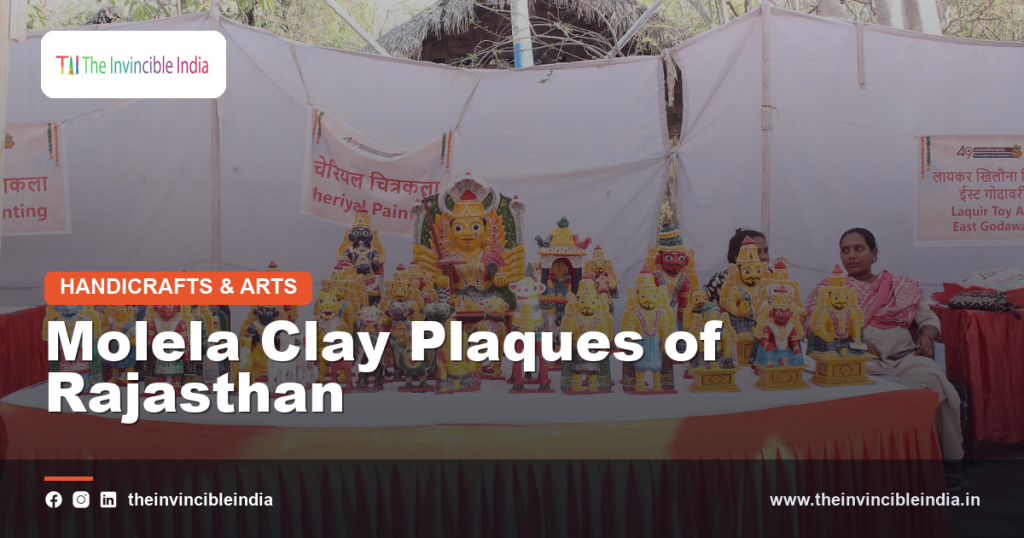
In a small village on the banks of the Banas river in southern Rajasthan, generations of potter families have shaped one of India’s most distinctive folk-art traditions: the terracotta plaque of Molela. Built up by hand from flattened slabs of local clay rather than thrown on a wheel, these reliefs depict deities, riders, and ritual scenes in bold, high-relief forms that are as sculptural as they are devotional. Closely related in spirit to the wider world of Indian terracotta craft, Molela work occupies a singular niche, serving pilgrim shrines across the region while also finding a growing audience among collectors of Indian folk art.
Quick Facts
| Detail | Information |
|---|---|
| Village | Molela, Rajsamand district, Rajasthan |
| Community | Kumhar (potter) families |
| Material | Local river clay mixed with donkey dung and straw |
| Technique | Hand-built slab relief, not wheel-thrown |
| Common Subjects | Dev Narayan ji and other folk deities |
| Primary Use | Votive plaques for shrines and household worship |
A Village Known for Clay
Molela is a modest village in the Rajsamand district of southern Rajasthan, set close to the Banas river whose banks provide the fine-grained clay on which the local craft depends. For many generations, the village has been closely identified with the making of terracotta plaques, to the point that its name has become synonymous with the art form itself across the region. Unlike many pottery centres that produce vessels and everyday wares, Molela’s potter families have concentrated their skill on a narrower and more specialised output: flat or gently curved clay reliefs built for devotional display rather than daily use.
This concentration on a single craft form over successive generations has allowed techniques, motifs, and working methods to be refined and passed down within families, giving Molela work a recognisable consistency of style even as individual artisans bring their own touches to figures and compositions.
The Kumhar Artisan Community
The plaques of Molela are made almost entirely by families belonging to the Kumhar, or potter, community, for whom clay work is a hereditary occupation passed from parent to child. Skills are traditionally learned informally within the household workshop, with children observing and gradually assisting before taking on independent commissions of their own. This apprenticeship model has kept the craft rooted in a small number of extended families even as demand for the plaques has grown beyond the immediate region.
Workshops are typically modest, attached to the family home, with open courtyards used for drying clay pieces in the sun before firing. The communal and familial nature of production means that Molela terracotta is less an individual artistic pursuit than a shared craft identity, in which reputation is built collectively by a village rather than by a single celebrated maker.
Sourcing and Preparing the Clay
The raw material for Molela terracotta is a fine alluvial clay drawn from the bed and banks of the nearby river, chosen for its plasticity and its ability to hold fine detail without cracking during drying and firing. Before use, the clay is cleaned of stones and coarse particles and left to settle so that only the smoothest fraction is retained for modelling.
Artisans traditionally temper the prepared clay with donkey dung and chopped straw or fibre, additions that improve workability and help the body withstand the stresses of firing by allowing trapped gases to escape evenly. The resulting mixture is kneaded thoroughly by hand until it reaches a uniform, pliable consistency, a stage that experienced potters judge entirely by feel rather than by measurement, drawing on years of practice with the same local material.
Handbuilding Without a Wheel
What most distinguishes Molela work from many other Indian pottery traditions is that it is not thrown on a wheel at all. Instead, artisans flatten the prepared clay into slabs and press it into or over simple wooden or clay moulds and armatures, then build up figures and background elements by hand, layer upon layer, much as a sculptor works in relief.
Fingers, simple wooden tools, and improvised implements are used to press, smooth, and incise the surface, giving each plaque a slightly different character even when the same deity or scene is repeated across many pieces. Because the work is built additively rather than carved away, artisans can create deep, almost three-dimensional relief, with figures projecting boldly from a flat or gently curved backing plate.
Modelling the Figures
Once the base slab has been formed, the artisan begins adding modelled clay elements: heads, limbs, ornaments, weapons, and mounts are shaped separately in rough form and then attached to the main body while the clay is still workable, so that the joins fuse seamlessly during drying and firing. Facial features, jewellery, and costume details are added last, using small tools and fingertips to press in eyes, folds of cloth, and decorative patterning.
The overall composition is built with an eye to balance and narrative clarity, since many plaques are meant to be read at a glance by devotees as a recognisable scene from a deity’s story. This combination of sculptural modelling and narrative composition is part of what gives Molela plaques their particular visual energy compared with more static devotional images.
Drying and the Firing Process
Before firing, completed plaques are left to dry slowly in the shade, since rapid drying in direct sun can cause cracking, particularly in larger or more elaborately modelled pieces. Only once the clay has dried evenly throughout is a plaque considered ready for the kiln.
Firing is traditionally carried out in simple open or semi-open kilns fuelled by wood, dung cakes, or agricultural residue, with temperatures and timing judged through experience rather than precise instruments. The firing transforms the raw clay into a durable, weather-resistant terracotta body capable of withstanding outdoor display at shrines for years. Because kiln conditions can vary, some colour variation between individual plaques is normal and is generally accepted as part of the material’s natural character rather than treated as a flaw.
Natural Colour and Painted Finishes
Many Molela plaques are left in their natural fired terracotta colour, ranging from warm reddish-brown to deeper earthen tones depending on the clay and firing conditions, a finish valued for its rustic, earthy dignity. Left unpainted, the sculptural quality of the relief work is thrown into sharp relief by the play of light and shadow across the raised surfaces.
Other plaques, particularly those intended for prominent shrine display, are finished with bright painted decoration applied after firing, using colours that pick out clothing, jewellery, and background details. The choice between natural and painted finishes is often guided by the preferences of the buyer or the intended shrine, so that both approaches continue side by side within the same workshops rather than one superseding the other.
Dev Narayan ji and Folk Deity Imagery
Among the most recurring subjects in Molela terracotta is Dev Narayan ji, a folk deity widely venerated across rural Rajasthan and closely associated with pastoral and agrarian communities. Plaques devoted to this deity often show him mounted on a horse, surrounded by attendants, animals, and symbolic elements drawn from the oral epic traditions that recount his life and deeds.
Beyond this central figure, Molela artisans also model a wide range of other regional deities, guardian spirits, and mythological scenes associated with local devotional practice. The plaques function as portable, durable images of these figures, allowing their stories and presence to be carried from the workshop to shrines and homes across a wide geographic area, reinforcing shared devotional narratives among dispersed communities.
Votive Function and Ritual Use
Molela plaques are not created primarily as decorative art but as votive objects intended for worship, installed at shrines where devotees come to seek blessings or to give thanks for wishes fulfilled. A plaque is typically commissioned or purchased and then formally installed at a shrine, sometimes alongside older plaques from previous generations of pilgrims.
This ongoing, active ritual use distinguishes Molela terracotta from many purely decorative craft forms: the plaques accumulate at pilgrimage sites over time, forming dense clusters of devotional imagery that reflect a continuous local practice rather than a single historical moment. Their durability as fired clay makes them well suited to outdoor shrine environments, where they can withstand exposure to weather over extended periods.
Pilgrim Networks and Trade
The demand for Molela plaques has traditionally been sustained by networks of pilgrims and devotees travelling to shrines across Rajasthan and into neighbouring regions, who purchase plaques either directly from Molela workshops or from vendors near the pilgrimage sites themselves. This trade has given the craft an economic base that extends well beyond the village, linking a small artisan community to a much wider circuit of religious travel and devotion.
Over time, the reputation of Molela as the source for these particular devotional objects has meant that even buyers from distant areas will specifically seek out plaques made in the village, reinforcing its identity as a recognised centre of production. This geographic reach has helped sustain multiple households in the craft across successive generations.
Family Workshops and Hereditary Practice
Molela terracotta production is organised primarily around family-based workshops, where several members of a household, often spanning multiple generations, work together on different stages of the process, from clay preparation to modelling, drying, firing, and finishing. This structure allows knowledge to be transmitted continuously and allows larger commissions to be completed collaboratively.
Within these workshops, roles are frequently divided according to experience and skill, with senior artisans handling the most demanding figural modelling while younger family members take on preparatory tasks as they learn the craft. The hereditary nature of the practice has helped preserve traditional techniques with relatively little external interruption, even as the range of subjects and finishes made available to buyers has gradually expanded.
Beyond Deity Plaques: Wider Subjects
While devotional plaques remain the core of Molela production, artisans have also extended their repertoire to include scenes of rural and village life, depictions of animals, decorative wall panels, and other terracotta forms aimed at buyers seeking decorative rather than strictly ritual objects. These pieces draw on the same handbuilding and relief techniques but allow for freer, more narrative or genre-based compositions.
This broadening of subject matter has helped Molela artisans reach collectors, interior decorators, and cultural institutions interested in Indian folk art more generally, complementing the steady demand from shrine-related commissions. The underlying craft skills remain consistent across both categories of work, with the same hand-building and firing methods applied regardless of the final subject.
Recognition and Patronage
Over recent decades, Molela terracotta has received growing recognition beyond its traditional shrine-based market, with individual artisans from the village being acknowledged through craft awards and government cultural programmes that highlight master practitioners of Indian handicrafts. Exhibitions and craft fairs organised by state and national bodies have periodically featured Molela work, introducing it to urban and international audiences unfamiliar with its votive origins.
Museums and cultural documentation projects have also taken an interest in preserving examples of the craft and recording its techniques, recognising it as a distinctive regional contribution to India’s broader tradition of terracotta art. Such recognition has helped raise the profile of individual artisans while reinforcing the value of sustaining the craft within its home village.
Challenges Facing the Craft
Like many hereditary craft traditions, Molela terracotta faces ongoing challenges in sustaining interest among younger generations, who may be drawn toward other forms of employment offering steadier income or requiring less physically demanding, time-intensive work. The labour involved in sourcing clay, hand-building each piece, and managing wood-fired kilns can make the craft less immediately attractive compared with alternative livelihoods.
Fluctuations in pilgrim traffic, competition from mass-produced devotional images in other materials, and the difficulty of scaling a fundamentally handmade process also place pressure on artisan incomes. Maintaining consistent access to good-quality clay and firing fuel adds a further layer of practical difficulty that individual family workshops must continually navigate to keep production viable.
Preservation and Support Efforts
Efforts to preserve Molela terracotta have generally combined documentation, skill-development support, and market linkage initiatives aimed at connecting artisans with buyers beyond the immediate pilgrim trade. Craft development organisations and government emporia have periodically worked with Molela potters to display and sell their work in urban centres, helping diversify income sources.
Training and design workshops have also encouraged some artisans to experiment with new forms and finishes while retaining the core handbuilding technique, aiming to widen the craft’s appeal without displacing its devotional roots. Continued support of this kind is generally seen as important for ensuring that the specialised skills involved are not lost as economic pressures on artisan households evolve.
Identifying Authentic Molela Work
Genuine Molela terracotta can generally be recognised by its hand-built construction, the visible texture of hand-pressed clay, and the characteristic bold, high relief of its figures, which differs noticeably from moulded or mass-produced ceramic devotional items. Slight asymmetries and individual variation between pieces, rather than being flaws, are often signs of authentic handwork.
Buyers interested in acquiring genuine pieces are generally encouraged to purchase directly from recognised Molela workshops or from established craft emporia and exhibitions that source their stock directly from the village, helping ensure that proceeds support the artisan families who continue the tradition. This direct connection between buyer and maker remains an important part of how the craft sustains itself economically.
Molela Terracotta Today
Today, Molela remains closely identified with the terracotta plaque tradition that has defined the village for generations, with family workshops continuing to serve both the enduring pilgrim trade and a growing audience interested in Indian folk art more broadly. The craft persists as a living devotional practice as much as an artistic one, with new plaques still being commissioned and installed at shrines much as they have been for generations.
As awareness of India’s diverse regional handicraft traditions continues to grow, Molela terracotta stands as a distinctive example of how a highly localised community skill can sustain both religious practice and artistic expression, carried forward by the same potter families whose hands continue to shape clay into enduring devotional form.
Sources & Further Reading
- Ministry of Culture, Government of India (indiaculture.gov.in).
- Development Commissioner (Handicrafts), Ministry of Textiles, Government of India (handicrafts.nic.in).
Frequently Asked Questions
What is Molela terracotta known for?
Molela terracotta is known for hand-built clay relief plaques, most often depicting Hindu folk deities such as Dev Narayan ji, made by potter families in Molela village in Rajasthan for use as votive objects at shrines.
How are Molela plaques made?
Artisans flatten local river clay into slabs, build up figures by hand using moulds and modelling tools rather than a potter’s wheel, dry the pieces slowly, and fire them in traditional kilns before optionally painting them.
Where does the clay for Molela terracotta come from?
The clay is sourced from the banks and bed of the nearby river, chosen for its fine texture and plasticity, and is traditionally tempered with donkey dung and straw to improve its workability and firing strength.
Who makes Molela terracotta plaques?
The plaques are made by families of the Kumhar, or potter, community in Molela, with skills passed down within households across generations rather than taught through formal institutions.
Are Molela terracotta plaques only used for religious purposes?
While devotional plaques for shrines remain the core of the craft, artisans also make decorative panels and figures depicting village life and animals for buyers interested in Indian folk art beyond its ritual use.