


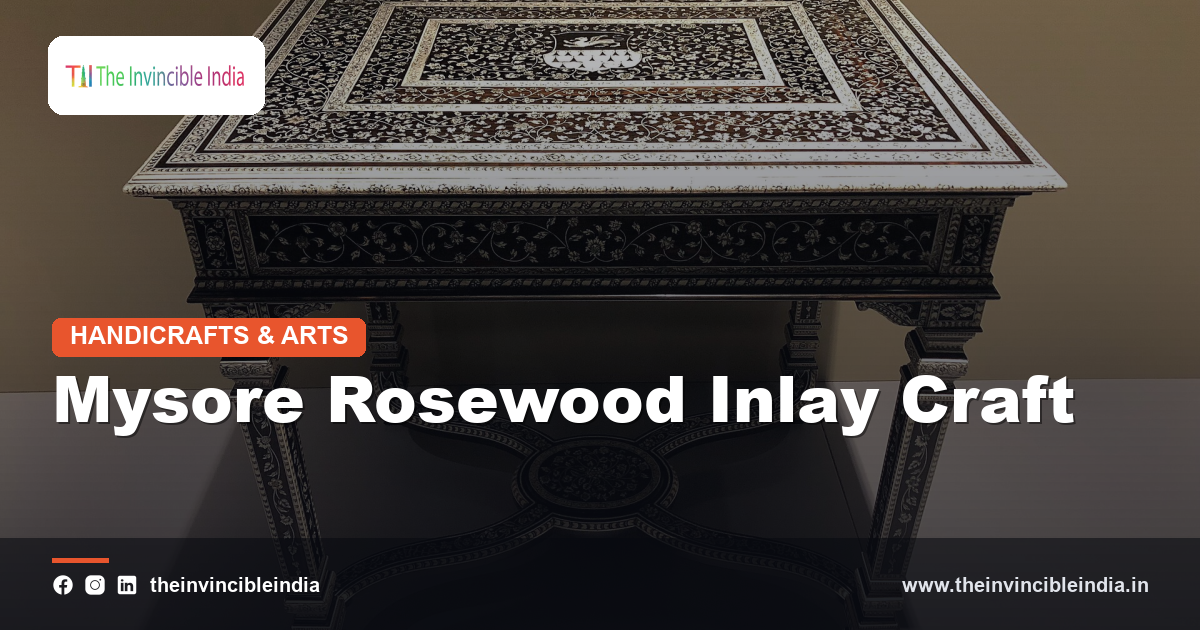
Mysuru, the royal city of Karnataka, is famous for silk, sandalwood, incense and a quieter treasure: rosewood inlay. In this craft, artisans set fine pieces of contrasting material into deep, dark rosewood to form detailed scenes, floral patterns and elegant borders. The result is furniture and decorative objects of great richness, prized for polish, precision and patience. The craft shares a neighbourhood and a sensibility with Mysore sandalwood carving, and both reflect the patronage and taste of the city’s royal past. This guide explores the history, materials, methods, motifs and continuing legacy of Mysore rosewood inlay.
Quick Facts
| Detail | Information |
|---|---|
| Craft | Inlay work on rosewood |
| Region | Mysuru, Karnataka |
| Base material | Rosewood |
| Inlay materials | Contrasting woods and other materials |
| Typical products | Furniture, panels, boxes and decor |
| Status | Recognised traditional craft of Karnataka |
Mysuru and Its Tradition of Fine Crafts
Mysuru has long been regarded as a centre of fine craftsmanship, shaped by the support of the Wodeyar rulers and by the festive life of the city, especially its grand Dasara celebrations. Sandalwood carving, silk weaving, ivory-free lacquer toys and incense making developed alongside one another, and inlay on rosewood became part of this broader artistic ecosystem.
The city’s craft identity rests on a culture of refinement, where skilled workers were encouraged to perfect details and finish. Rosewood inlay reflects this approach, as every panel demands precise cutting and careful polishing. The craft therefore stands as one thread in the larger fabric of Mysuru’s heritage, illustrating how royal appreciation and local talent together nurtured enduring art.
Historical Background of the Craft
The detailed early history of rosewood inlay in Mysuru is not recorded in a single definitive account, so it is best described in broad terms. Inlay work, the art of embedding one material into another to form designs, has a long presence in Indian decorative traditions, appearing in stone, metal, ivory and wood. In Karnataka it found a natural home in the region’s abundant timber and skilled carpentry.
Under the patronage of the Mysore court, artisans developed furniture and decorative objects of exceptional quality. Over time the craft passed through families and workshops, acquiring a recognisable local style. Its history is thus one of gradual refinement, in which royal demand, regional resources and inherited skill combined to produce a distinctive form of woodcraft.
Rosewood as the Foundation
Rosewood is prized for its deep, rich colour, fine grain and strength, qualities that make it an ideal ground for inlay. The dark surface provides a dramatic backdrop against which lighter materials stand out sharply, and its density allows delicate cutting without easy splintering. The wood also takes a high polish, giving finished pieces a glowing finish.
Responsible sourcing of timber is an important issue, because rosewood species have faced pressure from overuse, and legal and conservation rules apply to their trade. Many craftspeople and buyers today pay attention to sustainable sources and to alternative woods. Respect for the material, both as art and as a living resource, is therefore an important part of the craft’s ethics.
Inlay Materials and Contrasts
The beauty of inlay lies in contrast. Traditional workshops have used a range of materials to set into rosewood, including lighter woods, bone, metal and other decorative substances. Historically ivory was employed in certain Indian inlay traditions, but it is now illegal to trade, and contemporary craftspeople rely on legal alternatives such as wood, resin and synthetic materials.
These materials are chosen for colour, workability and durability. Pale tones shine against the dark ground, while subtle shades can be combined to add depth and shading. The skill of the artisan lies in matching pieces so that they fit seamlessly, forming a pattern that appears to float on the surface. The choice of materials thus shapes both the appearance and the ethical standing of each piece.
Designing and Drawing the Pattern
Every inlay piece begins as a design. The artisan or designer draws the pattern on paper, frequently based on traditional motifs, and transfers it onto the surface of the rosewood. The drawing decides the balance, the flow and the level of detail, and it can be simple and geometric or rich with figures and foliage.
A well-planned design accounts for the limitations of the materials and tools. Curves must be achievable, narrow parts must not break, and the composition must suit the form of the object. The drawing stage therefore combines artistic imagination with practical judgement, and it lays the groundwork for the intricate cutting and assembly that follow in the workshop.
Cutting, Carving and Fitting
Once the design is ready, the artisan carefully carves out channels in the rosewood to receive the inlay pieces. Corresponding shapes are cut from the contrasting material using fine saws and sharp tools, with extraordinary precision needed so that every piece fits snugly. Even a tiny error can leave gaps or distort the pattern.
The pieces are then glued into their recesses and pressed down until firmly held. The craftsperson tests and adjusts each fit, repeating the process for countless small shapes in a complex piece. This stage is slow and demanding, relying on trained eyes and steady hands, and it is what separates finely made inlay from ordinary decoration.
Scraping, Polishing and Finishing
After the inlay is fixed, the surface is scraped and sanded until the inlaid elements sit perfectly flush with the rosewood. This levelling makes the pattern appear seamless to touch as well as to sight. The surface is then rubbed smooth with progressively finer abrasives to remove scratches and prepare it for finishing.
Polish or lacquer is applied to bring out the grain of the wood and the brightness of the inlay. Several coats may be used, each allowed to dry and rubbed back before the next. A well-finished piece has a deep, glowing surface that invites the hand, and the quality of this final step greatly influences the beauty and longevity of the object.
Traditional Motifs and Themes
Mysore rosewood inlay is known for motifs drawn from nature, mythology and royal life. Flowering creepers, lotuses, birds, elephants and peacocks are common, as are scenes from Hindu epics and depictions of deities and courtly processions. Such imagery reflects the religious and cultural life of Karnataka.
Borders and backgrounds often contain repeating floral or geometric patterns that frame the central composition. The figures are usually rendered with fine detail, even on small surfaces, which demands remarkable control from the artisan. These themes link the craft to wider traditions of Indian art, allowing each inlaid panel to serve as both decoration and cultural storytelling.
Furniture, Panels and Decorative Objects
Rosewood inlay is applied to a wide range of objects. Large pieces include doors, cabinets, tables, chairs and wall panels, while smaller items include jewellery boxes, trays, elephants, chess sets and decorative plaques. Each type of object presents different challenges in design and construction.
Furniture, in particular, carries a sense of heirloom quality, since rosewood is strong and the inlay is intended to last. Smaller items make the craft accessible to a wider audience and are often chosen as gifts and souvenirs. The diversity of products shows the versatility of the technique, which can adapt to grand architectural settings as well as to intimate household decoration.
The Artisan Communities of Mysuru
The craft is sustained by workshops and families who have practised woodworking in Mysuru for generations. Training often begins early, as young apprentices learn by observing and assisting experienced craftspeople. Skills such as drawing, cutting, fitting and polishing are gained gradually through years of practice.
In addition to traditional apprenticeships, government institutions and craft bodies in Karnataka have supported training and promotion. These efforts help maintain standards and encourage new entrants. The persistence of skilled artisans in Mysuru demonstrates that a craft can survive through communal dedication, and that knowledge carried in human hands remains the real foundation of such traditions.
Distinguishing Genuine Inlay From Imitation
Because inlay work is labour-intensive and therefore costly, cheaper imitations exist, including pieces with printed or stuck-on decoration rather than true inlay. A genuine piece has recessed channels filled with contrasting material, and the surface feels perfectly smooth across the joins. Close examination often reveals clean, precise edges with no gaps.
Buyers should ask about the wood, the inlay material and the method of manufacture. Purchasing from government-run emporiums, cooperatives and trusted workshops gives greater confidence about authenticity and legality of materials. Careful buying supports honest craftspeople, and it ensures that the value paid reflects the true skill and time invested in the object.
Caring for Rosewood Inlay Pieces
Rosewood inlay is durable, yet it responds to care. The pieces should be kept away from direct sunlight, which can fade colours and dry the wood, and from damp areas, which may cause swelling or loosening of inlay. Stable indoor conditions help the wood and inlay move together rather than pull apart.
Routine maintenance involves dusting with a soft cloth and occasionally applying a suitable furniture polish sparingly. Harsh chemicals and abrasive cleaners should be avoided. Gentle, regular care keeps the surface glowing and the inlay secure, allowing a fine piece to be enjoyed for many years and handed on as a treasured family possession.
Sustainability and Legal Materials
The future of rosewood inlay depends on responsible use of resources. Concern about the conservation of rosewood species has led to regulations and a growing interest in plantation-grown timber and alternative woods. The use of banned materials such as ivory is prohibited, and the craft has adapted by adopting lawful substitutes.
These shifts show that traditional arts can evolve in response to ethical and environmental realities. Artisans, designers and buyers share a responsibility to choose materials that protect both heritage and nature. By embracing sustainable practices, the craft can maintain its beauty while honouring the forests and the communities that depend on them, securing a stronger future for this refined art.
Challenges Facing the Craft
Mysore rosewood inlay faces several practical challenges. Raw material costs, restrictions on timber, competition from machine-made and imitation products, and fewer young people entering the trade all place pressure on workshops. The time-intensive nature of the work also makes it difficult to compete on price with mass production.
Responses include training programmes, better marketing and recognition of the craft’s heritage value. Geographical Indication status for regional crafts in Karnataka has also helped protect authenticity. The persistence of the craft under these conditions is a tribute to the determination of its makers, and continued public appreciation will be key to ensuring that the tradition does not fade.
Contemporary Design and New Markets
Modern designers and artisans are finding new ways to present rosewood inlay, including contemporary furniture, minimalist accessories and architectural features. Traditional motifs are sometimes simplified or combined with clean modern lines, making the craft relevant to new homes and tastes.
Online platforms and exhibitions have also widened the reach of Mysuru’s artisans, connecting them with buyers in India and abroad. Such innovation is most successful when it keeps the integrity of the technique and credits the makers fairly. By blending tradition with contemporary design, the craft continues to find new admirers while preserving the discipline that gives it its character.
Mysore Rosewood Inlay Today
Today Mysore rosewood inlay stands as an elegant symbol of Karnataka’s artistic heritage, valued for its precision, richness and quiet beauty. It connects the present with the royal workshops of the past, and it continues to grace homes, institutions and collections with its glowing surfaces and detailed designs.
For the artisan, the craft provides livelihood and a sense of continuity. For the collector and the casual admirer, it offers a chance to appreciate the patience behind every fitted piece. Supporting authentic, sustainably made inlay helps ensure that this refined tradition of Mysuru continues to flourish and inspire in the years that lie ahead.
Sources & Further Reading
- Ministry of Culture, Government of India (indiaculture.gov.in).
- Development Commissioner (Handicrafts), Ministry of Textiles, Government of India.
Frequently Asked Questions
What is Mysore rosewood inlay?
Mysore rosewood inlay is a traditional craft from Mysuru in Karnataka in which contrasting materials are set into carved channels in rosewood to form decorative designs. The surface is then levelled and polished to a smooth, glowing finish.
What materials are used in rosewood inlay?
The base is rosewood, and the inlay may include lighter woods and other lawful decorative materials. Ivory was historically used in some Indian inlay traditions but is now prohibited, so legal alternatives are used.
What motifs appear on Mysore inlay work?
Common motifs include floral creepers, lotuses, birds, elephants and scenes from Hindu mythology. Borders often feature repeating floral or geometric patterns.
How can I tell genuine inlay from imitation?
Genuine inlay has recessed channels filled with contrasting material, and the surface feels smooth across the joins. Buying from reputable emporiums, cooperatives and trusted workshops gives greater confidence.
How should I care for rosewood inlay furniture?
Keep it away from direct sunlight and damp, dust it with a soft cloth and use a suitable polish sparingly. Avoid harsh chemicals that could damage the finish or loosen the inlay.