


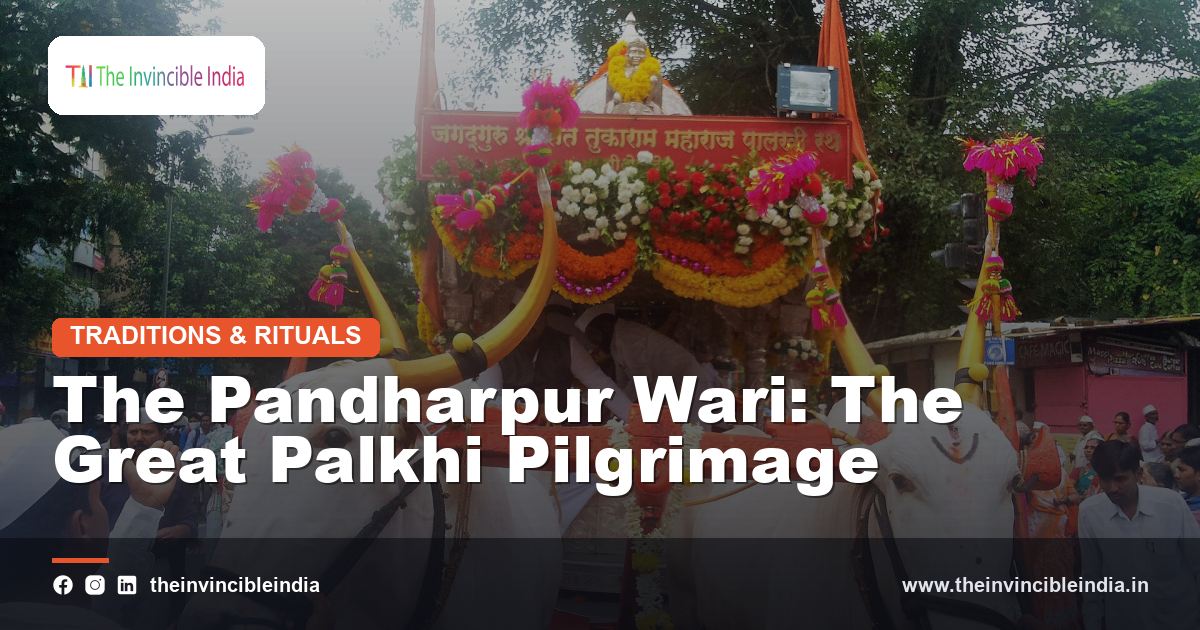
Every year, as the monsoon settles over Maharashtra, long columns of pilgrims set out on foot toward the town of Pandharpur, singing the verses of the saint-poets as they walk. This movement, known as the Wari, is among the largest and most enduring devotional journeys in the Indian subcontinent, and it is carried forward by the Varkari community in honor of the deity Vithoba. Rooted in the Marathi bhakti tradition, it joins the rhythm of village life with a spiritual discipline of walking, singing and sharing. Like the other great journeys described in the guide to pilgrimage in India, the Wari is as much a community as a destination. This guide explains its origins, its processions, its rituals and its continuing social meaning.
Quick Facts
| Detail | Information |
|---|---|
| Tradition | Varkari sampradaya of Maharashtra |
| Destination | Vithoba temple, Pandharpur |
| Main Deity | Vithoba (Vitthal) with Rukmini |
| Journey | On foot, in processions called dindis |
| Key Occasion | Ashadhi Ekadashi, in the monsoon season |
| Famed Palkhis | Those of Sant Dnyaneshwar and Sant Tukaram |
What the Wari Means
The word wari is commonly understood to mean a regular, repeated journey, and those who undertake it as a lifelong vow are known as Varkaris, meaning those who make the wari. The pilgrimage leads to Pandharpur, a town on the banks of the river Chandrabhaga, where the deity Vithoba is worshipped together with his consort Rukmini. For the Varkari, the walk itself is a form of devotion, and every step is offered as an act of surrender rather than as a means to a reward.
This idea of the journey as worship explains why the Wari is described as a living tradition rather than a single event. It is repeated each year, handed down within families and villages, and renewed by new walkers alongside those who have walked for decades. The Wari therefore stands as a faith expressed through movement, song and shared effort.
The Deity Vithoba and the Temple of Pandharpur
At the heart of the pilgrimage stands the temple of Vithoba, also called Vitthal or Panduranga, in the town of Pandharpur. The deity is traditionally shown standing on a brick with hands resting on the hips, a form that devotees interpret as the Lord waiting patiently for his devotees to arrive. Vithoba is regarded within the tradition as a form of Vishnu, and he is worshipped in company with Rukmini, who is also known by the affectionate Marathi name Rakhumai.
The temple draws pilgrims throughout the year, but it is the great gatherings at fixed points of the lunar calendar that give it its special character. For the Varkari, reaching the temple and seeing the deity, an act known as darshan, is the culmination of the journey. The shrine at Pandharpur thus serves as both the spiritual destination and the emotional center of the whole tradition.
Origins in the Bhakti Movement
The Varkari tradition belongs to the wider bhakti movement, which emphasized personal devotion and the accessibility of the divine to every person, regardless of learning or social position. In Maharashtra this movement found expression in the Marathi language, so that spiritual teaching could be understood by ordinary villagers and not only by scholars of Sanskrit. The saint-poets who shaped the tradition composed their verses in the speech of everyday life.
The pilgrimage to Pandharpur developed over many centuries as devotees gathered around these teachers and their songs. The precise early history is a subject for scholars, and the tradition itself is understood to be very old. What can be said with confidence is that the Wari grew from a devotional culture that valued humility, community and the voice of the common person.
The Saint-Poets of Maharashtra
The Varkari tradition honors a lineage of saints whose poems and teachings remain central to its worship. Among the most revered are Sant Dnyaneshwar, remembered for his Marathi commentary on the Bhagavad Gita, and Sant Tukaram, whose abhangas are sung across Maharashtra to this day. Others include Sant Namdev, Sant Eknath, and Sant Chokhamela, along with women saints such as Janabai, Muktabai and Bahinabai, whose verses give voice to the devotion of those often left out of formal learning.
These figures came from many walks of life, and that diversity is itself a defining feature of the tradition. Their songs are sung during the walk, repeated in evening gatherings, and taught from one generation to the next. The saint-poets are therefore the living companions of every Varkari on the road.
The Palkhi: The Palanquin of the Saints
The central symbol of the Wari is the palkhi, a palanquin that carries the padukas, or sacred footwear, of a saint. The padukas are treated as the presence of the saint himself, and the palanquin is accompanied by the pilgrims as it moves along the road. The two most widely known processions are those that carry the padukas of Sant Dnyaneshwar from Alandi and of Sant Tukaram from Dehu, both places near Pune that are associated with the lives of the saints.
Many other palkhis set out from different towns and villages across the region, each joining the larger stream of pilgrims as the destination draws near. The palanquin is decorated and honored with simple devotion, and people along the route come forward to bow before it. The palkhi thus acts as a moving shrine around which the whole pilgrimage organizes itself.
Dindis and the Organization of the Walk
The pilgrims do not walk as an unstructured crowd. They travel in groups called dindis, each of which is typically linked to a village, a locality or a devotional circle, and each of which has its own leaders and its own place in the order of the procession. Members of a dindi walk, sing and eat together, and they take turns in the duties that keep the group moving.
This structure allows a very large gathering to travel with discipline and calm. Volunteers, local residents and devotional organizations assist along the way, and the arrangement depends heavily on shared effort rather than formal command. The system of dindis shows how a vast pilgrimage can be sustained through trust, cooperation and a common purpose.
The Route, the Halts and the Rhythm of the Day
The journey to Pandharpur takes the pilgrims across the Deccan plateau over a period of many days, passing through towns and villages where fixed halts are observed. Each day follows a familiar pattern: an early start, a stretch of walking, a midday rest, and a further stage before the evening halt, when the palkhi is placed in a chosen spot and the pilgrims gather for prayer and song.
The pace is steady rather than hurried, and the landscape is often green with the first rains of the season. Villages along the path prepare in advance to receive the visitors, offering shelter, water and food. The daily rhythm of walking and resting becomes a discipline in itself, teaching patience and simplicity. The route and its halts together give the pilgrimage its quiet, repeating beat.
Abhangas, Kirtans and the Sound of the Wari
Music is inseparable from the Wari. The pilgrims sing abhangas, which are devotional verses in the Marathi language, and they accompany them with simple instruments such as the cymbals, the drum called the mridanga, and the single-stringed ektara. Kirtan, a form of devotional discourse mixed with song, is performed in the evenings, when a leader narrates teachings from the saints and the gathering responds in chorus.
The best known refrain of the tradition is the repeated calling of the divine name, joined with the names of the saints. The effect of thousands of voices singing in unison along a country road is one of the most striking aspects of the pilgrimage. Through song, the Wari turns a long walk into a shared act of prayer that everyone can join.
Dress, Symbols and the Varkari Identity
Varkaris are recognizable by a few simple marks of their tradition. They wear a garland of tulsi beads around the neck, which signals a vow of simple living and devotion, and many carry a small saffron flag called the patāka. Men often wear plain white clothing and a cap, while women commonly wear sarees and carry on their heads a small pot holding the sacred tulsi plant, an object of care and respect throughout the journey.
A mark on the forehead made from a fragrant paste is also widely worn. These symbols are modest and unadorned, in keeping with the values of the tradition. They identify the pilgrims to one another and to the villages they pass through. The Varkari dress is therefore an outward expression of an inner commitment to humility.
Ringan and Dhava: Rituals Along the Way
Along the route, certain ritual moments are awaited with great anticipation. One of these is the ringan, in which the pilgrims form a large circle in an open field and a horse, regarded as a sacred participant, runs around the ring while the devotees stand in rows and raise their voices. The scene is watched with reverence, and the moment is treated as a point of shared emotional release.
Another is the dhava, a joyful run toward the final stages of the journey, when the pilgrims, drawing near to Pandharpur, hurry forward in expectation. These ritual episodes add variety to the long march and mark its stages in a way that the pilgrims remember. Together, they show how the Wari weaves ceremony into the ordinary act of walking.
Ashadhi Ekadashi: The Great Gathering
The main pilgrimage is timed to arrive at Pandharpur for Ashadhi Ekadashi, the eleventh day of a fortnight in the month of Ashadha, which falls in the monsoon season. On this day, devotees gather in the town in very large numbers, bathe in the river, and wait in long, patient lines for a glimpse of the deity. Many observe a fast, in keeping with the character of Ekadashi in the Hindu devotional calendar.
The atmosphere in the town at this time is one of great emotion and fellowship, with the sound of bhajans filling the lanes and the temple precincts. For the Varkari, the arrival and the darshan mark the fulfillment of the vow. The Ashadhi gathering therefore stands as the high point of the Wari year.
The Kartiki Wari and Other Pilgrimages
While the Ashadhi pilgrimage is the largest, Pandharpur also receives pilgrims at other times of the lunar year. The Kartiki Ekadashi, which occurs in the month of Kartik after the monsoon, is another important occasion, and the town sees a further gathering of devotees at that time. Smaller observances connected to other Ekadashi days are kept by devotees who travel to the temple throughout the year.
Many Varkaris describe the wari as a vow to be repeated at regular intervals, and some undertake it over many years or across a lifetime. The idea of returning again and again is part of the tradition itself. The multiple occasions for the pilgrimage show that the bond between the community and Pandharpur is continuous rather than confined to a single season.
Equality and Community on the Road
One of the most admired features of the Wari is the sense of equality among those who take part. On the road, distinctions of occupation, wealth and background are set aside, and pilgrims address one another with the respectful term mauli, meaning mother, regardless of age or gender. Farmers, teachers, shopkeepers and officials walk side by side, share meals, and sleep in the same open spaces.
This ethic comes directly from the teachings of the saint-poets, who stressed that devotion is open to all. The shared labor of carrying, cooking and caring for fellow walkers strengthens the sense of belonging. The pilgrimage thus functions as a school of social harmony as well as a form of worship, and its egalitarian spirit remains one of its deepest strengths.
Food, Hospitality and Seva
The Wari depends on a culture of hospitality. Villages along the route open their homes, courtyards and schools to the pilgrims, and local families prepare simple meals for those passing through. Volunteers distribute water, fruit and other refreshment, and many organizations offer medical help, rest areas and practical support. This giving is understood as seva, or selfless service, and is regarded as a form of worship in its own right.
The meals eaten on the journey are plain and vegetarian, consistent with the discipline observed by the pilgrims. Sharing food from the same source, without regard to rank, reinforces the unity of the group. The hospitality along the route is therefore not merely a convenience but an essential part of the spiritual exchange between the walkers and the places they visit.
Women, Youth and the Widening Circle of Walkers
Women have long been a visible part of the Wari, and the tradition celebrates female saints such as Janabai, Muktabai and Bahinabai, whose compositions are sung alongside those of the male saints. Women walk in their own dindis as well as in mixed groups, and the carrying of the tulsi pot is a role performed with particular pride. Their participation reflects the inclusive spirit of the bhakti tradition.
In recent years, young people, students and visitors from other regions have also joined the walk, drawn by its music, its camaraderie and its spiritual atmosphere. Researchers, photographers and travelers observe the procession with interest, and many join for a short stretch. The widening circle of participants shows that the Wari continues to speak to new generations as well as to the old.
Cultural Influence on Marathi Life
The Wari has left a deep imprint on Marathi language, music and social life. The abhangas of the saint-poets are among the best loved verses in Maharashtra, and their phrases are woven into everyday speech and proverb. Devotional singing, kirtan performance and the ideal of humble service have shaped the region’s cultural character for centuries.
The pilgrimage also gives expression to the bond between faith and the agricultural calendar, since it begins when the monsoon arrives and the fields are sown. Folk arts, village fairs and local traditions along the route draw on the energy of the procession. In this way the Wari is not only a religious event but a thread that ties together the cultural life of an entire region.
The Pandharpur Wari Today
Today the Pandharpur Wari continues to be carried out each year with remarkable continuity, adapting to modern conditions while keeping its essential form. Authorities, local bodies and volunteers cooperate to provide water, sanitation, health care and traffic arrangements for the pilgrims, and the route is supported by a great deal of public goodwill. Visitors and observers are generally welcomed, provided they respect the customs of the walkers.
The tradition is a reminder of how faith, music and community can sustain a shared practice across many generations. For the Varkari, the walk remains what it has always been, an act of devotion expressed in company with others. The Wari endures as one of the most vivid living pilgrimages in India.
Sources & Further Reading
- Ministry of Culture, Government of India (indiaculture.gov.in).
- Sangeet Natak Akademi (sangeetnatak.gov.in).
Frequently Asked Questions
What is the Pandharpur Wari?
The Pandharpur Wari is an annual pilgrimage on foot to the temple of Vithoba at Pandharpur in Maharashtra, undertaken by the Varkari community and many other devotees. Pilgrims travel in groups called dindis, singing the devotional verses of the saint-poets.
Who are the Varkaris?
The Varkaris are followers of a devotional tradition centered on the worship of Vithoba, who make the pilgrimage to Pandharpur as a regular vow. They are known for their simple living, their tulsi bead garlands and their love of the abhangas of the saints.
What is a palkhi?
A palkhi is a palanquin that carries the padukas, or sacred footwear, of a saint and is accompanied by pilgrims throughout the journey. The palkhis of Sant Dnyaneshwar and Sant Tukaram are among the most widely known.
When does the main Wari reach Pandharpur?
The main pilgrimage is timed to reach Pandharpur for Ashadhi Ekadashi, which falls in the monsoon season in the month of Ashadha. A further gathering takes place at Kartiki Ekadashi after the monsoon.
Can visitors watch or join the Wari?
Visitors are generally welcome to observe the procession and many people join for a short stretch. It is important to respect the customs of the pilgrims, follow local guidance and avoid disrupting the order of the dindis.