


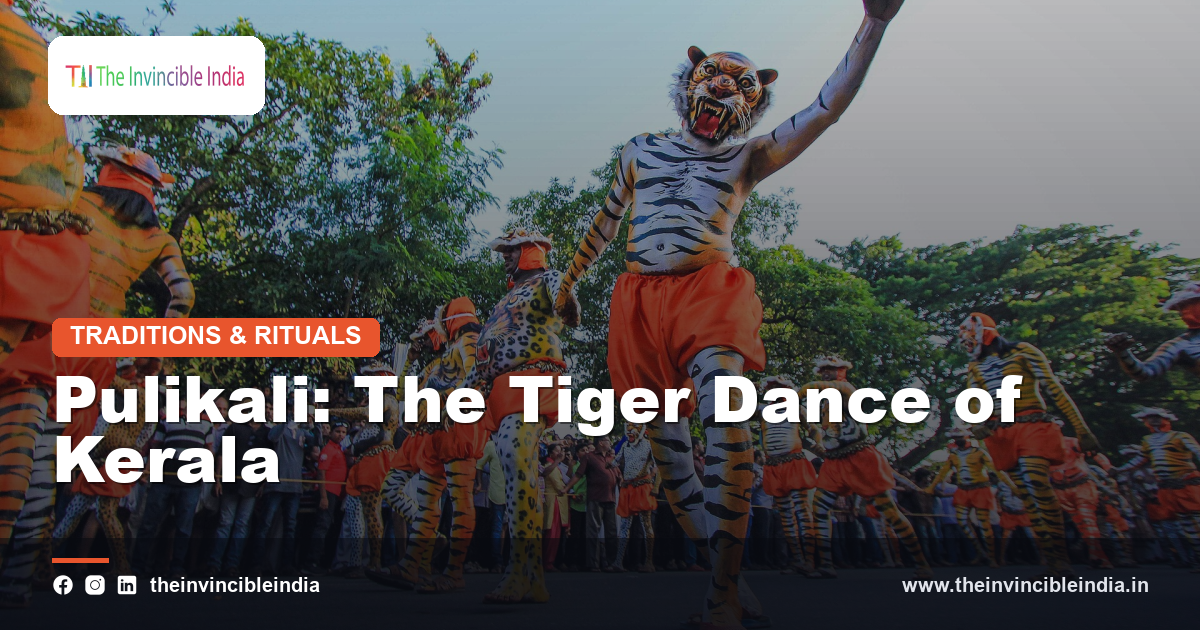
When the festival of Onam reaches its later days, the streets of Thrissur in Kerala fill with a startling sight: hundreds of men with their bodies painted in bright yellow, red and black, dancing to thundering drums in the guise of tigers. This is Pulikali, a folk art whose name means the play of the tigers, and it is one of the liveliest and most photographed expressions of the harvest season in the state. Although it is a lighthearted spectacle, it rests on the skill, stamina and shared effort of local communities. As part of the wider celebrations explained in the guide to Onam, Pulikali offers a vivid view of Kerala’s playful and communal spirit. This guide explores its look, its music, its preparation and its significance.
Quick Facts
| Detail | Information |
|---|---|
| Meaning | Play of the tigers (Puli = tiger, Kali = play) |
| Associated Festival | Onam, in the month of Chingam |
| Best Known Venue | Thrissur, Kerala |
| Performers | Mostly men, painted as tigers and hunters |
| Music | Chenda, thakil, urumi and other percussion |
| Art Form | Folk dance with body painting |
What Pulikali Is
Pulikali is a folk art of Kerala in which performers paint their bodies as tigers and dance to the beat of drums. The word comes from the Malayalam terms puli, meaning tiger, and kali, meaning play, and the name captures the mood of the performance: it is playful, boisterous and joyful rather than solemn. The dancers wear little more than shorts and a mask, leaving the body free to carry the painted patterns.
The art is most strongly associated with Thrissur, a city regarded as the cultural capital of Kerala, where it forms a major attraction of the Onam season. Although tigers dominate, other characters such as leopards and hunters also appear. Pulikali thus stands as a dramatic, humorous and thoroughly local celebration of the animal that gives it its name.
Pulikali and the Festival of Onam
Onam is the great harvest festival of Kerala, celebrated by people of different communities in the month of Chingam, usually in late summer. It is associated with the memory of the legendary king Mahabali, with elaborate floral carpets known as pookalam, with the festive meal called the sadya, and with a wide range of games, boat races and performances.
Pulikali belongs to this season and is traditionally staged on the fourth day of the festival, a day known in some places as Nalam Onam. By then the main household observances have been completed, and the community turns toward public entertainment. Pulikali therefore serves as a colorful outdoor chapter in the larger story of Onam, expressing the shared pleasure of a people at festival time.
Origins and Folk Roots
The exact beginnings of Pulikali are not firmly documented, and several accounts circulate in popular tradition. A widely repeated belief links its present form to the era of the rulers of the former Kingdom of Cochin, with the ruler Maharaja Rama Varma, popularly called Sakthan Thampuran, often mentioned in this context. Such accounts are part of local memory and are best understood as tradition rather than settled history.
What can be said in general terms is that tiger imagery has long been present in folk performance, ritual art and village entertainment across Kerala. Pulikali appears to have grown from these older folk practices into a larger, more organized public event. Its roots in popular culture are what give it its earthy humor and its broad appeal.
The Art of Body Painting
The most distinctive element of Pulikali is the painting of the body. Performers are covered with a base color, most often yellow, and then marked with black stripes, spots and shading in patterns that imitate the coat of a tiger. Red, white and other colors are used to add detail to the face, belly and limbs, and the patterns are often adapted to the shape and movement of the individual dancer.
The work is done by skilled painters who use brushes and, in some cases, other tools, and it can take many hours to complete for each performer. The paint must withstand heat, sweat and long hours of dancing. Body painting is therefore not merely decoration but an artistic craft in which the dancer becomes a living canvas.
Preparation and the Painting Camps
Preparation for Pulikali begins well before the day of the procession. Local teams, often organized by neighborhood clubs and associations, gather in the days beforehand to rehearse, choose designs and arrange costumes. On the morning of the performance, the painters begin their work early, and the dancers wait patiently as the patterns take shape on their skin.
These preparation spaces have an atmosphere of their own, filled with the smell of paint, the sound of rehearsal drums and the humor of men transforming into animals. Families, friends and curious visitors often come to watch the process. The painting camps therefore form a quiet but lively backstage to the public spectacle, and they show how much shared work lies behind each team.
Masks, Costume and Props
Alongside the paint, the performers wear a tiger mask, typically fitted with a prominent open mouth, teeth and ears, and often finished with bright colors. A tail is attached at the back, and a belt, usually decorated with a hanging element, is worn around the waist. The mask and tail complete the illusion and add to the comic energy of the dance.
Some performers appear as hunters, carrying wooden props or small weapons that are used in playful chases and mock confrontations with the tigers. The costumes are simple, lightweight and designed for movement. Together, the masks, tails and props reflect the folk character of the art, in which clever and inexpensive materials produce a dramatic visual effect.
The Music: Chenda, Thakil and Urumi
No Pulikali is complete without its percussion. The performance is driven by drums such as the chenda, a cylindrical drum played with sticks, the thakil, and the urumi, a double-headed drum played with a curved motion of the hands. The pulsing rhythm sets the pace for the dancers and gives the procession its infectious energy.
Drummers walk and play alongside each team, adjusting the tempo to the movement of the tigers, who respond with crouching, leaping and prowling steps. The drumming is loud, rhythmic and deeply tied to the traditional soundscape of Kerala festivals. The music is thus the heartbeat of the performance, and the dance would lose much of its force without it.
The Dance: Movement and Character
The dance of the Pulikali performers is expressive and humorous. Dancers imitate the movements of a stalking tiger, stooping low, springing forward, shaking the belly and swaying to the beat. The prominent belly is a source of much amusement and is shaken in time with the drums as part of the show.
There is also a playful narrative at work. Hunters appear to chase the tigers, tigers pretend to stalk the audience, and the whole scene takes on the tone of a joyful chase. The dance demands strength and stamina, particularly in the heat of the festival season. Through expressive movement and humor, Pulikali turns a simple idea into a lively theatrical performance.
The Procession Through Thrissur
The central event takes place in Thrissur, where the teams march through the heart of the city toward the area around the Swaraj Round, near the famous Vadakkumnathan temple grounds. Large crowds line the streets, filling balconies, rooftops and roadsides to watch the tigers go by, and the atmosphere is one of festival excitement.
Each team is accompanied by its drummers and often by a decorated vehicle or tableau. The procession moves slowly so that the audience can enjoy the dancing, and the performers pause to repeat their steps at several points. The parade in Thrissur has become a landmark event of the Onam season, and it brings together local pride and civic celebration in a single afternoon.
Teams, Clubs and Community Effort
Pulikali is organized largely by local teams, many of them associated with neighborhoods or community groups in and around Thrissur. Each team takes responsibility for recruiting dancers, arranging painters and musicians, preparing tableaux and meeting the costs of the performance, often through local contributions and sponsorship.
Healthy rivalry between teams adds to the excitement, and prizes or recognition may be offered for the best performances, designs and tableaux. This spirit of friendly competition encourages creativity and keeps the tradition fresh. The organization of Pulikali depends on volunteer effort and local pride, and it is this community base that has allowed the art to survive and grow over time.
Tableaux and Floats
In addition to the dancing tigers, the procession features tableaux, or decorated floats, which carry images drawn from mythology, folklore and everyday life. These displays may show scenes from the epics, figures from the festival season, or lighthearted and topical themes, and they are crafted with considerable skill from lightweight materials.
The tableaux provide a visual counterpoint to the energy of the dancers, allowing the audience to enjoy artistry of a different kind. They also demonstrate the range of craft traditions found in the region, from sculpting to painting and decoration. The floats thus add depth and variety to the parade, turning it into a broader showcase of local creativity and imagination.
Who Performs: Training, Stamina and Care
Traditionally, Pulikali has been performed mainly by men, and the dancers range from young participants to experienced performers who return year after year. The work is physically demanding, since the dancers must perform for long hours under the sun while carrying the weight of paint and costume, and they often rehearse for days in advance to build endurance.
Attention is also paid to the health and comfort of the performers, including the use of safe paints and the provision of water and rest. The pride taken in the role is considerable, and many dancers regard participation as an honor. The performers of Pulikali are therefore athletes of folk art, whose dedication gives the spectacle its power.
Humor, Satire and the Spirit of Play
A strong thread of humor runs through Pulikali. The exaggerated bellies, the mock ferocity of the tigers and the antics of the hunters all invite laughter from the crowd, and the performers often interact with spectators in a teasing, friendly way. The festival mood allows a degree of playful freedom that sits comfortably alongside the more devotional parts of Onam.
This spirit of play is part of the broader character of the harvest season in Kerala, when people celebrate abundance with food, games and shared enjoyment. The laughter that accompanies the tigers is not a distraction from tradition but a central part of it. Pulikali shows that festival culture in India includes joy, wit and performance as well as ritual.
Pulikali Beyond Thrissur
Although Thrissur is the best known home of Pulikali, tiger performances have also been staged in other towns and localities of Kerala during the Onam season. Smaller local events and neighborhood celebrations feature their own versions of the dance, often with fewer participants but with the same painted bodies and the same lively drumming.
Performances have also been presented at cultural programs, exhibitions and tourism events in other places, where audiences unfamiliar with the festival can enjoy a taste of Kerala folk art. These appearances help to spread awareness of the tradition. The broader reach of Pulikali illustrates how a local custom can become a symbol of regional identity that travels well beyond its place of origin.
Tourism, Media and Public Interest
Pulikali attracts photographers, filmmakers, travelers and journalists from different parts of India and from abroad. The striking visuals of painted tigers against the busy streets of Thrissur make the festival an easy subject for the camera, and coverage in newspapers and on television has helped to build its wider reputation.
Tourism authorities and cultural bodies often promote the event as one of the highlights of the Onam season. This attention has brought both opportunity and responsibility, since it supports the livelihoods of artists while also calling for care in preserving the tradition’s integrity. The interest of visitors and the media has therefore helped to keep Pulikali in the public eye and to encourage continued support.
Safeguarding the Art and Its Craft
The continuity of Pulikali depends on the transmission of skills from one generation to the next. Painters pass on techniques of mixing color and drawing patterns, drummers teach younger players the rhythms, and experienced dancers guide newcomers in movement and conduct. Cultural organizations and local committees play a role in supporting these efforts.
Concern is sometimes expressed about the rising costs of staging the event and the need to protect performers’ health and welfare. Efforts by clubs, authorities and cultural supporters aim to address these concerns while keeping the tradition alive. The care given to teaching, safety and fair support is what will allow the craft of Pulikali to be handed on with dignity.
Pulikali Today
Today Pulikali remains one of the most eagerly awaited sights of the Onam season in Kerala. Teams continue to refine their designs and choreography, spectators gather in large numbers, and the festival continues to blend old folk traditions with modern organization and publicity. It remains rooted in the community life of Thrissur and the generosity of its people.
As a performance, Pulikali celebrates humor, craftsmanship and collective effort at the end of the monsoon. As a symbol, it conveys the vitality of Kerala’s culture to the wider world. The tiger dance endures as a cheerful reminder that tradition in India is not only preserved but also played with joy.
Sources & Further Reading
- Kerala Tourism, Government of Kerala (keralatourism.org).
- Ministry of Culture, Government of India (indiaculture.gov.in).
Frequently Asked Questions
What does Pulikali mean?
Pulikali comes from the Malayalam words puli, meaning tiger, and kali, meaning play, and it is therefore often translated as the play of the tigers. It is a folk performance in which dancers painted as tigers move to drum music.
When is Pulikali performed?
Pulikali is performed during the Onam season in Kerala, traditionally on the fourth day of the festival. The date changes each year because Onam follows the Malayalam calendar month of Chingam.
Where is the best place to see Pulikali?
The best known Pulikali procession takes place in Thrissur, where teams march through the city toward the Swaraj Round. Smaller performances also take place in other towns and localities during Onam.
How are the performers painted?
Performers are painted by skilled artists, usually with a yellow base and black stripes, along with other colors for detail. The process can take many hours, and the paint must hold up through hours of dancing.
What instruments accompany the dance?
The dance is accompanied by percussion instruments, mainly the chenda, the thakil and the urumi. Their loud, steady rhythm sets the pace for the tigers and gives the procession its energy.